Market research · March 2026
Analyst Market Research 2025
NEWHR surveyed 1,493 analysts across 14+ specializations. They told us where they live, which companies they work for, which markets they focus on, how they look for jobs and what they aim for. And also how much they earn and how their pay has changed.

Kira Kuzmenko
CEO NEWHR
At NEWHR we consider analytics one of the key professions that move business forward.
We are continuing our longitudinal trend study of the profession and can show how the analyst market is changing and what stays the same.
The core of our respondents are product and data analysts, the two most common specializations on the market. Since 2024 we have singled out systems and business analysts, and since 2025 heads of analytics, because their tasks and approach differ from those of individual contributors.
You can find our other studies of the IT job market here. We like to rely on data in our work and invite you to do the same with us. Write to us: data@new.hr
About the study
The study was conducted as an online survey. Respondents were recruited through NEWHR's online media, partner channels and our own respondent base.
- 1,493 people made up our sample
The sampling error is 2.6% at a 95% confidence level
14 specializations
- Data analysts
- Product analysts
- BI analysts
- Marketing analysts
- Systems analysts
- Business analysts
- Heads of analytics
- And others*
6 grades
- Intern
- Junior
- Middle
- Senior
- Principal
- Team lead
- Head of Analytics
4 types of companies
- Russian
- Partly Russian
- Foreign local
- Foreign international
- * See all specializations of the survey participants
- Financial analysts
- R&D / Research
- DWH analysts
- Operations analysts
- Game analysts
- Web analysts
- Customer / CRM analysts
- Data, product, BI and marketing analysts
- Systems and business analysts
- Heads of analytics (may be responsible for several areas and do not belong to any specific specialization)
Key findings
The analyst market in 2025: 7 key trends
- 1 Most analysts' salaries are growing, while market-wide pay barely grows — Two thirds of analysts saw their salary grow in 2025, but these raises are more often tied to grade promotions or indexation. Market-wide growth was under 10% (for comparison: before 2022 salaries grew by 15–20% a year). An important point: for the first time, the main reason for a raise was not a change of company but indexation. The era of "change jobs, get +30%" is over.
- 2 Money is the deciding factor for retaining and attracting analysts — Money has finally overtaken meaning. For the first time, a good salary became the main argument both for staying with an employer and for accepting a new offer (a year ago salary was in second place for retention, in 2023 in third). Interesting tasks and professional growth still matter, but they are losing ground. This is not analysts' cynicism but adaptation to a new economic reality.
- 3 The Russian and foreign markets keep drifting apart — The two markets, Russian and international, increasingly live by their own rules. The appeal of foreign companies to analysts from Russia has fallen by 31% in two years. Interest in relocation keeps declining too. Analysts focus first of all on the markets they are already in.
- 4 The market is slowing down: job searches have become longer and harder — Job search times for analysts have grown, slightly but noticeably. And this happened specifically in 2025. 77% of analysts find a job within three months; that is still not bad, but a year ago the figure was 81%. The share of those who look for a new company for up to 6 months rose from 53% to 61%. The market has not collapsed, but it has tightened: fewer offers, more competition.
- 5 Avito leads as the most attractive potential employer. VK and Sber have the worst reputation — Avito holds first place among potential employers for the second year running and keeps improving its position.
- VK and Sber top the anti-ranking. Yandex lost 18 rating points in a year and took third place in the anti-top.
- The most controversial brands are Yandex and T-Bank: people both want and do not want to work there.
- Dodo and Avito most often leave analysts with good impressions of their interviews. Although analysts most often go to interviews at Yandex, T-Bank, Sber, Avito and Ozon.
- 6 ML and AI are the new must-have — Interest in AI tools can be recorded as a new trend. Mastering ML and AI tools is becoming increasingly important for the market. Over the year, the share of respondents performing tasks related to ML services rose from 14% to 22%. And 41.5% want to develop their ML skills.
- 7 Grade affects not only salary but also freedom to choose a location, job search speed and the size of the company an analyst joins — An analyst's grade correlates with company size, location, salary and job search speed. Middles are concentrated in large corporations, seniors get more freedom of choice (including geographic), and team leads and principals find jobs the fastest. In 2025 a grade promotion became one of the main grounds for a raise. Investing in your grade is investing in your negotiating position when you are hired.
Respondent profile
Who are all these people
Average age of analysts
Analytics continues to attract young people: the main age range of our respondents is 21–40. However, the share of more mature specialists (41 to 55) is also significant, which points to a healthy, normal development of the profession without crises or age "imbalances".
21-40 years | 89.2%
- Typical age range
26-30 years | 31.0%
- Most common age
41–55 years | 10.0%
Mature analysts
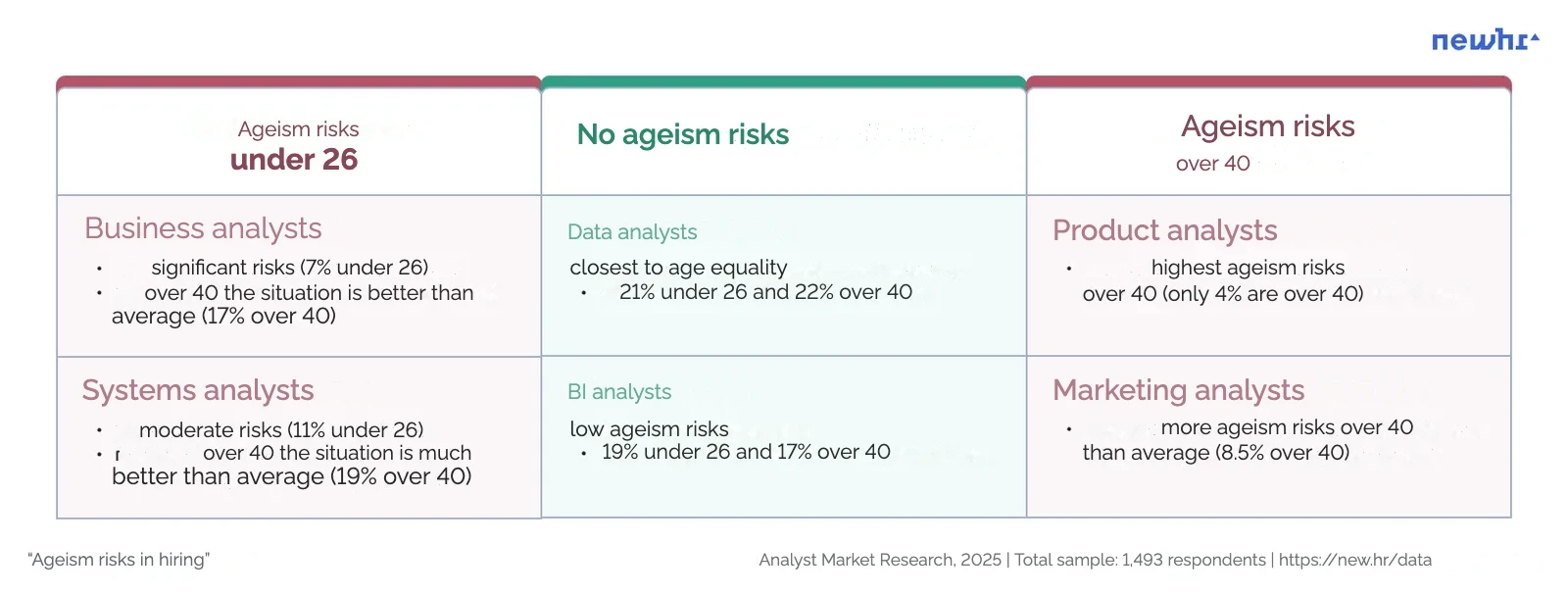
Based on the respondents' age, we can roughly estimate the risks of ageism in hiring for different analyst specializations.
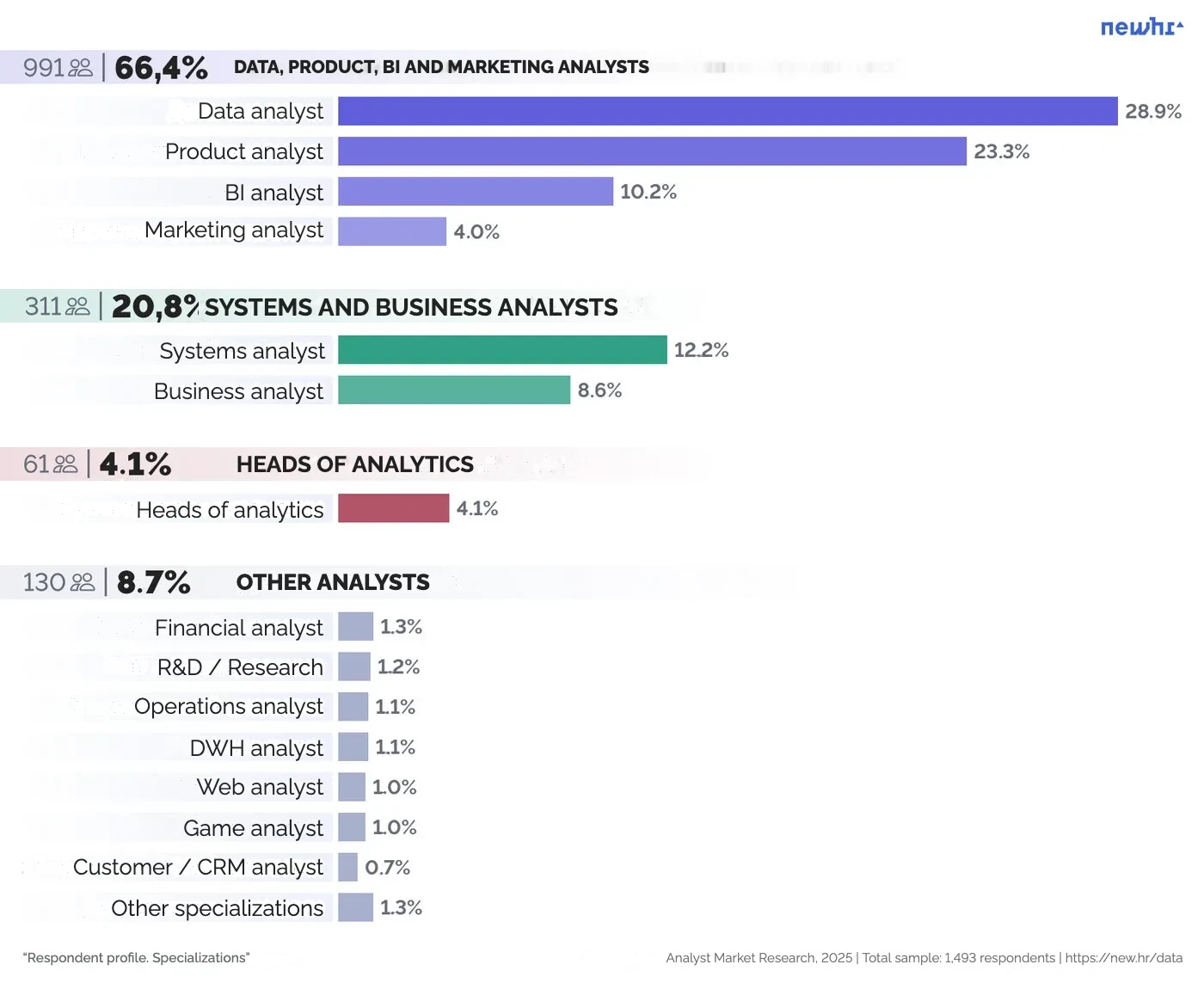
Specializations in analytics
Question: How would you describe your main professional specialization in analytics?
Number of respondents: 1,493
- Data, product, BI, marketing — 66.4% (991 people) + other analysts — 8.7% (130 people)
- Systems and business analysts — 20.8% (311 people)
- Heads of analytics (may be responsible for several areas and do not belong to any specific specialization) — 4.1% (61 people)
Ratio of men and women among analysts
By IT standards, analytics has a high share of women, almost half (46.5%), but among managers they make up only 23%. The "glass ceiling" for women has not moved compared with previous years' surveys.
- In the previous survey, data analysts stood out for an almost equal representation of men and women; in this study, marketing analysts are close to parity: 49% women to 51% men.
- The most men are among web analysts (67%), DWH analysts (59%) and data analysts (57%).
- The most women are among customer/CRM analysts (70%) and business analysts (65%).
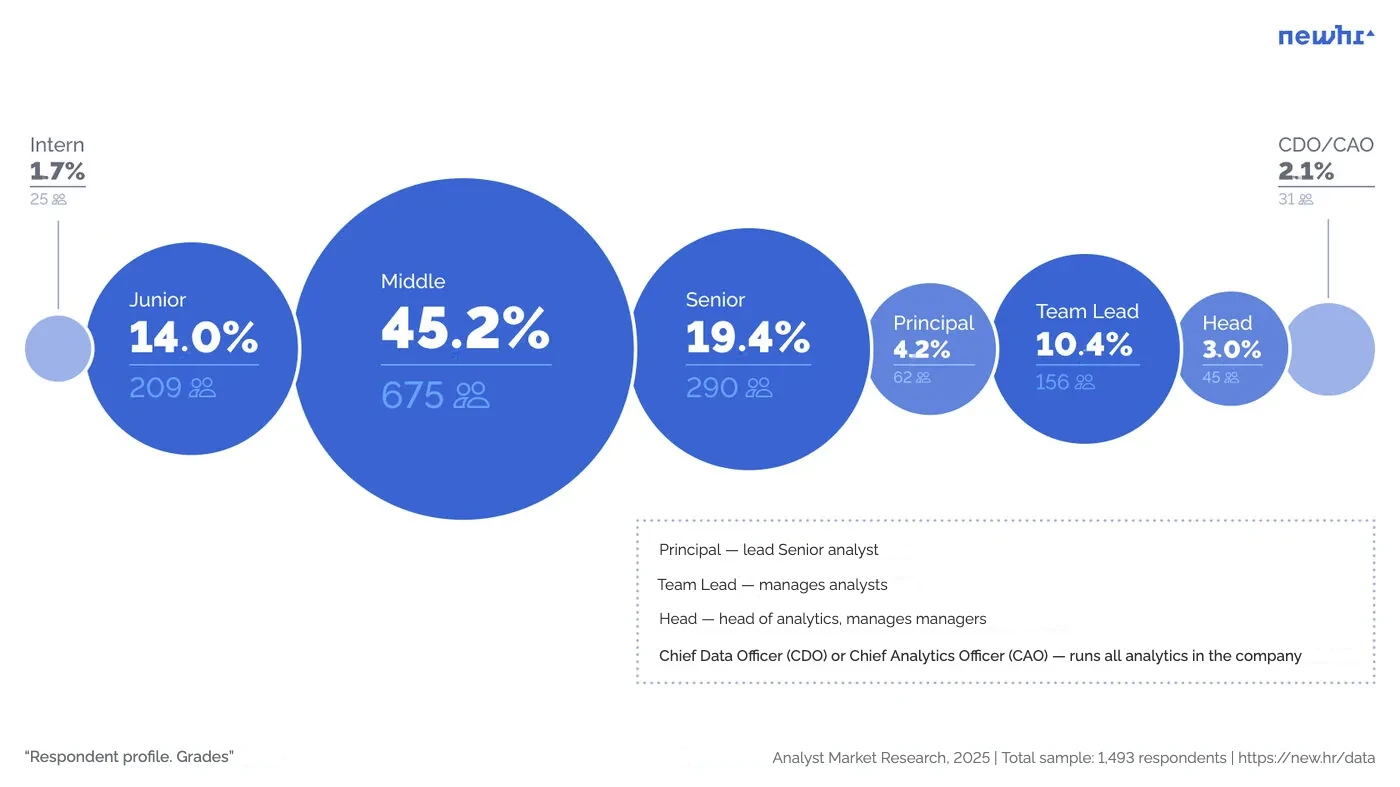
Analysts by grade: from Junior to C-level
Question: State your grade
Number of respondents: 1,493
- Middle 45.2%
- Senior (together with Principal) 23.6%
- Junior (together with Intern) 15.7%
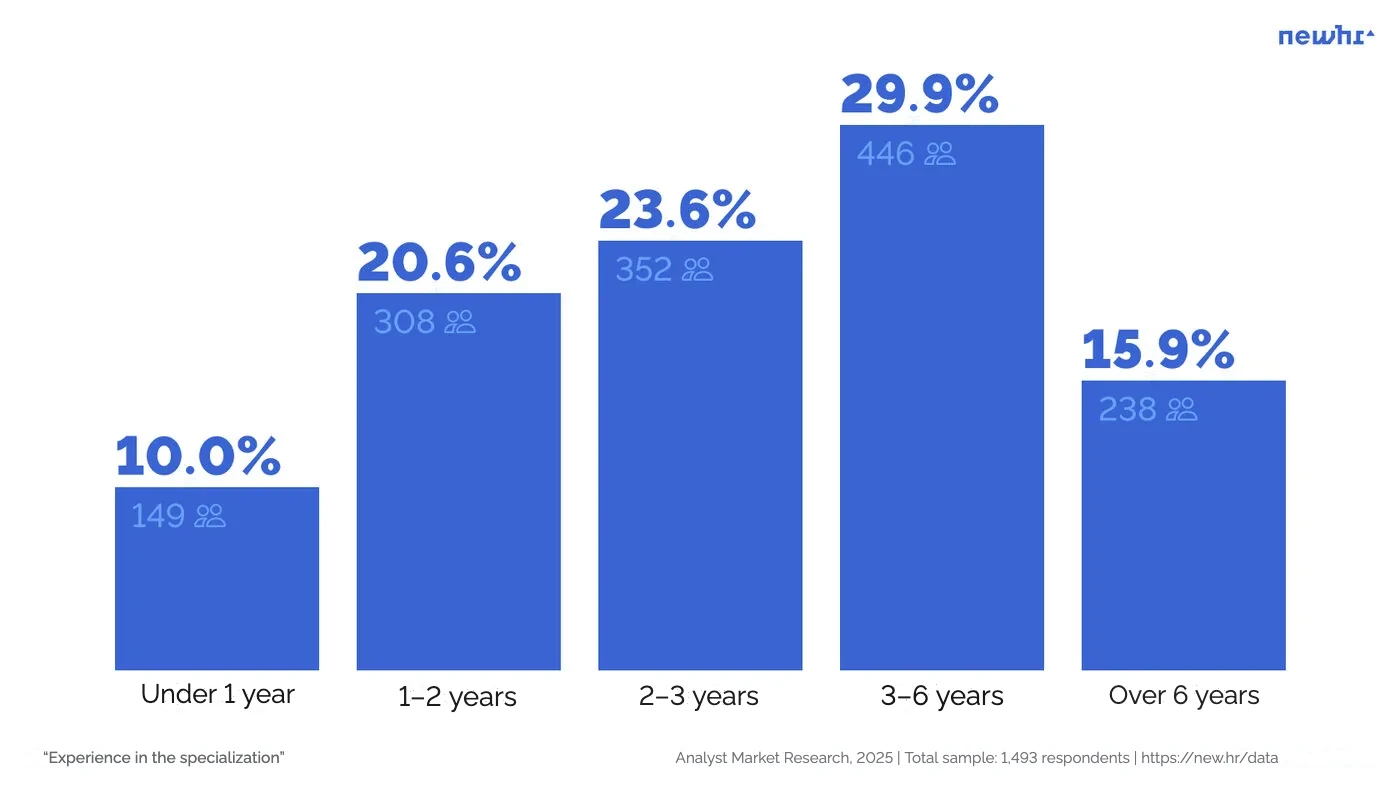
Work experience by specialization
Question: How long have you worked in this specialization?
Number of respondents: 1,493
Beginner analysts (under a year) are most common among marketing analysts (41%), data analysts (38%) and business analysts (32%). The share of beginners is also high among operations, financial and customer analysts.
Long experience in analytics, 3 years or more, is found among systems (54%), business (50%) and product analysts (46%).
79% of analytics managers have at least 3 years of management experience, including 6+ years.
Alena Makarova
Head of Research
at NEWHR
"In 2025 our sample has fewer beginner analysts, both by experience and by grade. Perhaps they simply did not reach our survey in the same numbers as last year, but it is also possible that this is how a new trend shows itself: a falling market demand for inexperienced analysts.
In the study we rely only on the answers of respondents who already have professional experience in analytics. So a lower share of beginners in the sample may mean that their inflow into the market is shrinking too."
"The number of beginner analysts, interns and juniors fresh out of courses, has not changed. There are as many of them as in previous years. However, employers' demand for such people has dropped. In 2025 companies cut back on hiring specialists without experience.
In addition, the use of LLMs shortens the path from junior to middle. This can also explain the shift of respondents' grades towards Middle: newcomers start identifying themselves as middles sooner (which may not always match employers' view)."
Oksana Prutyanova
Lead of analyst
and data scientist search at NEWHR
Work tasks
All analysts do this…
In 2025 the share of analysts performing tasks related to ML services grew. Interest in AI tools can be recorded as a new trend.
What tasks analysts perform
Question: What are the main analytics tasks within your area of responsibility?
Number of respondents: 1,493
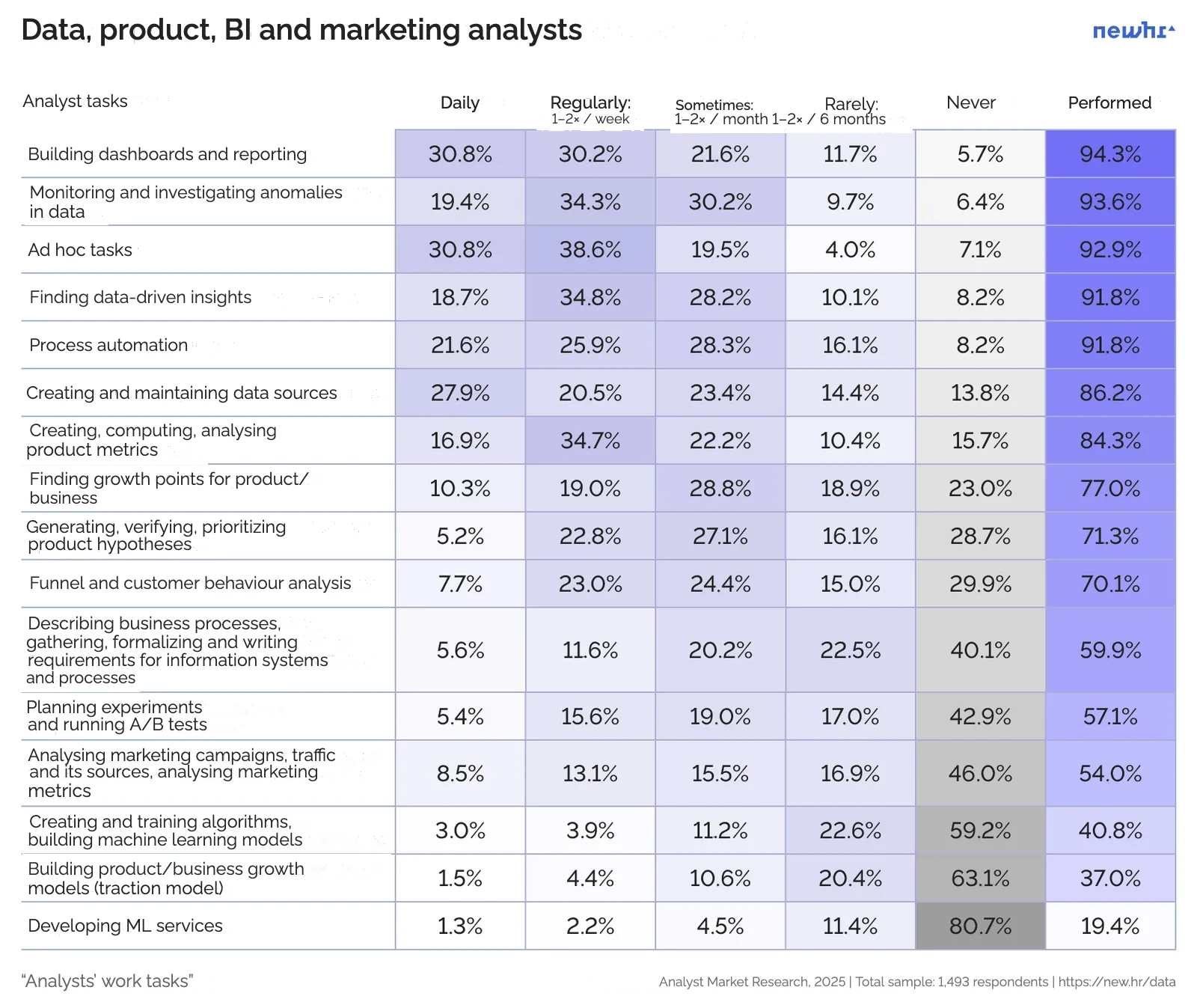
- Ad hoc tasks (69%)
- Building dashboards and reporting (61%)
- Monitoring and investigating anomalies (54%)
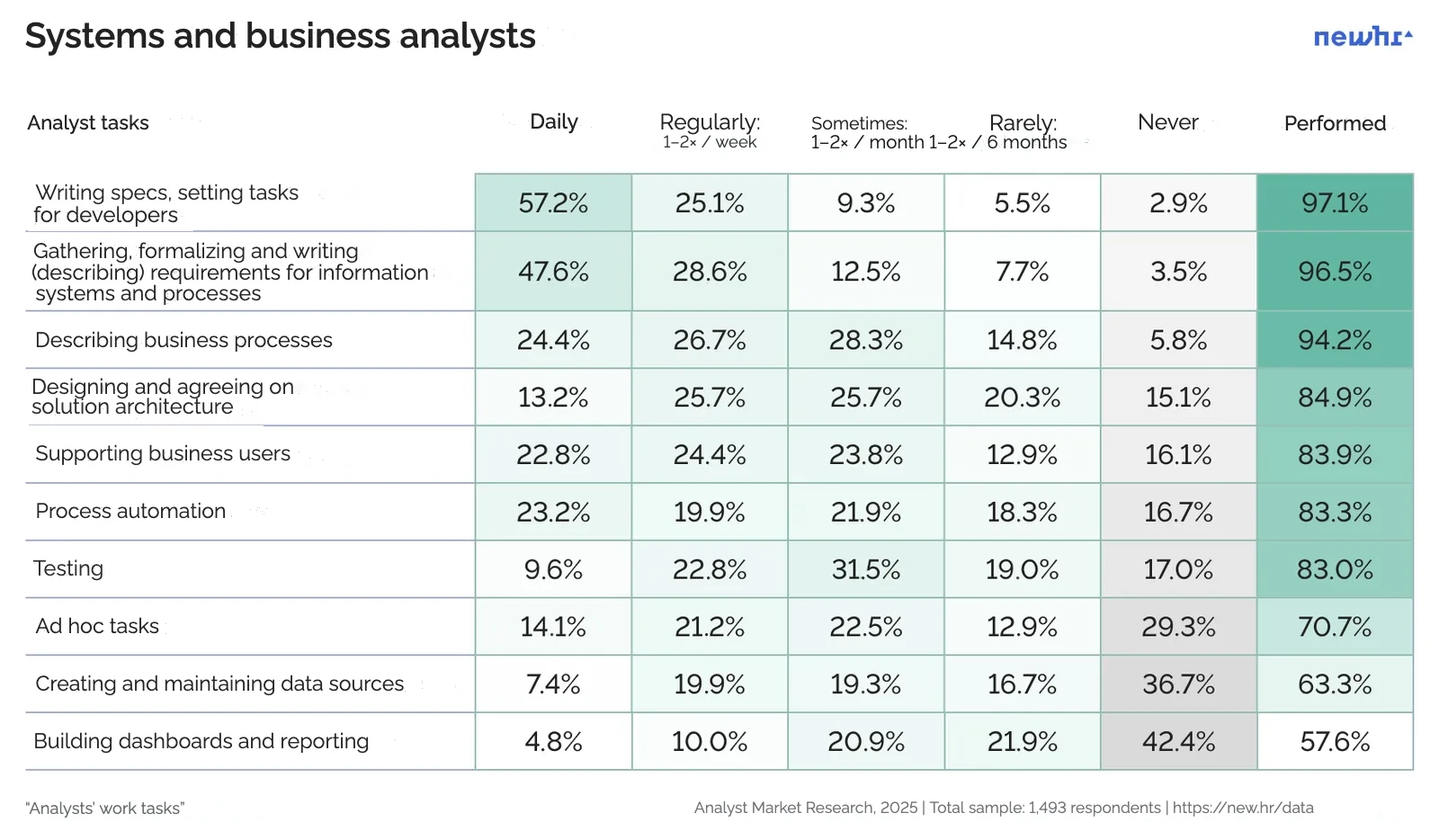
- Writing specs, setting tasks (82%)
- Gathering and writing requirements for information systems and processes (76%)
- Describing business processes (51%)
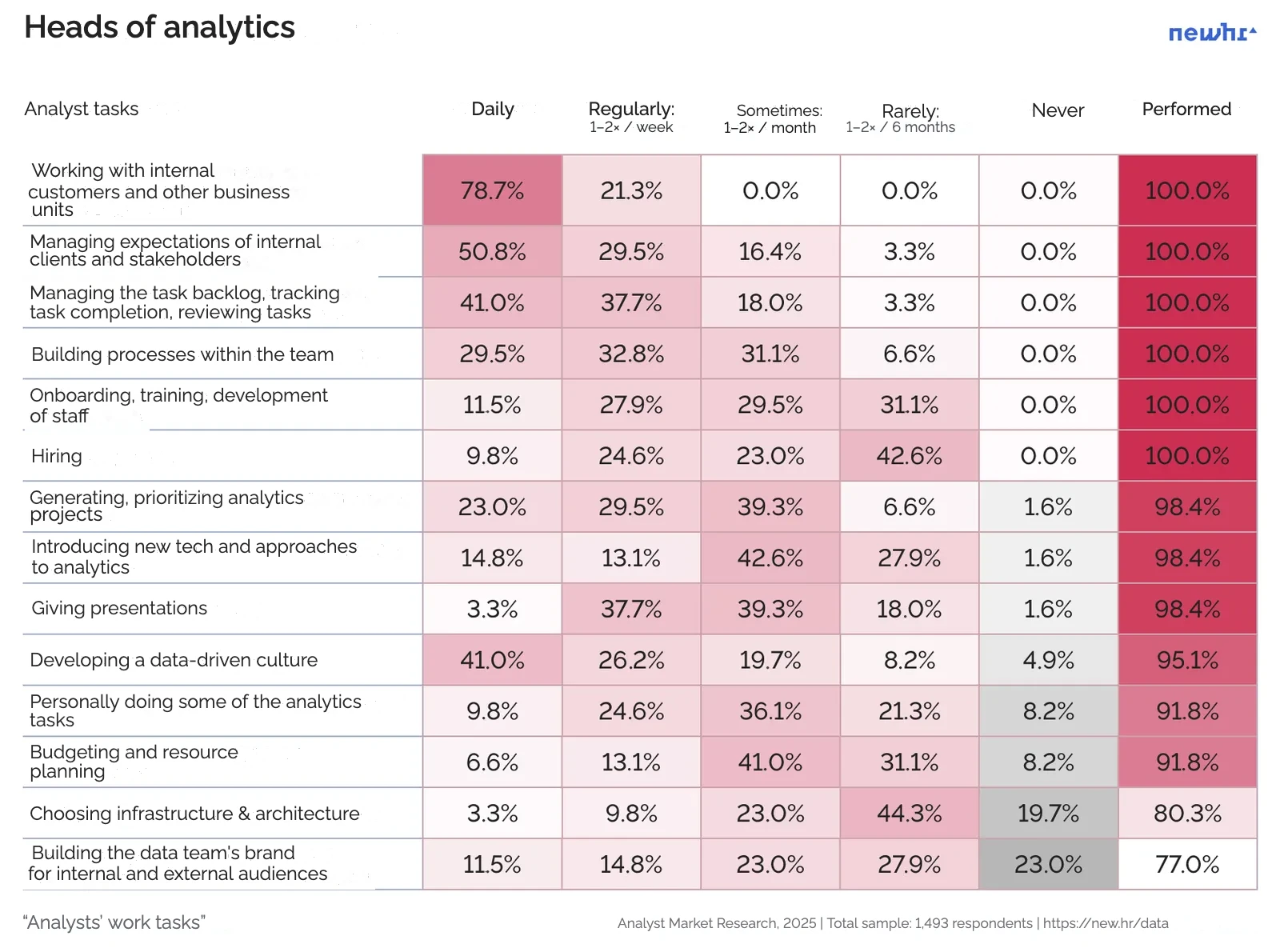
- Working with internal customers (100%)
- Managing stakeholder expectations (80%)
- Managing tasks, reviewing tasks (79%)
- Building processes (62%)
Oksana Prutyanova
Lead of analyst
and data scientist search at NEWHR
"More than 90% of heads said they personally do some of the analytics tasks: managers try to keep their analytical skills in shape.
Another nuance is interesting here: although any managerial work affects the analytics brand (both inside the company and outside it), not all heads are aware of their influence. Meanwhile, their public talks and internal communication have an effect on the data team's brand, both positive and negative."
Analysts' favourite tasks
- Research, the full cycle (53%)
- Dashboards and reporting (38%)
- Anomalies: detection, investigation (35%)
- A/B tests and experiments (35%)
- Finding insights in data (34%)
- Designing and agreeing on solution architecture (53%)
- Working with integrations (51%)
- Writing specs, setting tasks (49%)
- Process automation (46%)
- Gathering and writing requirements for information systems and processes (45%)
- Describing business processes (44%)
- Introducing new technologies and approaches (67%)
- Working with internal customers (51%)
- Developing a data-driven culture (51%)
- Building team processes (49%)
- Generating and prioritizing projects (43%)
Locations and relocation plans
The urge to move
The divergence of the Russian and global markets, which we have been noting over the past years, is only getting stronger. By the end of 2025 analysts are even more inclined to focus on the countries they are already in.
Where analysts live and work
Question: In which location do you live permanently / for most of the year / work from?
Number of respondents: 1,493
For 2 years now, the share of our respondents based in Russia has been growing steadily (from 61% in 2023 to 75% in 2025).
Fewer and fewer Russian-speaking analysts living abroad take part in the study. We interpret this as a sign of their declining interest in the Russian market. Nevertheless, the connection with the Russian-speaking professional community remains.
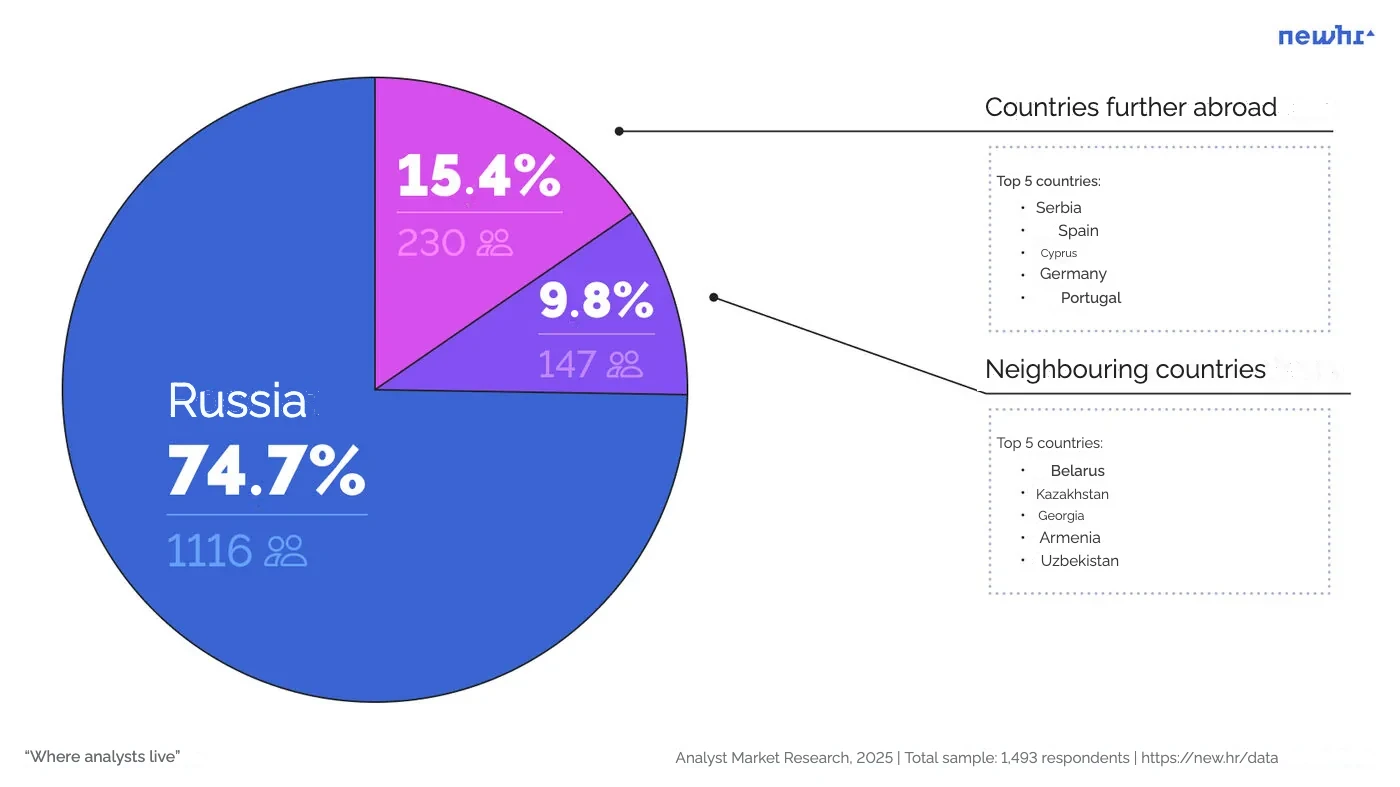
- Serbia (27%)
- Spain (11%)
- Cyprus (11%)
- Germany (9%)
- Belarus (33%)
- Kazakhstan (23%)
- Georgia (17%)
- Armenia (12%)
- The most "foreign" specializations are business analysts (38% abroad) and heads of analytics (33% abroad).
- The most "Russian" specializations are BI analysts (84% in Russia) and systems analysts (79% in Russia).
Breakdown by grade
The higher the grade, the larger the share of analysts living abroad. This holds up to the Senior/Principal level. But there are fewer heads outside Russia: seniors are freer to choose where they live than managers.
Oksana Prutyanova
Lead of analyst
and data scientist search at NEWHR
"Team leads and managers are usually more deeply "embedded" in the company structure and are the most tied to a location. The exception is top management. Such respondents feel comfortable in any market. Their technical and, no less important, soft skills let them adapt faster to different management styles and different corporate cultures."
Analyst relocation in 2025: plans to move
Question: Are you planning to move to another country in the next 1–1.5 years?
Number of respondents: 1,493
The share of analysts ready to relocate keeps shrinking: in 2 years it fell 2.4 times (from 25% in 2023 to 11% in 2025).
This supports our conclusion that a tendency to stay put now prevails: people are drawn to companies in the countries where they already are.
Most respondents do not plan to change location. This share has grown by 17.5% compared with 2023.
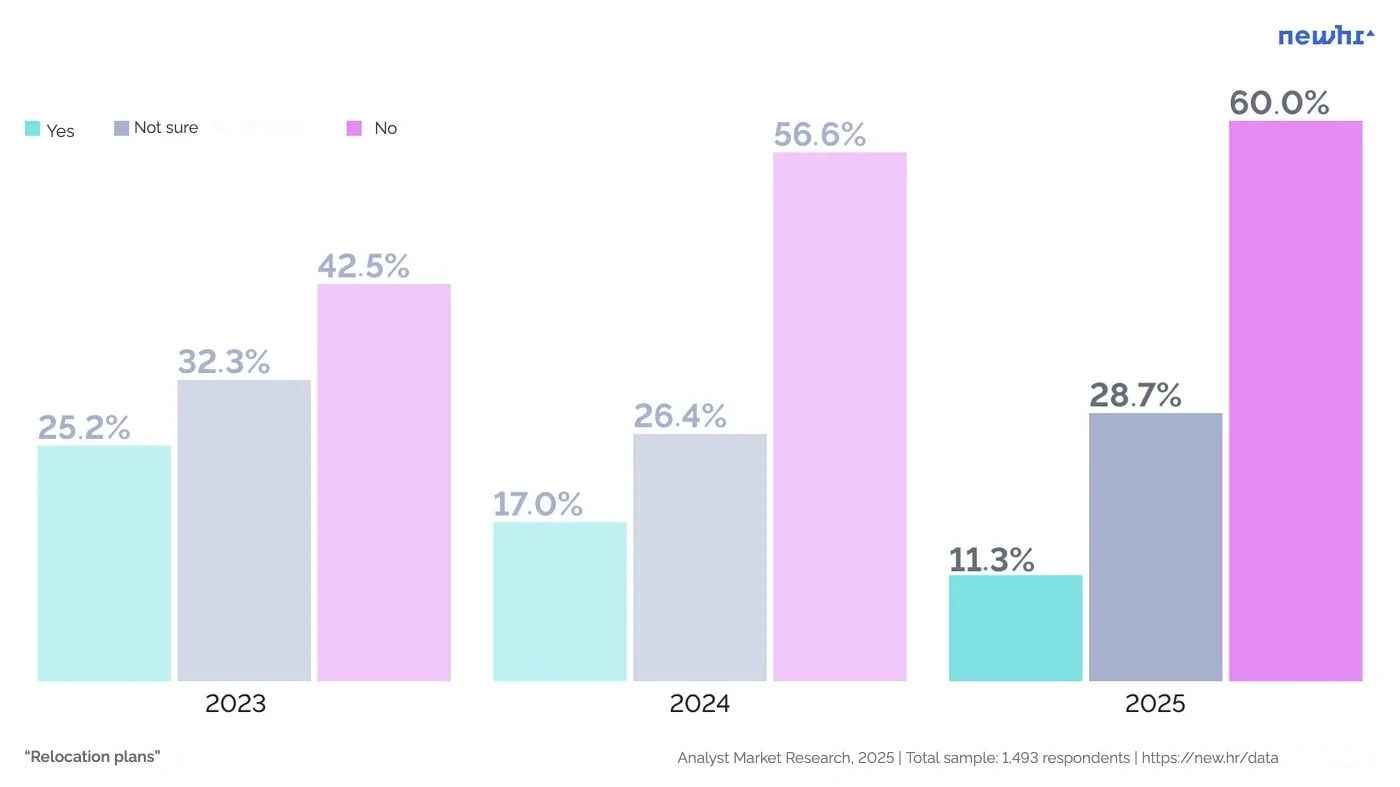
- The most "settled" specializations are analytics managers (only 8% plan to move, and 64% are firmly against it), systems analysts (7% plan to move) and BI analysts (9% plan to move). Data analysts are close to them (65% definitely do not plan to move).
- It is hard to name the most "nomadic" specializations: the share of those ready to move is consistently low among all respondents. However, there are slightly more of them among business analysts: 14% plan to change location.
Oksana Prutyanova
Lead of analyst
and data scientist search at NEWHR
"The falling interest in relocation may be a sign of accumulated fatigue from moving (after all, on top of the stress of changing jobs comes the need to get used to a new country and culture, bureaucratic hurdles, financial risks). Some may have "settled" while waiting for permanent residence. And those who stayed in Russia have adapted to the risks associated with the socio-economic situation in the country."
Employers and employment format
Where and how they work
The "buffer zone" of Russian-speaking companies abroad that formed in 2022–2023 is slowly dissolving. In 2026 there are fewer and fewer chances to sit on two chairs: analysts have to choose between Russian and foreign companies with all their particularities.
We divide companies into 4 types, based on how Russian-speaking analysts are distributed across the job market.
- Russian — The company is located in Russia, was founded in Russia, or is the Russian office of a foreign company
Example: Sberbank - Partly Russian — The company has Russian roots but works on a foreign market; the team is Russian-speaking/international
Example: inDrive - Foreign international — A foreign company; most of the team is international
Example: Amazon - Foreign local — A foreign company; most of the team are local specialists
Example: Uzum
Where analysts work: Russian and foreign companies
Question: Can your employer be called a Russian company?
Number of respondents: 1,493
The vast majority of our respondents work for Russian companies: 77%.
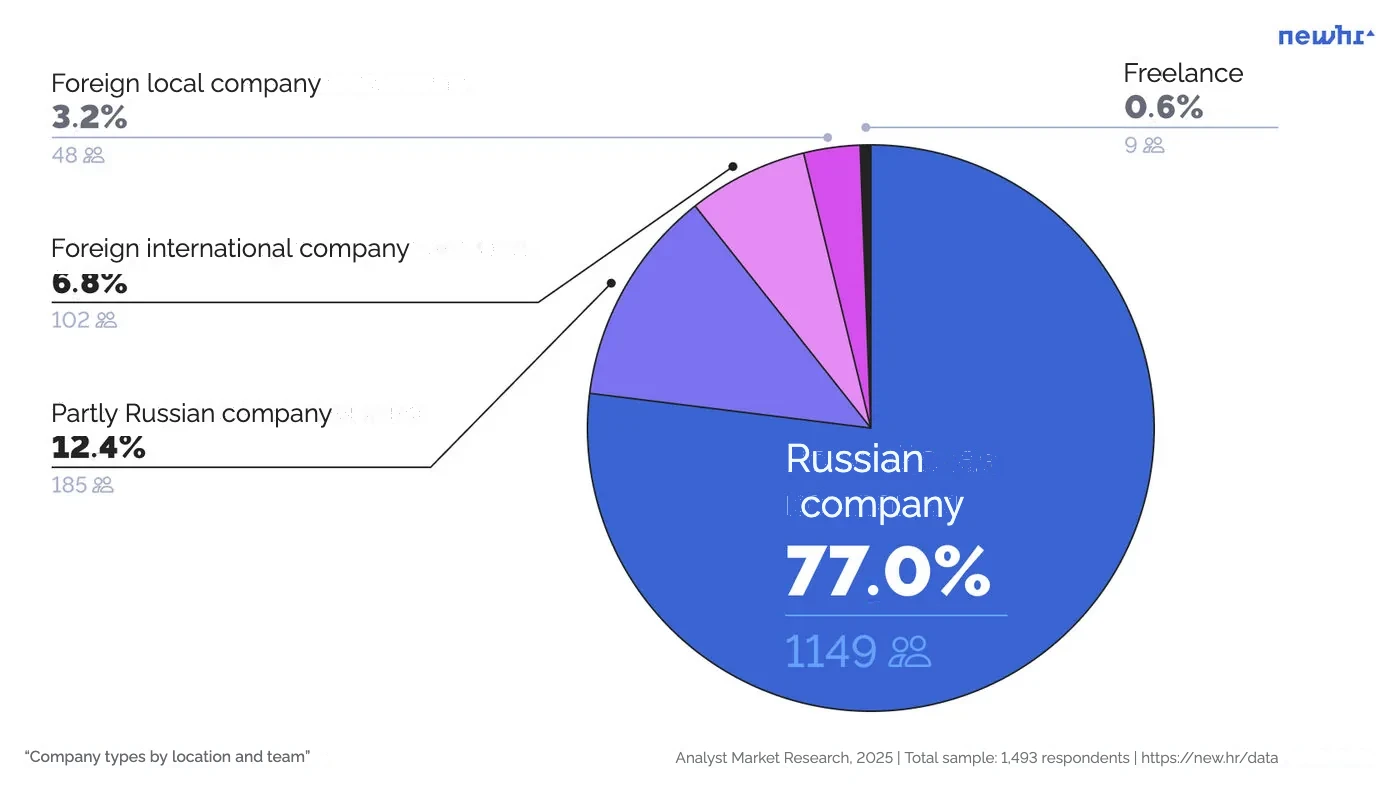
In previous years we noted a shrinking share of "partly Russian" companies. In 2025 the trend continued: their share fell to 12.4% (21.6% in 2023, 15.3% in 2024).
Meanwhile, the shares of Russian companies (from 76% to 77%) and foreign international companies (from 5.1% to 6.8%) are growing proportionally. We believe this points to a trend of people "flowing" from "partly Russian" companies to foreign international ones and, to a lesser extent, to Russian ones.
Most foreign local companies in our sample (¾) are from neighbouring countries (Kazakhstan, Belarus, Uzbekistan). Among companies from further abroad, German ones are the most common.
Remote, hybrid or office: how analysts work
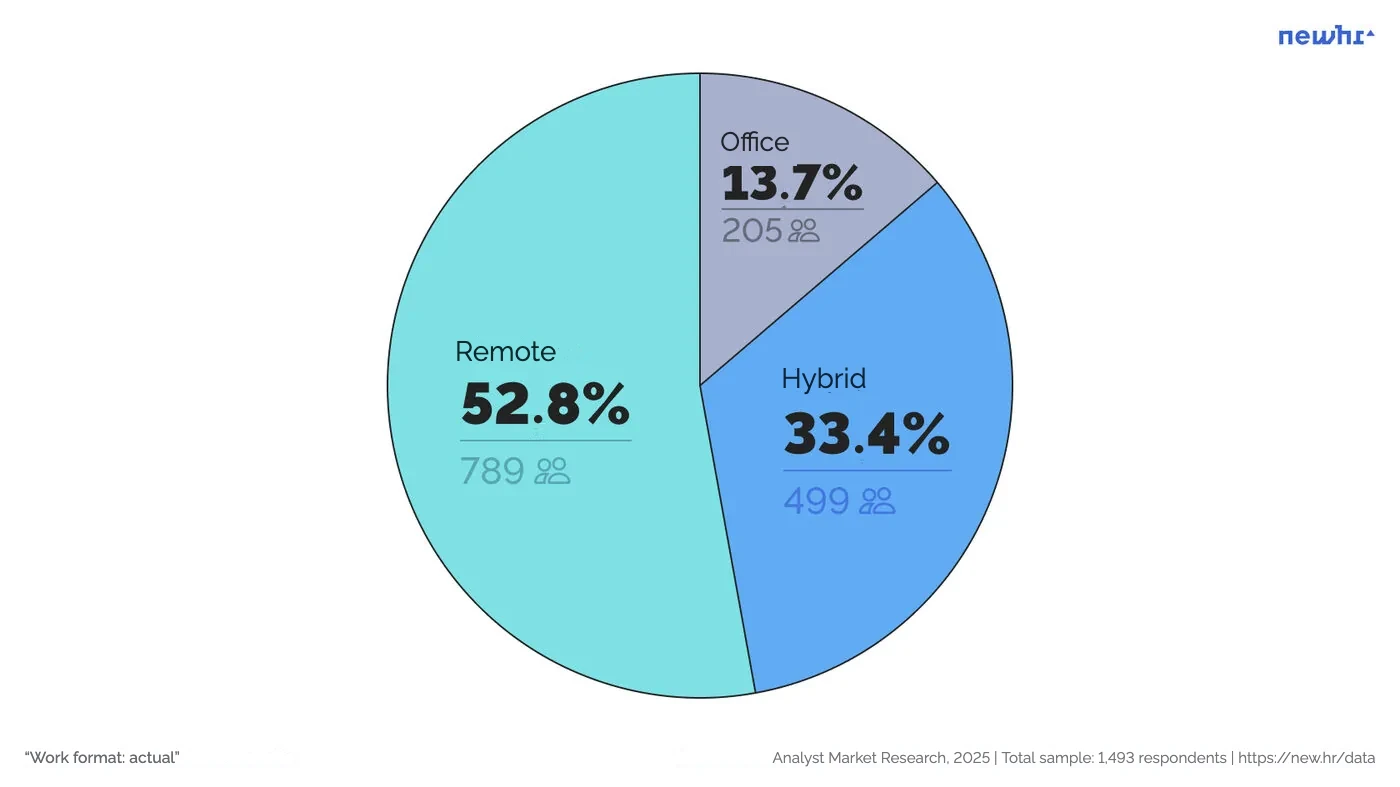
Question: What format do you work in?
Number of respondents: 1,493
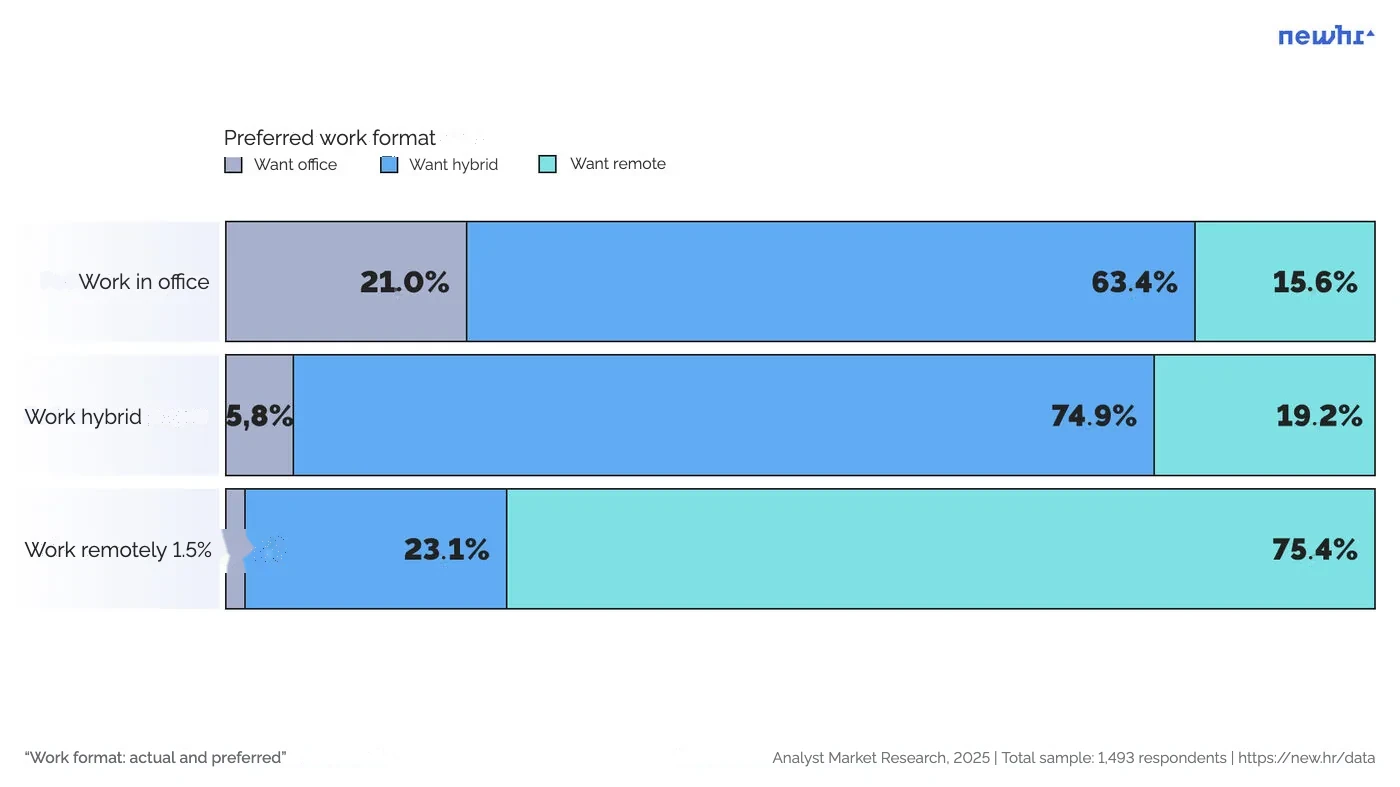
Question: What work format do you prefer?
Number of respondents: 1,493
- Remote work is still widespread (52.8%).
- Hybrid and remote remain the most attractive (45.9% and 48.4% respectively).
- Fewer respondents like the office than work in this format (13.7% vs 5.6%).
Alena Makarova
Head of Research
at NEWHR
"Our respondents prefer the format they already work in (except those who are forced to go to the office). Over 2025, employees on hybrid came to like hybrid even more, and remote workers love their remote work even more. Whatever the rumours, Russian-speaking analysts will certainly not move back to the office any time soon."
- The most "office" specialization is financial analyst (53%)
- The most "hybrid" specialization is marketing analyst (54%)
- The most "remote" specialization is systems analyst (70%)
Analysts' income
About money
Analysts report salary growth, but it is rather subjective: it comes from grade promotions and indexation. Market-wide, salaries are barely growing.
Analyst salary dynamics in 2025
Question: How has your salary changed over the past year?
Number of respondents: 1,477
Question: By how much has your salary increased over the past year?
Number of respondents: 994
Question: By how much has your salary decreased over the past year?
Number of respondents: 37
In 2025, 97.5% of respondents, 1,477 analysts, had professional income.
Most analysts saw their salary grow, although their share is slightly smaller than last year.
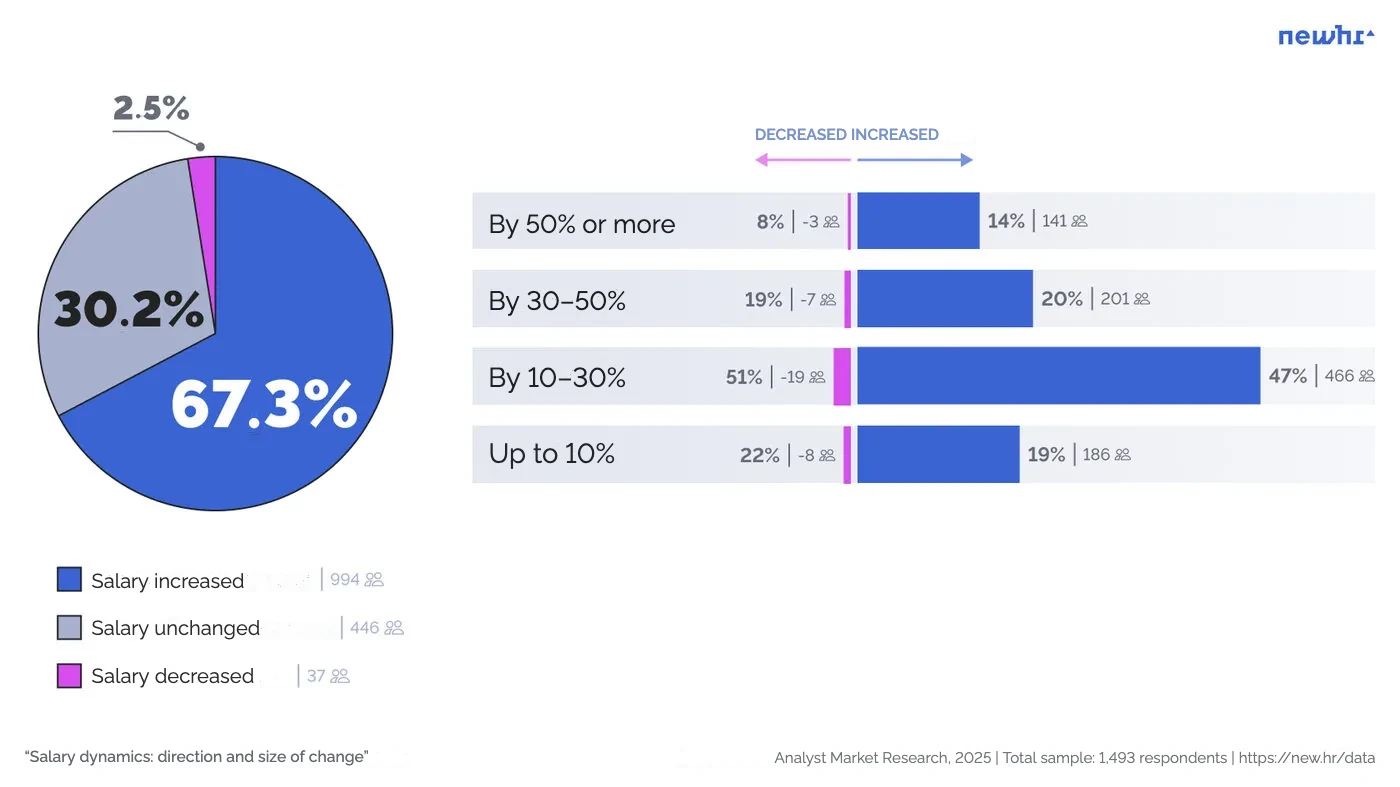
- 67% of respondents started earning more (70% in 2024, 68% in 2023)
- 30% stayed at the same salary (28% in 2024, 29% in 2023)
- 2.5% started earning less (2% in 2024, 3% in 2023)
- 19% of analysts started earning 10% more (15% in 2024)
- 14% of analysts started earning 50% more (20% in 2024)
Differences in salary growth for men and women
Salary dynamics for women are somewhat worse than for men.
- 1.6% of women and 0.6% of men received no salary
- Salary fell for 4% of women and 1% of men
- Salary grew for 64% of women and 69% of men.
- We see equality only in stagnation, among those whose salary did not change in 2025
Differences across analyst specializations
Salaries grew most often for product, BI and data analysts. Least often for systems analysts, who also have the highest share of pay cuts.
- Product analysts (growth for 75%)
- BI analysts (growth for 72%)
- Data analysts (growth for 70%)
- Heads of analytics (growth for 68%)
- Marketing analysts (growth for 65%)
- Business analysts (growth for 61.5%)
- Systems analysts (growth for 49%)
- Salaries grew most often for product, BI and data analysts.
- Marketing analysts are close to the average (growth for 65%, stagnation for 32%), but worse than a year ago (2024: growth for 86%, stagnation for 14%). Business analysts are a little gloomier (growth for 61.5%, stagnation for 35.5%, decline for 3%), but slightly better than a year ago.
- Systems analysts had the hardest time: growth for only 49%. And this continues last year's trend (2024: growth for 59%, stagnation for 39%).
- For analytics managers, salaries mostly changed in line with the market average: they grew for 68%, stagnated for 30% and fell for 2%
Differences in salary growth by company type
- Salaries grew most often in Russian and foreign international companies.
- Employees of "partly Russian" and foreign local companies (mostly companies from neighbouring countries) fared somewhat worse.
- Whatever the type of employer, salary growth covered at least 60% of analysts.
Salary dynamics / Analysts from companies
From Russian companies
From "partly Russian" companies
From foreign international companies
From foreign local companies
- Salary growth
- 68.5%
- 60.0%
- 67.5%
- 63.0%
- Stagnation
- 29.0%
- 37.0%
- 27.5%
- 32.5%
- Decline
- 2.5%
- 3.0%
- 5.0%
- 2.5%
Alena Makarova
Head of Research
at NEWHR
"Salaries increased for ⅔ of analysts, but this does not mean that base pay was actively growing across the market. A significant part of the raises is linked to respondents' grade promotions and to indexation. Absolute growth was within 4–8%.
On average, the annual growth of IT specialists' nominal income in Europe is 4–5%, so the situation seems normal. But there is a catch: people take as normal the annual growth they are used to. Russian-speaking IT specialists are used to much faster salary growth."
"Indeed, many Russian-speaking analysts expect annual growth of 15–20%, as it was before 2022, during the boom of Russian IT. Today's growth is rather linked to salary indexation. Against the changed cost of living, it may even be disguised stagnation."
Oksana Prutyanova
Lead of analyst
and data scientist search at NEWHR
Why analysts' salaries go up or down
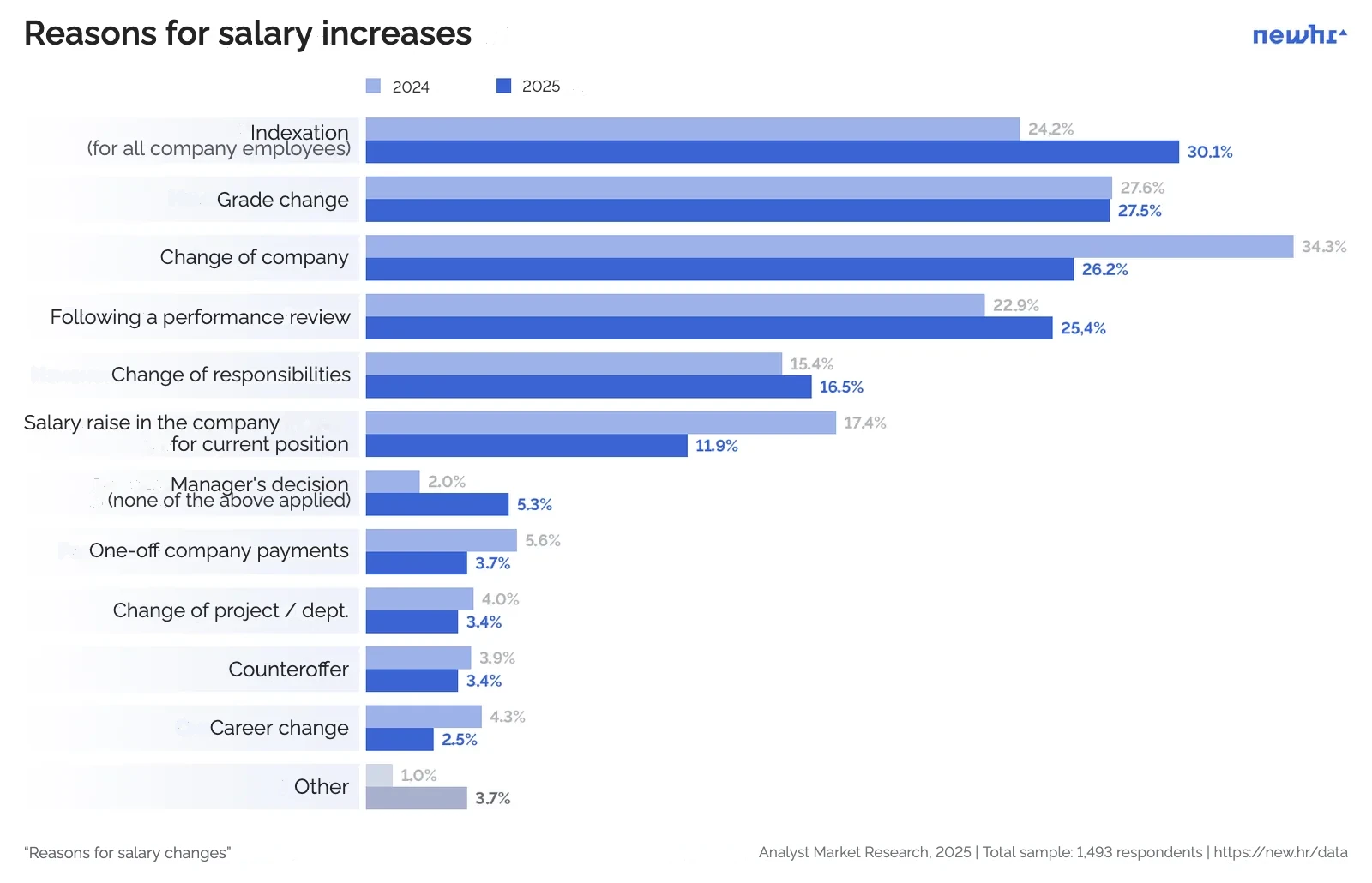
For the first time, the top reason for a salary increase is not a change of employer but indexation. The logic of "want more money, move to another company" is ceasing to work.
Question: On what grounds was your salary increased?
Number of respondents: 994
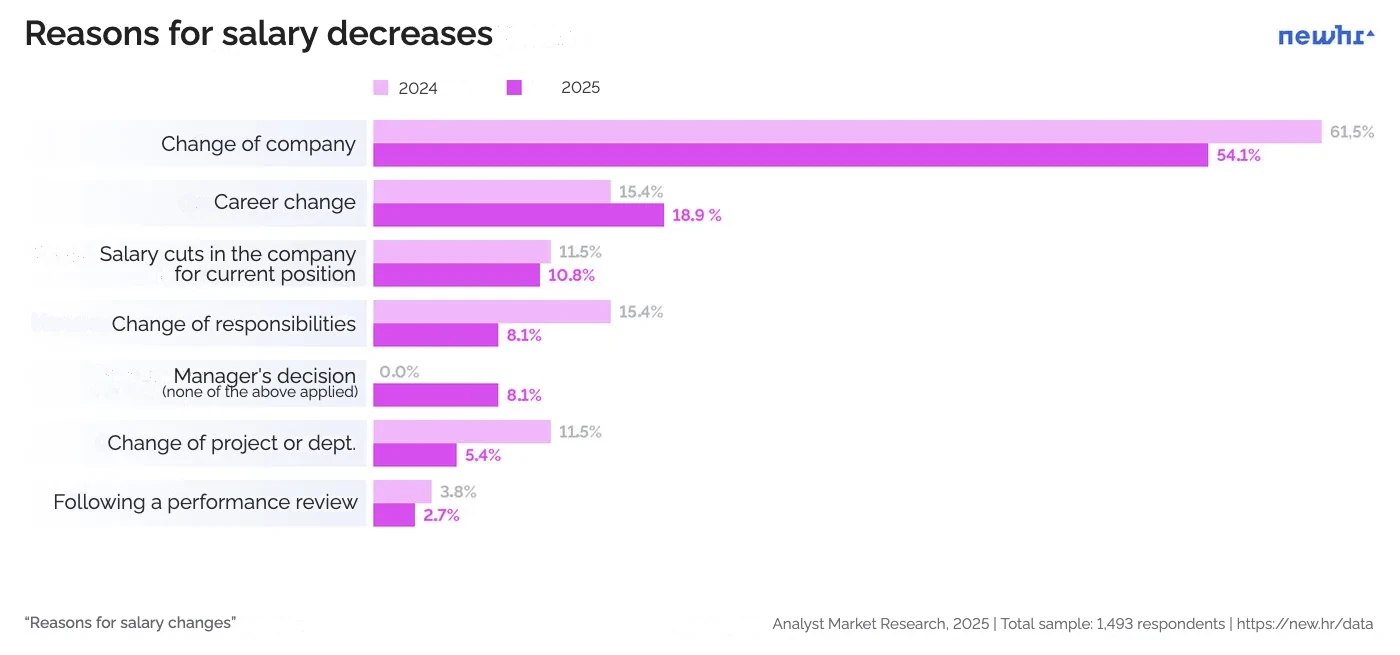
Question: On what grounds was your salary decreased?
Number of respondents: 37
The 2025 trend: analysts' salaries grow first of all with development inside the company and with indexation. Opportunities to change jobs are shrinking: this option has slipped to third place.
What drives changes in analysts' salaries
- Analysts almost always get a raise to the fixed part (94% of respondents) and in most cases only to it.
- The bonus part is raised much less often, although this became more frequent in 2025 (24% of respondents vs 16% in 2024).
- In 5% of cases the raise affects only bonuses.
- Most saw the fixed part cut (65% of respondents), but 43% noted that the bonus part decreased (1.6 times more often than in 2024).
- Given that 51% receive bonus payments regularly, this means that if an analyst has bonuses, pay cuts start with them.
What currency analysts are paid in
Question: What currency are you paid in?
Number of respondents: 1,493
Since the core of our sample is analysts working for Russian companies, most of them are paid in roubles (77.9%).
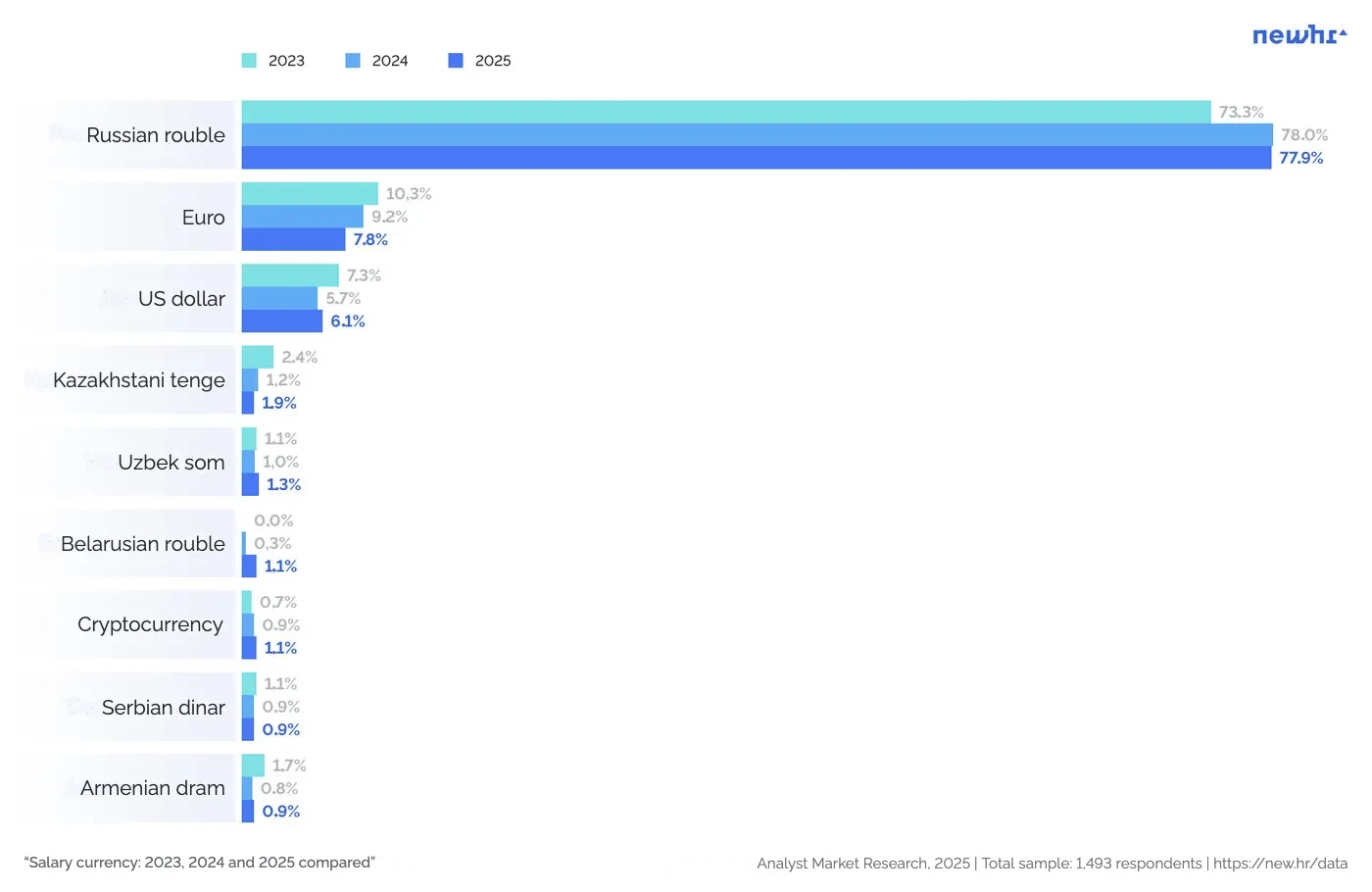
- In Russian companies only 5.3% of analysts are paid in foreign currency, and ¾ of that share is the currency of neighbouring countries.
- In "partly Russian" and foreign companies 16% of analysts are paid in roubles. That is the same as in 2024, but half the 2023 figure.
- The variety of currencies has decreased (from 22 to 18). The euro is still ahead of the dollar.
- 8.2% of analysts are paid in other currencies. The Kazakhstani tenge, Uzbek som and Serbian dinar lead among them.
- Payment in cryptocurrency has become an established practice. Overall only 1% of respondents are paid in crypto, but some categories deal with it much more often. For example, among analysts from "partly Russian" companies the figure is 7%, and among freelancers 11%.
Alena Makarova
Head of Research
at NEWHR
"Non-rouble payments in Russian companies keep declining. In 2024, 6% were paid in foreign currency, and in 2025 only 3.8%. Rouble payments in "partly Russian" companies remain but are also shrinking: the share of such employees fell from a third in 2024 to 22% in 2025.
These processes, like a number of others, point to the divergence of the Russian and foreign markets. Part of the "foreign" analysts are becoming less engaged with the Russian market, and everyone faces an ever stricter need to choose a market."
Salary ranges by specialization
Analyst salaries
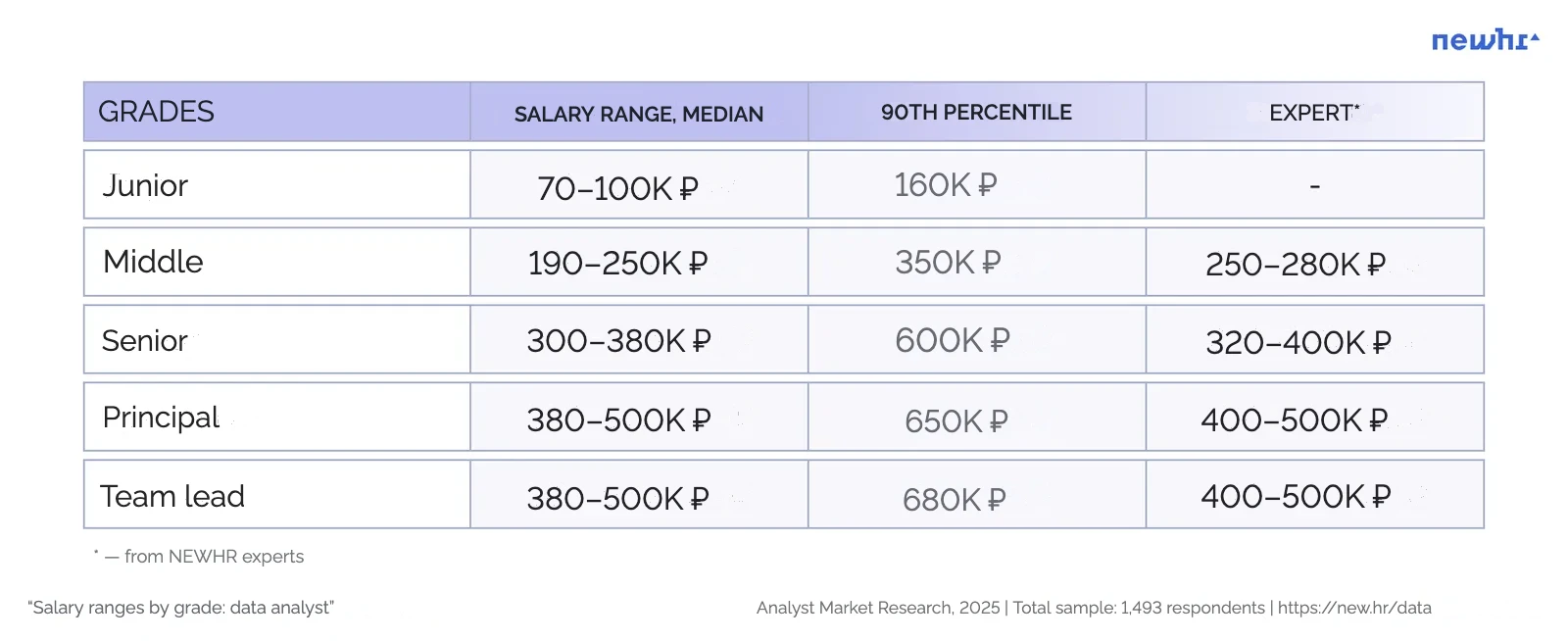
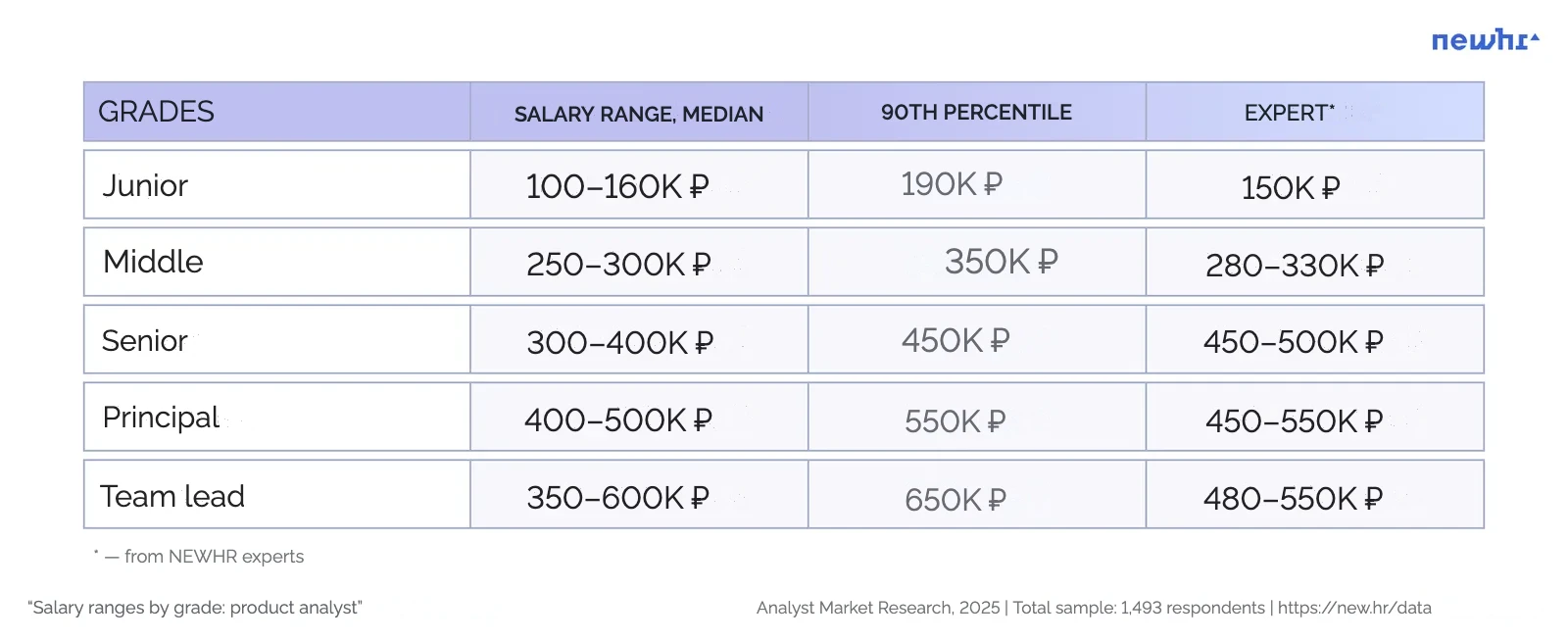
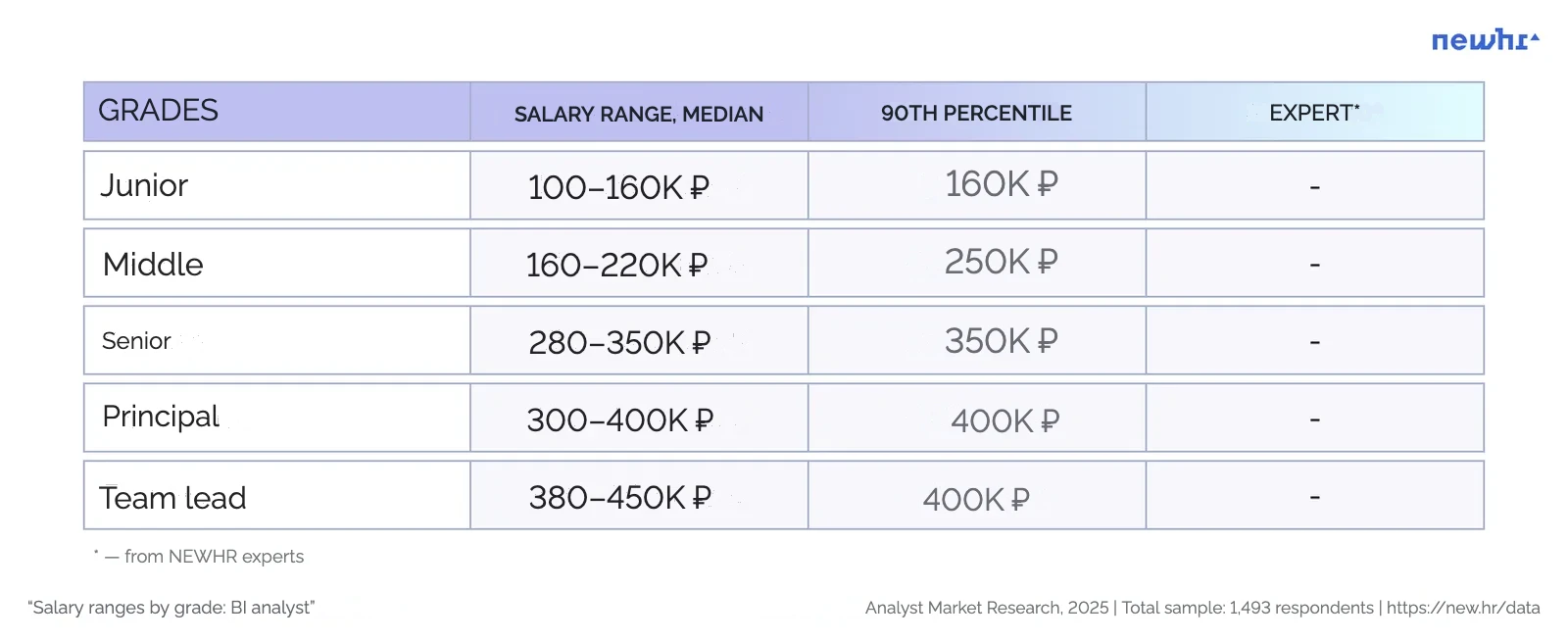
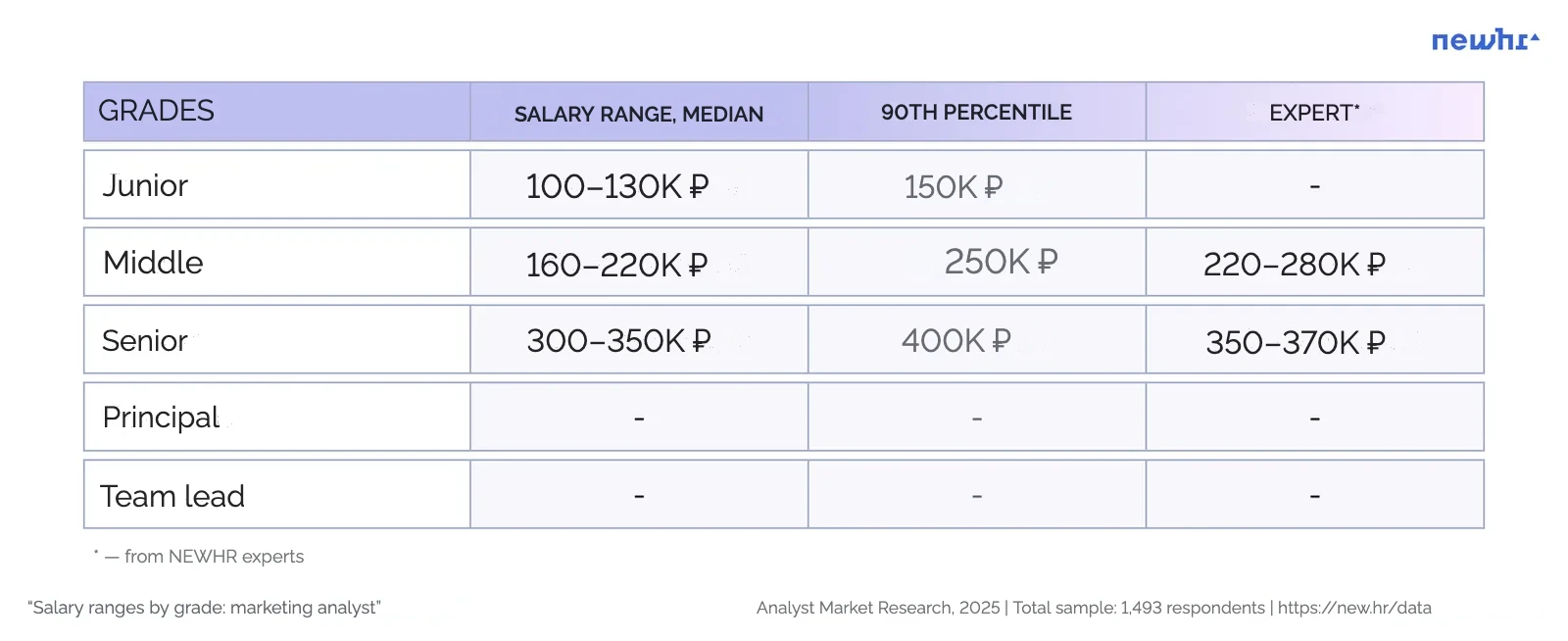
We derived analyst salaries for 2025 from three sources: the results of the study, averaged data from NEWHR's salary analytics, and the expertise of our recruiters.
Salary ranges are given for 6 analytics specializations and, separately, for heads of analytics: these are the most representative categories of our respondents. Salaries are stated net, after taxes.
In addition, we listed the skills that raise analysts' market value, based on real offers from the practice of the international recruiting agency NEWHR.
Data analyst salaries
Data analysts: collect, process and visualize data for the business.
What raises a data analyst's value
Technical skills
- SQL
- Python
- Working with large volumes of data
- Automation
- Business understanding — Knowing why the business needs particular data and what to do with it next, rather than just being able to export information.
- Partnership approach — The ability to challenge a request when needed and explain to the stakeholder what data is required to solve the problem.
Product analyst salaries
Product analysts: embedded in the product team, they help product managers make data-driven decisions.
What raises a product analyst's value
- Understanding the specifics of the business model — What matters is not the industry but the type of business model. An analyst who understands the subscription model is equally valuable in a bank, a taxi service or gamedev: the logic of retention and monetization is the same everywhere.
Expertise in a similar product
- Experience with a similar product is valued more than overall experience.
- Business approach — DAU/MAU, LTV, churn, conversion funnels: it is important not just to calculate them but to understand how the metrics relate to business decisions and what lies behind them.
BI analyst salaries
BI analysts: specialists in data visualization and building reporting systems. They turn raw data into clear decision-making tools at every level.
What raises a BI analyst's value
- Command of current tools — The market in Russia is restructuring: Tableau and Power BI are giving way to Russian and open-source alternatives. Companies look for analysts familiar with the current stack.
- Ability to build analytics infrastructure — Understanding the data model, the warehouse architecture and the aggregation logic, and the ability to take on a wide range of tasks.
- Understanding the business behind the metrics — A BI analyst who understands which decisions stand behind each metric and can put this into words for the business closes tasks that others cannot.
Marketing analyst salaries
Marketing analysts: work with marketing data, from ad campaigns to acquisition unit economics.
What raises a marketing analyst's value
- Multifunctionality — The ability to cover the tasks of several people, for example, web analytics plus traffic analysis.
- Understanding performance marketing — Understanding the logic of channels (paid search, targeted ads, SEO, CPA networks) and the ability to act as a partner in marketing decisions.
Attribution and end-to-end analytics
The ability to build end-to-end analytics from first touch to purchase.
Systems analyst salaries
Systems analysts: work at the junction of business and IT; they describe requirements, design processes and write specs for developers.
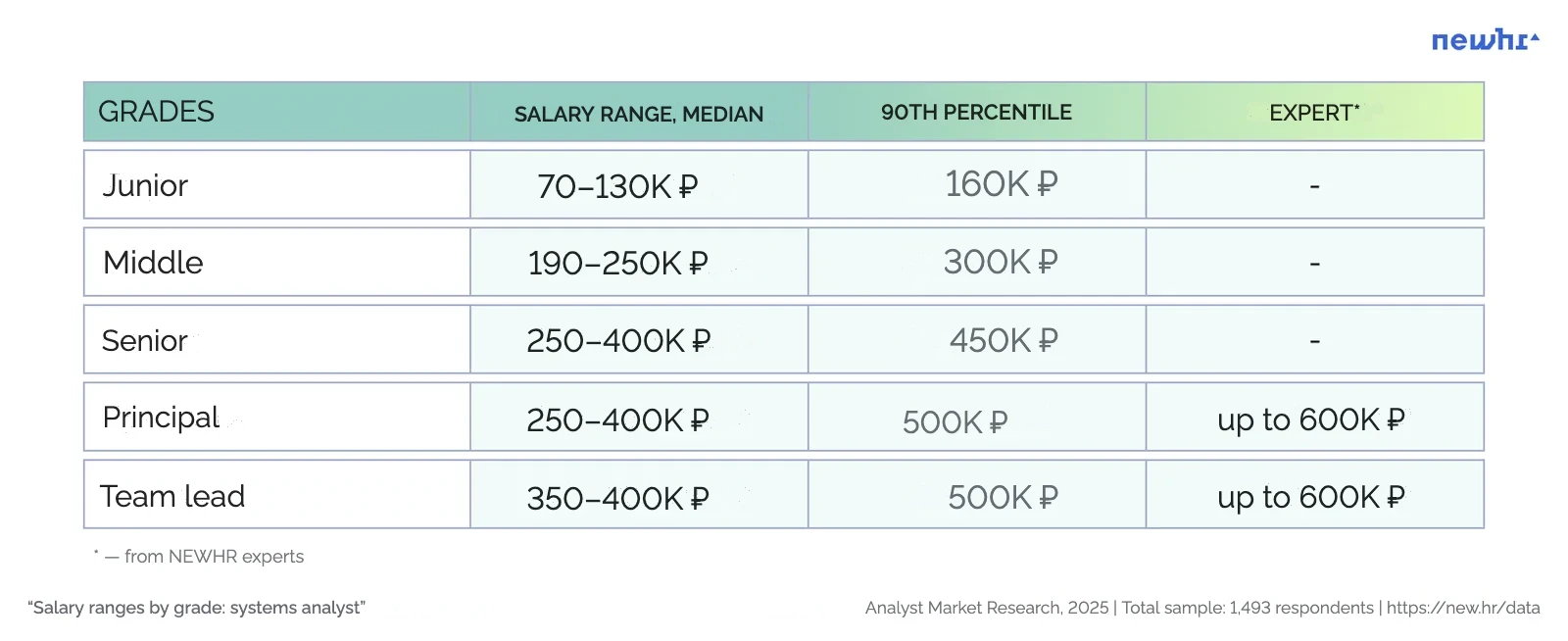
What raises a systems analyst's value
- Project expertise — Candidates with experience in several domains are valued by consulting companies that "lease out" their analysts to large projects.
A combination of technical and business skills
- Understanding of technical architecture and business processes.
- Multifunctionality — A broad professional range and the ability to cover tasks from data analytics and business analysis.
Business analyst salaries
Business analysts: a bridge between "what the business wants" and "how to implement it in data and systems". Deeply immersed in the business processes of a specific industry or company.
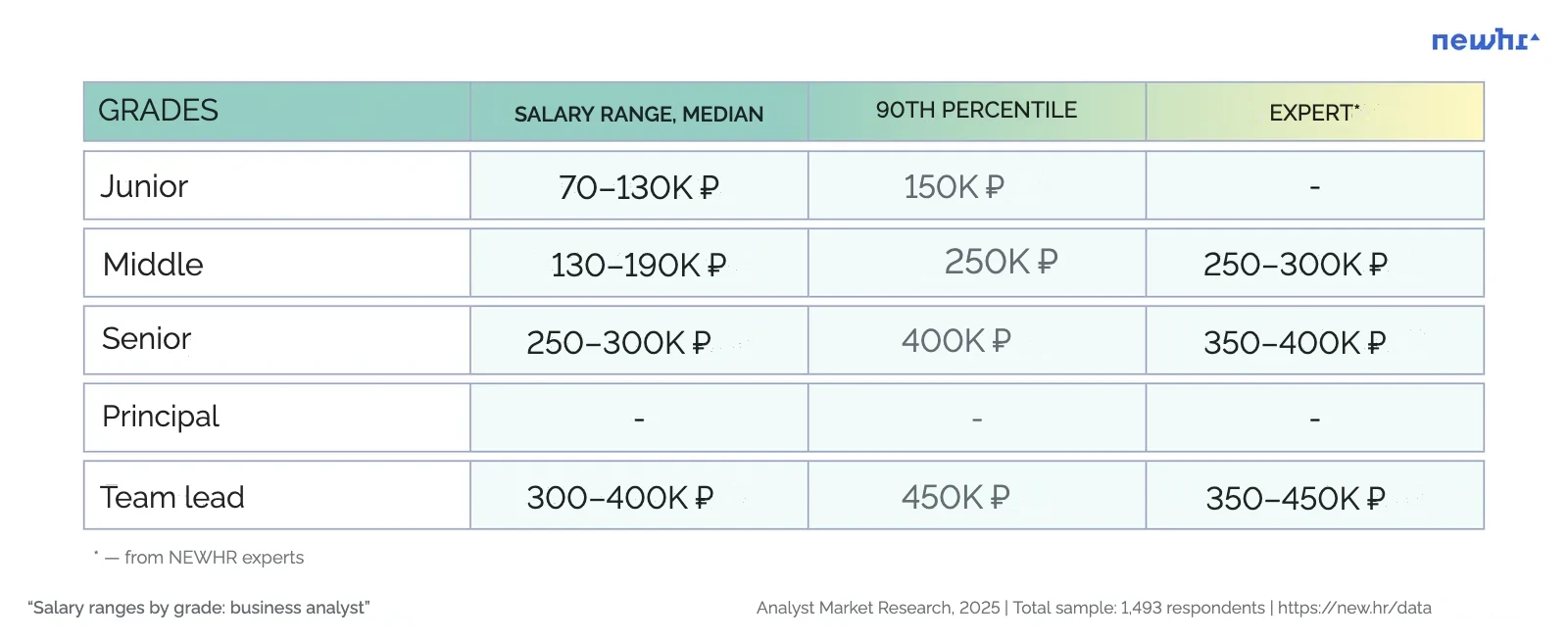
What raises a business analyst's value
- Narrow domain expertise — Companies are ready to pay extra for deep industry knowledge: banking, retail, logistics, the public sector, etc. The closer the match with the business need, the more expensive the candidate.
- Product expertise and knowledge of systems — Experience with specific systems (SAP, 1C, Oracle and especially ERP) narrows the pool of competitors.
- Combination of domain and system — Maximum value comes when both factors match. For example, the candidate understands bank processing and knows ERP.
Salaries of heads of analytics
By level of involvement in the business and scale of responsibility, heads of analytics fall into 3 groups with very different price tags.
Team-lead-style head: a small team (3–7 people: juniors, middles, sometimes seniors). The key difference from a specialist team lead is responsibility for the result of the whole team, not just their own. The value of a head at this level is largely an extension of team-lead logic, but with greater weight on management results.

What raises the value of a team-lead-style head
- Team size and composition — Managing a team of 7 with middles and seniors is harder and more expensive than managing a team of 3 juniors. The market takes this into account.
- Technical expertise — At this level it still matters that the head can solve a task themselves. The technical foundation is part of the price tag.
- Ability to retain people — A lost senior is a loss for the business. Companies value heads with a stable team.
Manager of managers: leads leads, each of whom has their own team. This is already management one level removed. Often responsible not only for analytics functions: ML teams, Data Engineering and adjacent technical areas may be added. At this level, value is determined by the scale of the area of responsibility.
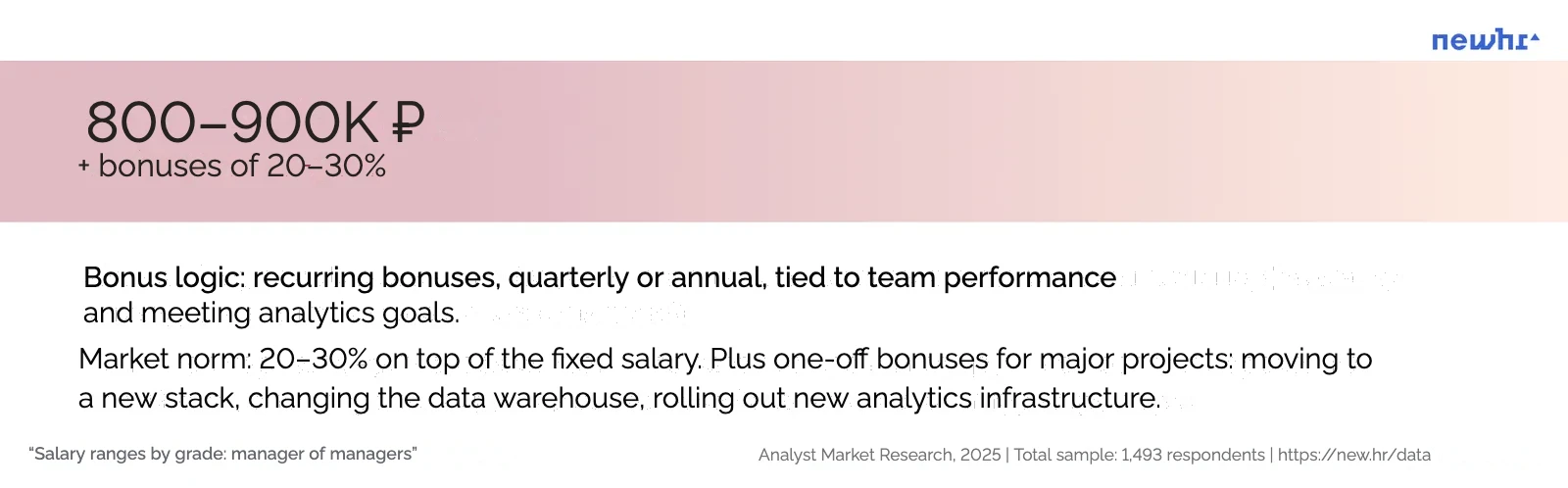
What raises the value of a manager of managers
- Cross-functionality and the number of verticals managed — A manager who understands analytics, ML and engineering is more expensive than one responsible for a single vertical. The wider the area of responsibility, the higher the price tag.
- Ability to manage one level removed — Leading leads is fundamentally harder than leading specialists. You have to set tasks for managers, keep a strategic focus and notice in time when something goes wrong.
- Type of business — Fintech, high-risk companies and stable banks pay noticeably more at this level than mid-sized e-commerce.
C-level | CDO: responsible not just for people but for the entire analytics function and its strategy in the company. The value of a C-level is the value of influence on the business, not of managing people.
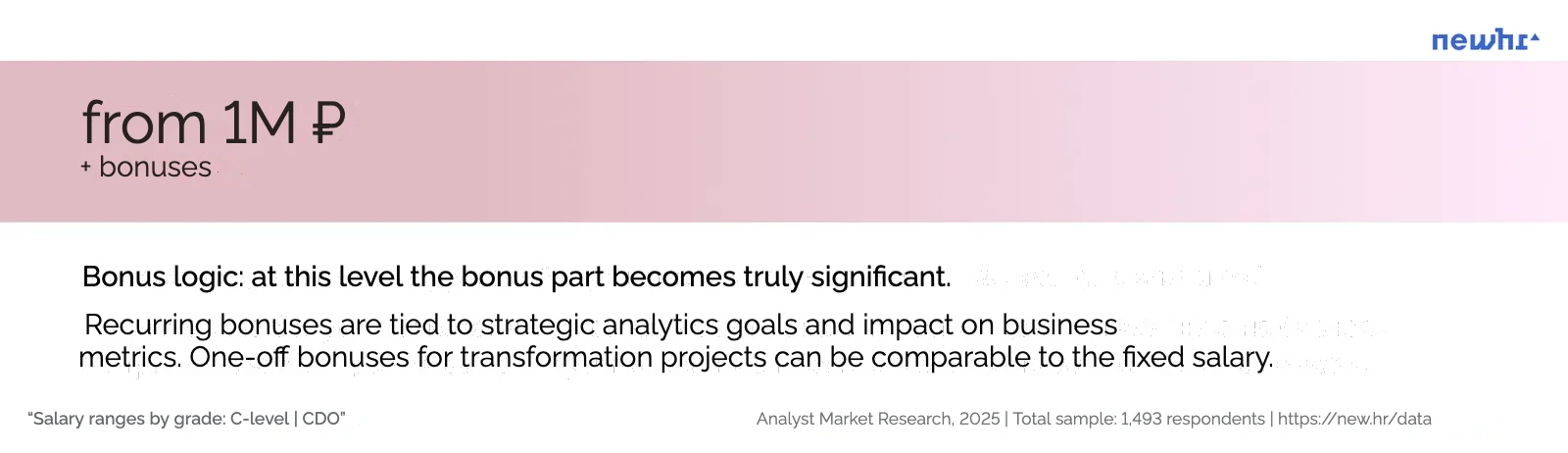
What raises the value of a C-level | CDO
- Strategic role — The difference between a C-level who simply runs a large team and one who really influences
product and business strategy through data is huge. The latter is worth fundamentally more. - Company scale and analytics maturity — In a large company with a developed analytics culture this role is more complex and more expensive. In a small company a C-level may be just a senior manager with a nice title.
- Ability to build the function from scratch — One of the most valuable scenarios is when a head joins a company where analytics as a function does not yet exist. This requires expertise and the ability to "sell" the value of data to founders and the board.
- Negotiating power at the offer stage — At this level an offer is a negotiation, not a choice within a range. A head who can show how their arrival will change business metrics gets better terms.
Oksana Prutyanova
Lead of analyst
and data scientist search at NEWHR
"If you look at what raises the value of an analyst in any specialization, a common pattern emerges. The market pays for a business mindset, the ability to ask the right questions, to be critical of the task at hand and not to be afraid to challenge a stakeholder's request when needed.
The business needs a partner, not an analyst-as-a-tool: AI agents can handle the calculations. The tech stack still matters, but it is the entry threshold, not a competitive advantage. An AI-native approach, however, is a real value factor: an analyst who uses LLMs and AI in daily work closes tasks many times faster. For the employer this is a direct saving, both in money and in decision-making speed.
For small companies and startups, a separate pricing factor has become the candidate's ability to handle full-stack tasks and cover needs beyond their formal role. In big tech, meanwhile, narrow expertise is still valued."
Careers in analytics
Where they come from and where they go
Analytics is not losing popularity and is actively attracting people from "outside": more than half of specialists come into the profession from other fields.
How specialists come into analytics
Question: Have you always worked as an analyst, or did you come from another specialty?
Number of respondents: 1,493
Our respondents are split almost evenly between those who built their careers in analytics from the start (47%) and those who came from non-analytics fields (53%).
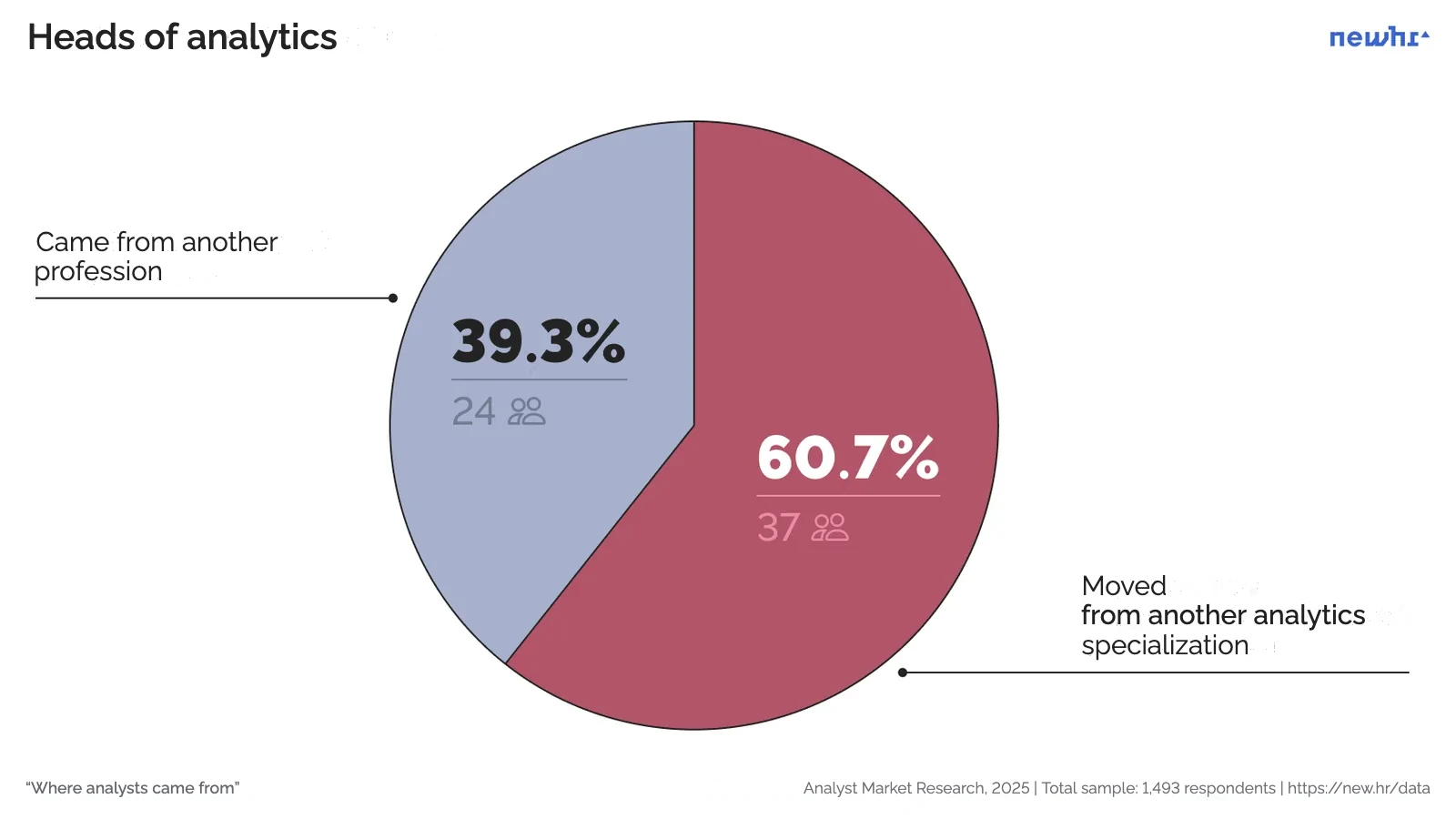
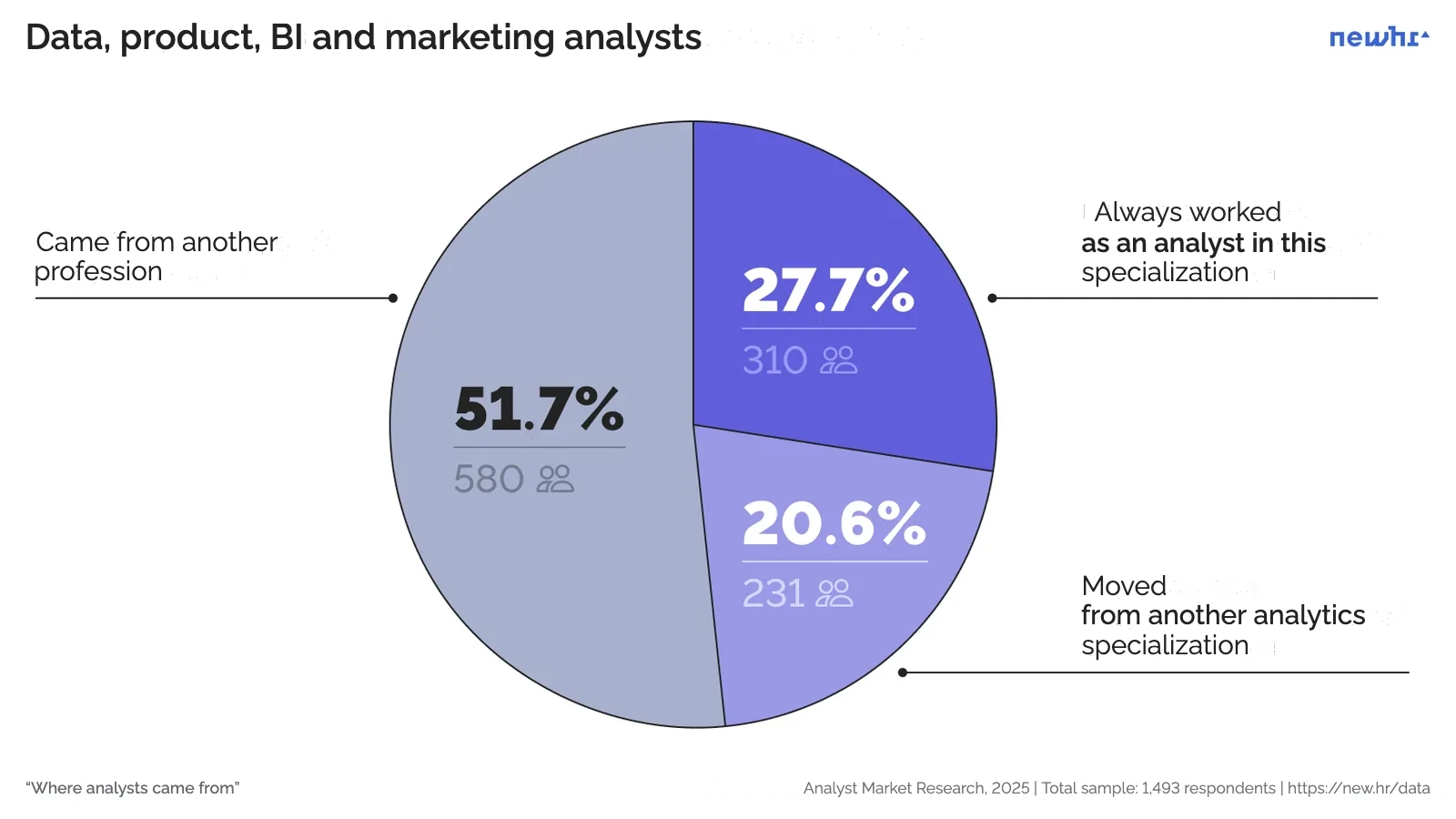
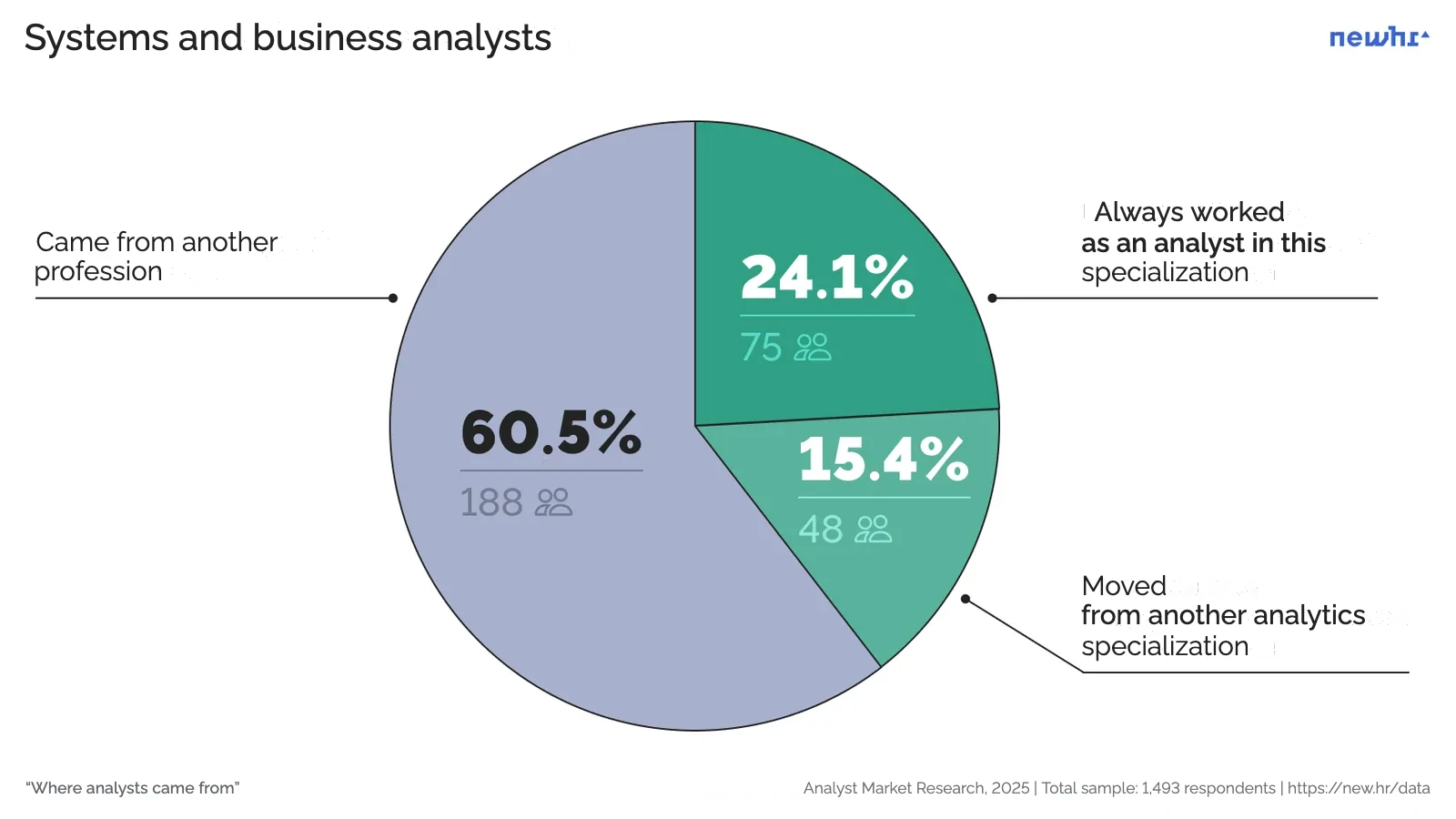
- Customer/CRM analytics (up to 80% of specialists are switchers from other professions)
- Business analytics (65% switchers)
- Operations analytics (up to 65% switchers).
- BI analytics (59% switchers)
- Data analytics (57% switchers)
- Systems analytics (57% switchers)
Donor fields for analytics
- IT and Digital (16%)
- Economics and finance (14%)
- Engineering and technology (10%)
- Sales and business development (8%)
- Marketing, advertising and PR (8%)
- Industry, construction, energy (8%)
Oksana Prutyanova
Lead of analyst
and data scientist search at NEWHR
"In recent years analytics has been actively replenished by switchers and course graduates. However, in 2025 many vacancies appear not because the market is growing; rather, employees are being redistributed between companies.
There is demand for expertise, but the need for more beginners is declining. And while the inflow of new people into the profession used to be absorbed by market growth, today this trend is slowing down."
Moves between specializations within analytics
Question: Which analytics specialization did you move from?
*Number of respondents:
Data, product, BI, marketing and others: 316
Systems and business analysts: 48*
We asked this question only to those who had moved between specializations within analytics itself.
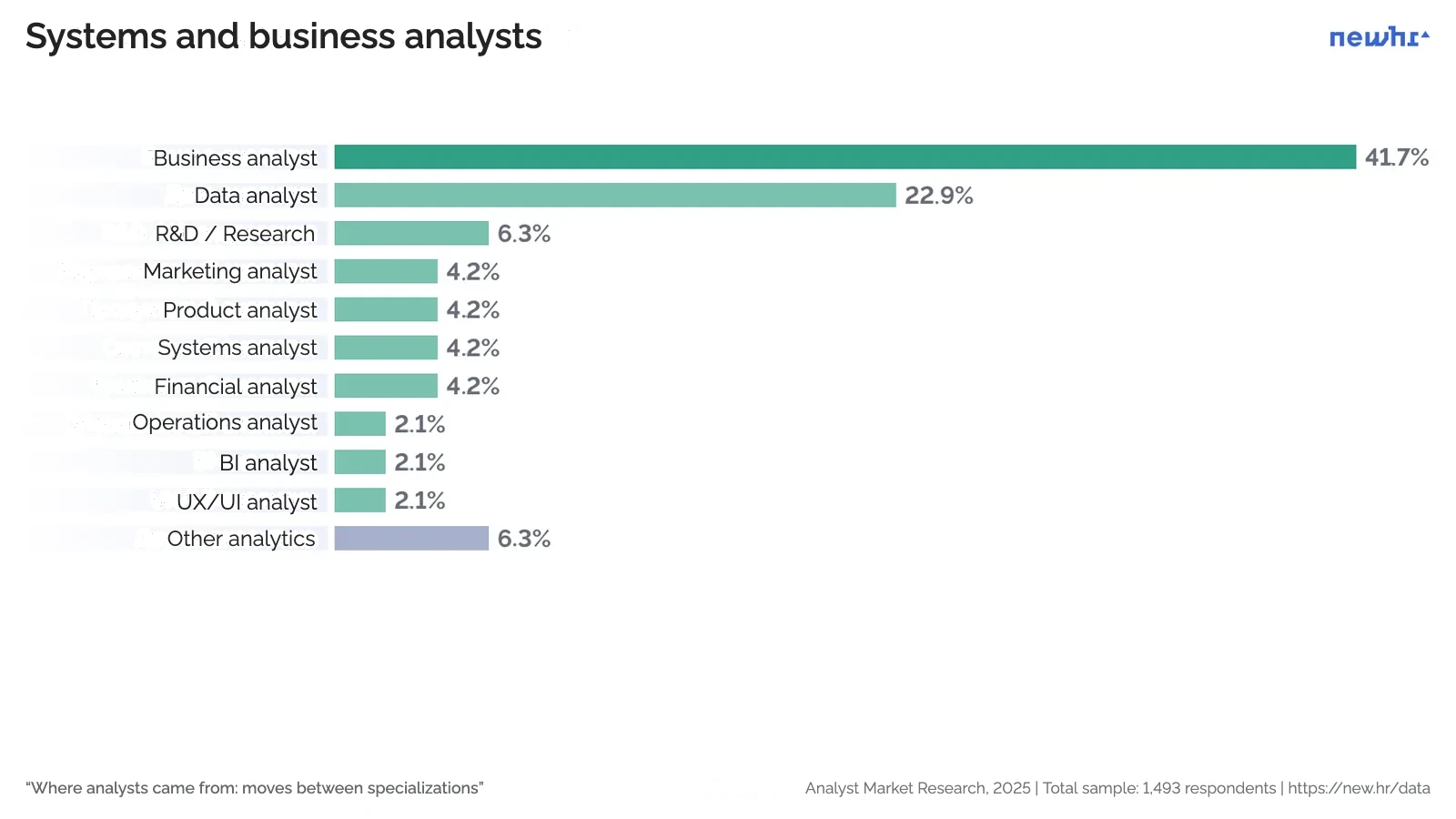
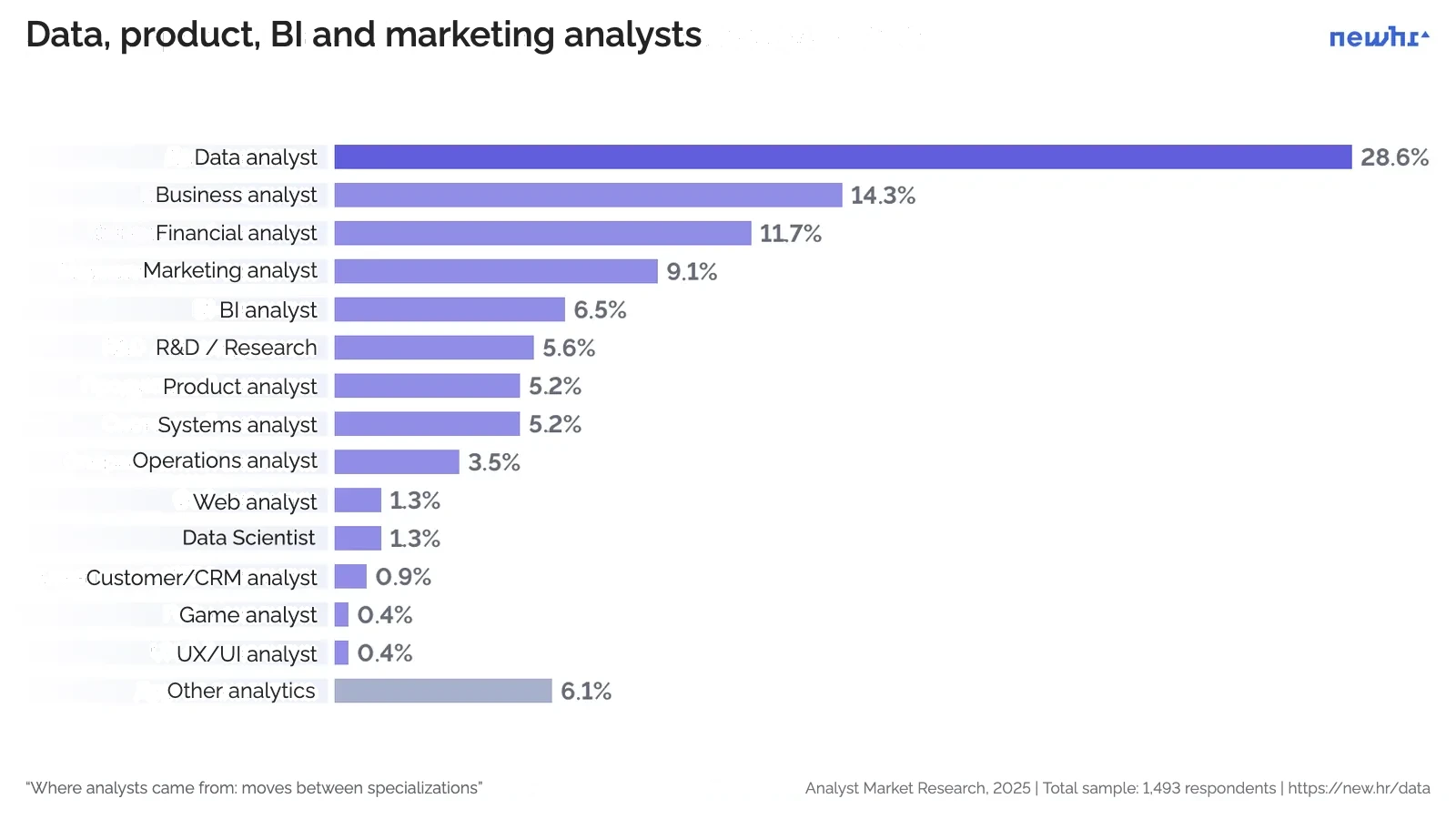
We can roughly identify the most common "donor" specializations in analytics, as well as "recipient specializations", the ones people most often move to within the profession.
- Data analytics (27.6% of all analysts in other specializations came from data analytics)
- Business analytics (19%)
- Financial analytics (10.4%)
- Product analytics (39.1% of product analysts moved from other specializations)
- Data analytics (20.1%)
- Systems analytics (13%)
- BI analytics (11%)
Analysts' professional plans
Analysts are loyal to their profession: only 4.5% want to change it. Most want to develop within analytics: grow in grade, become an expert, move to another company.
Question: What changes in your career and professional activity do you plan in the next 1.5–2 years?
Number of respondents: 1,493
Product analysts more often plan to become heads, and data analysts to change their specialization within analytics.
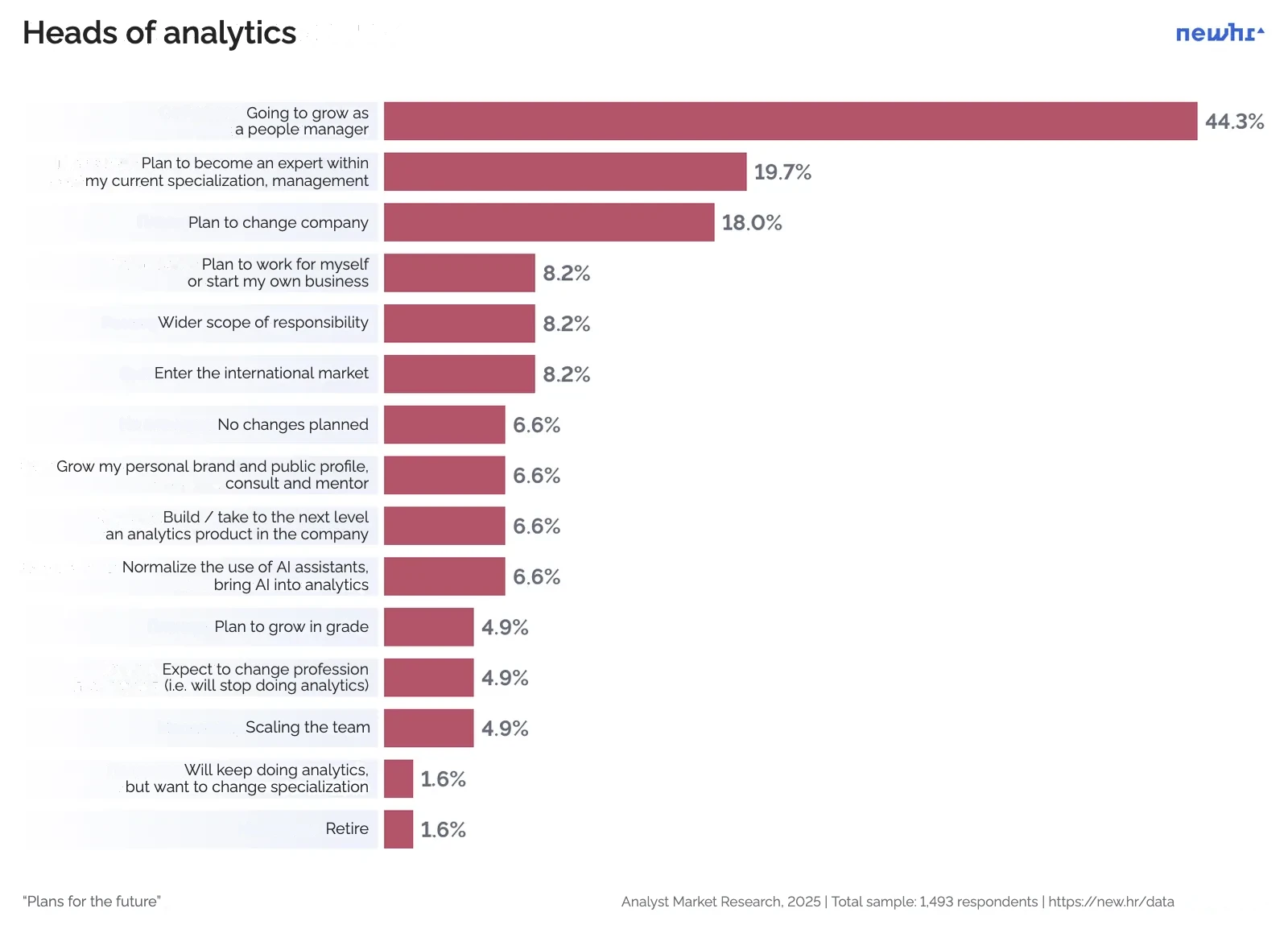
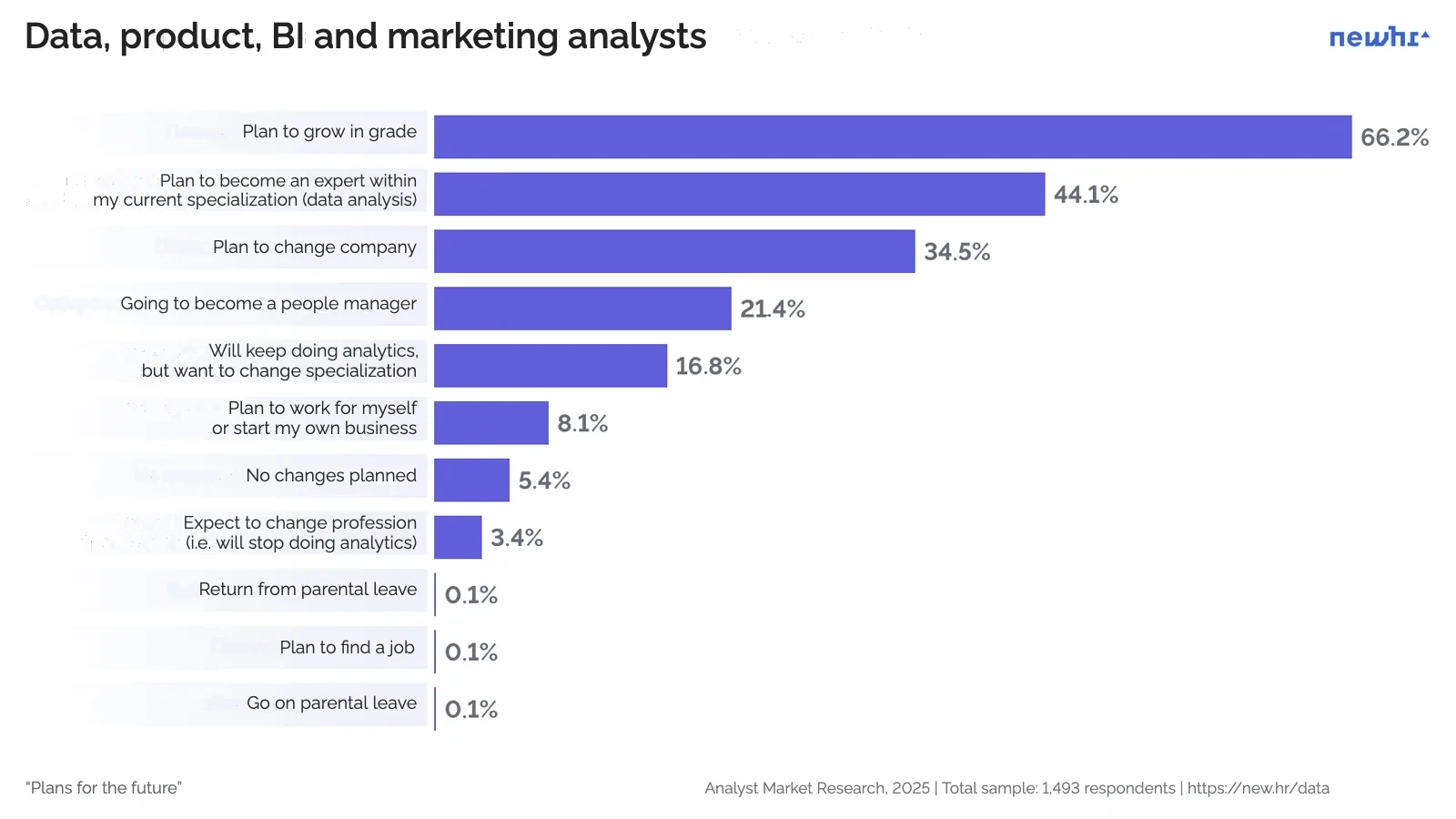
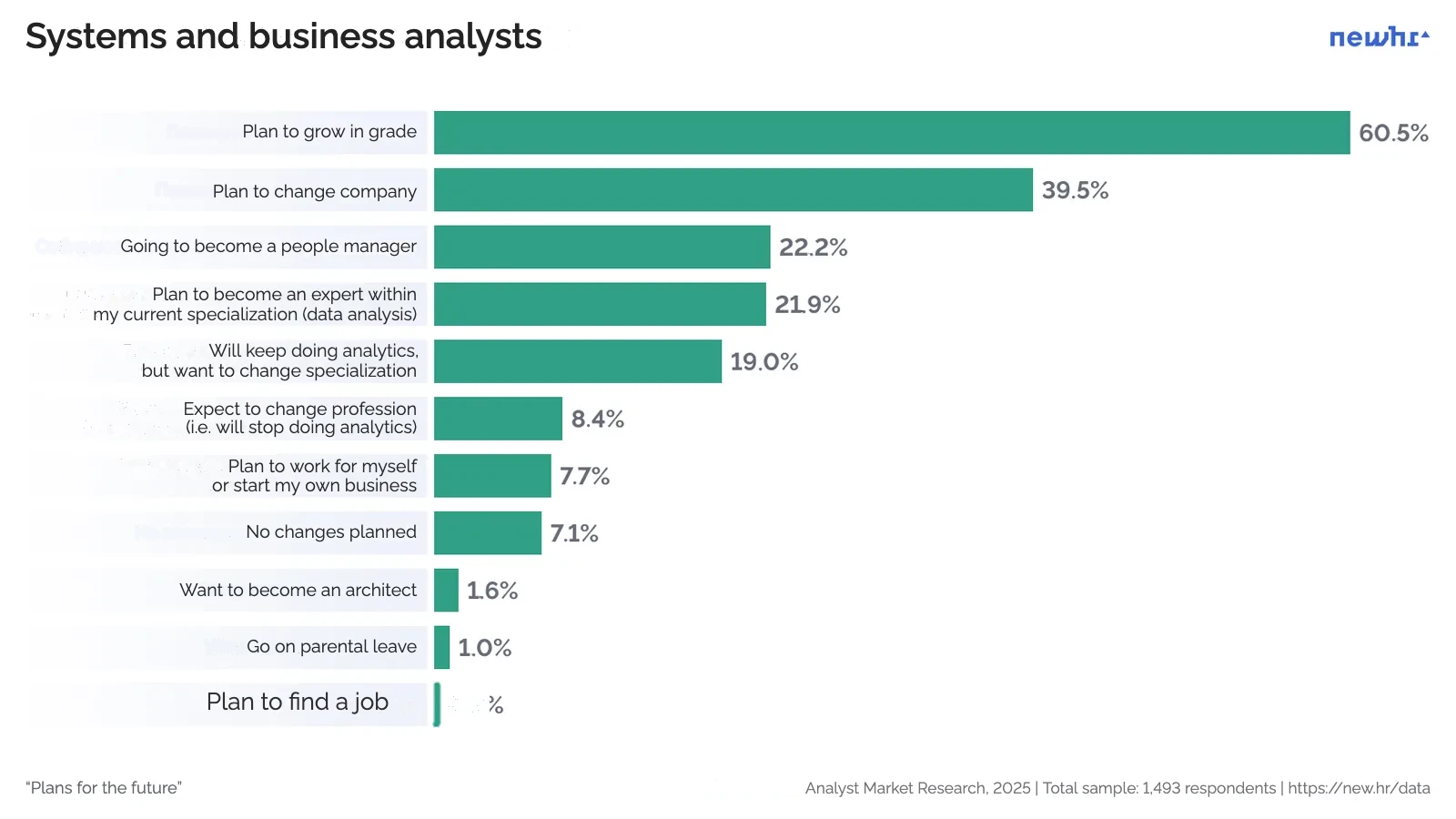
Analysts' plans for development within the profession
Question: How do you plan to develop within analytics?
Data, product, BI, marketing and others: 188
Systems and business analysts: 59
All analysts who plan to change specialization: 247
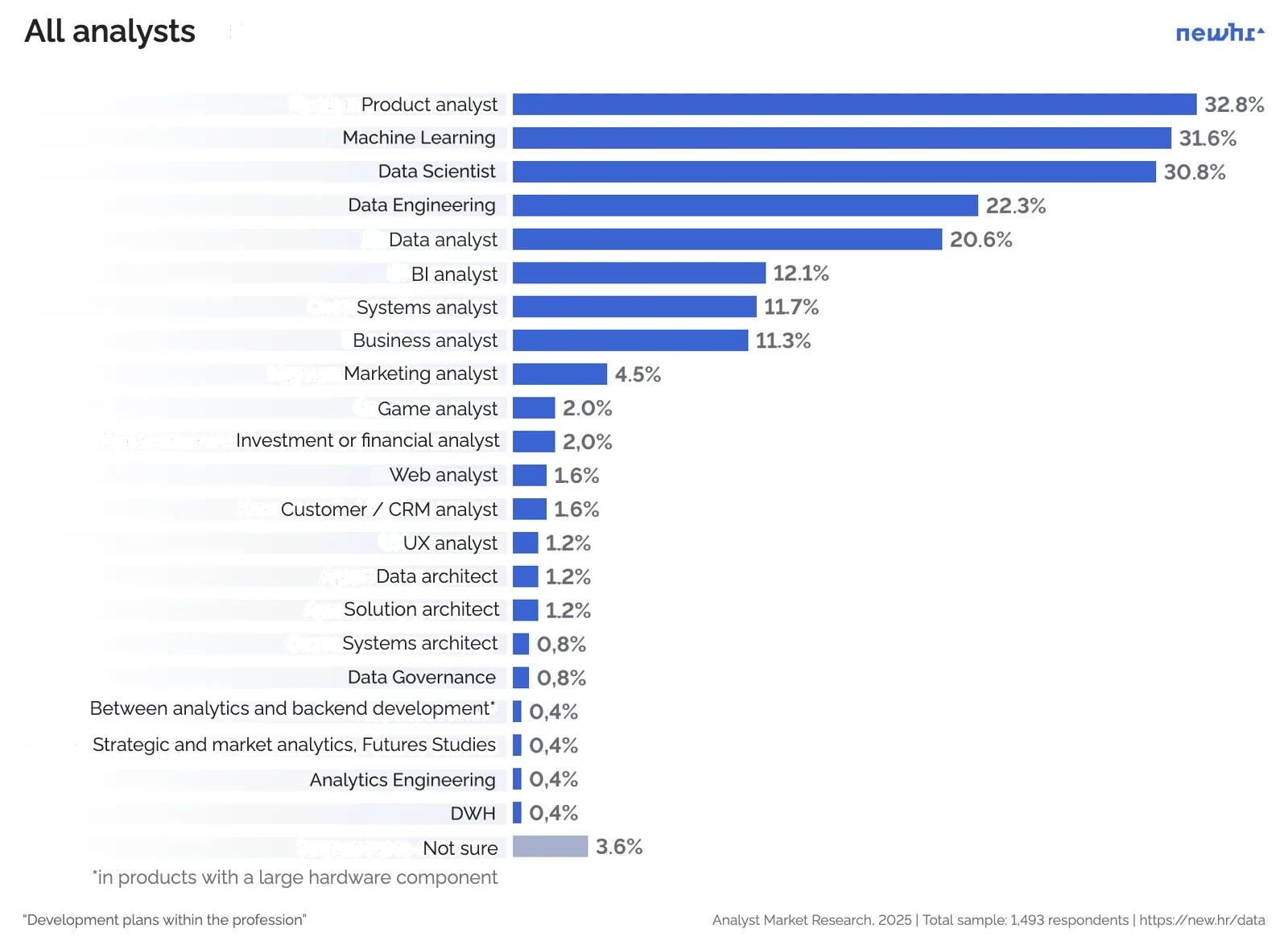
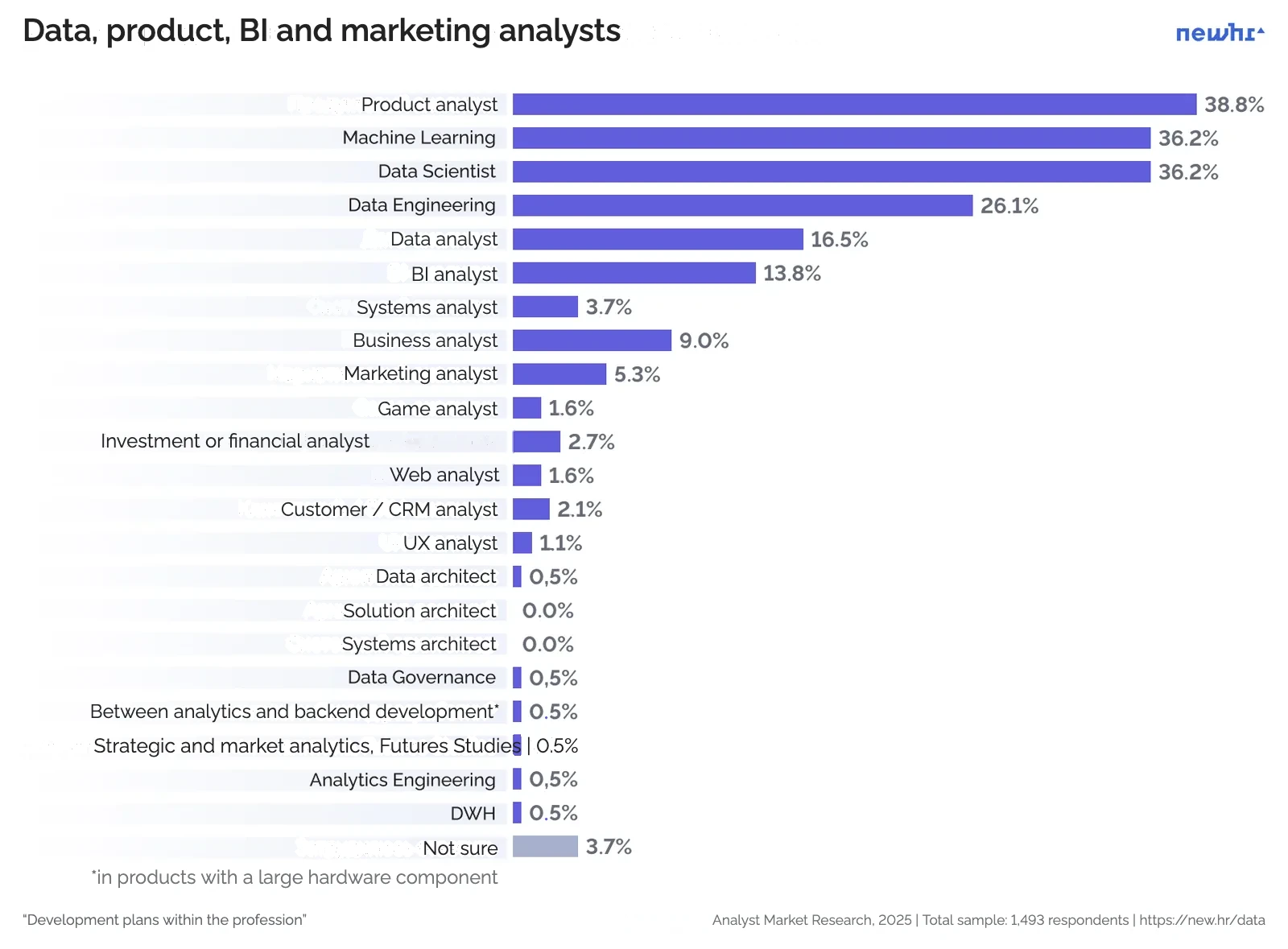
- Product analyst (33%, in 2024 — 44%)
- Machine Learning (32%, in 2024 — 35%)
- Data Scientist (31%, in 2024 — 38%)
- Data Engineering (22%, in 2024 — 29%)
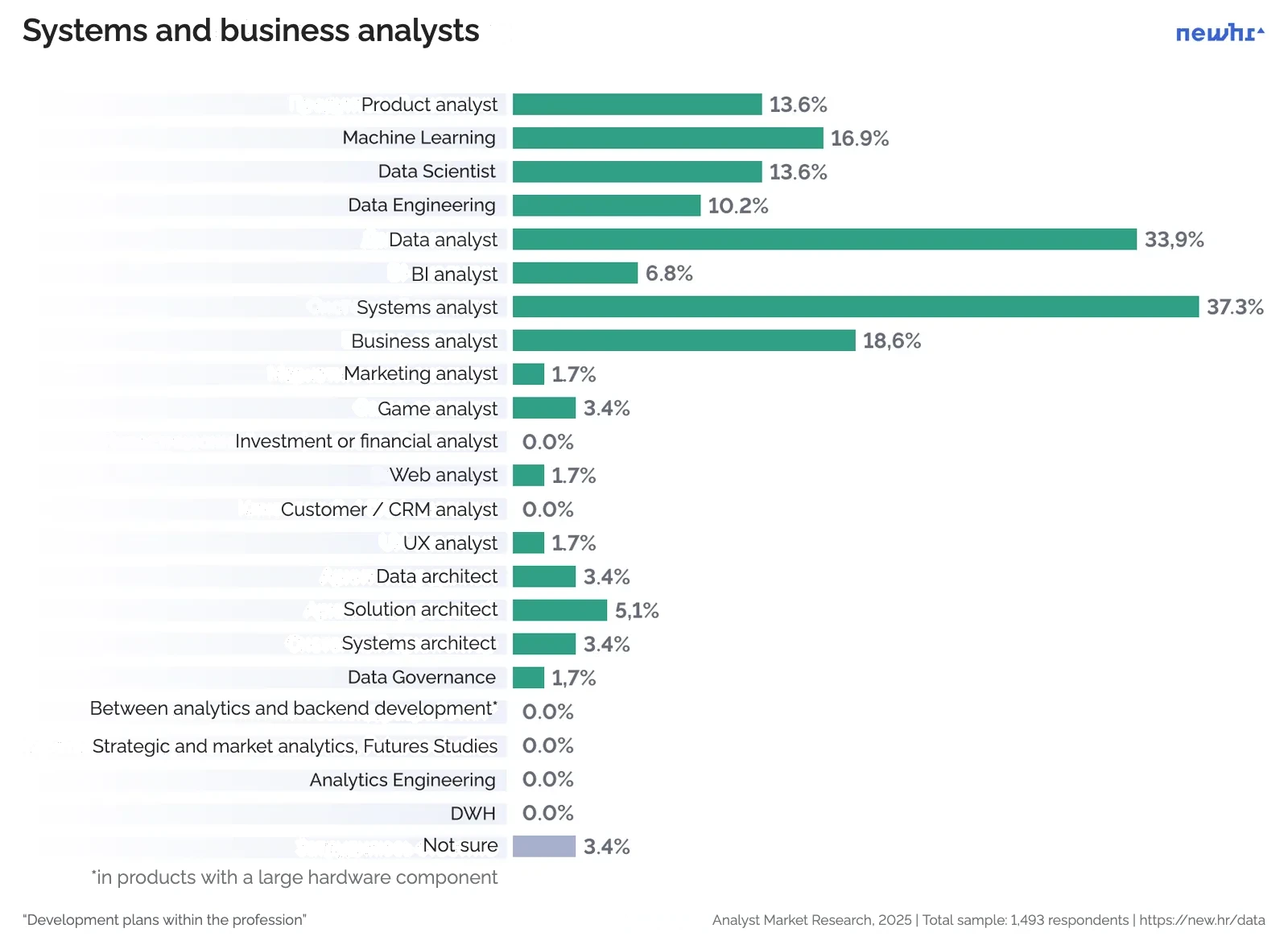
- Systems analyst (37%, driven by business analysts)
- Data analyst (34%)
- Business analyst (19%, driven by systems analysts)
- Machine Learning (17%)
Promising industries for analysts
Question: Which industries do you consider the most promising for your development?
Data, product, BI, marketing and others: 1,121
Systems and business analysts: 311
Heads of analytics: 61
All analysts: 1,493
- Fintech (44.4%)
- E-commerce and marketplaces (40%)
- Banks (26.3%)
- Consulting (20%)
- Banks (16.4%)
- HealthTech (16.4%)
- Delivery Services (15%)
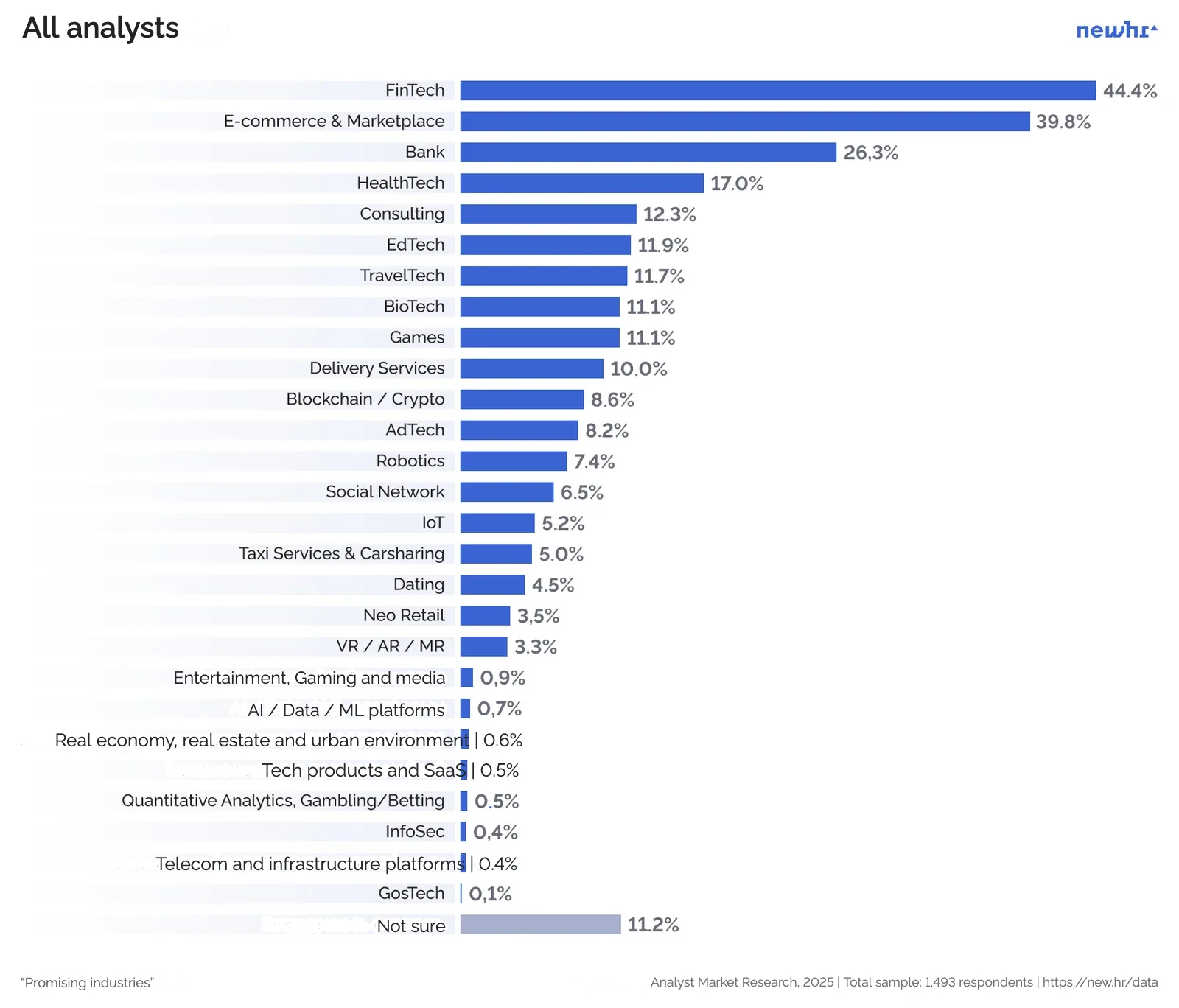
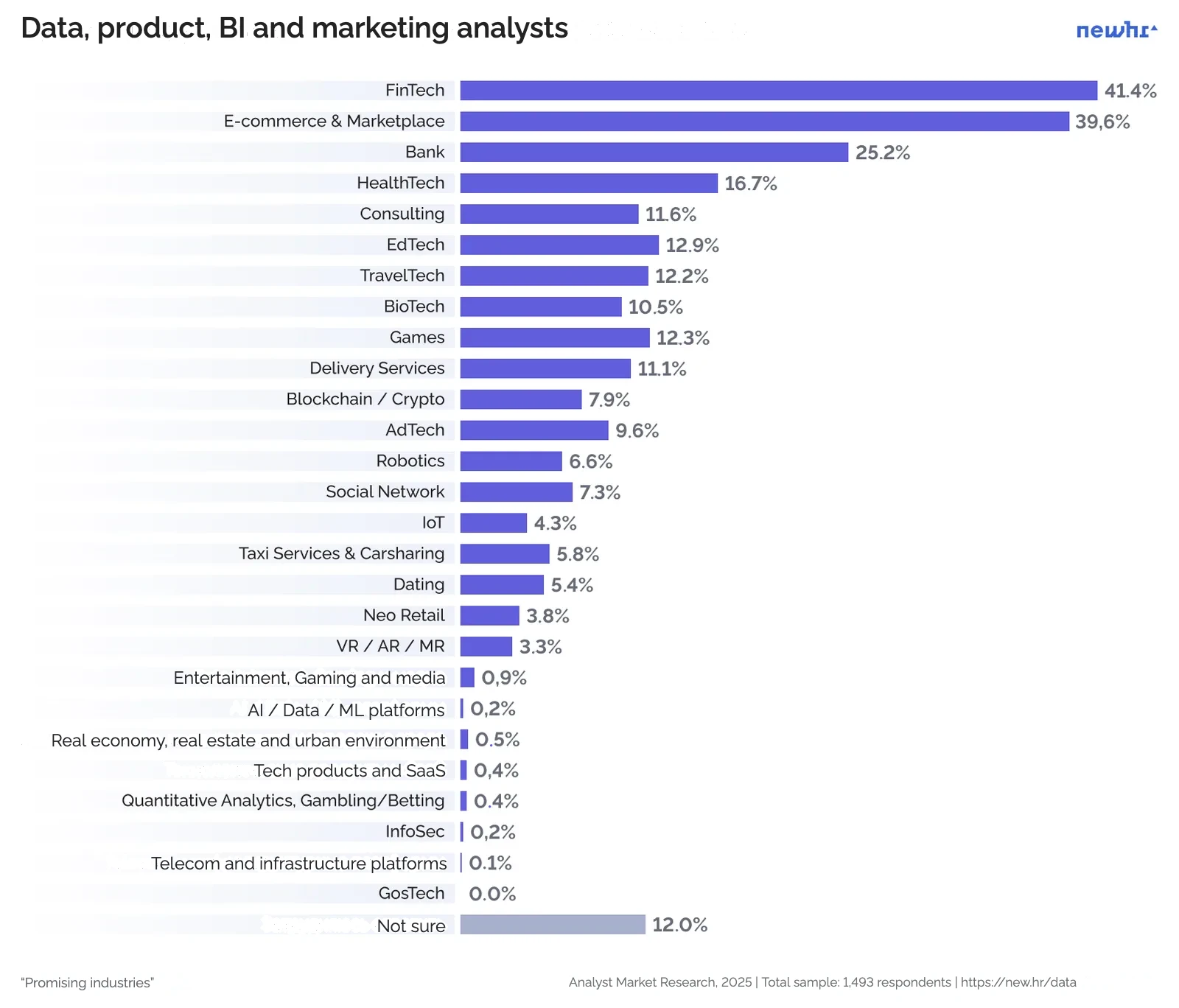
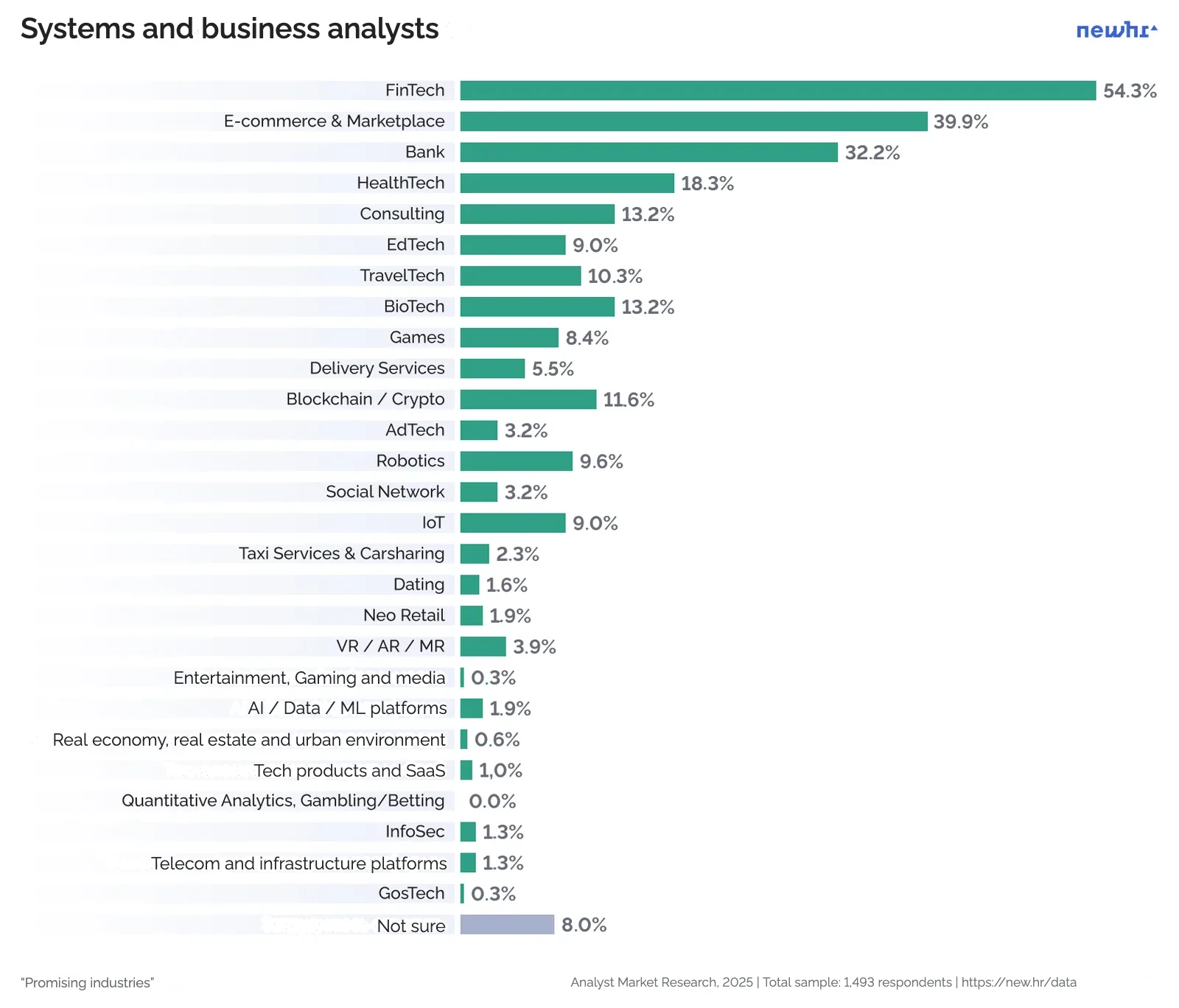
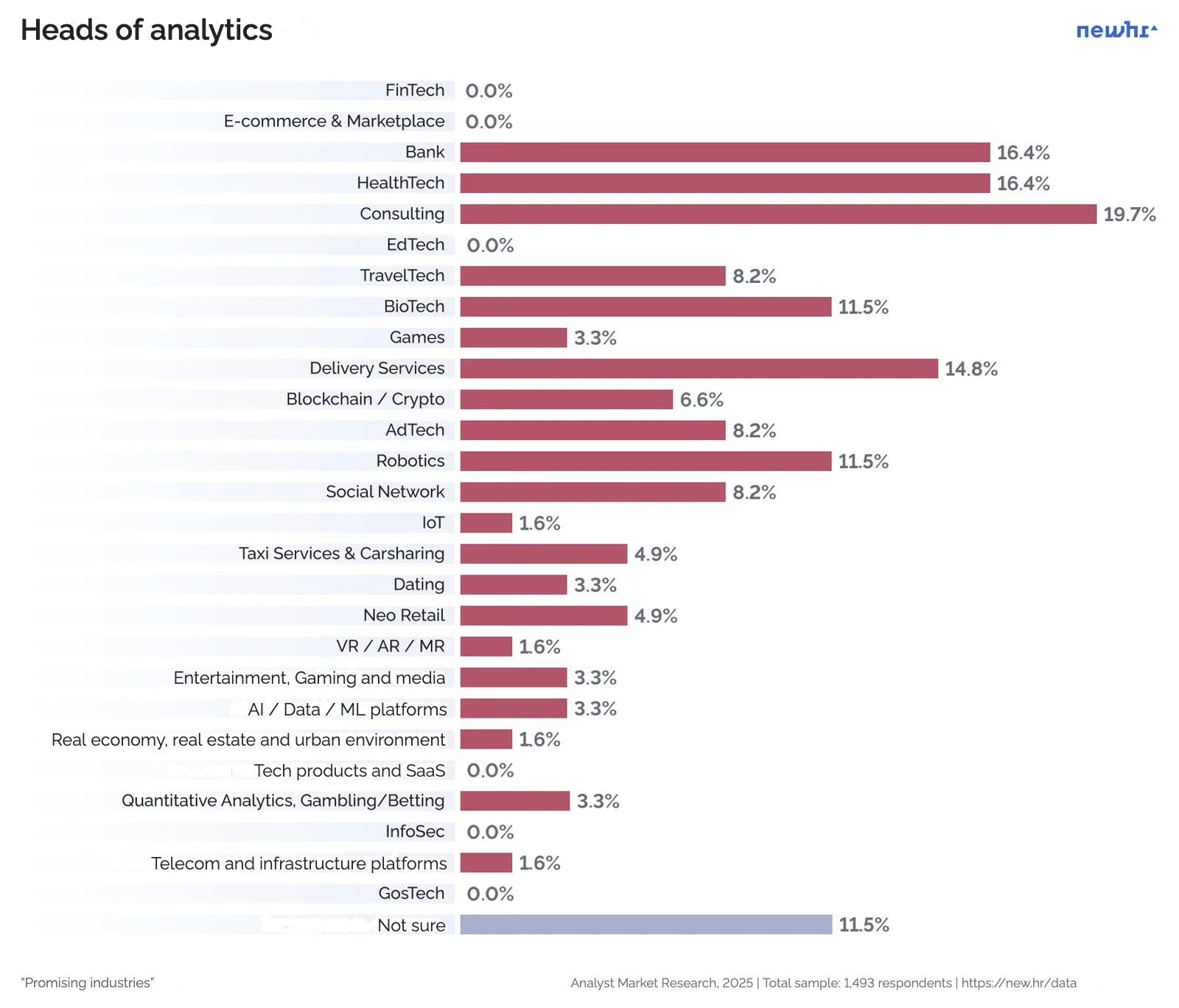
Overall, managers' interests are more specific: they pick 1–2 promising industries, while the others pick 3–4 on average. For heads, interest is already a goal, almost a plan.
Analysts' job search
From interview to offer
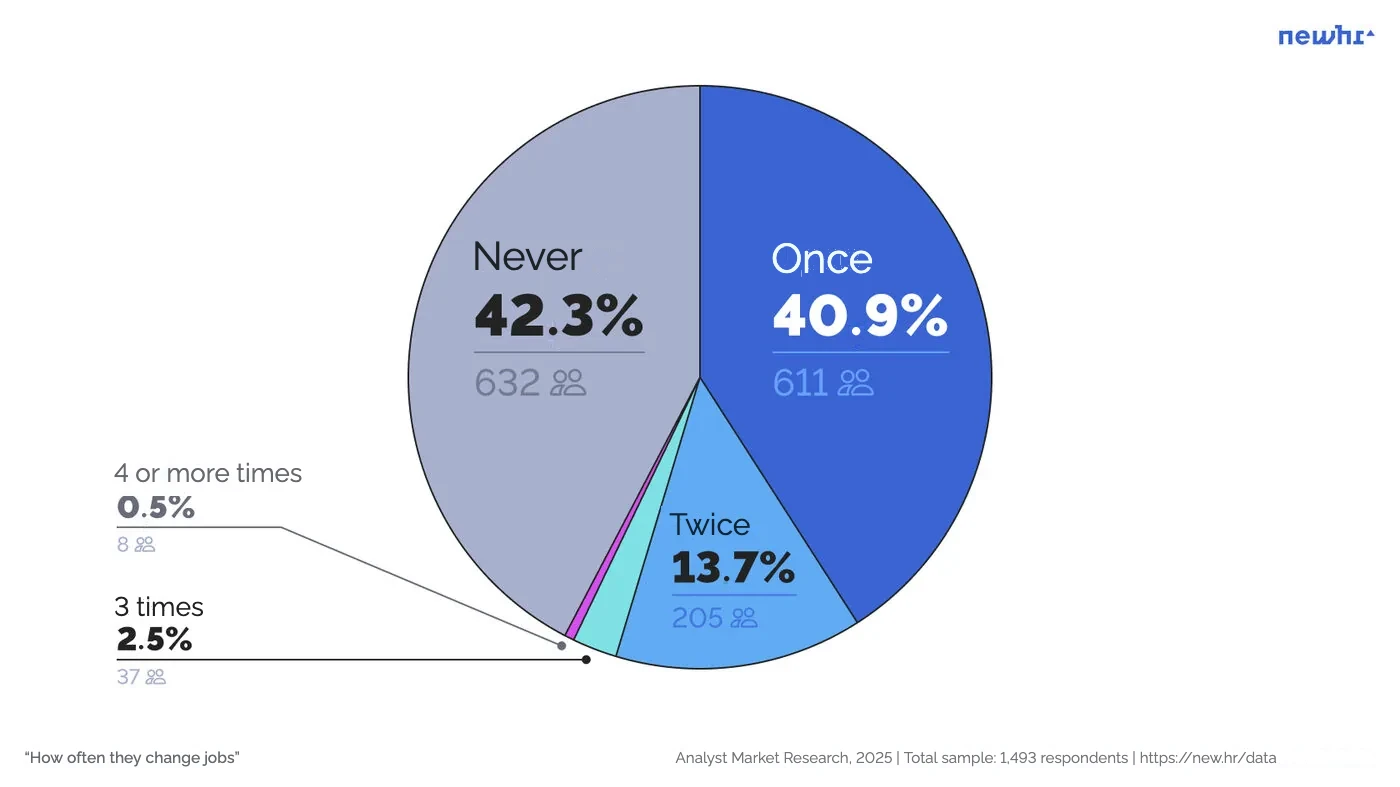
The share of analysts who have changed jobs is stable. More than half (58%) have changed employers at least once in the past two years.
How often analysts change employers
Question: How many times have you changed jobs in the past 2 years?
Number of respondents: 1,493
58% of analysts changed employers in the past 2 years. These figures differ only slightly from previous studies.
2023 saw a small rise in job changes, but over the last three years the shares of analysts who changed jobs have been stable.
We continue to note that analysts' own interest in moving does not seem to have much effect on actual job changes.
Differences between specializations
Product analysts (65% changed jobs in the past 2 years) and BI analysts (62% changed jobs) change jobs most actively.
Financial analysts (37% changed 2 or more employers) and marketing analysts (30% changed 2 or more employers) changed the most employers.
Heads of analytics changed employers least often. Two thirds of them (67%) did not move anywhere at all in the past 2 years. When heads did change jobs, they did it only once. Only 1 manager changed employers twice in 2 years.
Where analysts look for vacancies
Analysts outside Russia use global resources to look for vacancies and follow Russian ones less and less, while those living in Russia do the opposite. This is another sign of the markets drifting apart.
Question: Where do you find the most interesting analytics vacancies?
Number of respondents: 1,493
Stated their location: 1,265
- Top 6 vacancy sources for all analysts:
- HeadHunter (54.5%)
- Telegram channels (44.9%)
- LinkedIn (32.4%)
- Recruiters find me themselves (27.8%)
- Personal connections, networking (27.6%)
- Official company websites (18.5%)
For heads of analytics the top sources are different:
- Personal connections, networking (51%)
- Recruiters find me themselves (44.3%)
- Telegram channels (39.3%)
Oksana Prutyanova
Lead of analyst
and data scientist search at NEWHR
"We see that networking and personal connections still matter a lot. In addition, official company websites are among the top vacancy sources for the first time. This is a consequence of the crisis in hiring, the boom of auto-applications on job sites, and the new possibilities AI has given candidates (vacancy parsing, template CVs, spam applications, etc.).
As a result, recruiters receive literally hundreds of applications for each vacancy and increasingly choose other sourcing channels: referrals, posts on hiring managers' personal social media, direct approaches to candidates with a good reputation. We wrote more about this in our piece The trust crisis in IT hiring."
Top 5 vacancy sources by respondents' location
Number of respondents: 1,493
- HeadHunter (63%)
- Telegram channels (44%)
- Personal connections (28%)
- Recruiters come to me themselves (27%)
- LinkedIn (20%)
- LinkedIn (65%)
- Telegram channels (48%)
- HeadHunter (46%)
- Recruiters come to me themselves (29%)
- Personal connections (24%)
- LinkedIn (76%)
- Telegram channels (51%)
- Recruiters come to me themselves (33%)
- Personal connections (32%)
- Company websites (24%)
Alena Makarova
Head of Research
at NEWHR
"Another sign of the markets drifting apart: analysts outside Russia use global resources to look for vacancies, while those living in Russia use domestic Russian ones. For example, the most popular Russian resource, HeadHunter, dropped out of the top 5 in 2025 for Russian-speaking analysts living further abroad."
How long it takes analysts to find a job
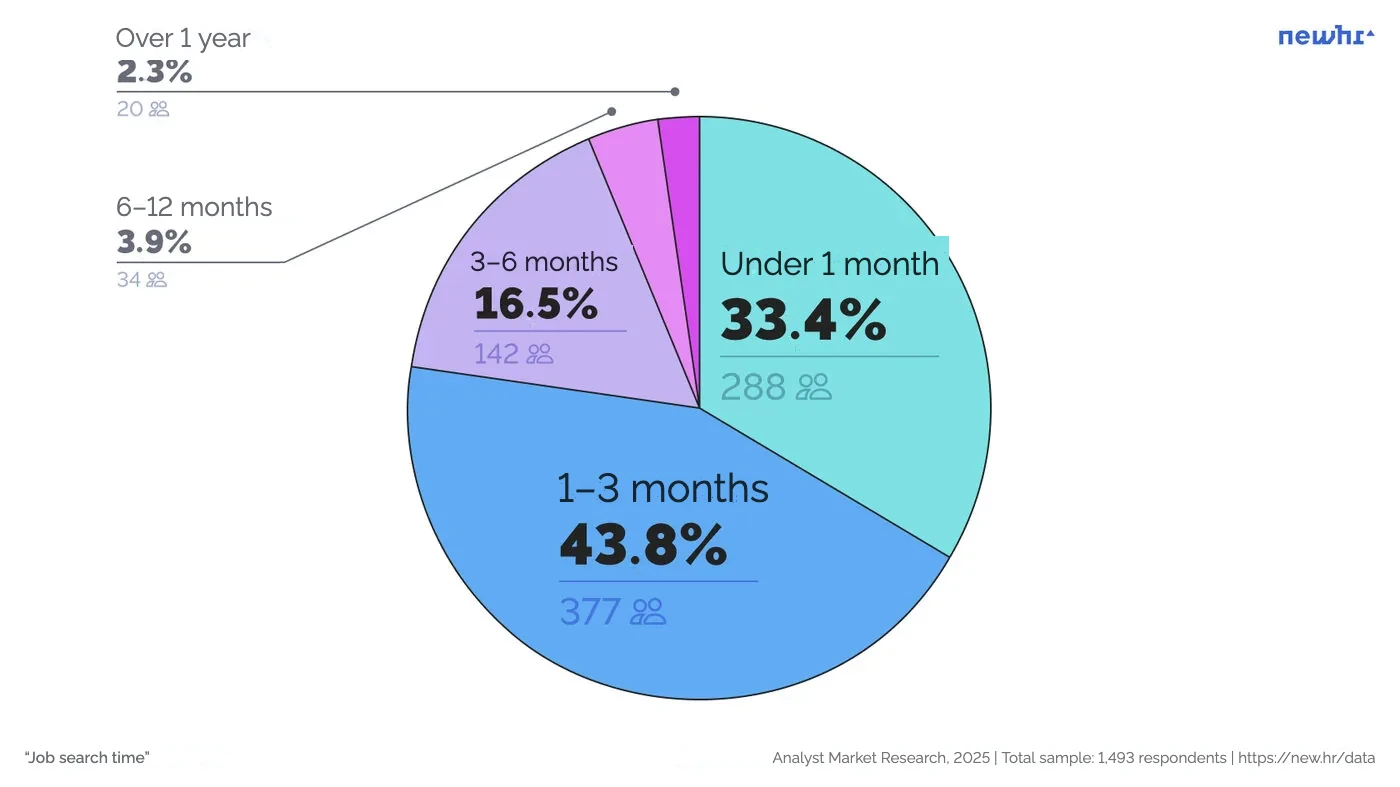
Job search times for analysts have grown, slightly but noticeably. And this happened specifically in 2025.
Question: How long did your last job search take?
Number of respondents: 861
- 33% of analysts searched for less than 1 month (43% in 2024)
- 1–3 months: 44% (37% in 2024)
- 3–6 months: 16% (15% in 2024)
What affects job search time
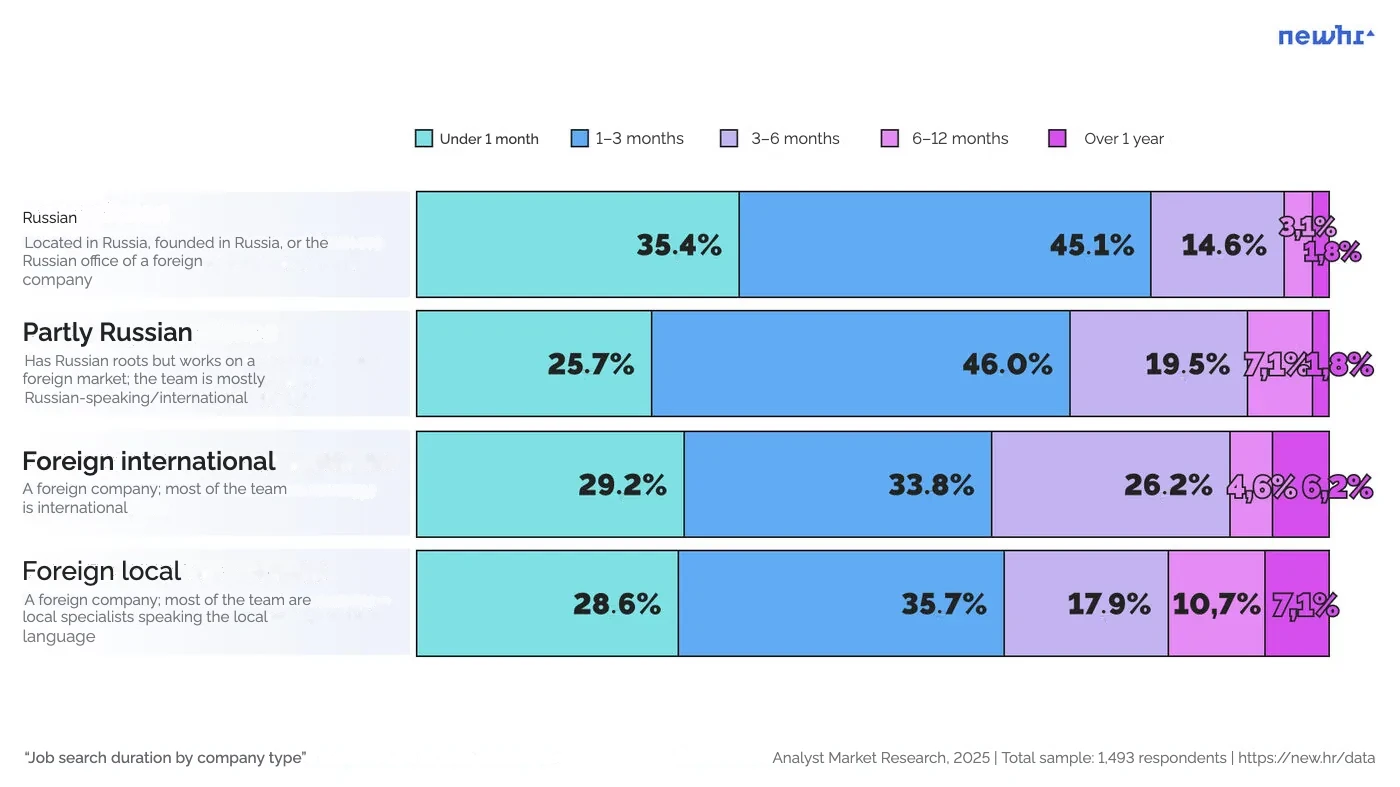
- Team leads, principals and seniors found jobs the fastest: 84% of team leads, 80% of principals and 79% of seniors found a new company within 3 months.
- The search was slower for heads of analytics, juniors and C-level.
- Product analysts — 86%
- BI analysts — 86%
- Systems analysts — 83%
- Data analysts — 82%
- Marketing analysts — 75%
- Business analysts — 71%
- Heads of analytics — 44%
Oksana Prutyanova
Lead of analyst
and data scientist search at NEWHR
"Today's job market is tilted towards the employer. Companies can afford to take longer to choose: there is no race for candidates, and no need to rush an offer before the candidate gets a more tempting one. This may also increase the average job search time."
Where analysts go for interviews
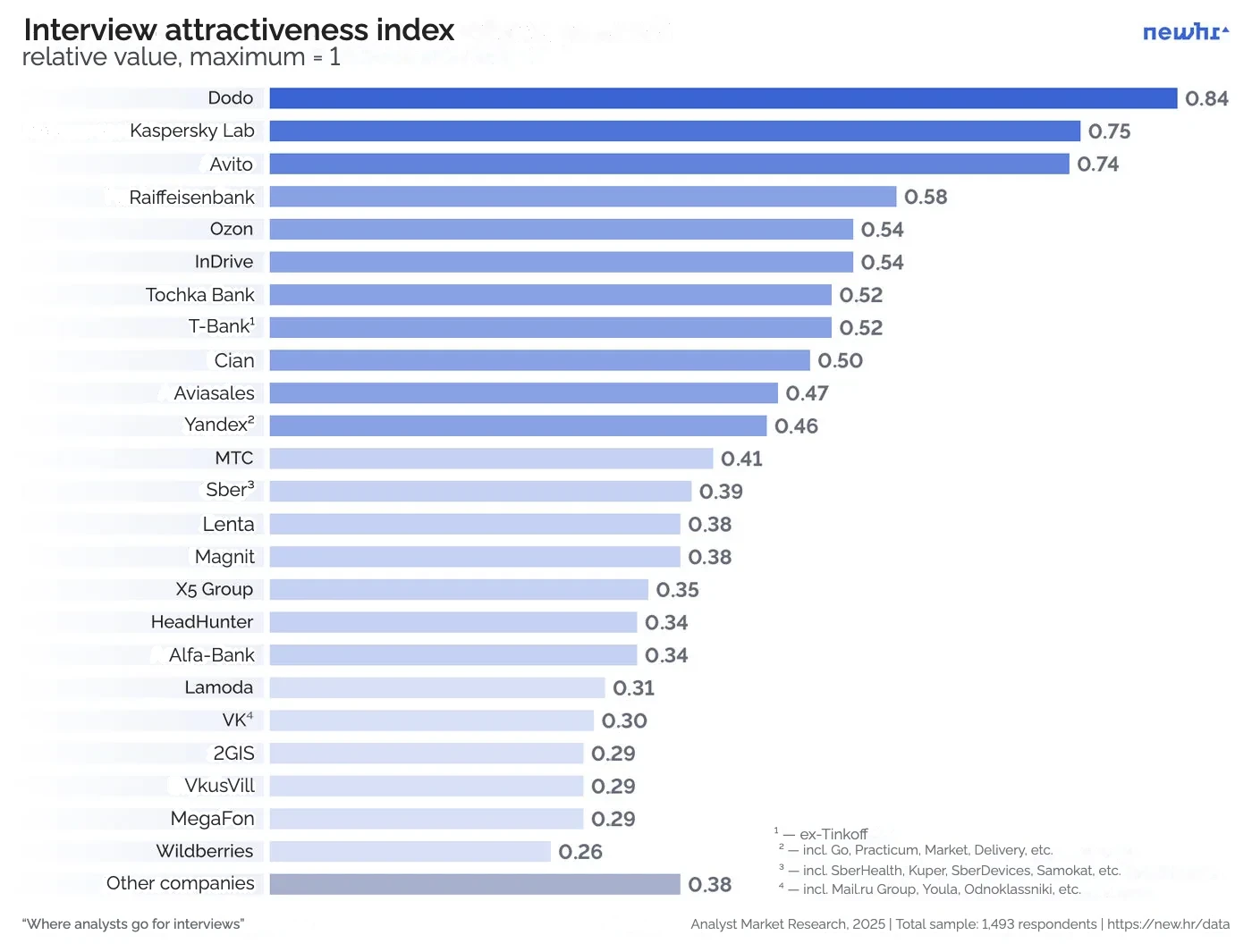
Analysts went to interviews at very different companies. The absolute leader by interview attendance was Yandex (45% of respondents had been there), whose brand is extremely controversial.
We assess candidates' impressions taking interview attendance data into account. For this we introduced an index of relative interview attractiveness (the ratio of positive interview impressions to attendance). It gives a more accurate picture of how candidates feel about interviews at different companies.
Question: Name the companies where you had interviews.
Question: At which companies did you like the interview process?
Went to interviews: 898
Named the companies they went to: 520
Named the companies where they liked the interview: 409
- The attractiveness leader is Dodo (0.8). Kaspersky Lab and Avito are very close to it (0.7).
- The lowest attractiveness is at Wildberries, MegaFon, VkusVill, 2GIS and VK: 0.25–0.3.
- Market leaders such as T-Bank, Yandex and Sber have average interview attractiveness, in the 0.4–0.5 range.
Alena Makarova
Head of Research
at NEWHR
"In 2025 the attractiveness of interviews at many companies grew compared with 2024. This may be linked to the shrinking supply on the market: the harder the job search, the more any interview is valued, even if the company has not changed the process at all."
How many analysts are looking for a job
Question: Are you considering a job change right now?
Number of respondents: 1,493
The ratio of analysts who are calmly staying put to those interested in looking for a job has not changed. But there has been a small redistribution among those interested in a new job.
The share of active job seekers grew by 4.4% at the expense of passive candidates (whose share fell by 4%). Interest in job searching may keep growing; we will be able to see this in a year.
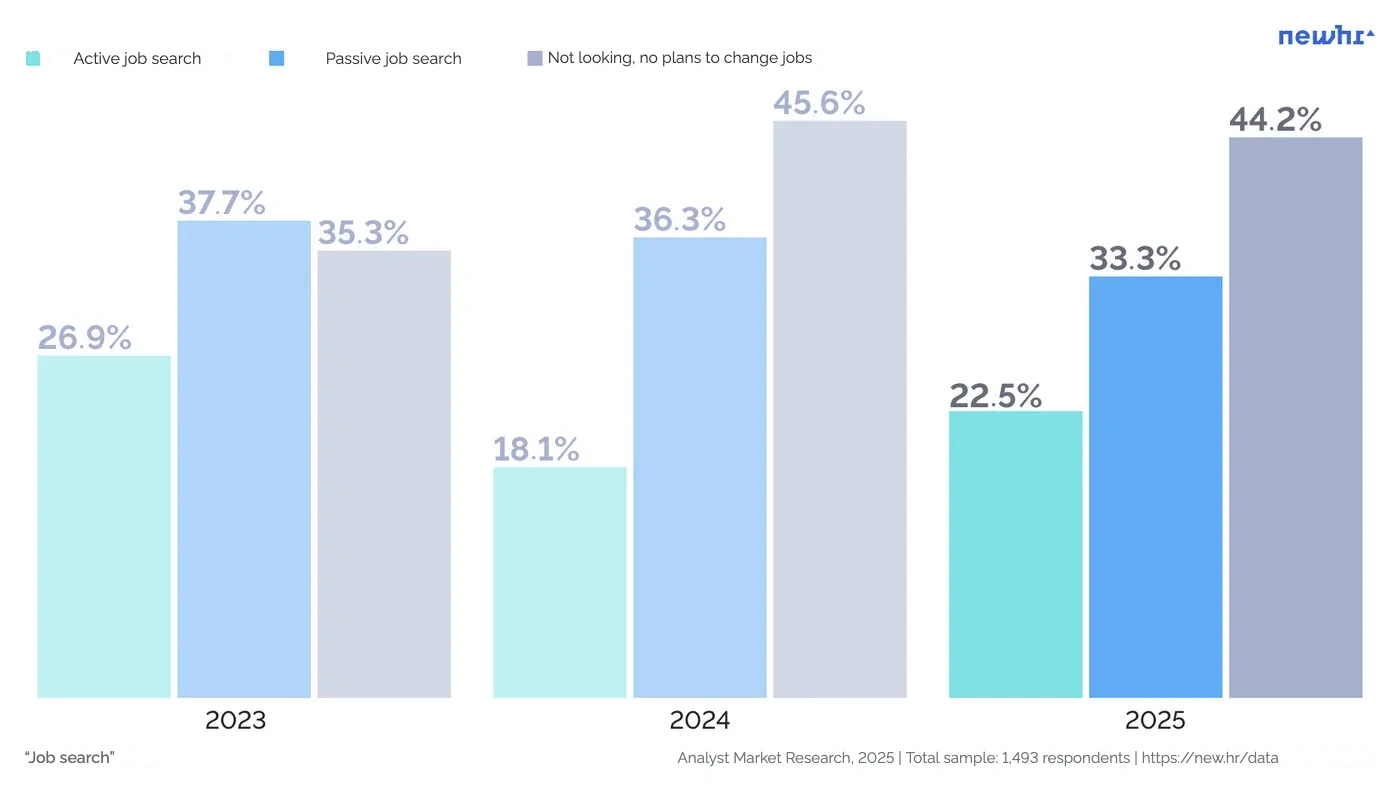
There are significant differences between specializations. The share of active job seekers ranges from 15% to 35%, and the share of those not looking from 30% to 51%, depending on the respondents' specialization.
- Business analysts (35% actively searching)
- Systems analysts (25%)
- Data analysts (23%)
- Product analysts (51% not looking for a job)
- Marketing analysts (51%)
- BI analysts (50%)
Analysts monitor the market even if they have no plans to change jobs: although 77.5% of analysts are not actively searching and are "stable" with regard to their employers, 60% of respondents went to interviews during the year. Product (67%) and marketing analysts (66%) went to interviews most actively. Monitoring the market is a stable need.
Why analysts stay with a company: retention factors
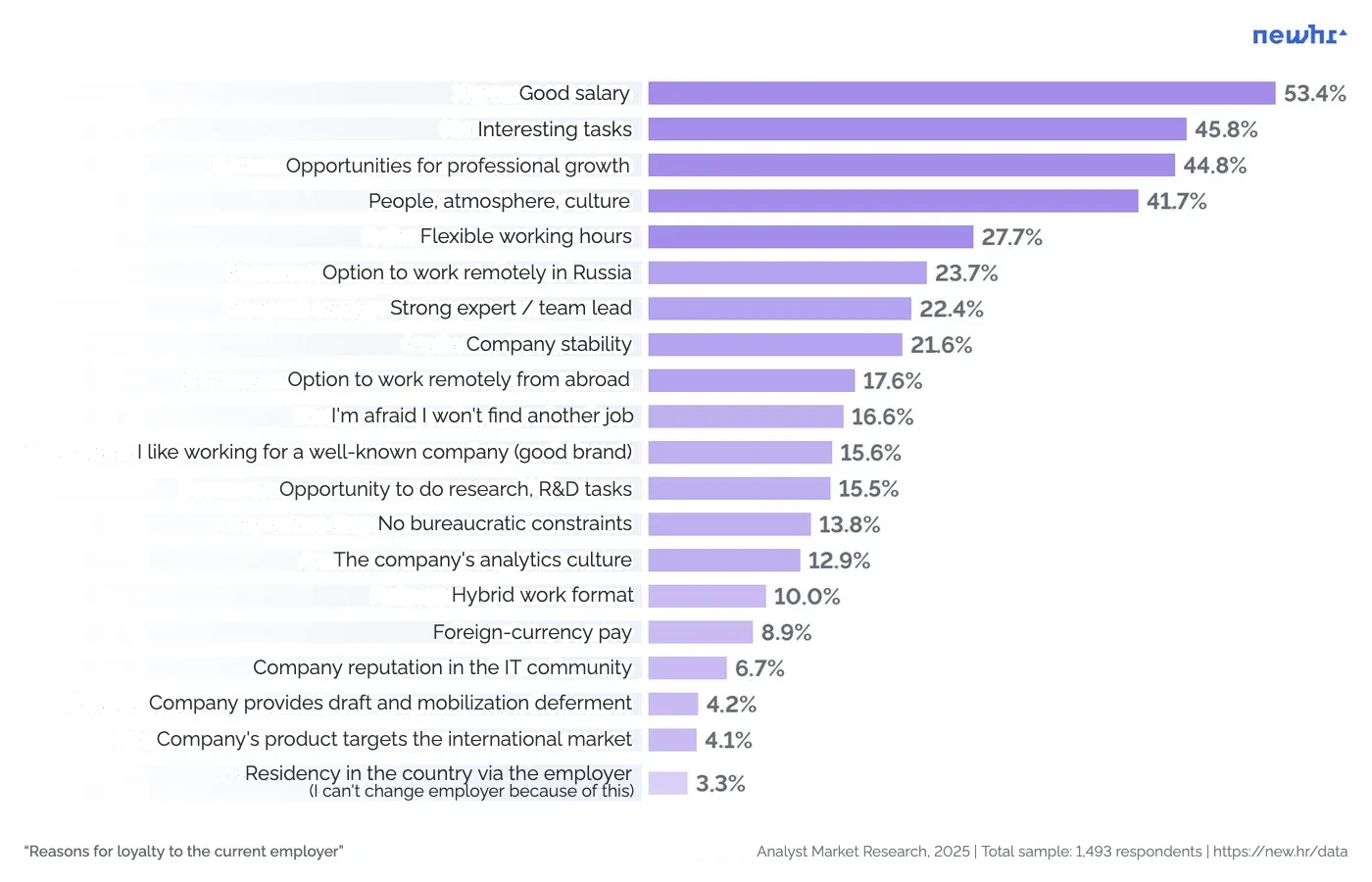
In 2025 salary took first place among the reasons for loyalty to an employer. For the sake of money, analysts are more willing than in previous years to give up comfortable conditions (flexible hours and remote work).
Question: What keeps you at your current job?
*Number of respondents: 1,157
Multiple choice*
- Interesting tasks (46%)
- Opportunities for professional growth (45%)
- People, atmosphere, culture (42%)
- Low salary (44%)
- Lack of growth and career prospects (42%)
- No interesting tasks (34%)
- Unhappy with work processes (32%)
- Poor prospects for the company as a whole (20%)
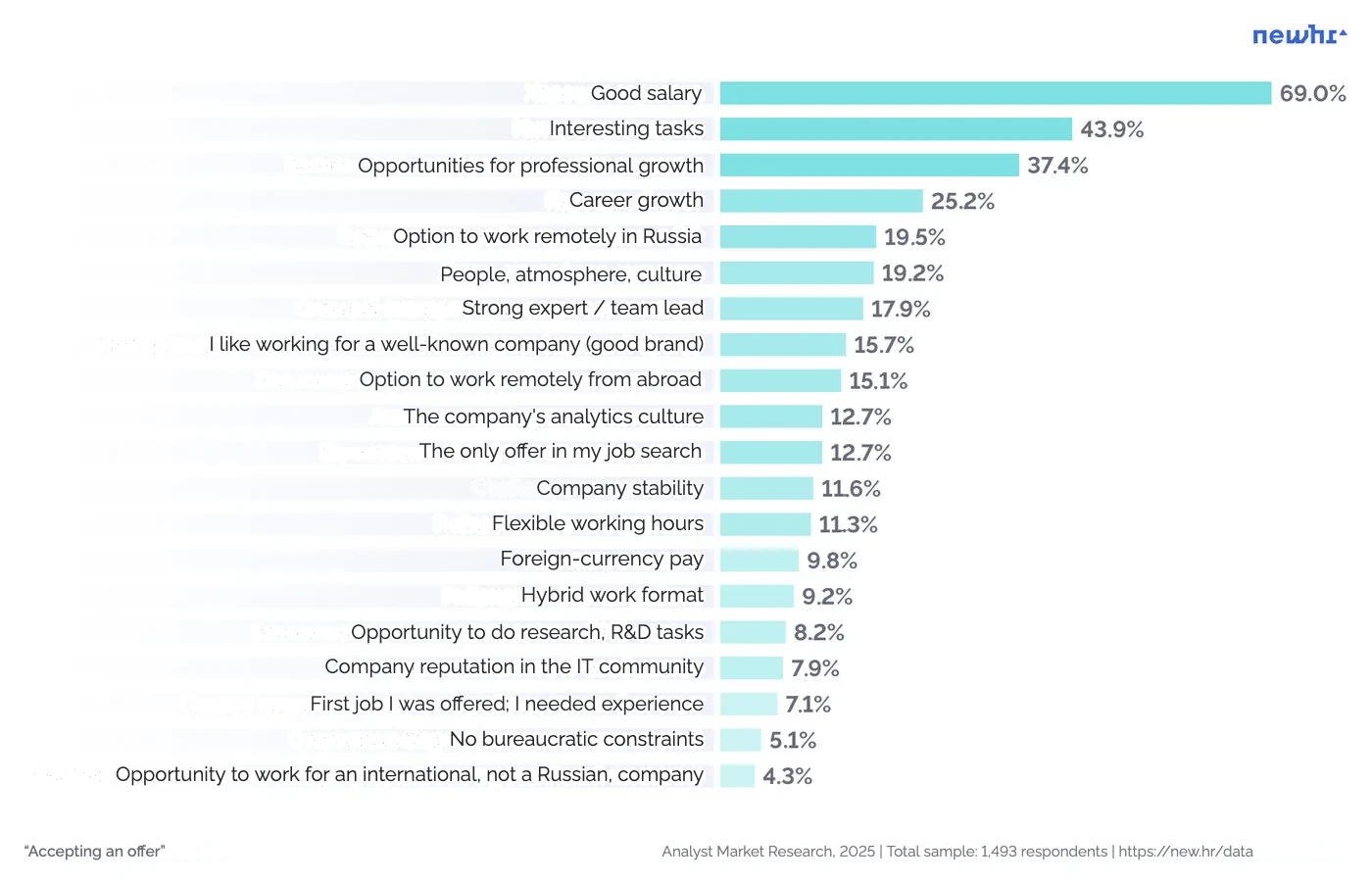
What influences an analyst's decision to accept an offer
Question: What was the key argument for you to accept an offer during your last job search?
*Number of respondents who accepted an offer in the past 2 years: 861
Multiple choice*
- Salary (69%, in 2024 — 62%)
- Interesting tasks (44%, in 2024 — 51%)
- Professional growth (37%, in 2024 — 43%)
Where analysts want to work
Favourite companies
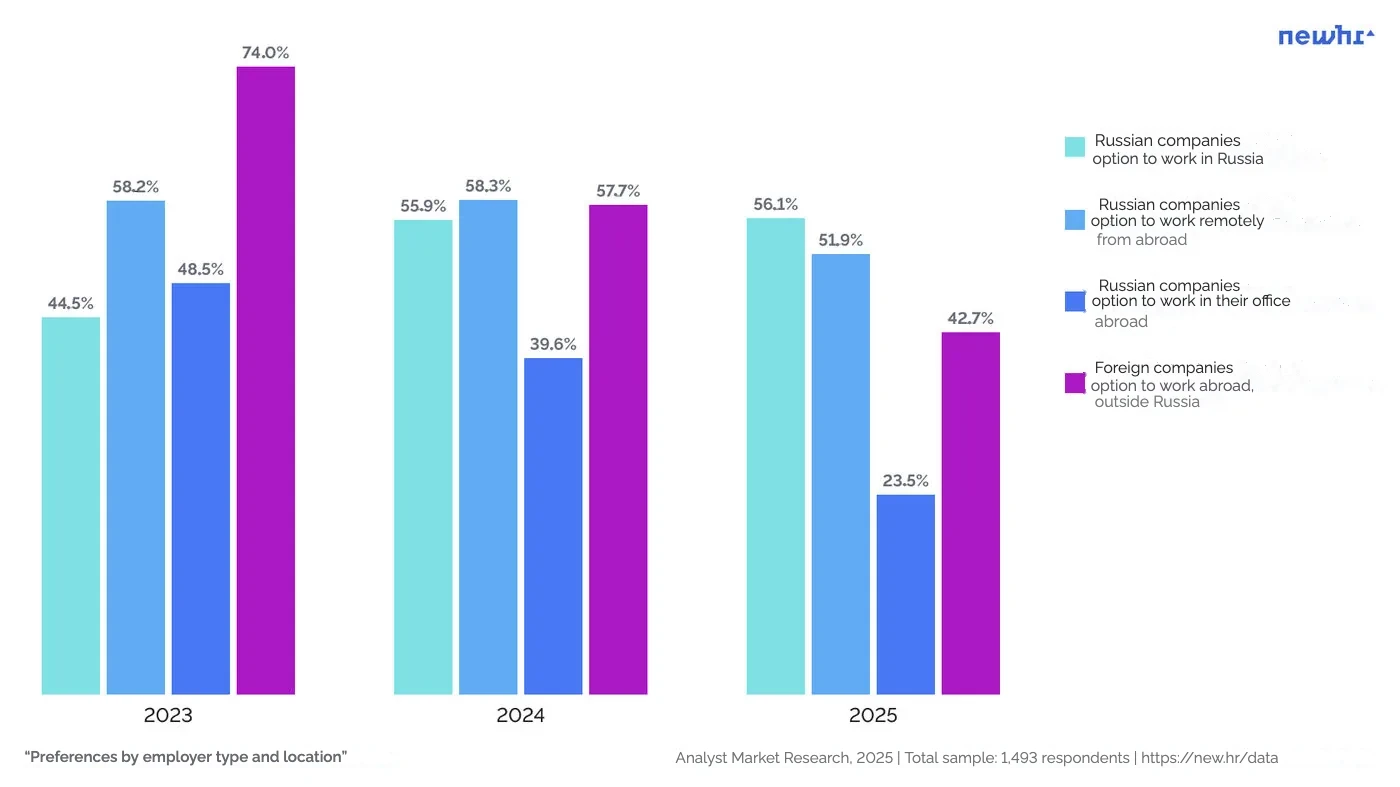
The 2022–2023 trend, when analysts from Russia were drawn first of all to foreign companies, is over. A new normalization has taken place: specialists are interested in the markets that are more accessible to them.
Preferred companies by type and location
Question: From which companies are you prepared to consider offers in principle?
*Number of respondents: 1,493
Multiple choice*
Russian analysts' interest in foreign companies is declining, continuing the trend we noted in previous studies. Over two years their attractiveness fell by 31% (from 74% in 2023 to 43% in 2025).
Working for companies inside Russia from abroad, and working abroad for companies that originated on the Russian market, are also losing popularity.
At the same time, the attractiveness of working for Russian companies from Russia is growing.
Alena Makarova
Head of Research
at NEWHR
"Analysts are increasingly tied to the markets they are in. And the markets are separating along the Russia ⟷ abroad line. This situation benefits Russian companies: competing with a foreign employer simply because it is foreign is no longer an issue. On the other hand, we see that the separation of markets encourages the "draining" of the most experienced and valuable specialists abroad."
Preferred companies depending on the current employer
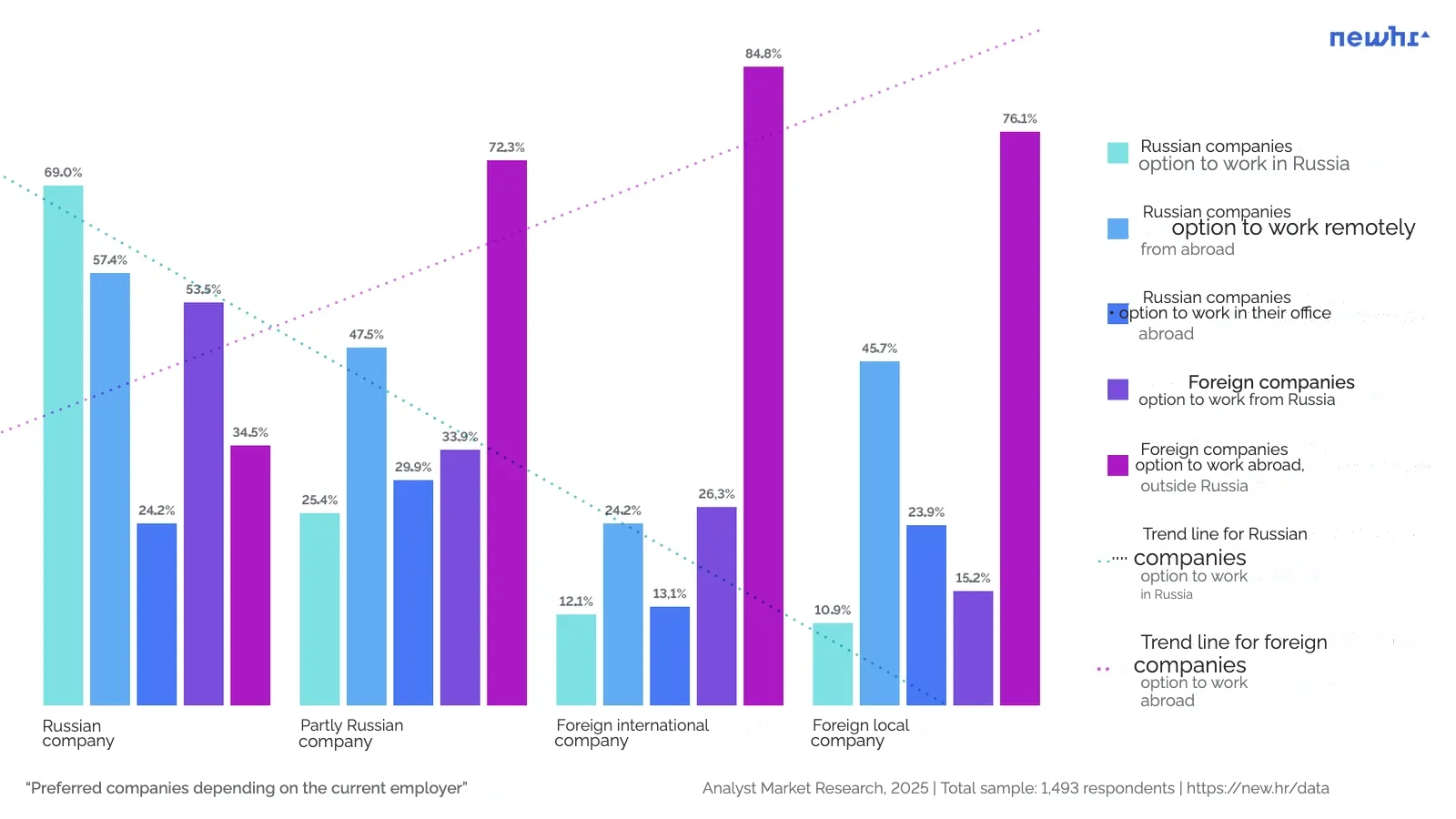
Question: From which companies are you prepared to consider offers in principle? By employer type
*Number of respondents: 1,447
Multiple choice*
For analysts from Russian companies, Russian employers are the priority, while foreign ones have lost their appeal (especially if relocation is required).
And conversely, for those who are already abroad and work for foreign companies, foreign companies with the option of living abroad are the absolute priority. Analysts from foreign international companies are practically gone for good: Russian employers interest only 12% of them.
Special priorities of analysts who are between the two markets
A quarter of employees of "partly Russian" companies abroad are interested in working for a Russian company if they can work remotely from abroad. They are not lost to the Russian market and may well be a talent pool.
Top and anti-top Russian employers for analysts
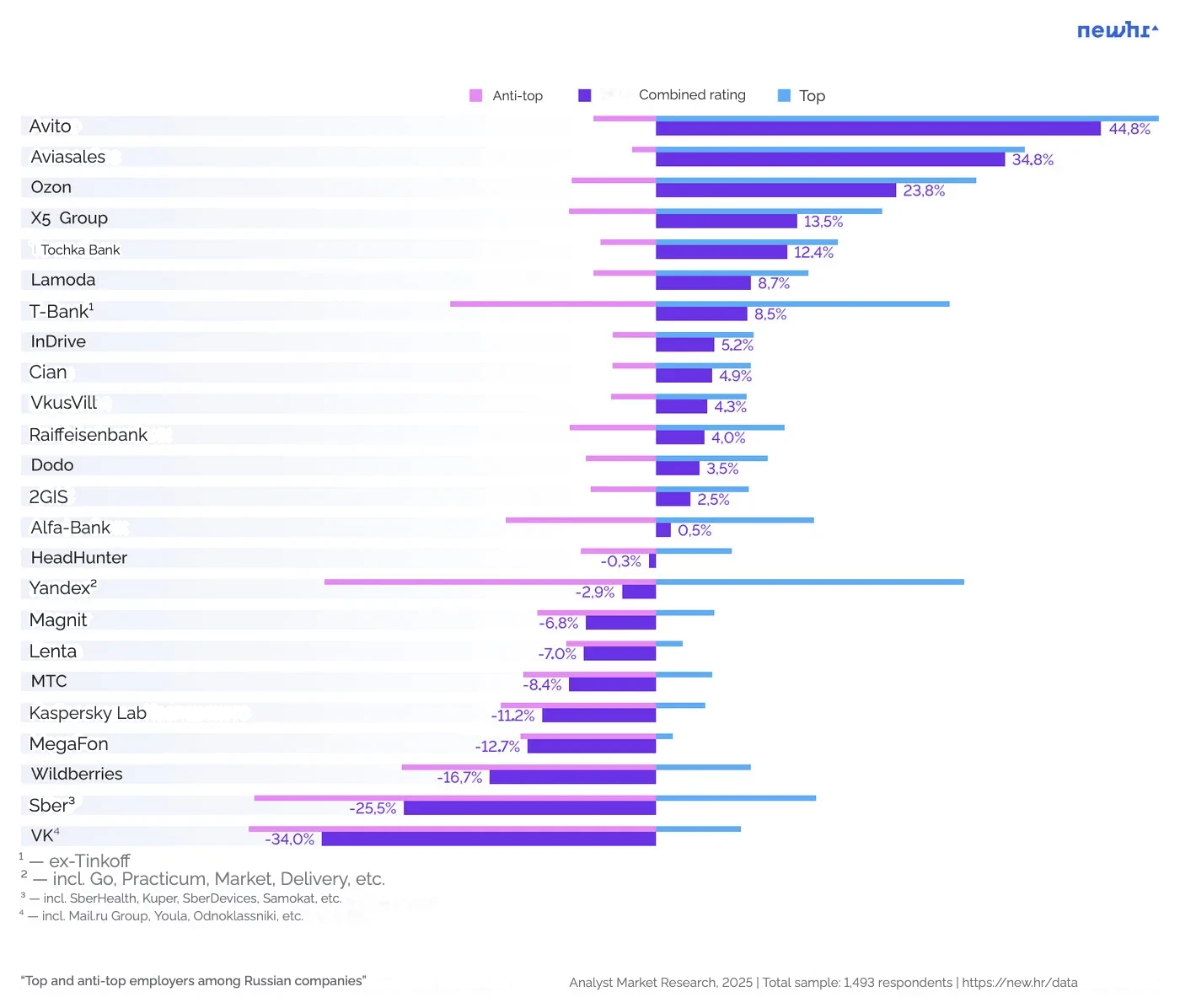
Avito remains the most attractive employer for Russian analysts. VK and Sber have the worst reputation.
Question: Choose 3 companies on the Russian market where you would gladly consider a job
Number of respondents: 1,493
Question: Name 3 companies where you would definitely not consider a job
Number of respondents: 1,493
- Avito has the most positive rating (+45%). This means the company has a predominantly positive HR brand among Russian analysts.
- VK (-34%), Sber (-26%) and Wildberries (-17%) have the most negative ratings.
- Yandex (-34% and +31%), T-Bank (-21% and +30%) and Alfa-Bank (-15% and +16%) have controversial ratings.
Analytics culture
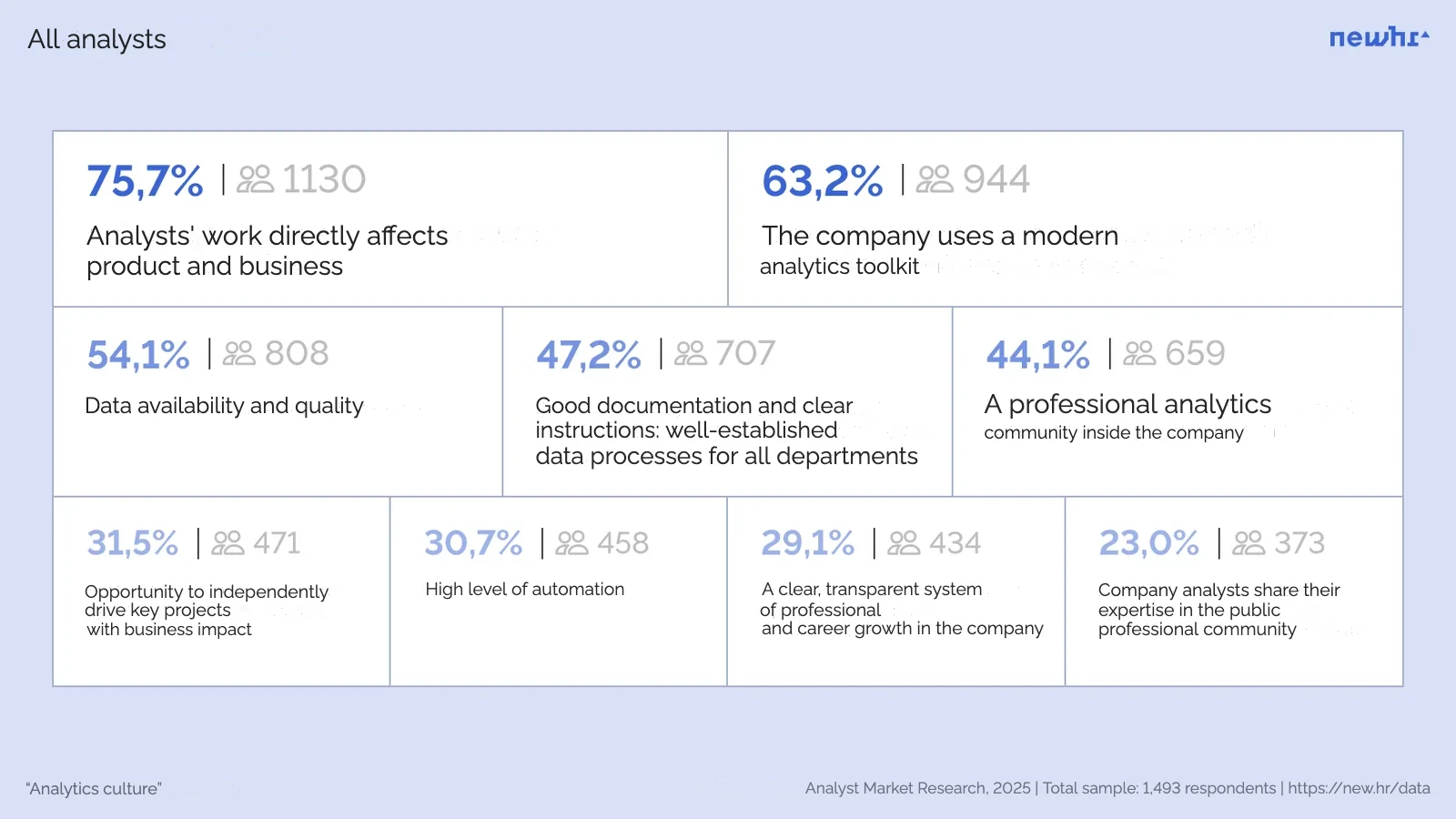
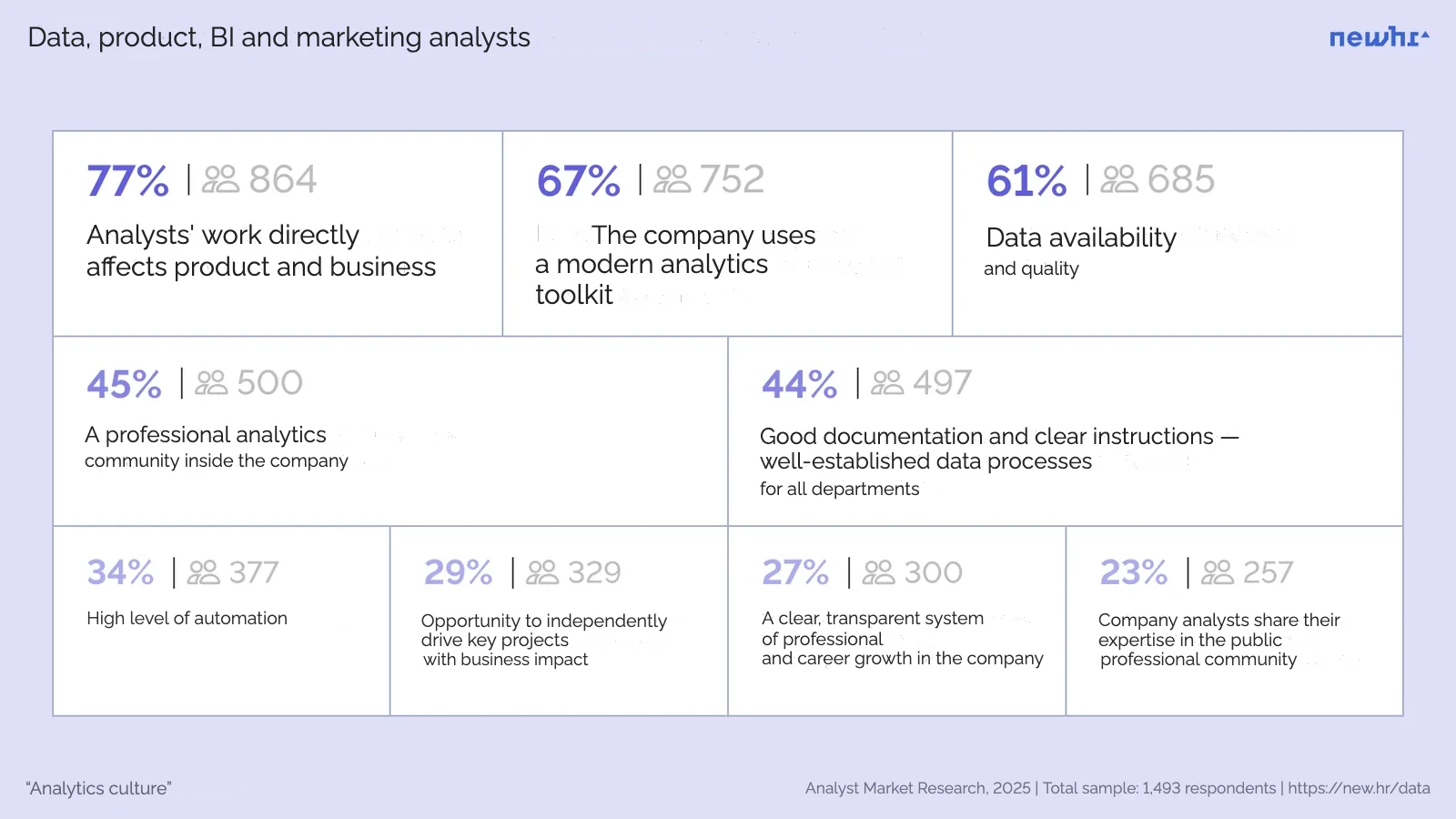
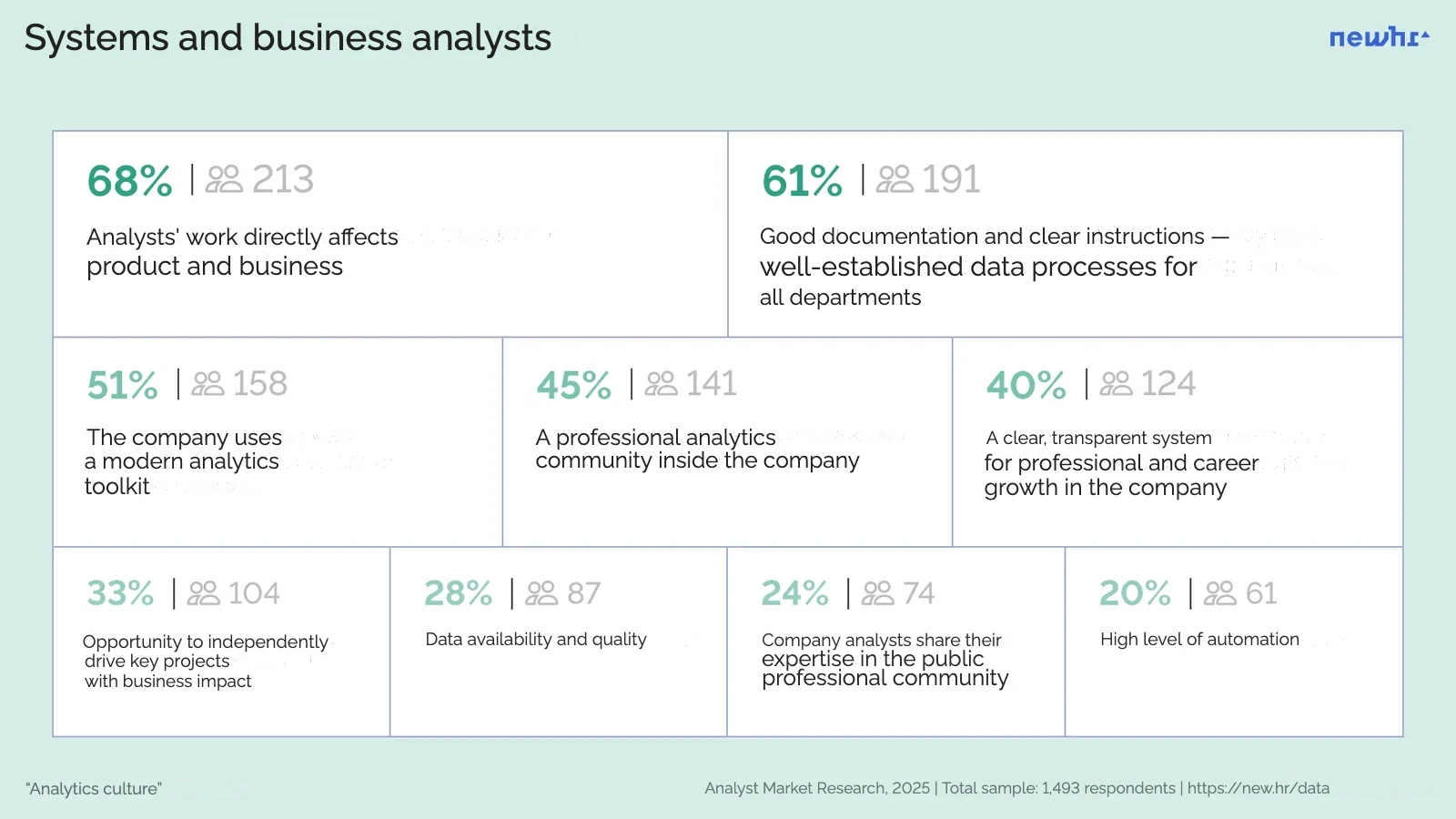
For analysts themselves, a good analytics culture means recognizing the role and importance of data for all processes, and organizing the company's work on that principle.
Good analytics culture according to analysts
Question: What does a good analytics culture in a company mean to you?
Data, product, BI, marketing and others: 1,121
Systems and business analysts: 311
All analysts: 1,493
According to our respondents, a good analytics culture in a company means first of all that analysts' work directly affects the product and the business (75.7%).
A characteristic suggested by the respondents themselves in 2024 gained a lot of weight: good documentation and clear instructions, that is, well-established data processes for all departments (47.2%).
Good analytics culture in respondents' words
Spelling and punctuation preserved
- "A culture of quality, not speed"
- Business analyst
Good analytics culture in respondents' words
Spelling and punctuation preserved
- "1. Don't use the analyst as a secretary
- 2. Trust and respect for the analyst's expert opinion"
- Business analyst
Good analytics culture in respondents' words
Spelling and punctuation preserved
"Management does not ignore objective reality and does not paint a reality of its own"
Product analyst
Good analytics culture in respondents' words
Spelling and punctuation preserved
- "Leadership does not think it knows everything itself"
- R&D | Research
Good analytics culture in respondents' words
Spelling and punctuation preserved
- "The product develops based on data from the analytics team"
- Product analyst
Good analytics culture in respondents' words
Spelling and punctuation preserved
"Stakeholders use data to make decisions and proactively reach out to analysts"
Data analyst
Good analytics culture in respondents' words
Spelling and punctuation preserved
"The company understands the role of the systems analyst, namely that he is not a manager"
Systems analyst
Good analytics culture in respondents' words
Spelling and punctuation preserved
"Analysts first of all make decisions, not just consult"
Product analyst
Good analytics culture in respondents' words
Spelling and punctuation preserved
"When the business understands why analytics is needed and respects and listens to analysts' opinion"
Product analyst
Good analytics culture in respondents' words
Spelling and punctuation preserved
"Analysts' work is valued: from development teams to business owners"
Systems analyst
Good analytics culture in respondents' words
Spelling and punctuation preserved
- "A culture of quality, not speed"
- Business analyst
Good analytics culture in respondents' words
Spelling and punctuation preserved
- "1. Don't use the analyst as a secretary
- 2. Trust and respect for the analyst's expert opinion"
- Business analyst
Conferences and experts
Who analysts follow
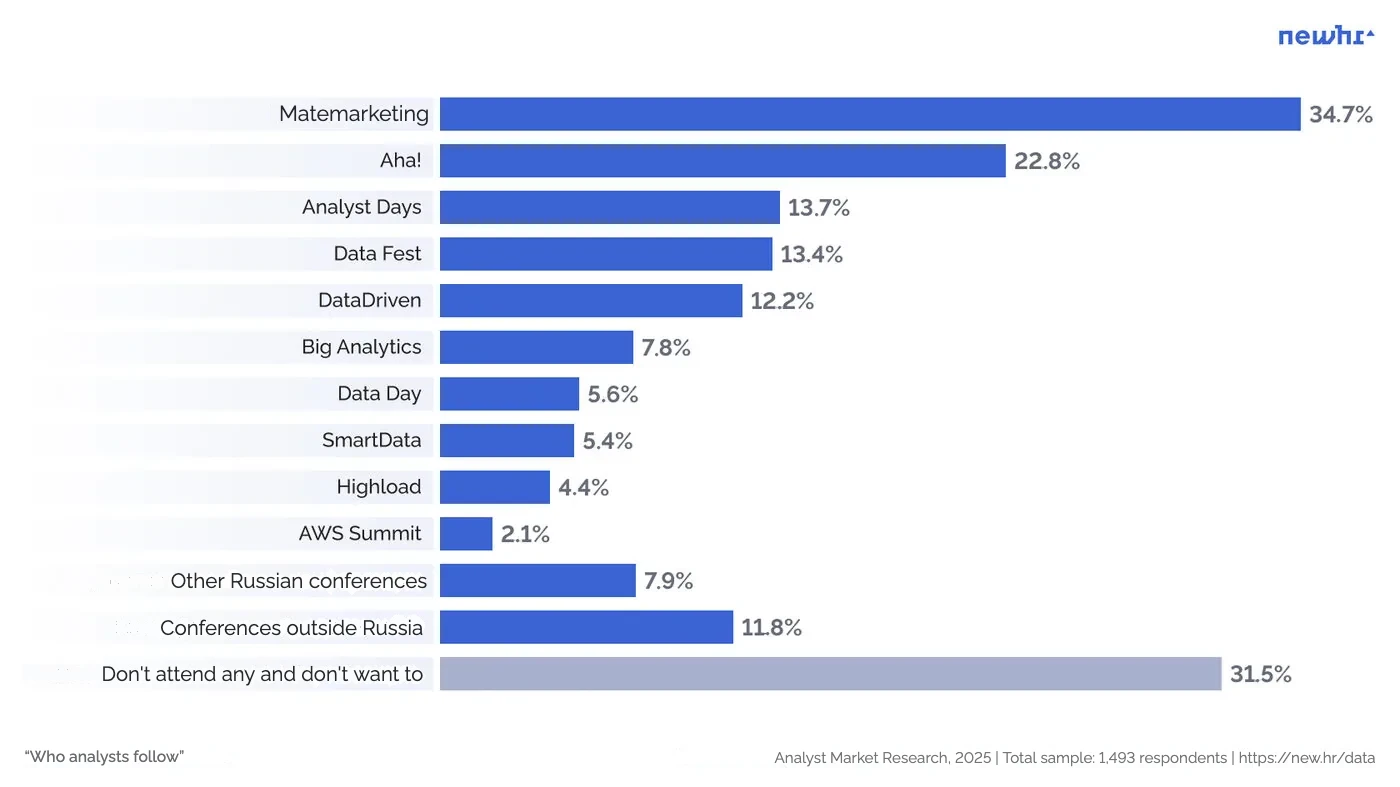
Analysts strive to keep up with professional news. 68.5% regularly attend conferences. Matemarketing remains the most significant one, leading by a wide margin.
Which conferences analysts attend
Question: Which data analysis conferences do you attend?
*Number of respondents: 1,493
Multiple choice*
- Matemarketing (attended by 35% of respondents)
- Aha! (attended by 23%)
- Analyst Days (13.7%)
- Data Fest (13.4%)
Which experts analysts follow
Feedback
.
Analysts collecting data on analysts for analysts (and not only). Cool, useful work.
.
Your studies are incredibly cool! Your 2023 study helped me move from Yekaterinburg to Moscow (I used the study's information to analyse the market), and after moving in autumn 2024 I was happy to take part in the new study and make my contribution.
.
Thank you for the chance to take the survey; it turns out it has interesting information and questions that are exactly what I need for my further development.
.
A decent survey, it will be interesting to see the results) It's just a pity that some questions limit the number of answers: your results will be skewed towards the first options in the list… And I don't know analysts who could say with certainty that they are definitely product and not data, for example; I mean, it's a pity you can't choose both of these options.
- .
- Thank you for your work, keep it up, good luck and all the best 🙏
Our partners
We thank everyone who shared information about the study and helped us gather such an impressive sample! 💙
The list of partners is below. If you helped us find respondents but did not find your channel in the list, write to data@new.hr. If you want us to correct something in the description, write to us too!
Nadya Andrianova | Designing Numbers
- Designer, data artist
Alexander Isakov | asisakov
- Analytics and machine learning using AI
Nastya Kirsha
- Presentation designer
Alexander Botvin
- HR analytics expert
Sasha Barakov
- Head of BI at Avito
- .
Sergey Koloskov
- Product consultant and strategist
Hello New Job!
- A channel about finding a job in IT
Job for Analysts & Data Scientists
- Vacancies for digital analysts and data scientists
Daniil Dzheparov
- Data analyst
Natalya Kiseleva
- Dataviz and BI trainer, data artist and data comic artist
Danila Elistratov | Danyalitika channel
- Analyst / Analytics teacher
Nastya Kuznetsova
- BI and data visualization expert
Это разве аналитика? (Is This Even Analytics?)
- Data analysis
Power BI Design
- UX/UI of analytics reports
BI Hub
- Automation and methodology in BI
Semyon Osipov | Truba Dannykh (Data Pipe)
- Data Engineering
Roman Bunin | Reveal the Data
- BI, analytics and data visualization, AI
Shuvaeva Valeria
- Data analyst
Elena Ubogoeva
- Product analyst
Daniil Khanin
- CEO ueCalc
Alexey Nikushin
- Producer of conferences for analysts
Pavel Bukhtik | No Data No Growth
- CEO & Founder, author of the No Data No Growth channel
Andron Aleksanyan
- CEO & founder Simulative/IT Resume
Simulative
- Analytics training
Yuri Borzilo
- Product analytics and A/B tests, author of the "Borzilo" channel
Valeriy Babushkin
- Senior Principal Data, Data & Analytics
Filipp Upravitelev
- Product analyst
Alexander Efimov
- Lead product analyst
Nikolay Valiotti
- CEO and founder of LEFT JOIN
Nastassia Dziarhach
- Business analyst
BA & SA | 10 000 Interview questions
- 10,000 interview questions
Карьерный трек для аналитиков (Career Track for Analysts)
- CV reviews, career growth consulting
Designing Numbers
- Nadezhda Andrianova's channel about unusual visualizations
Клуб анонимных аналитиков (Analysts Anonymous Club)
Honest talk about analytics
Adapted from the original article in Russian on newhr.org. Read the Russian version.