Market research · January 2024
How IT salaries changed in 2023
A NEWHR Data study based on a survey of 3,074 people
"The last two years have fundamentally changed the labour market and made it hard to predict. In times of uncertainty you want a firmer grip on reality, so the NEWHR Data team launched regular studies of salary changes in the IT market.
We ran the first such study in spring 2022, with 536 participants. The current study (the one in front of you) had 5.7 times as many respondents — 3,074 people.
Such a large sample makes our study representative for assessing the situation in the market of Russian-speaking IT specialists. To learn more about what "representativeness" and "sampling error" mean, read our short article on the subject."
Kira Kuzmenko, CEO of NEWHR Data
About the study
The study was conducted as a survey.
The questionnaire consisted of 6 closed questions. Respondents were recruited through NEWHR Data's online media and our own respondent database.
3,074 people
- took our survey in January 2024
19 specialisations
- Development
- Infrastructure
- Testing
- Product management
- Project management
- Analytics
- Data science
- Marketing
- HR and others.
6 grades
- Intern
- Junior
- Middle
- Senior
- Team lead
- Top manager
4 types of companies
- Russian company
- Russian-speaking: a foreign company with roots in Russia and a Russian-speaking team
- International: a foreign company with roots in Russia and an international team
- Foreign company with no ties to Russia
We used a convenience sample, not a stratified one.
The sample results have not been weighted to the shares of specialists in the market.
Key findings
- 59% of IT specialists saw their salaries grow — Despite the crisis, more than half of IT specialists saw their salaries rise. This growth does not depend on the respondent's specialisation, grade or type of company.
- Salaries rose more often in Russian companies than in foreign ones — 65% of IT specialists working for Russian companies had a higher salary by the end of the year. Among employees of foreign companies, only 50% saw a rise. The gap can be explained by different labour market conditions. Russia has a shortage of experienced specialists and a focus on attracting and retaining them. Abroad there is no such shortage.
- Experienced IT specialists get raises more often than less experienced ones — Salaries rose most often for middle specialists: 65% of respondents at this grade reported a rise. Least often — for juniors (50%). Pay for seniors, team leads and top managers grew at roughly the same rate (about 60%).
- A base salary increase (not indexation) is the key driver of pay growth in Russian companies — This may reflect Russian companies' desire to retain employees and to offset inflation and the weaker rouble. Employers want to stay competitive in the race for specialists on the domestic market.
- Changing company is the key driver of pay growth in foreign companies — After the hiring freezes and layoffs of 2022, the foreign market began to thaw in 2023. Opportunities to join foreign companies appeared. So in 2023 Russian-speaking IT specialists actively looked for and found jobs abroad.
"An important nuance to keep in mind when analysing the data:
we asked respondents to report the actual change in their salary without accounting for purchasing power. This means that a hypothetical IT specialist who earned 200,000 roubles in Moscow in 2022 might start earning 4,000 euros in Germany in 2023, yet their quality of life would go down."Alyona Makarova, Head of Research at NEWHR Data
IT salaries are growing despite the crisis
Salary growth does not equal growth in purchasing power
Respondent profile
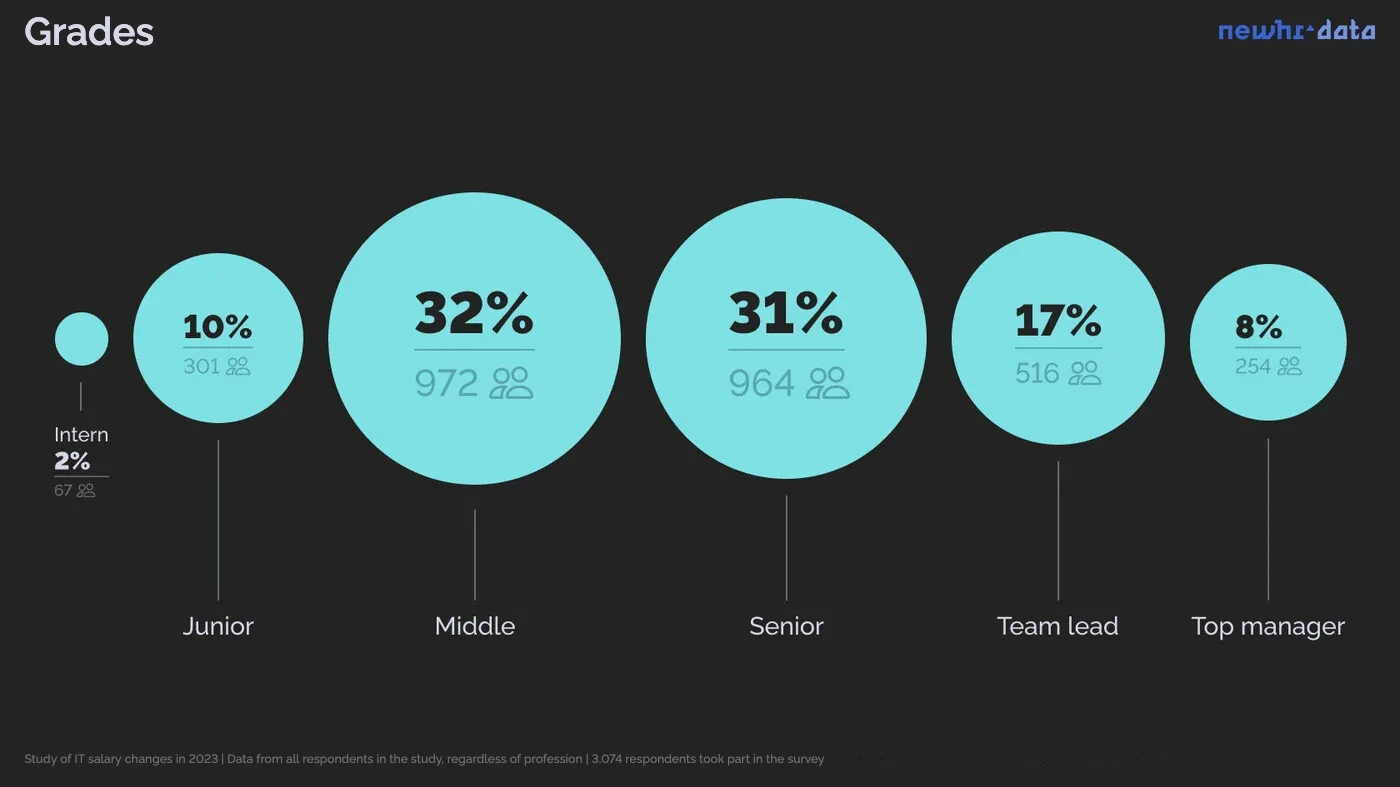
Question: Which specialisation and grade do you belong to?
Number of respondents: 3,074
- Top manager — senior executive
- Team lead — head of a team
- Senior — experienced professional with a broad scope of responsibility
- Middle — confident professional
- Junior — beginner with some experience
- Intern — entry-level specialist, trainee with no experience
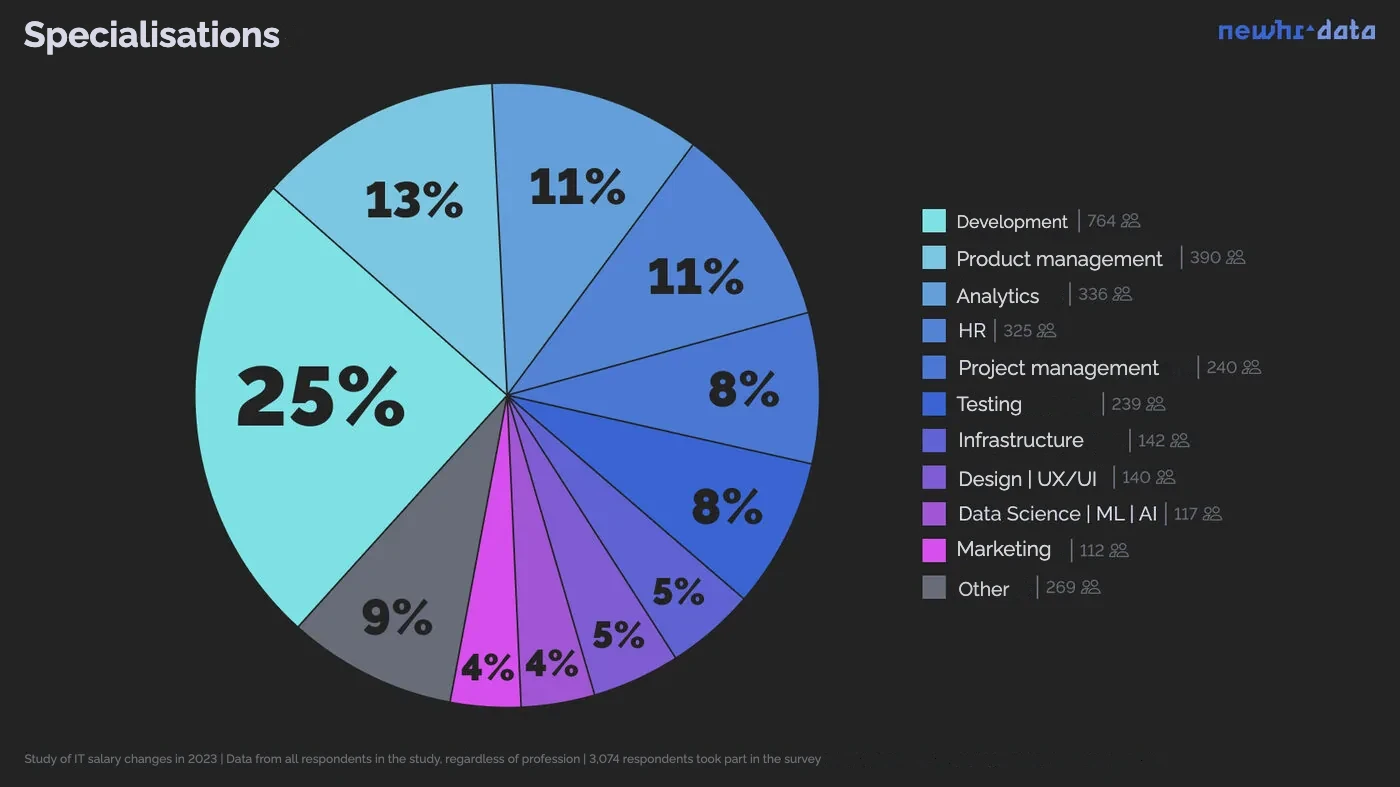
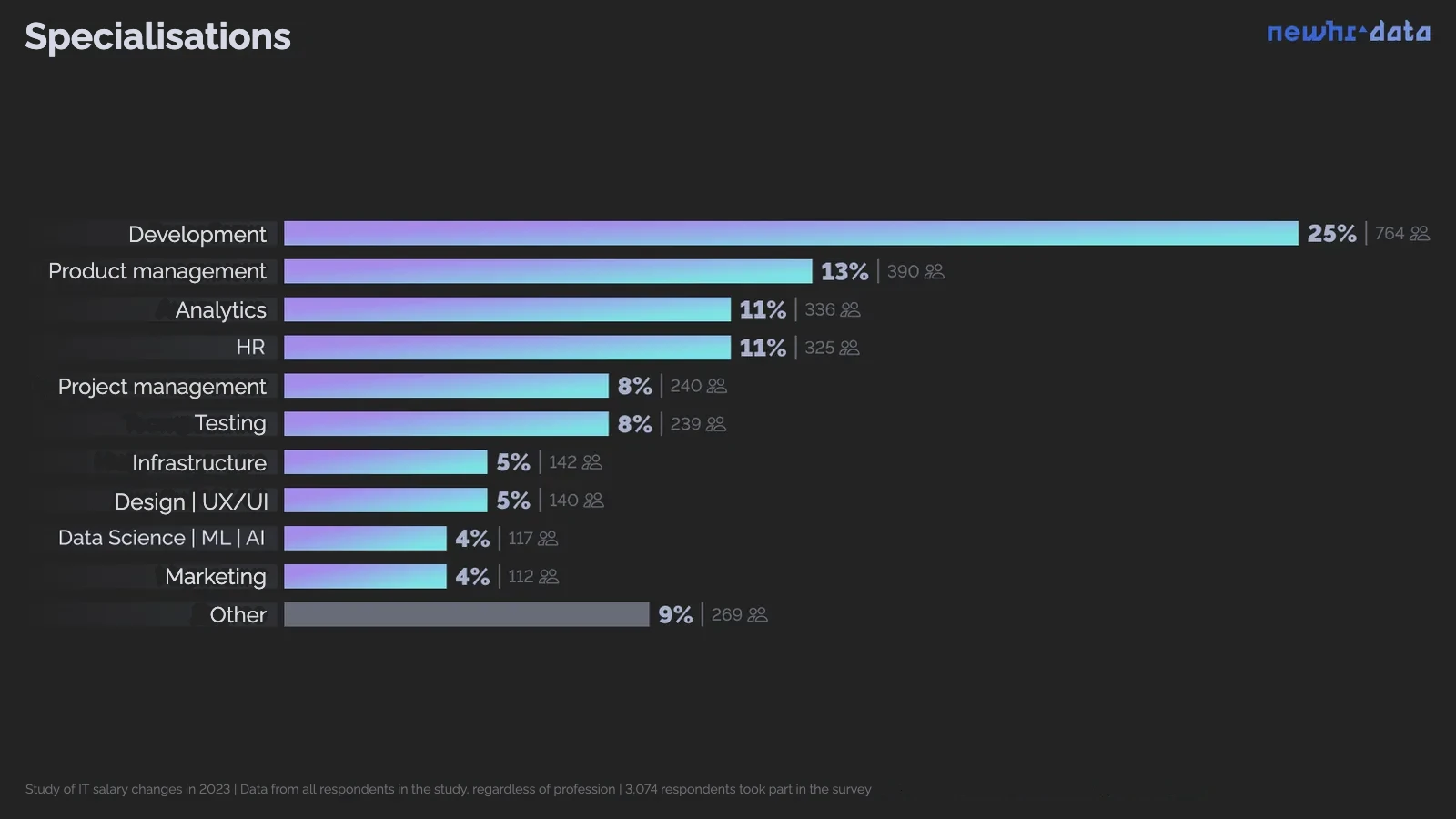
- Exact breakdown of respondents across the 19 specialisations
- Backend | full-stack | desktop development — 15.4% | 472 people
- Frontend development — 7.2% | 221 people
- Mobile development — 2.3% | 71 people
- Infrastructure (DevOps, SRE, system administration) — 3.4% | 104 people
- Testing — 7.8% | 239 people
- Network engineering — 0.3% | 10 people
- DBA — 0.2% | 6 people
- Information security — 0.5% | 14 people
- Product management — 12.7% | 390 people
- Project management — 7.8% | 240 people
- Analytics — 10.9% | 336 people
- Data Science | ML | AI | Data engineering — 3.8% | 117 people
- Design and UX/UI — 4.6% | 140 people
- Marketing — 3.6% | 112 people
- HR — 10.6% | 325 people
- Content/Media — 1.3% | 41 people
- Producing — 0.6% | 18 people
- Sales/BizDev — 1.8% | 55 people
- PR — 0.6% | 17 people
- Other — 4.8% | 146 people
Keep in mind that the sample is skewed towards experienced IT specialists. Most respondents are at middle and senior grades. There were fewer team leads and top managers among the respondents, although this matches the distribution of grades in the IT industry as a whole.
Junior and intern specialists are underrepresented in our sample. So it is not worth drawing firm conclusions about income trends for these grades.
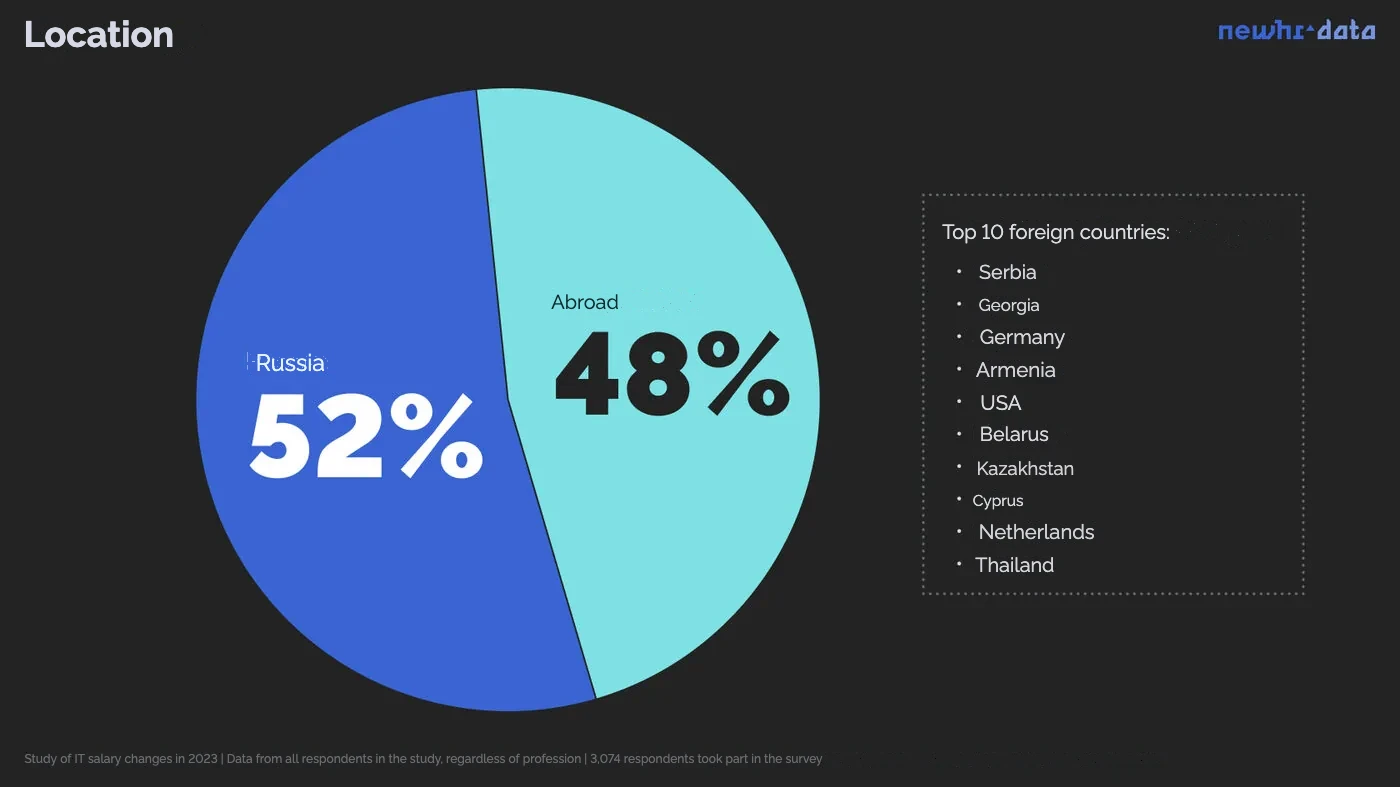
Geography
Respondents' location was detected automatically for everyone who completed the questionnaire.
Number of respondents: 3,074
Salary changes
- The main trend of 2022: a freeze on hiring and salaries. Most IT specialists (52%) saw no change in their salaries that year.
- The main trend of 2023: growth despite market turbulence. In the charts below we look at what drove salary increases in 2023. But we stress that salary growth does not mean an increase in purchasing power.
Question: How did your salary (base + regular bonuses) for the whole of 2023 change compared with 2022?
Number of respondents: 3,074
We asked respondents to consider their nominal salary without adjusting for inflation.
If a respondent had more than one employer in 2023, we asked them to answer about the one they consider their main place of employment.
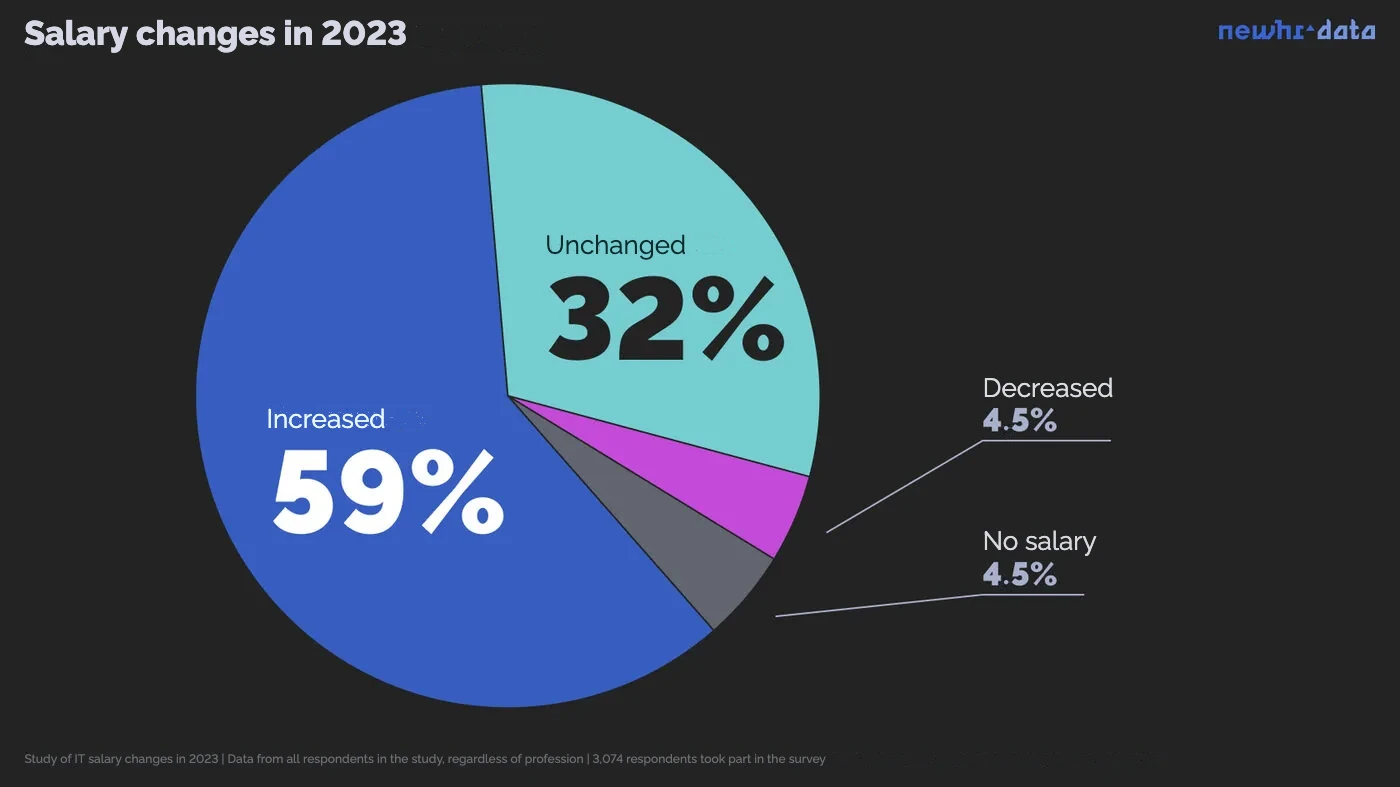
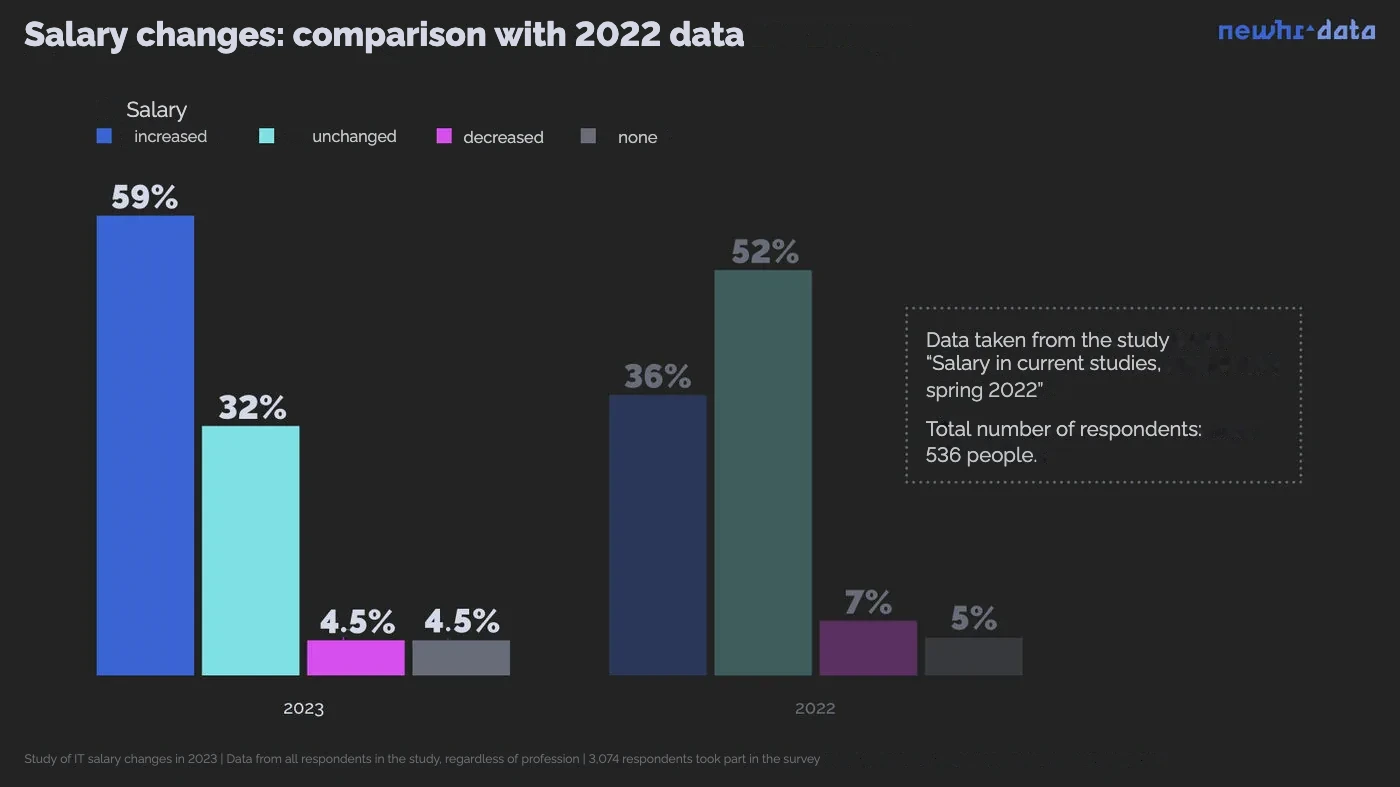
Compared with 2022, there was a slight rise in unemployment in IT. In 2022, 3% of IT specialists stopped receiving a salary because they had no job. In 2023, this figure rose to 4.6%.
This is still a very low figure. For comparison, unemployment in Russia as a whole was at record lows and stood at 3% in December last year (Rosstat data).
Salary trends by company type
We divided companies into 4 types
Based on how Russian-speaking IT specialists are currently distributed across the labour market.
- Russian — Essentially a Russian company: founded in Russia and operating in Russia.
Example: Sberbank - Russian-speaking — Partly Russian: the team is mostly Russian-speaking, but the company has moved from Russia to foreign markets.
Example: inDrive - International — Partly Russian: the team is international and English-speaking; the company has moved from Russia to foreign markets.
Example: Miro - Foreign — The company has never had ties to Russia; most of the team is international.
Example: Booking.com
Question: Can your employer be called a Russian company?
Number of respondents: 3,074
If a respondent had more than one employer, we asked them to answer only about their main place of employment in 2023.
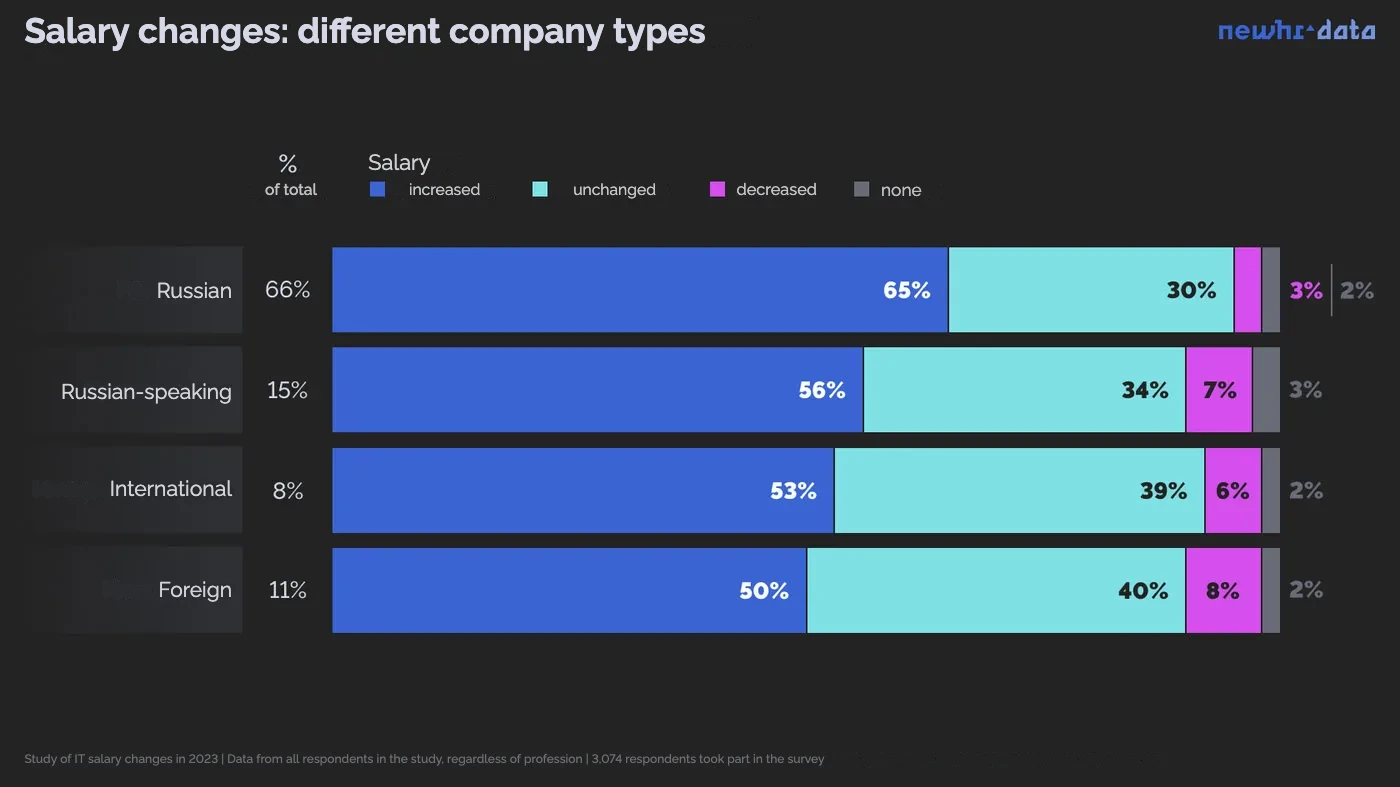
The most interesting observation: a larger share of IT specialists saw their salaries rise in Russian companies than in other types of companies. The gap in salary growth between Russian and foreign companies is 15 percentage points in favour of Russian ones.
At the same time, salary freezes were more typical of foreign companies (40% versus 30% in Russian ones).
"In 2022 the entire IT market froze and tried to avoid sudden moves while waiting for some certainty. All IT companies, both in Russia and on the global market, found themselves in a freeze and a crisis. It was an employer's market: there were several times fewer vacancies than candidates.
In 2023 the thaw came. A cautious growth trend emerged (not as rapid as in 2021). The situation has changed. Now Russia has a talent shortage, while the global market still has a surplus.
The main problem of Russian IT: the qualifications of specialists on the market do not always meet business requirements. The industry has faced a demographic dip and a mass relocation of IT specialists. The result is a huge number of juniors looking for work and a lack of experienced specialists. Companies in Russia are forced to compete for more qualified candidates, poaching them and raising their salaries."
Kira Kuzmenko, CEO of NEWHR Data
Salary trends by grade
Question: What was your professional grade in this specialisation at the end of 2023?
Number of respondents: 3,074
- Top manager — senior executive
- Team lead — head of a team
- Senior — experienced professional with a broad scope of responsibility
- Middle — confident professional
- Junior — beginner with some experience
- Intern — entry-level specialist, trainee with no experience
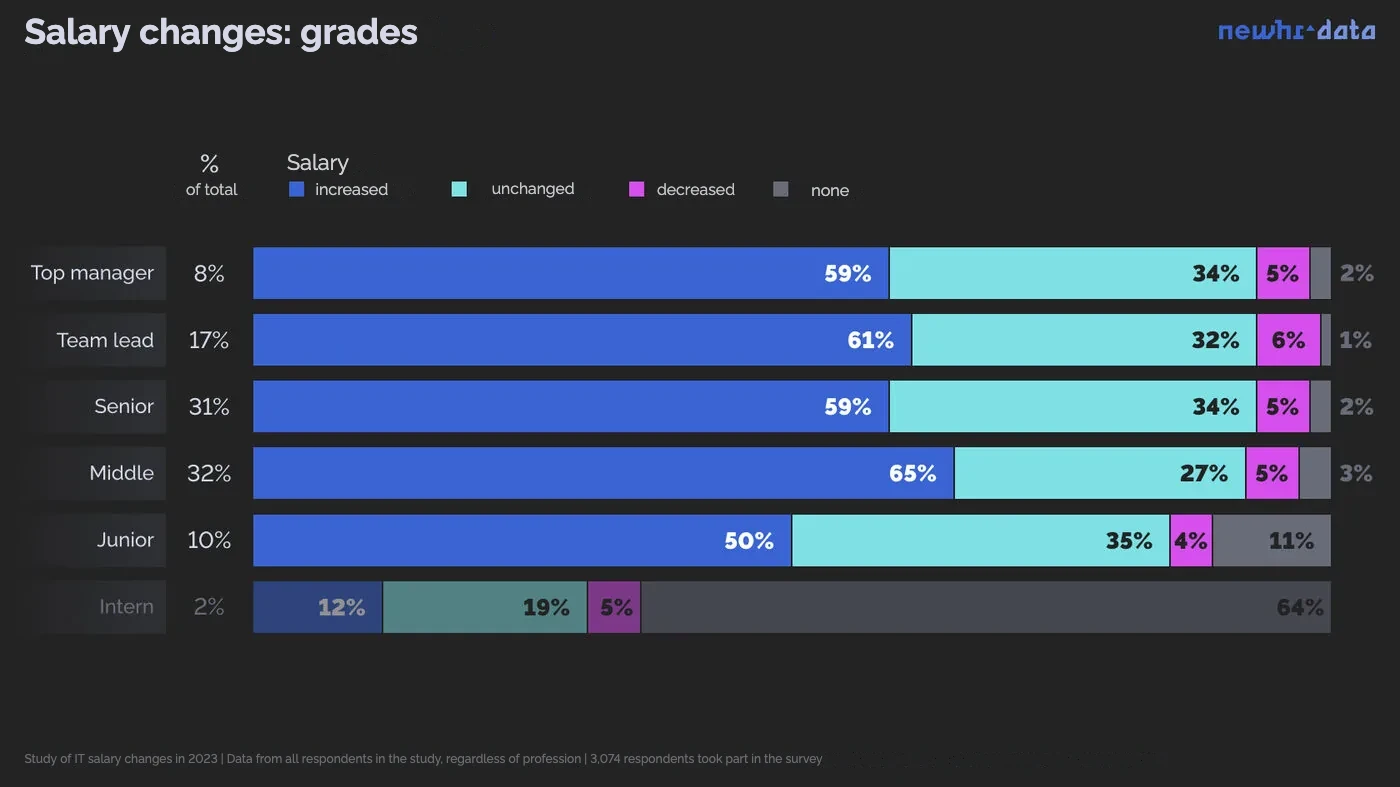
Salaries grew most for middle specialists, which matches the market situation. As usual, those who do the hands-on work are in higher demand. According to our previous study, in 2022 salaries also grew primarily for middle and senior specialists, as well as team leads.
"Keep in mind that most of a top manager's compensation comes not from salary but from variable pay. We did not ask about it in this study. Top managers, especially in foreign companies, may receive the same base salary as senior specialists. The main difference lies in bonuses and stock options."
Kira Kuzmenko, CEO of NEWHR Data
How much salaries grew
- In Russian companies, an 11–30% base salary increase is typical growth. Salaries rise within this range inside a company, when moving to another company and with a counteroffer. In Russia the focus is also more often on raising base salary than bonuses.
- In foreign companies, increases of up to 10% of base salary are more common (2–4% on average). This is standard for international European companies: income there often grows through bonuses and stock options rather than base salary increases.
- The candidates who managed to win the competition for vacancies at international European companies were most likely experienced and highly paid.
- Salaries grew thanks to changing company (confirmed by our data — see the charts below).
Question: By how much did your salary increase in 2023?
Number of respondents: 1,812 people | 59%
The first chart shows by what percentage the salary increased for respondents who reported a rise.
The second chart shows the size of the salary increase by company type.
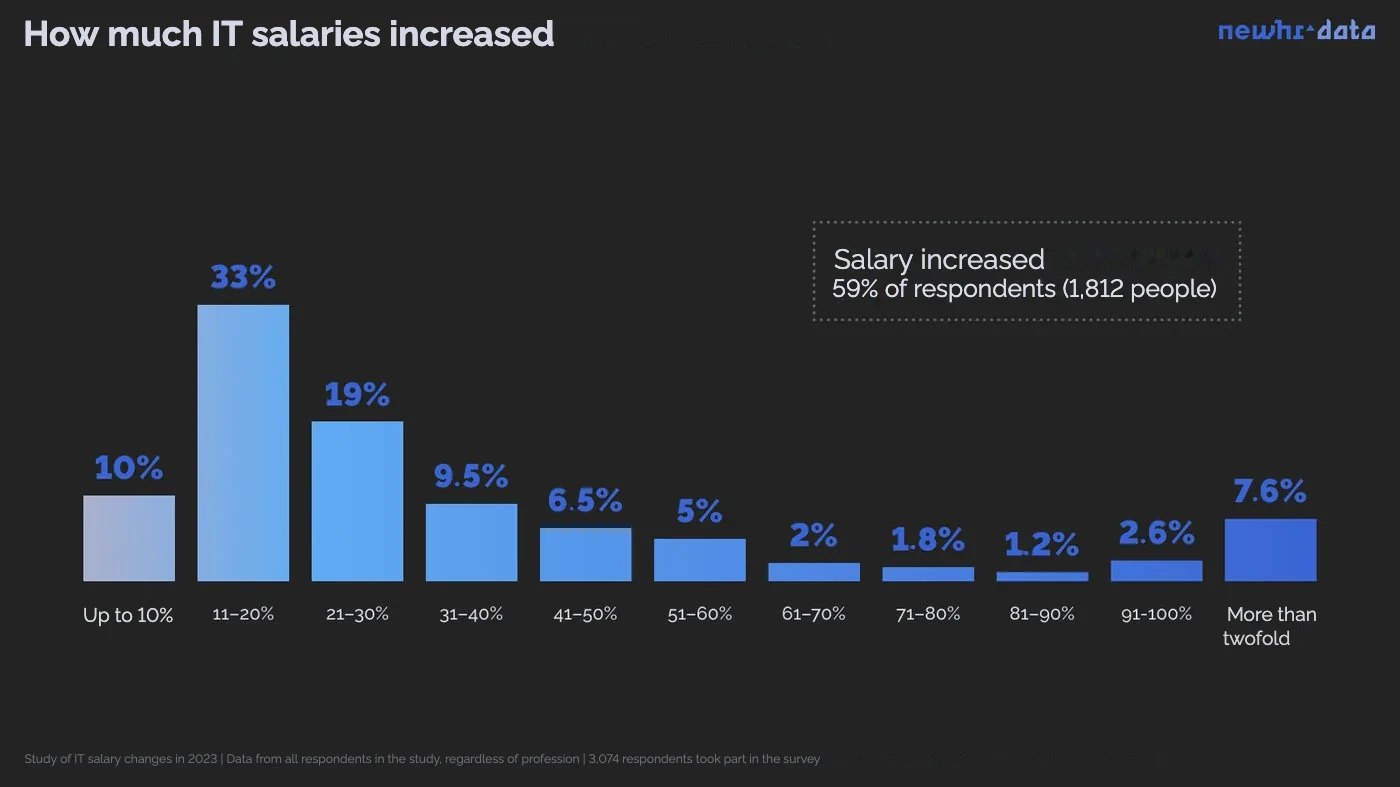
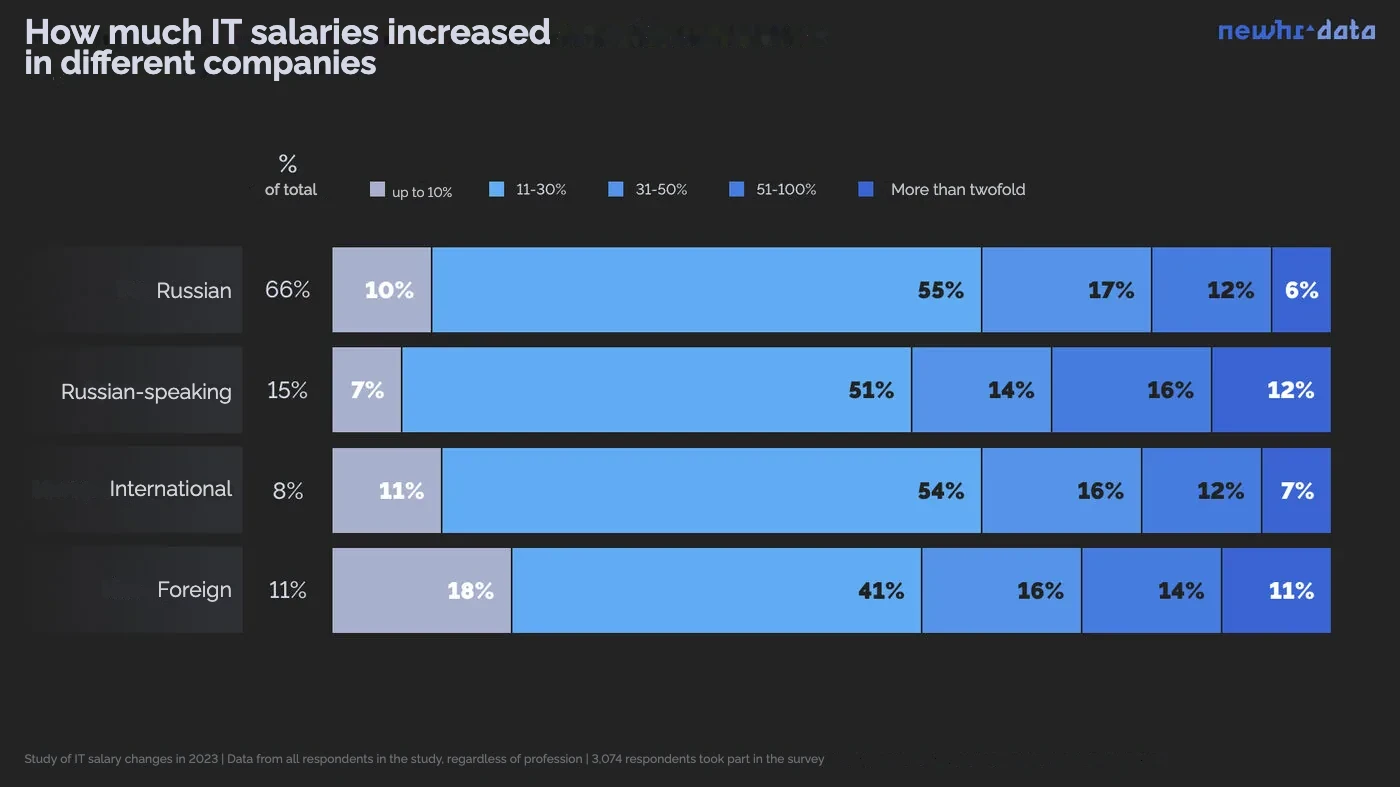
Conclusion: if you work in IT, you can most likely count on a pay rise. But it will not necessarily give you a better standard of living, given rising prices or a move to a country where everything costs more.
What drove salary growth
Question: What caused your salary to increase in 2023?
Number of respondents: 1,812 people | 59%
Respondents could choose more than one factor behind the increase in pay.
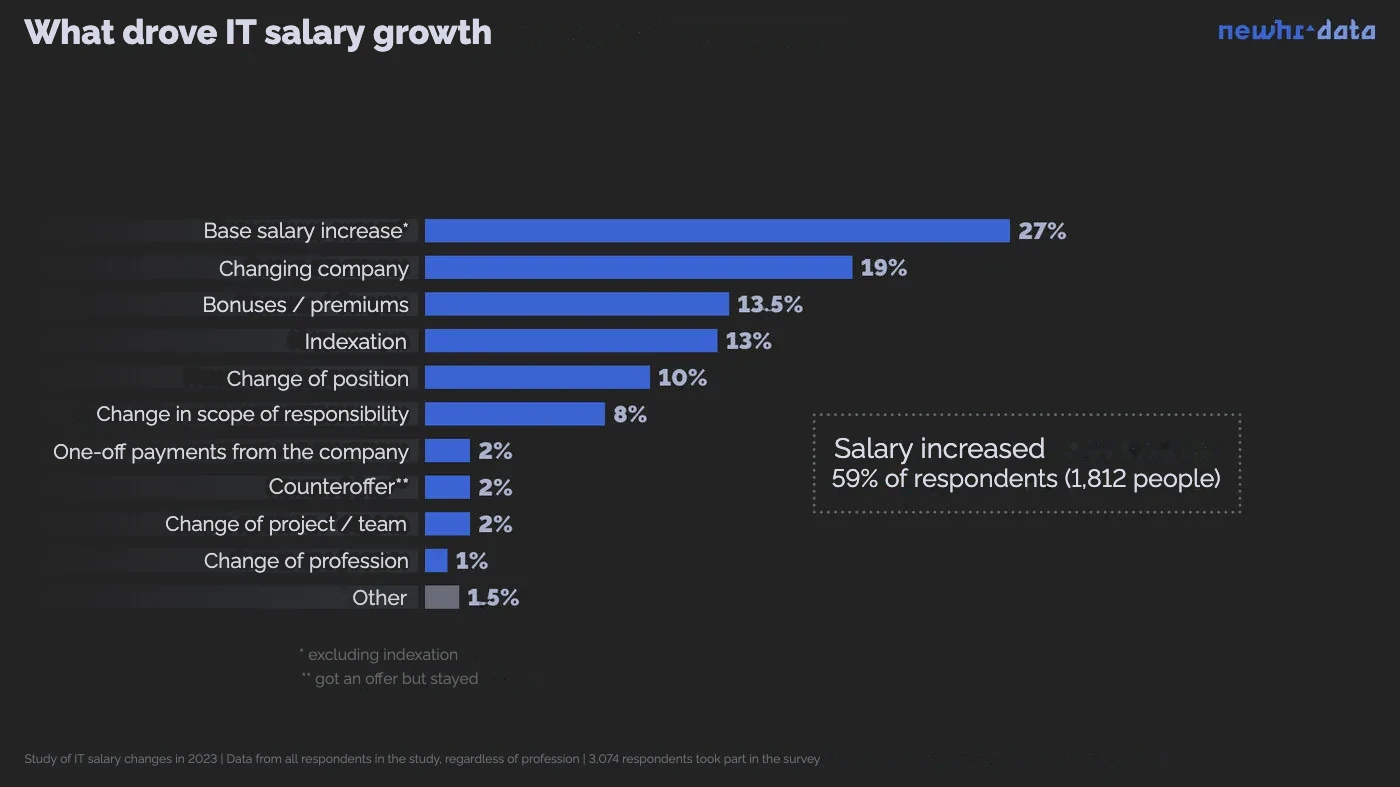
Since respondents could choose multiple answers, we can assume that salary increases most likely came from several factors at once. For example, over the year an employer indexed a specialist's salary, then the specialist moved to another company and got a base salary increase as a result (in total, three factors worked for one person at once).
"To get a more detailed picture of the market, it is interesting to see which pay-rise factors played a role in different types of companies. This is shown in the chart below."
Kira Kuzmenko, CEO of NEWHR Data
Question: What caused your salary to increase in 2023?
Number of respondents: 1,812 people | 59%
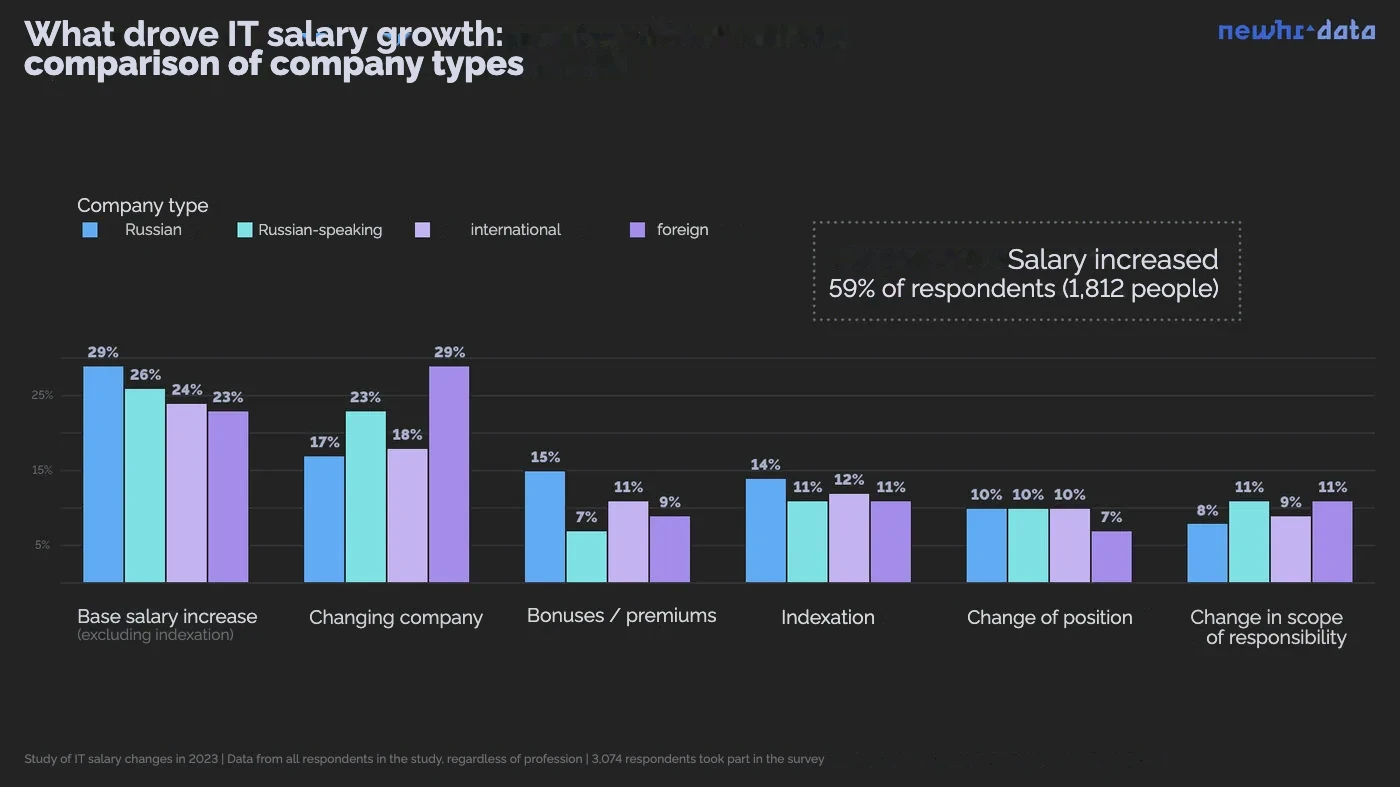
- In Russian companies, pay increased primarily through a higher base salary. The reason is most likely that Russian companies want to retain employees this way.
- In foreign companies — through changing company. In 2023 the overall market situation was such that many Russian-speaking IT specialists were looking for work outside Russia.
Question: How did your salary (base + regular bonuses) for the whole of 2023 change compared with 2022?
1,812 people | 59%
We singled out 14 specialisations in which we had a sufficient number of respondents. They show how differently salaries grew across specialisations.
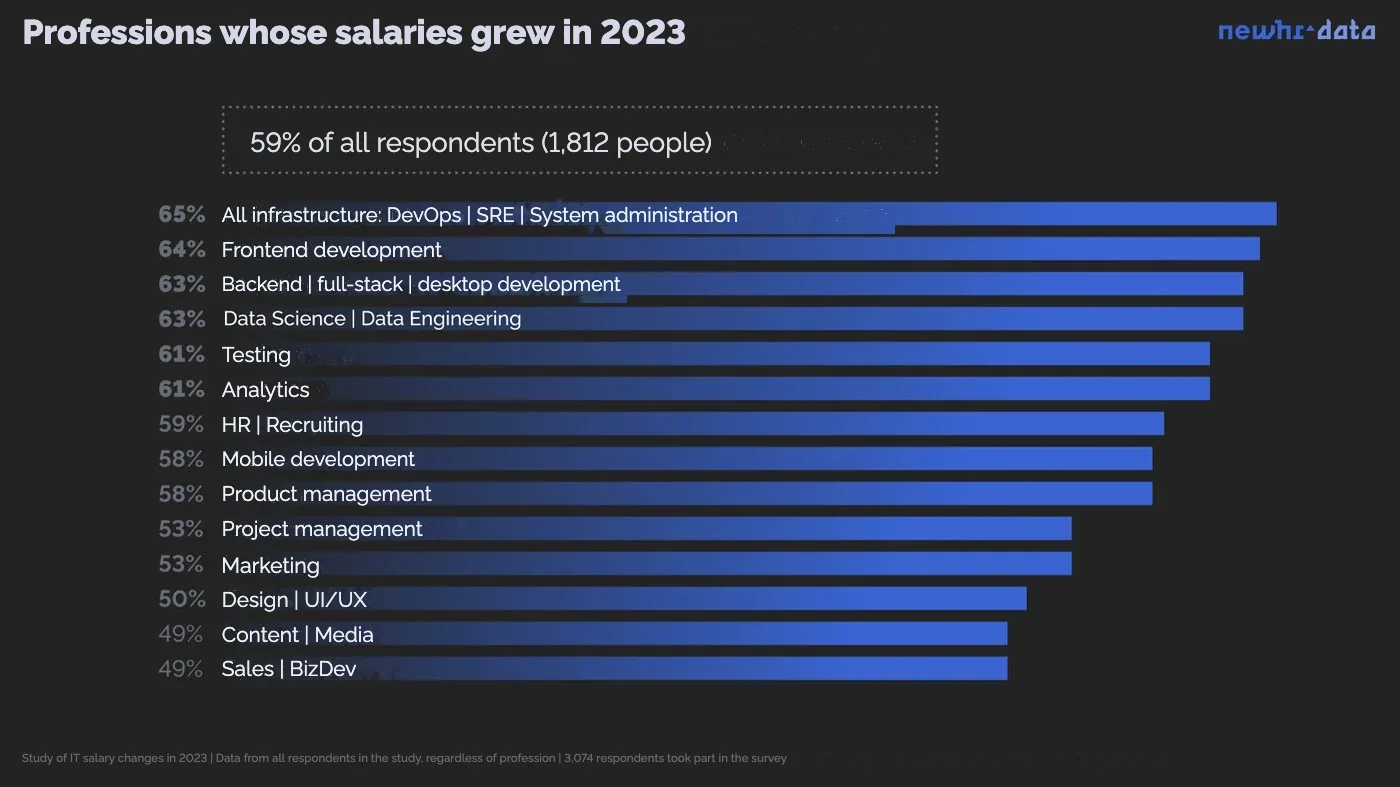
- Development, infrastructure, testing, data science and analytics — this is what businesses were willing to pay more for.
- Design, marketing, content and sales showed lower salary growth. Perhaps because they are not in as much demand in the current environment.
How much salaries fell
Question: What caused your salary to decrease in 2023?
Number of respondents: 142 people | 4.5%
Respondents could choose more than one factor behind the decrease in pay.
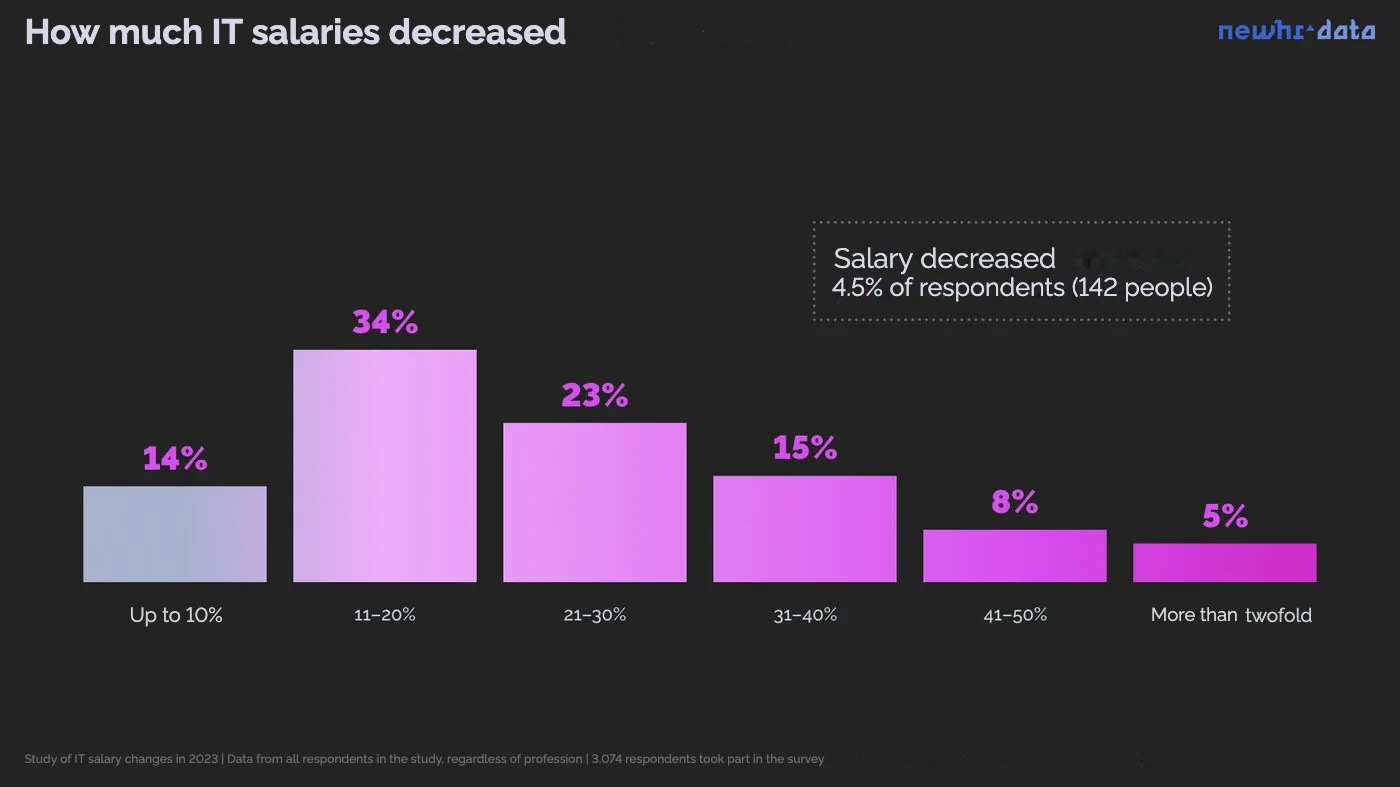
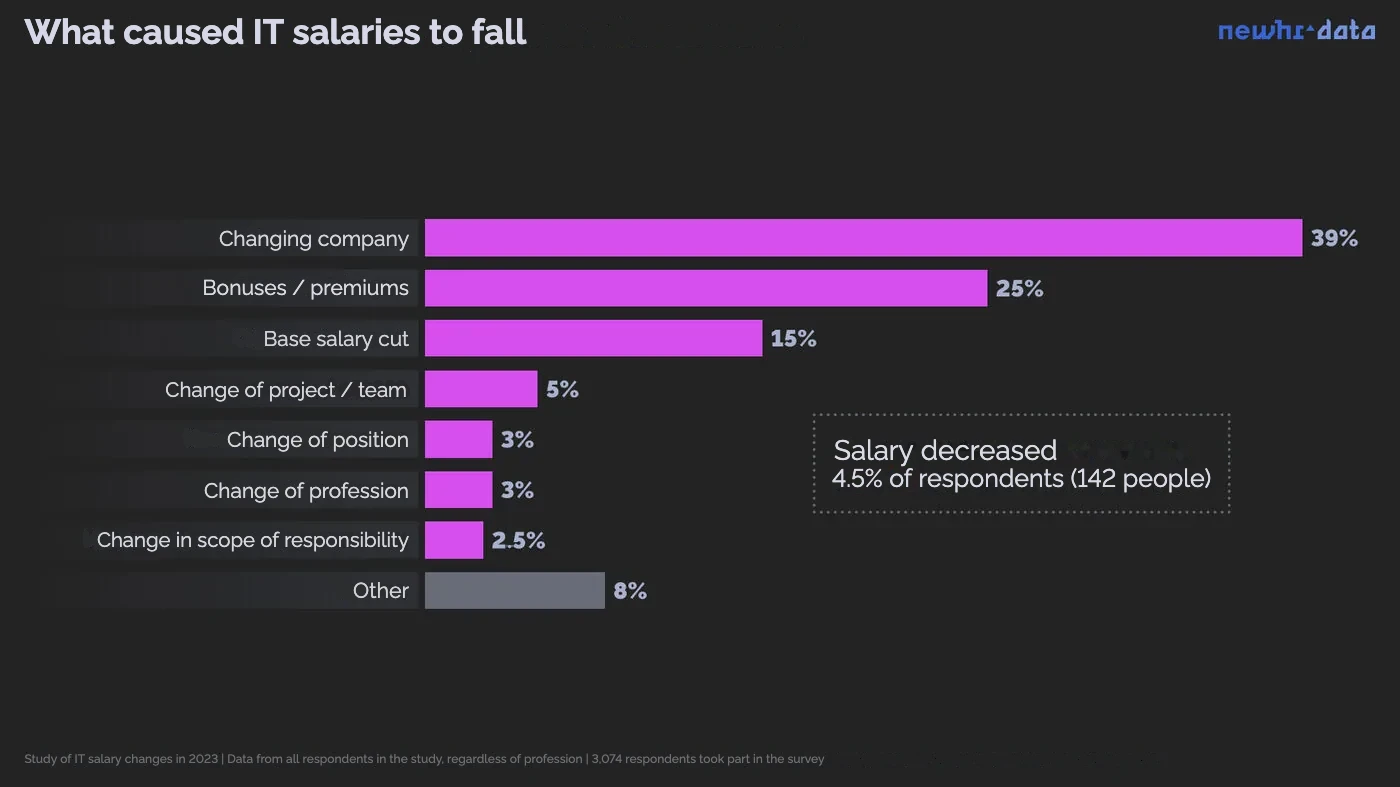
Very few respondents reported a drop in salary — less than 5%. Most often they said the reason was changing company (see the chart below). This happens, for example, when a specialist is looking for work in another country and is ready to accept a lower grade and/or income for it.
What caused salaries to fall
Question: What caused your salary to decrease in 2023?
Number of respondents: 142 people | 4.5%
Respondents could choose more than one factor behind the decrease in pay.
How salaries changed across professions
Adapted from the original article in Russian on newhr.org. Read the Russian version.