Market research · May 2024
Relocation of IT specialists
NEWHR Data surveyed 4,952 IT professionals. We found out which of them stayed in Russia, moved abroad or came back. We also asked what they plan to do next, which companies they work for and which they want to work for.
"We set ourselves a task: to understand what the relocation situation of Russian-speaking IT professionals looks like today. There is a lot of hype and debate on this topic in the public space. People often say that almost everyone who left has returned to Russia.
This flatly contradicts what NEWHR recruiters observe and the experience of the specialists who came to study on our course Hello New Job! So we decided to find out for ourselves how Russian-speaking IT professionals actually feel about relocation.
We are incredibly grateful to everyone who responded to our call and filled in the questionnaire! A sky-high thank you also to everyone who shared our survey! We haven't forgotten you and have listed you in the "Our partners" section.
With your help we collected responses from almost 5,000 (!) people who identify themselves as specialists in the IT industry. Despite such a large sample, we cannot claim that what you see is a cross-section of all Russian-speaking IT professionals. Our sample is skewed towards those who care about relocation in one way or another.
For more on how to read our research correctly and what to keep in mind, see the disclaimer below."
Kira Kuzmenko, CEO NEWHR Data
Important disclaimer
- The research is fairly representative for all grades except interns. See the "Respondent profile" section.
- People who care about relocation were more likely to respond to the invitation to take the survey than those who had never even thought about it.
- What share of those who left the country have returned or plan to return to Russia, and how many decided to settle abroad.
- What share of those who never left plan to stay in the country, and what share are preparing to move abroad.
About the research
The research was conducted as an online survey. Respondents were recruited through the NEWHR Data online media, partner channels and our own respondent database.
- 4,952 people — made up our sample. Respondents were recruited through NEWHR media, partner channels and our own respondent database
The sampling error is 1.4% at a 95% confidence level.
21 specialisations
- Development
- Infrastructure
- Testing
- Product management
- Project management
- Analytics
- Data science
- Marketing
- HR and others*
6 grades
- Intern
- Junior
- Middle
- Senior
- Team lead
- Top manager
4 types of companies
- Russian
- Partly Russian (operate abroad; founded by people from Russian-speaking markets)
- Foreign local (operate in the market of a single country)
- Foreign international (operate in many countries)
- * See all the specialisations of the survey participants
- Development (backend, fullstack, desktop)
- Frontend development
- Mobile development
- Analytics
- Data science, ML, AI
- Data engineering
- Product management
- Project management
- Testing
- Technical management
- Infrastructure (DevOps, SRE, sysadmin, networks, infosec)
- HR, recruiting
- Design, UX/UI/CX
- Marketing
- Sales, business development
- Content, media
- IT support
- Gamedev (industry)
- Producing
- Top management (CEO, COO, CFO, etc.)
- PR
SAMPLE description
Disclaimer: our sample does not represent the entire population of Russian-speaking IT professionals. It is skewed towards relocants.
Russia and the world
- 47% of our respondents are in Russia, 53% are abroad.
Geography
- 80 countries, including Russia
- Respondents abroad are concentrated in Europe (33% of the whole sample)
- The rarest countries: South Africa, Mauritania, Liberia, the Dominican Republic.
- Strategies — The sample represents well both those staying in Russia and separate segments of relocants.
- The sample is representative enough to trace the relocation choices and relocation strategies of IT professionals.
Age
- Mostly people aged 25–41.
- The most common age is 33–34.
- The youngest respondent is 16. The oldest is 63.
Gender
1/3 of the sample are women.
2/3 are men.
Gender and grade
- The share of men is higher among senior grades and managers.
Men: top 3 specialisations
- Backend development
- Analytics
- Product management
Women: top 3 specialisations
- HR and recruitment
- Analytics
- Testing
Key findings
- 16% of those who moved abroad in 2022–2024 have returned to Russia — The share of returnees may rise to 19% if everyone (among our respondents) who plans to return to Russia does so.
- 97% of relocants plan to stay abroad — Only 3% of relocants intend to return to Russia in the near future. 65% are in the process of integrating into their host country. Most of them describe their departure with the word "emigration" rather than "relocation".
- Fewer people are leaving — After the peak in 2022, the outflow of people from Russia dropped sharply in 2023–2024. Unless shock events occur, the number of people leaving will remain small.
- The choice to leave or stay is not linked to gender or IT specialisation — Other factors, however, do correlate with relocation: grade, employer support and age.
- "Companies are moving all IT people out" is a myth — 2/3 of respondents who left Russia moved at their own expense.
- Relocants are not interested in working for Russian companies — The longer an IT professional lives abroad, the more likely they are to work for foreign companies with no ties to Russia.
- Serbia is the top country for '22–24 relocants — Serbia ranks 1st among the countries where relocants currently live. It will keep its lead even if the relocants in our sample move to the countries they eventually plan to end up in.
- Work abroad more often starts at companies with Russian roots — Every 3rd relocant works for a partly Russian company (linked to Russia but operating abroad).
Disclaimer on the figures in the charts: all data in the charts are rounded to whole percentages. As a result, shares may not add up to 100%. If you need more precise figures, write to data@new.hr.
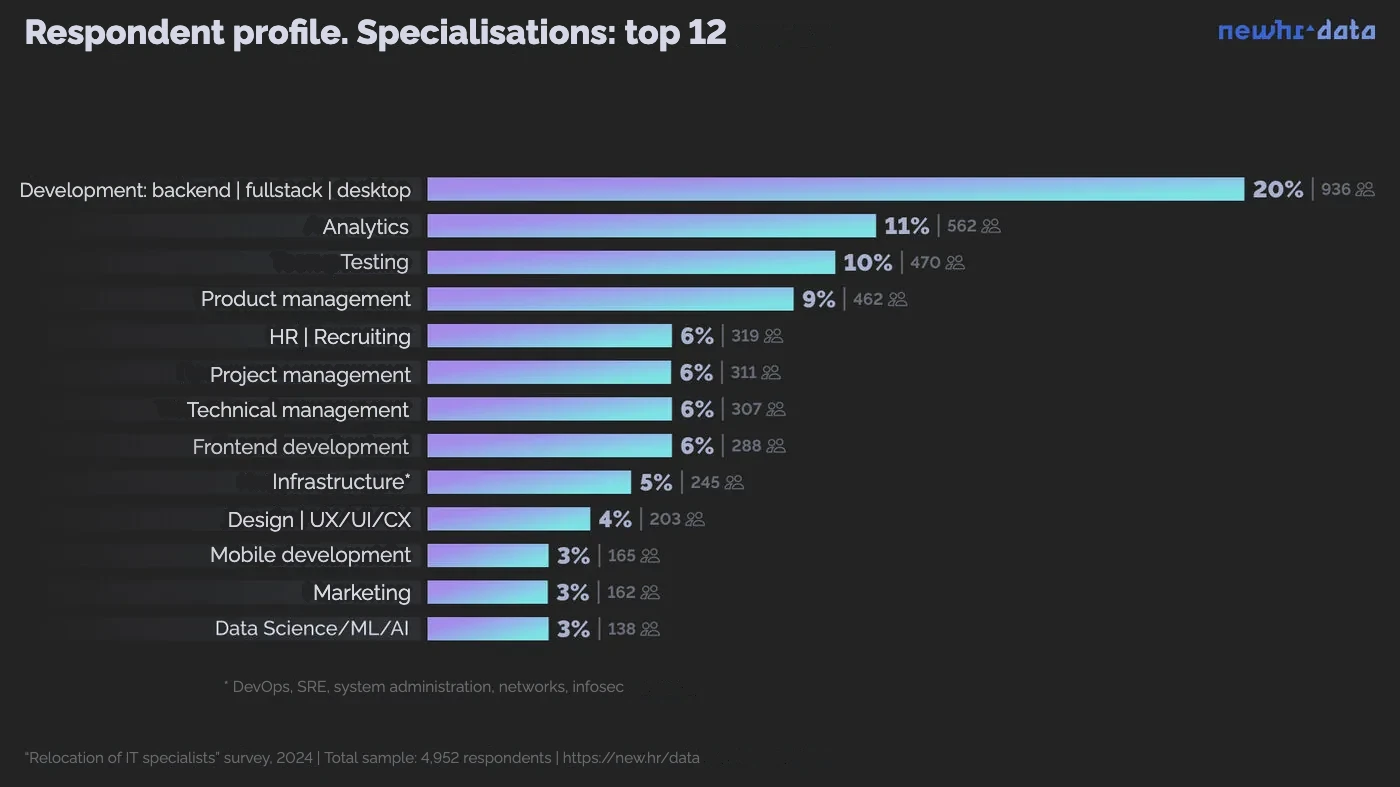
RESPONDENT profile: specialisations
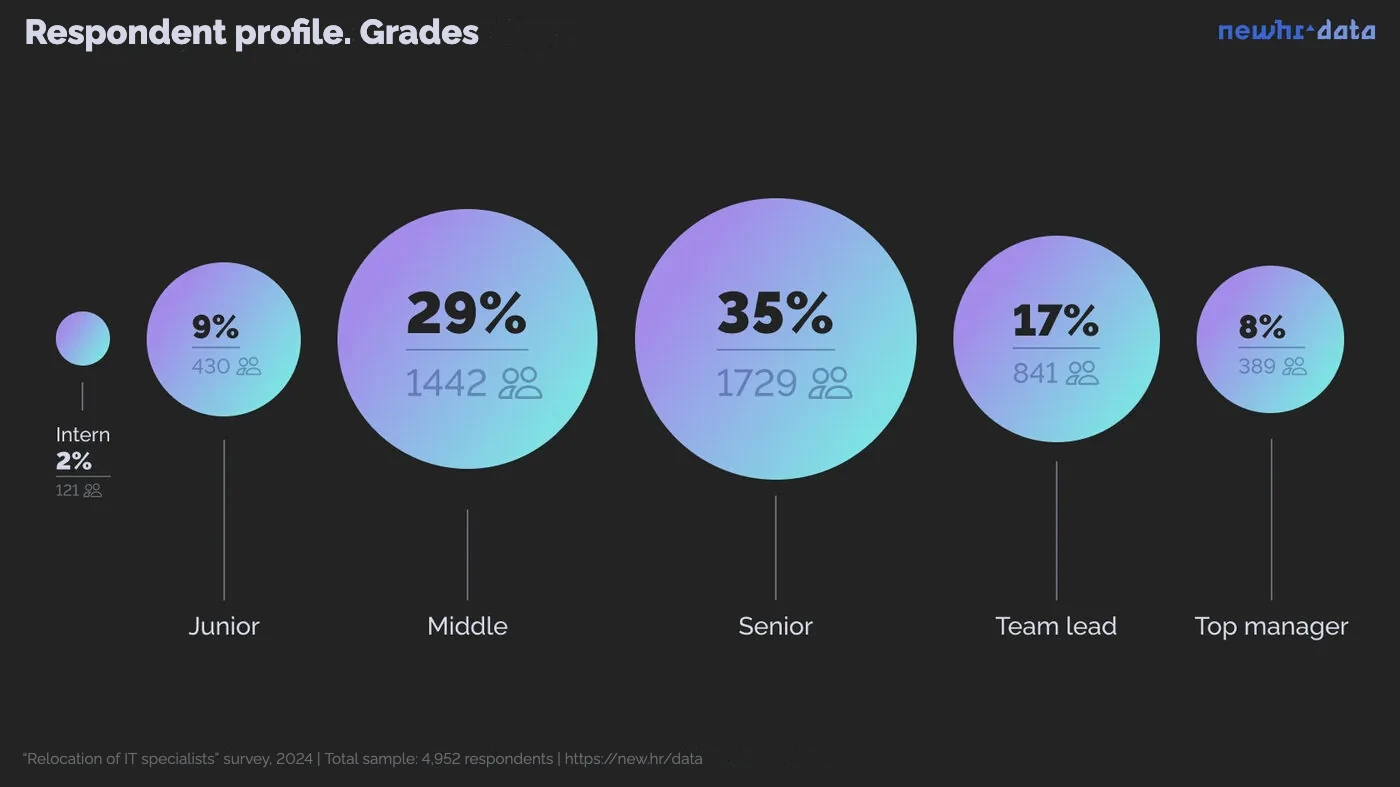
- We have data on all the main IT specialisations and grades.
Number of respondents: 4,952
- Intern — an entry-level specialist, a trainee with no experience
- Junior — a beginner with a little experience
- Middle — a confident professional
- Senior — an experienced professional with a broad area of responsibility
- Team lead — the head of a team
- Top manager — a senior executive
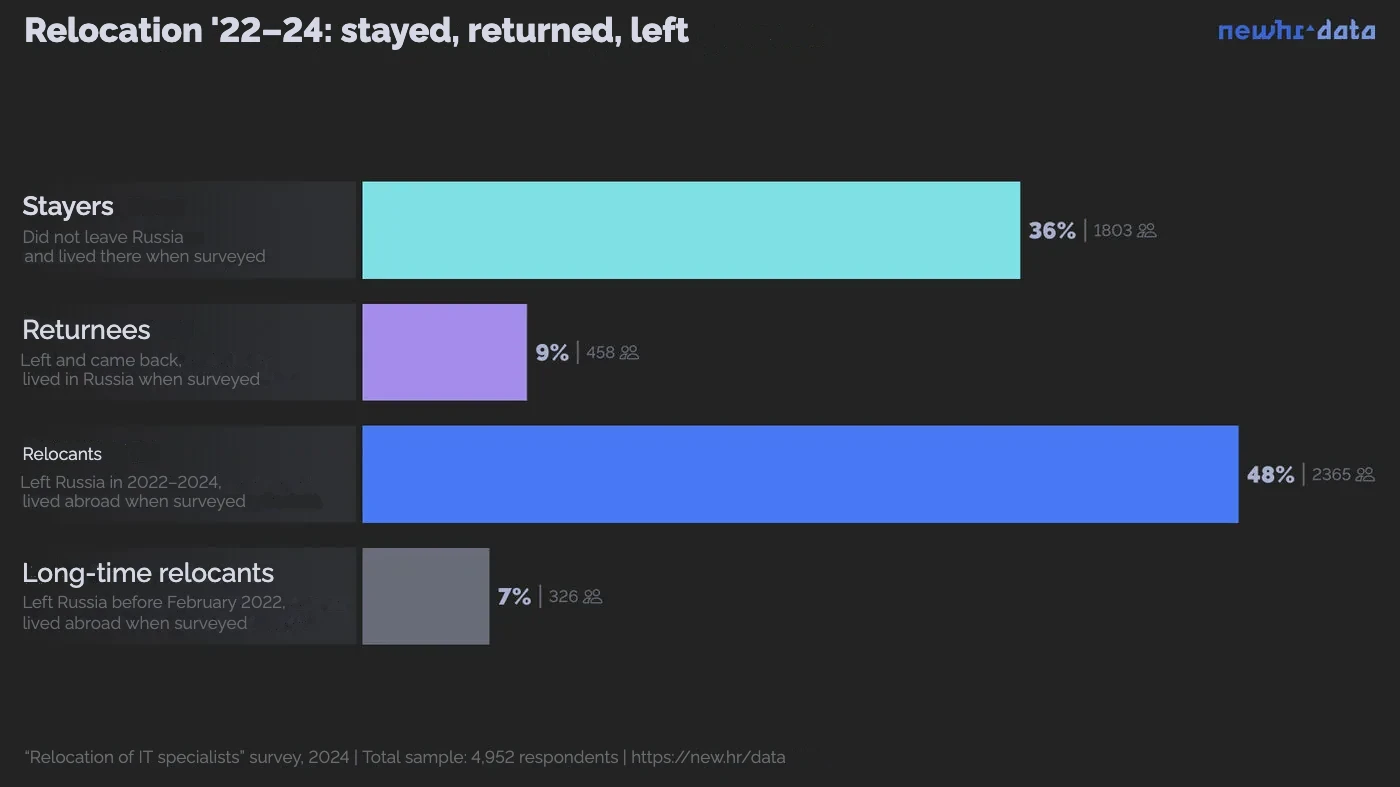
Leave or stay?
Number of respondents: 4,952
- staying in Russia,
- returnees,
- relocants,
- long-time relocants.
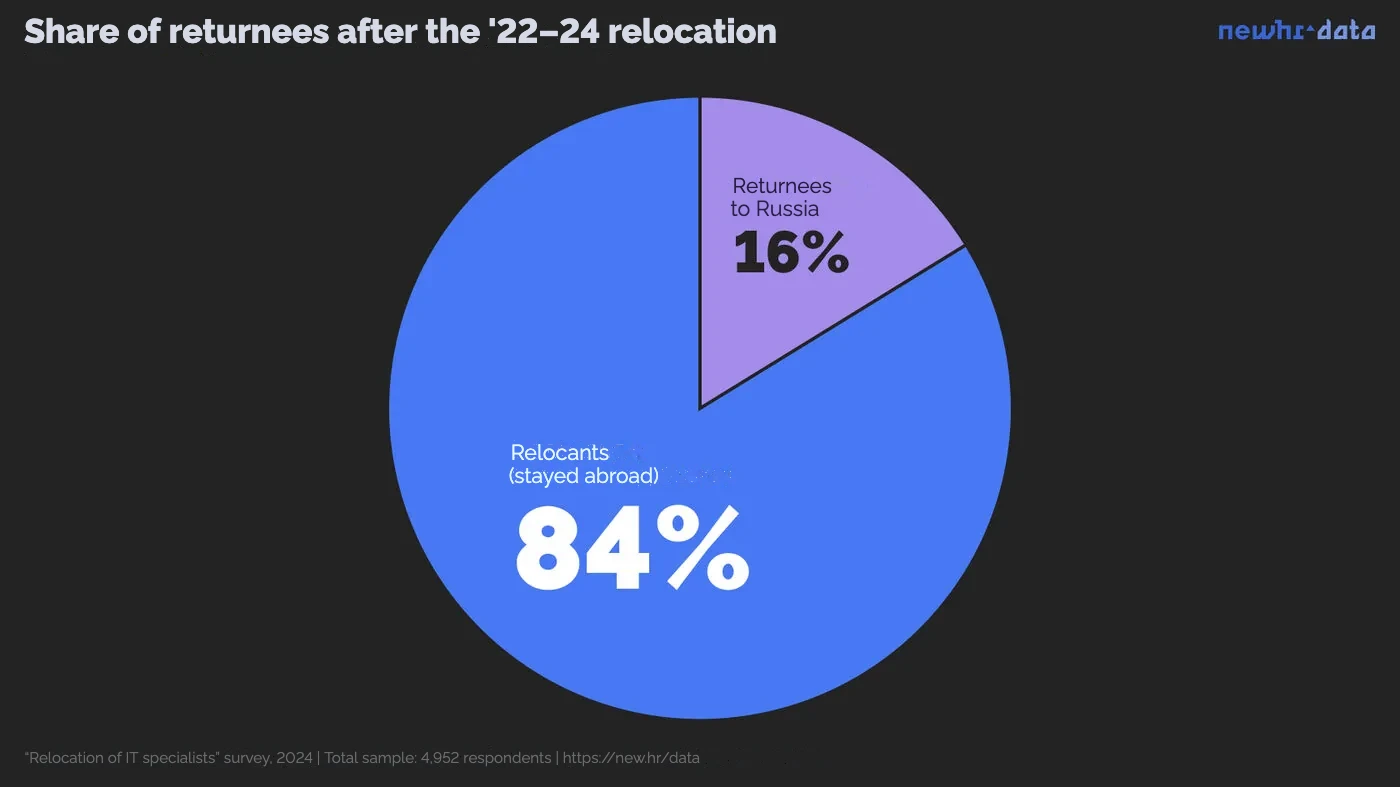
- How many of those who left have returned
Number of respondents: 464
We were particularly interested in how many relocants have returned to Russia, as this topic is often debated in the public space.
According to data from the Russian Ministry of Digital Development, two thirds of the IT professionals who have left since 2022 have returned to the country. An expert of a parliamentary commission put this share even higher — at 80%.
NEWHR Data figures are noticeably different.
By April–May 2024, 16% of the IT professionals in our sample who had left the country since 2022 had returned to Russia. If we add those who only plan to return, this share rises to just 19%.
Our respondents' stories
Click the arrow to see the next quote
"I'm a beginner who decided after 2022 to study programming in order to leave Russia for good. Right now I want to build up experience in Russia to middle+/senior level and then relocate to Europe"
Our respondents' stories
Click the arrow to see the next quote
"While moving in 2022, I switched to analytics in IT. I couldn't find a remote job, so I had to go back to Russia to gain experience"
Our respondents' stories
Click the arrow to see the next quote
"As an HR people partner, I took part in relocating the people in our company over the last 2 years, and only 2 out of 20 came back. Support from the company matters enormously, and it's not even about financial support"
Our respondents' stories
Click the arrow to see the next quote
"Reading all the discussions about taxes in other countries, rent, food, I'm kind of * [scared] to move :D I've probably just got used to being in my comfort zone at the Russian level"
Our respondents' stories
Click the arrow to see the next quote
"The Russian market offers salaries on par with international companies, while the risk of being laid off isn't as high, and the standard of living is much higher"
Our respondents' stories
Click the arrow to see the next quote
"I'm a beginner who decided after 2022 to study programming in order to leave Russia for good. Right now I want to build up experience in Russia to middle+/senior level and then relocate to Europe"
Our respondents' stories
Click the arrow to see the next quote
"While moving in 2022, I switched to analytics in IT. I couldn't find a remote job, so I had to go back to Russia to gain experience"
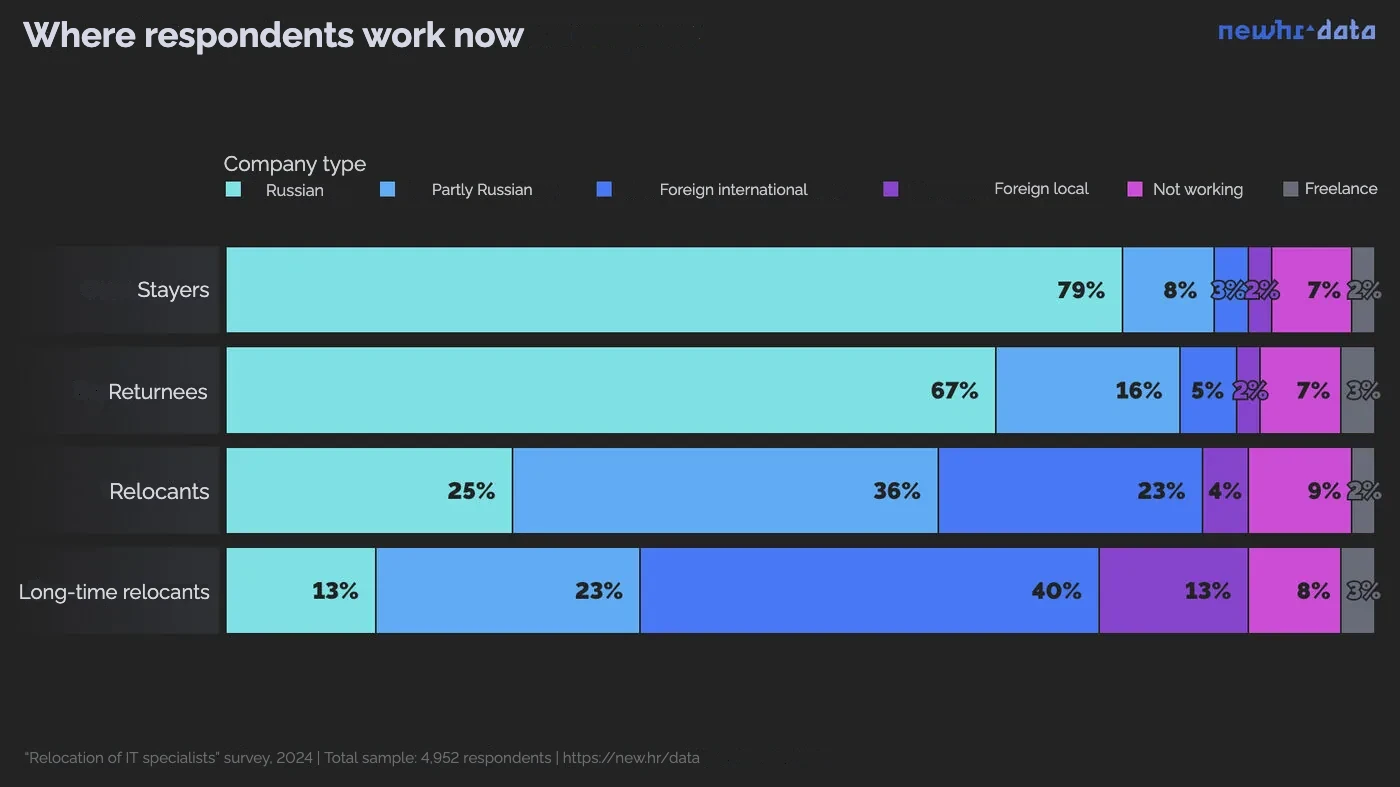
Where they work
We defined four types of companies.
- Russian — Domestic Russian companies or Russian branches of foreign companies.
Examples: VK, Yandex - Partly Russian — Companies founded by people from Russian-speaking markets and operating abroad. The team may be Russian-speaking or international.
Examples: Miro, Yango - Foreign international — Not linked to Russia and operate in many foreign markets at once.
Examples: Google, Airbnb - Foreign local — Not linked to Russia and operate mainly in the market of a single country. Teams often consist of people who speak the language of the local market.
Examples: Kaspi (Kazakhstan), Yettel (Serbia), XING (Germany) - Long-time relocants more often work for foreign companies
Number of respondents: 4,952
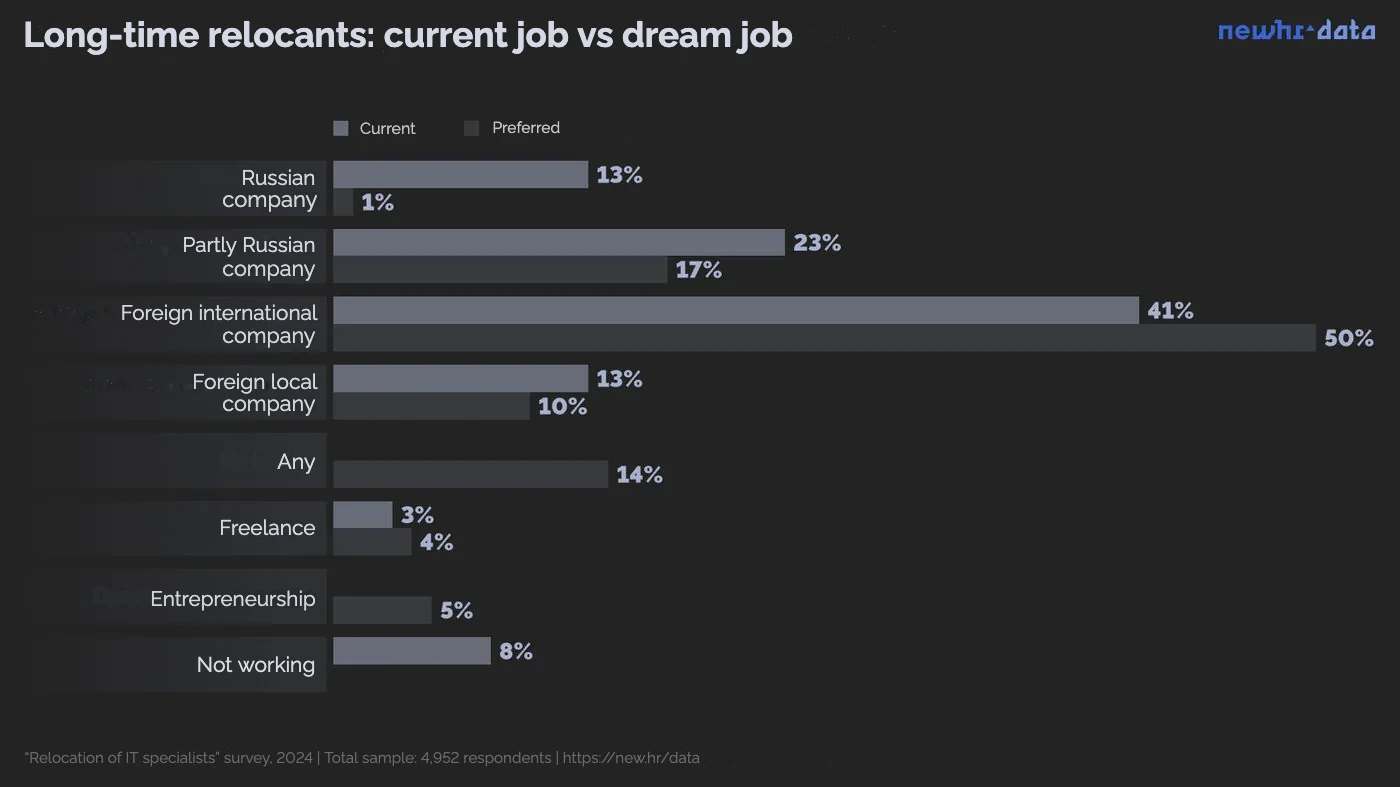
- More than 50% of long-time relocants work for local or global foreign companies.
- Every 3rd relocant of 2022–2024 works for a partly Russian company (founded by people from Russian-speaking markets and operating abroad).
- Even long-time relocants keep working for partly Russian companies (23%).
- 25% of relocants and 13% of long-time relocants keep working for Russian companies.
"Relocants' strong ties to Russia will gradually wear away. It's not a fast process. Many still work for Russian companies from abroad or in the buffer zone of partly Russian companies. Unless there are 'black swans' and shock events, the process will continue at the same pace"
Alyona Makarova, Head of Research, NEWHR Data
Who left more often
- What is linked to the decision to leave or stay?
Number of respondents: 4,952
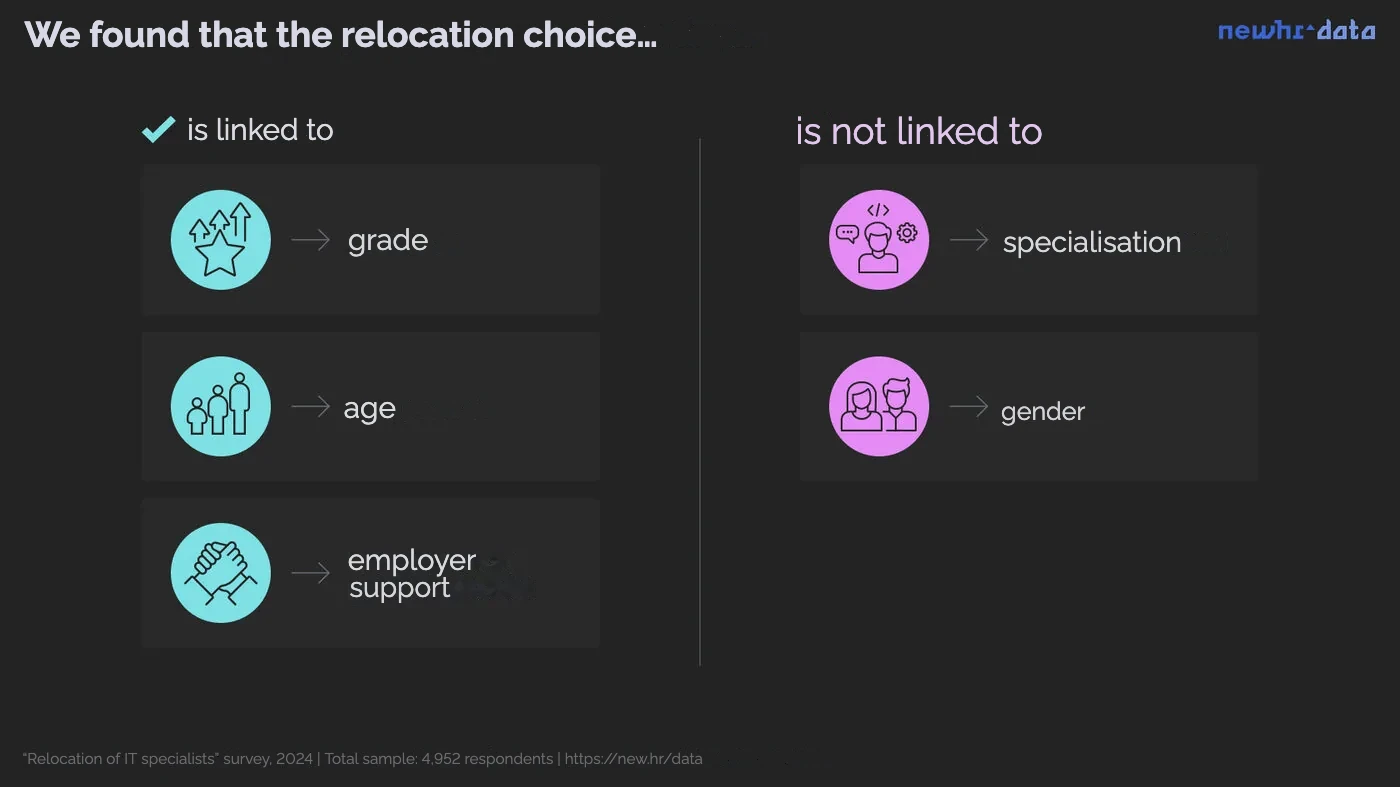
— Gender and profession are not linked to relocation. Men and women left or stayed in Russia at roughly the same rate.
— We found no correlations related to profession. Everyone left at roughly the same rate.
— Those who received employer support returned to Russia less often than those who left at their own expense (see the section "Relocants: when, where, at whose expense").
— Respondents aged 30–40 relocated most actively.
— Seniors make up the largest group among relocants (41% of the segment). They are followed by middles (28%) and team leads (18%).
— Men returned to Russia 1.5 times more often than women. The explanation: the spontaneous relocation of autumn 2022, which involved mostly men.
"Intuitively, it seems that relocating is easier for younger people. Not at all! The ones who left were people in their most productive and economically active age, from 30 to 40. These people have both energy and experience. Their departure may have created vacuum zones in the Russian market, which were filled by less experienced and possibly younger specialists"
Alyona Makarova, Head of Research, NEWHR Data
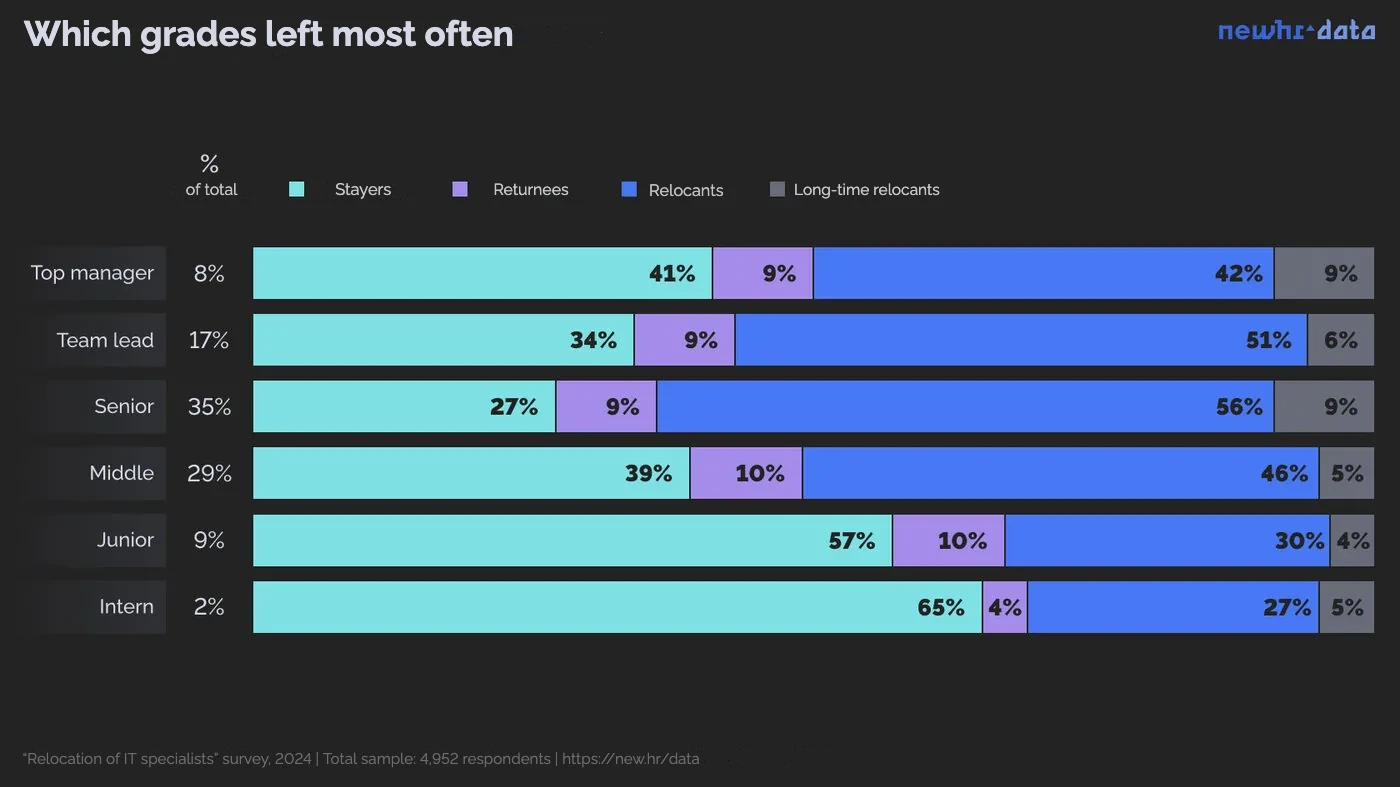
The more experienced the specialist, the more likely they are to move abroad and stay there
Number of respondents: 4,952
Senior-grade specialists turned out to be the most "mobile".
Managers are in a special situation. Among team leads there are more people staying than among seniors. Top managers were even less willing to leave.
"Why is it hard for managers to find a job abroad? The thing is that a future employer assesses managers not only on their track record, but also on their management skills.
A problem arises: the difference in management cultural codes. What is accepted in a Russian-speaking environment may be unacceptable in other cultures. For example, on the Russian market it is normal to give colleagues critical feedback directly. In Europe, an employee may feel they were treated rudely and go on months-long burnout leave. Adapting to another culture doesn't happen right away.
That's why Russian-speaking managers may accept a lower grade when looking for a job on the global market. For example, a team lead or head of development may apply for a senior developer role. This tactic works best for a successful job search at international companies. If a manager can't or isn't ready to step down a grade, a common strategy is to join a global-market company that was founded by people from a Russian-speaking background and has kept the corresponding cultural code."
Kira Kuzmenko, CEO NEWHR Data
Future strategies
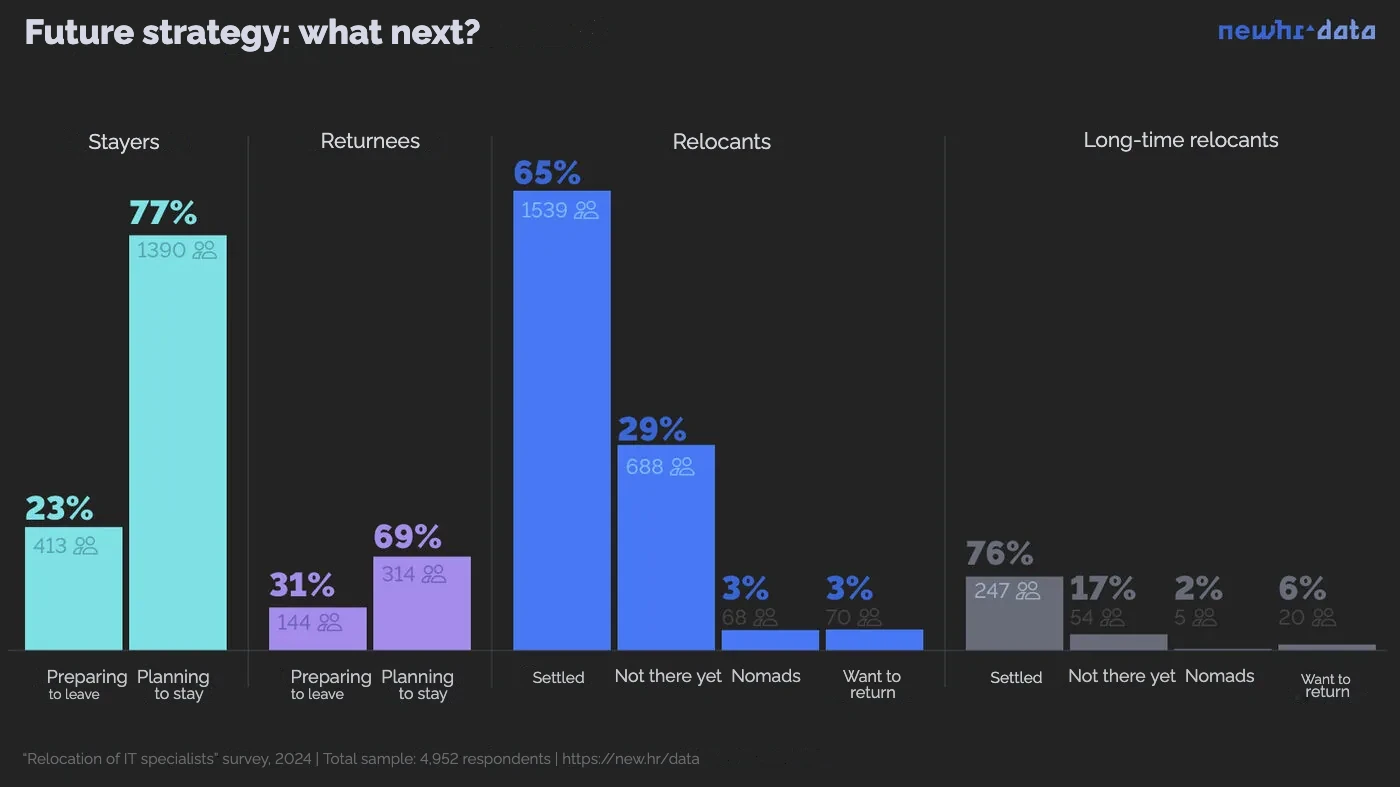
We asked respondents where they plan to go next (and whether they plan to go anywhere at all).
As a result, we identified 4 main relocant strategies.
- Settled — Relocants who plan to stay in their current host country and integrate into local life.
- Not there yet — Relocated abroad, but plan to move to another foreign country.
- Nomads — Relocants who keep changing foreign countries and don't intend to stay in any of them in the near future.
Ready to return
Those who relocated but plan to go back to Russia.
- Plans and timing
Number of respondents: 4,952
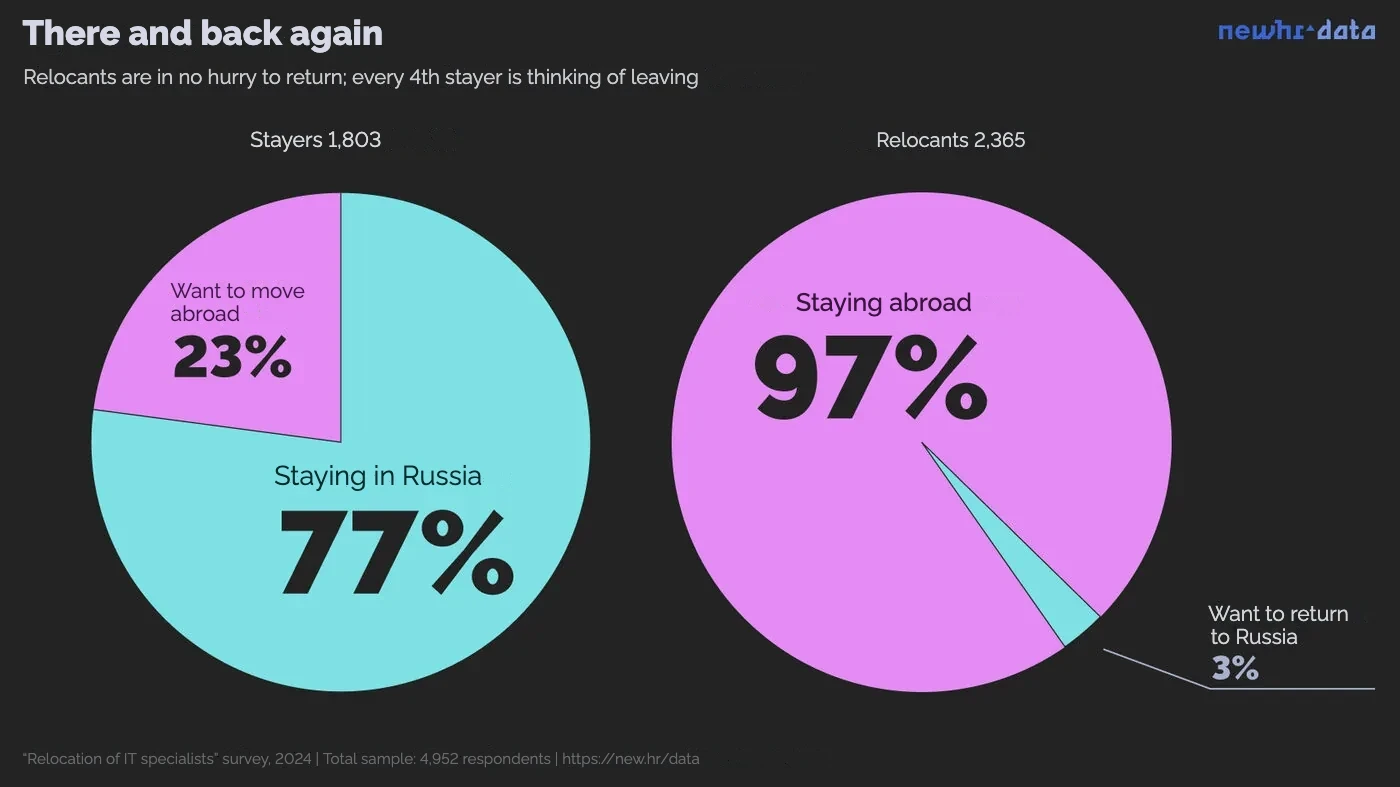
IT professionals who have left mostly no longer look towards Russia. Only 3% of relocants want to return to Russia. This means Russian employers have fewer and fewer opportunities to bring them back.
The most popular future strategy in all segments is to stay in the country of current residence (in Russia or abroad) and not move anywhere else.
We believe the relocation situation has settled: most of those who planned to change location have already done so.
The share of those who want to leave Russia is much larger than the share of those who want to return to the country from abroad. At the same time, we believe that not everyone who wants to relocate will actually do it, since the number of people actually leaving has dropped sharply since 2022.
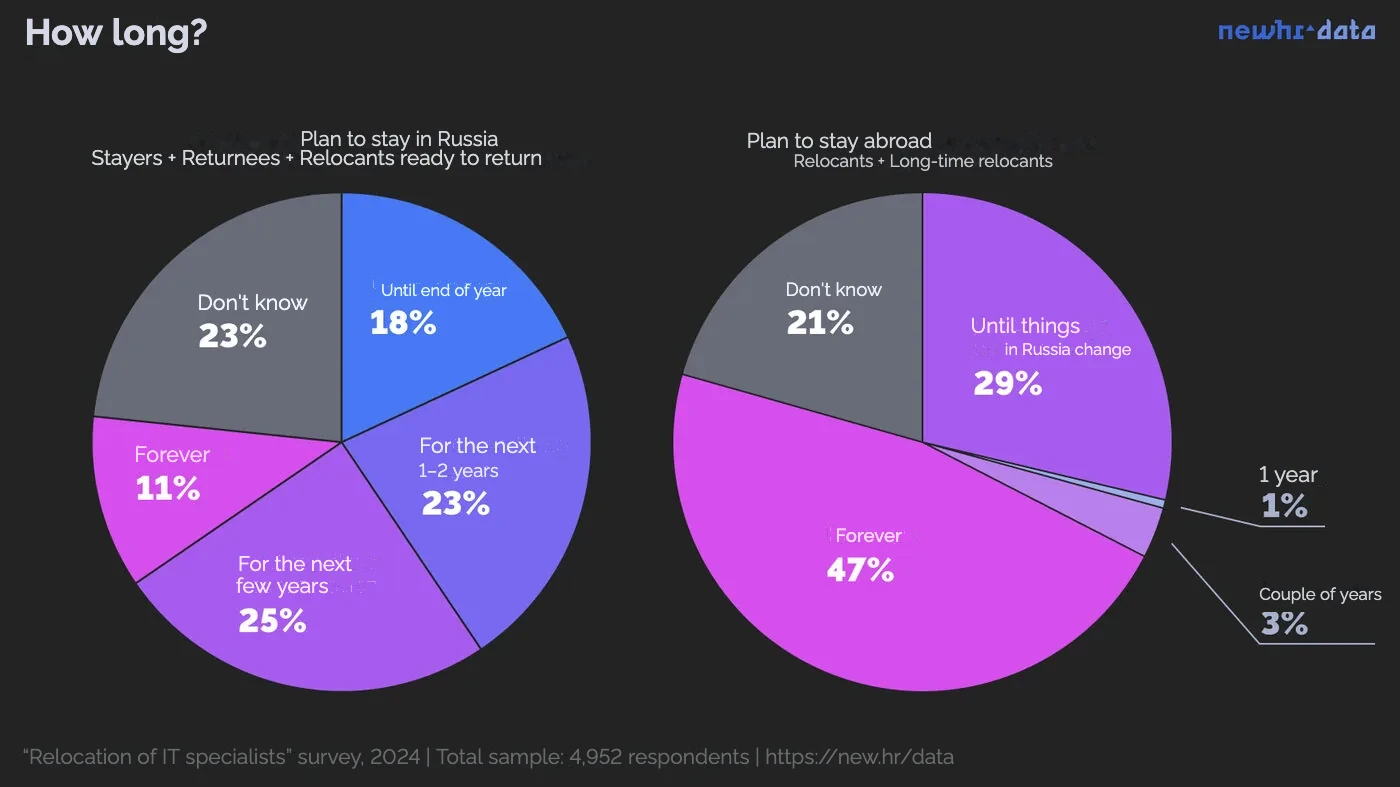
Almost 50% of relocants intend to stay outside Russia "forever", they said in the corresponding question. Another 29% are abroad "until the situation in Russia changes". Hypothetically, they may return.
"More than two years have passed. It feels like that's enough time for people to figure out where they stand and what they want. Many have already gone through emigration shock, reached their initial goals, adapted to the new reality and settled on a plan for the future.
OECD research has shown that successful integration of migrants often takes 3 to 5 years. Moreover, most of those who move make the final decision to stay in the new country only by the fifth year."
Kira Kuzmenko, CEO NEWHR Data
Relocants: when, where, at whose expense
- Most left in 2022
Question: When did you leave Russia?
Number of respondents: 2,365
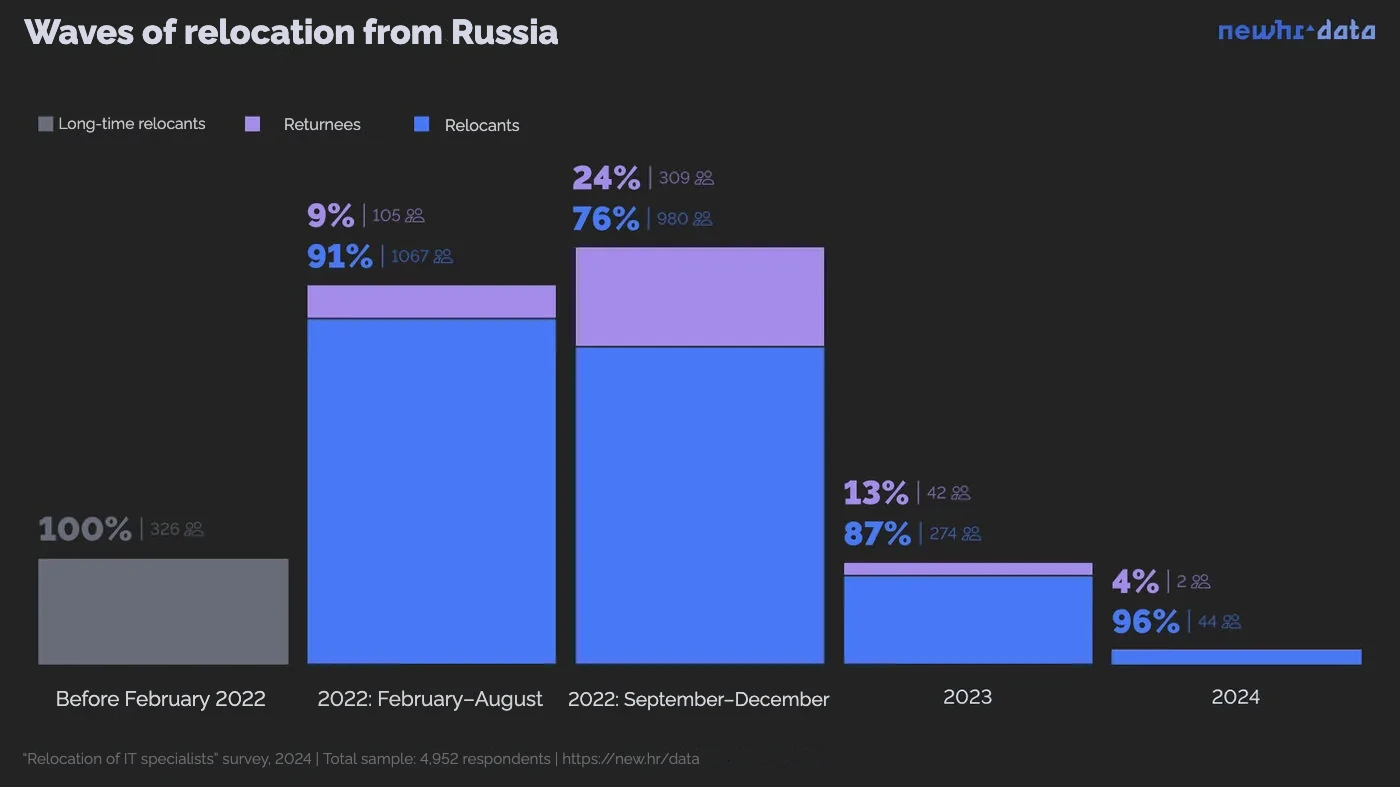
Most relocants left in 2022.
The peak of departures came in September–December 2022. But this wave also had the most returnees (almost every 4th person).
The autumn 2022 relocation was more spontaneous and less well planned than the other waves. That's why, in our view, the share of returnees is higher in this particular segment.
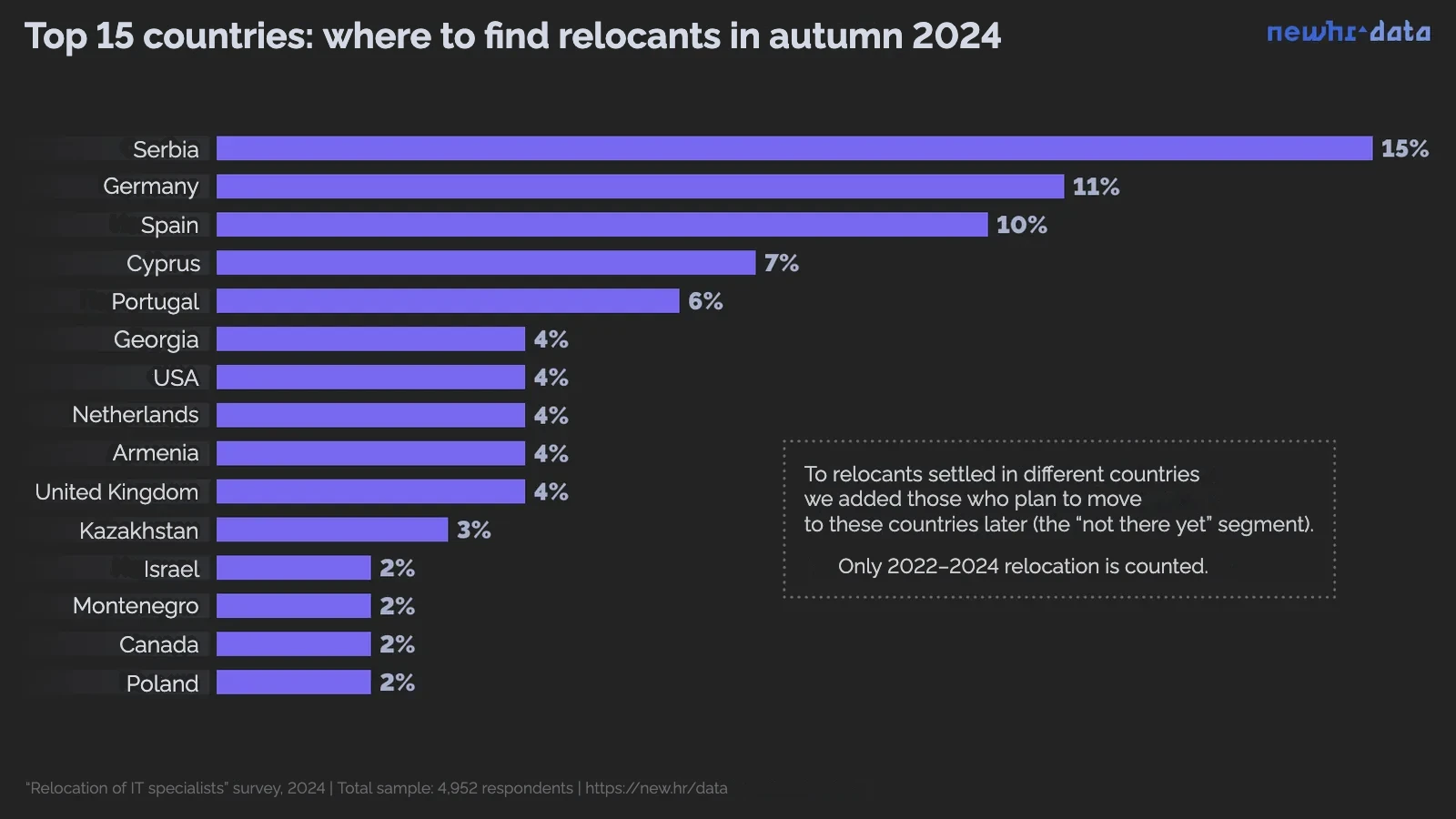
Serbia is the favourite country of IT relocants
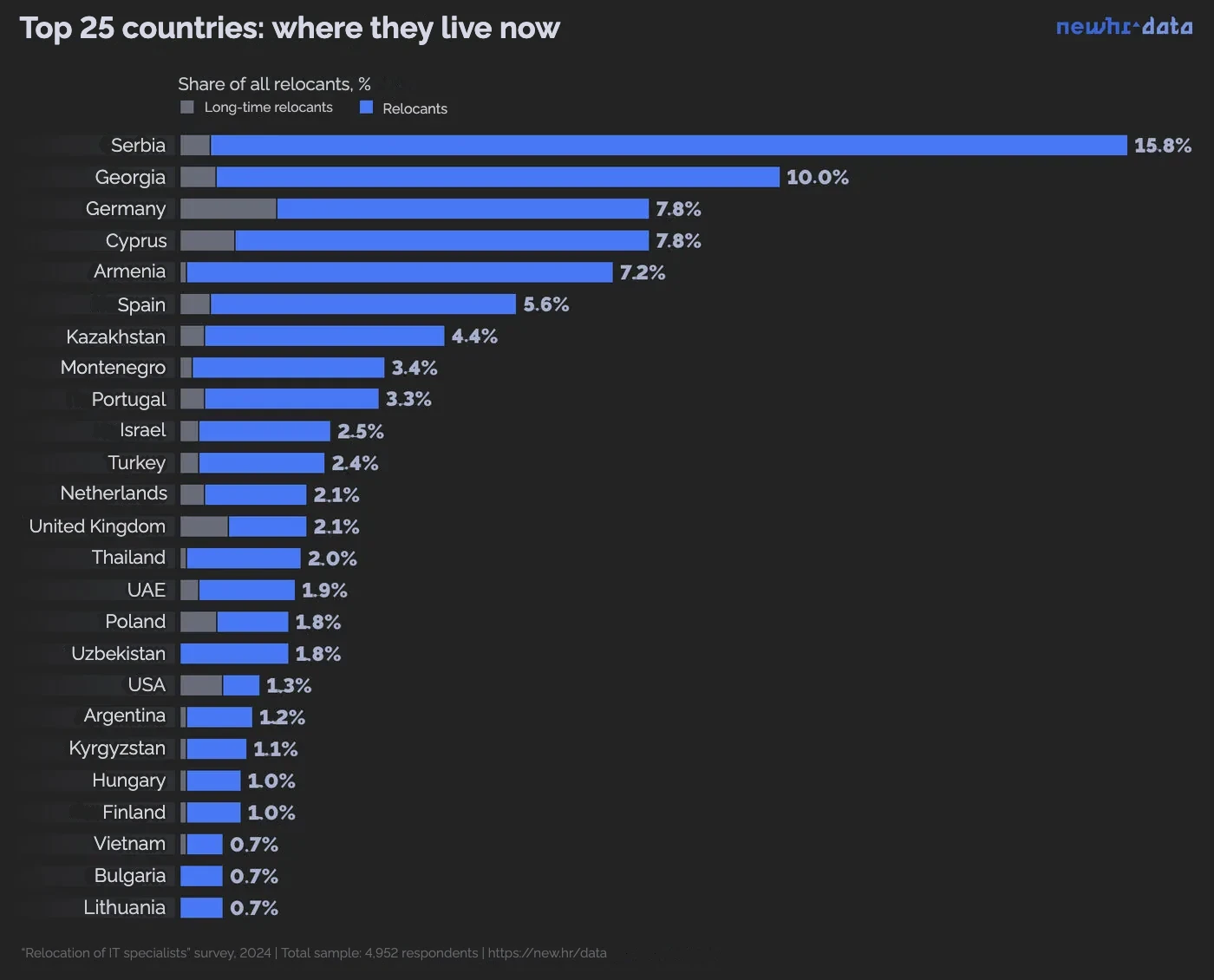
Number of respondents: 2,691 (top chart), 2,365 (bottom chart)
- For this, we added up relocants who have settled in different countries and those who only plan to move there (the "not there yet" segment).
- Serbia is in first place again. Germany and Spain are catching up with it.
- Georgia and Armenia no longer make the top 5.
- The forecast applies only to relocants of the 2022–2024 wave.
- There are few "digital nomads" in our sample, only 18%.
- About 82% of those who left in 2022–2024 either stayed in the first country they moved to or changed two countries.
- The remaining 18% moved more often (changed three or more countries). For comparison: only 10% of long-time relocants (before 2022) were this active.
"It's interesting that it was Serbia that came to embody the hopes and needs of IT relocants. I'd guess this happened thanks to a similar cultural environment, proximity to Europe, a reasonable migration policy, relatively low taxes, and also the friendliness of Serbs towards Russian-speaking people.
All this led to a Russian-speaking IT hub growing, and still growing, precisely in Serbia. Both large and small Russian-speaking companies are opening offices here. This makes Serbia an increasingly attractive place for IT professionals who want to relocate."
Kira Kuzmenko, CEO NEWHR Data
Only one in five relocants left alone
Question: Which of your close ones did you leave Russia with? (more than one option could be selected)
Number of respondents: 2,823
2 out of 3 relocants moved abroad with a partner.
1/5 of all relocants moved with children.
The same number, 1/5, moved with pets.
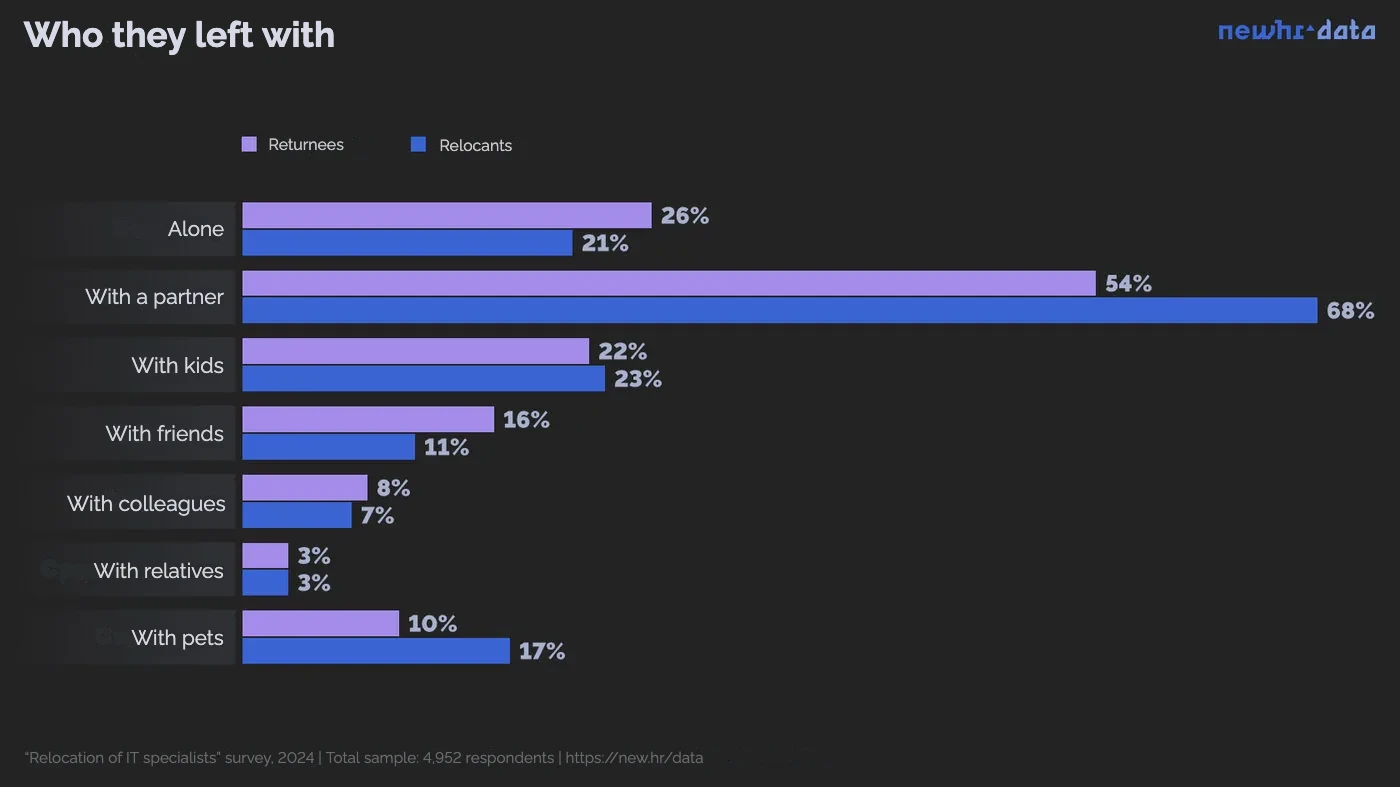
"Our research shows that the fewer companions a person has, the more likely they are to return. The vast majority of returnees and relocants in our sample did not leave the country alone.
Most often respondents (54% of returnees and 68% of relocants) left with their spouses. Children came next (22–23%). A significant share took pets with them.
These are not just fun facts, but an indicator of how serious people's intentions are. Any travel is harder with children and pets. The large shares of children and pets show that people uprooted their whole household, seriously and for the long term. In our view, this points to a desire to settle in another country and not return in the near future"
Alyona Makarova, Head of Research, NEWHR Data
Most relocants and returnees left at their own expense
Question: Who provided your relocation to your current host country / new country?
Number of respondents: 3,149
It seems that claims like "companies are moving all IT people out" are a myth.
Most relocants (59%) and long-time relocants (47%) relocated on their own.
Returnees have the highest share of those who relocated without any support (72% of all returnees left without employer support).
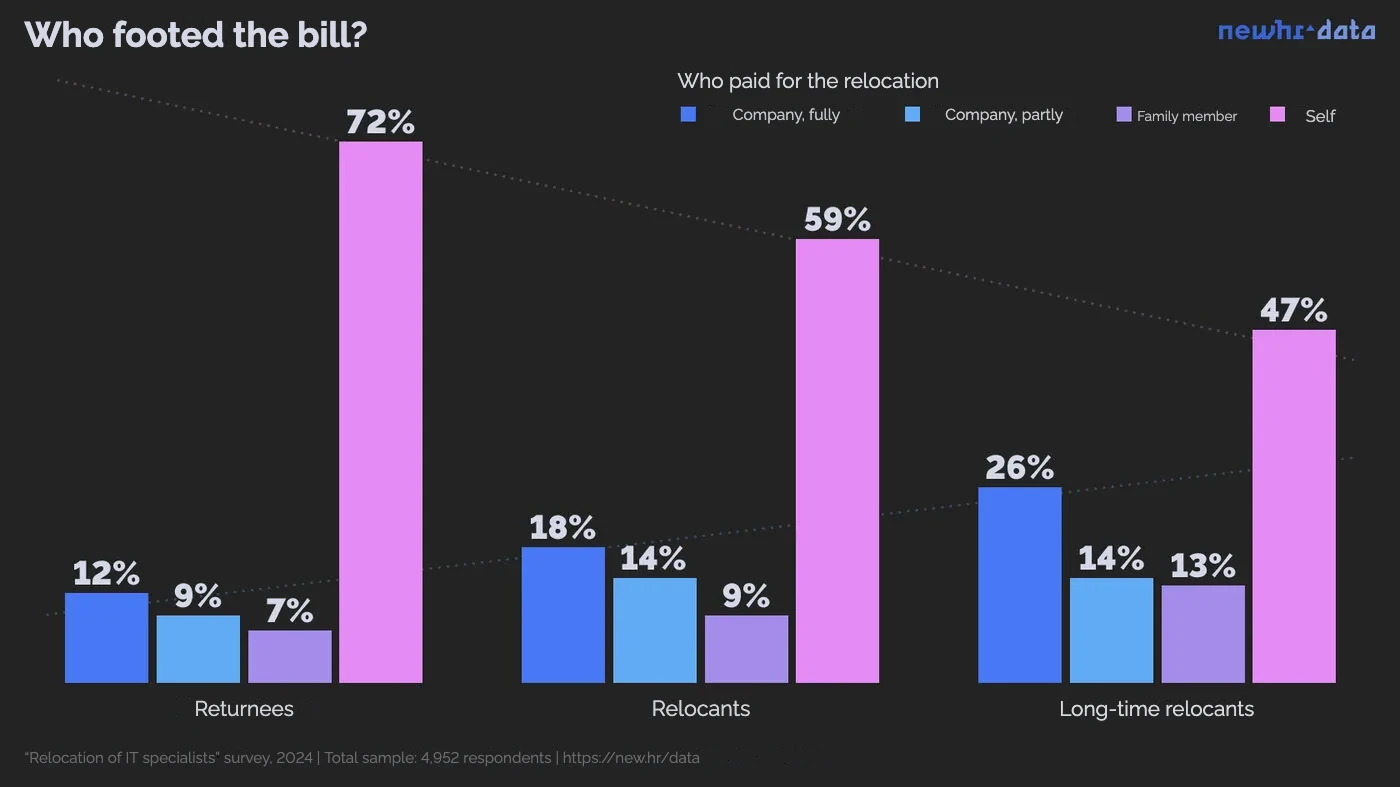
- Full financial and legal support from the employer
- Partial employer support
- Support from a family member
"Most IT professions make it possible to find a job on a new market on your own. The only obstacle to further career prospects on the global market can be poor English.
Based on the experience of students on our job search course Hello New Job! and of placing candidates at international companies (the recruiting agency NEWHR), specialists in technical roles (developers, DevOps engineers, testers) simply need acceptable English: the ability to understand what you're told in an interview and to answer in a somewhat understandable way.
But product managers, project managers, analysts, marketers and managers need very good command of the language and the ability to communicate freely, regardless of the context and the other person's accent. This creates additional difficulties for them when looking for a job on the global market."
Kira Kuzmenko, CEO NEWHR Data
WORK: wishes and reality
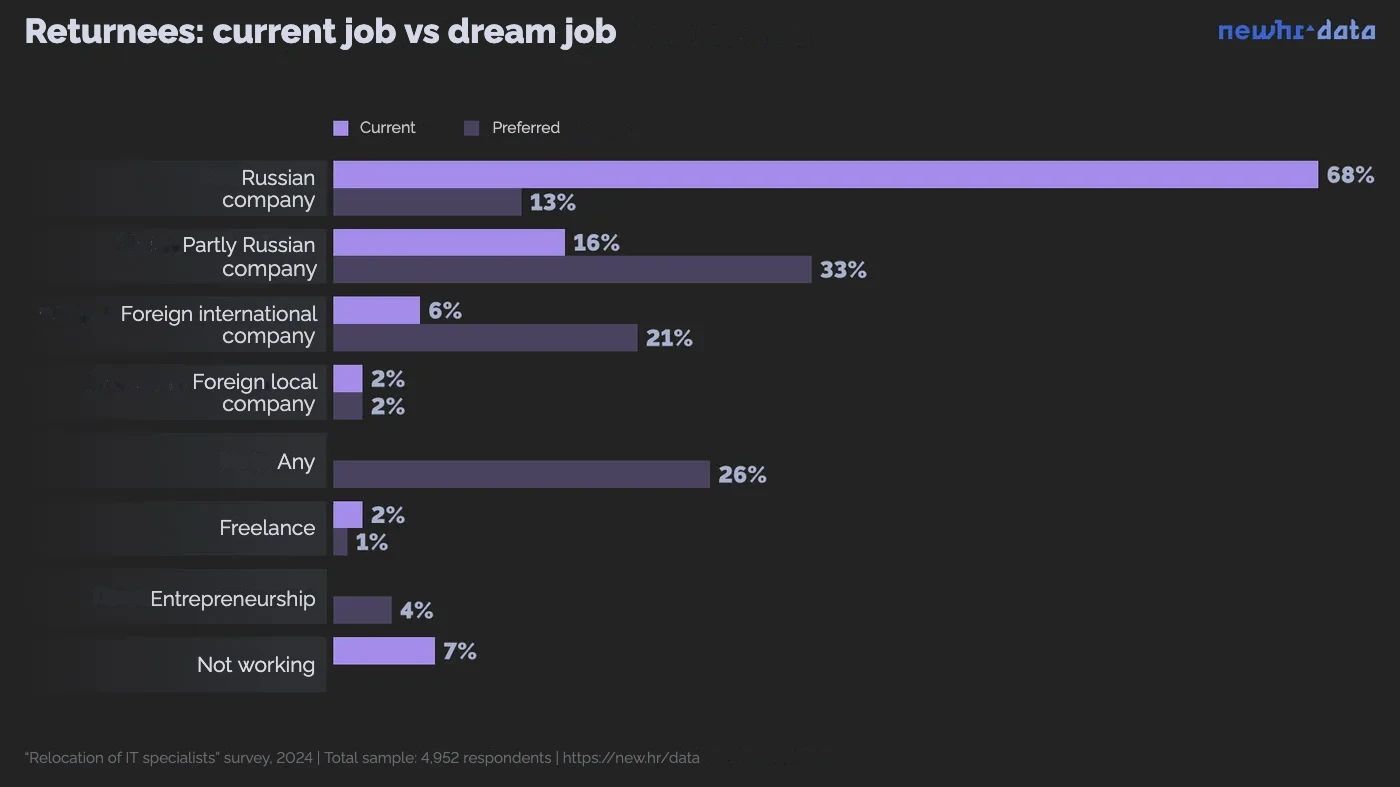
- Relocants are not at all interested in working for companies in Russia
Number of respondents: 4,952
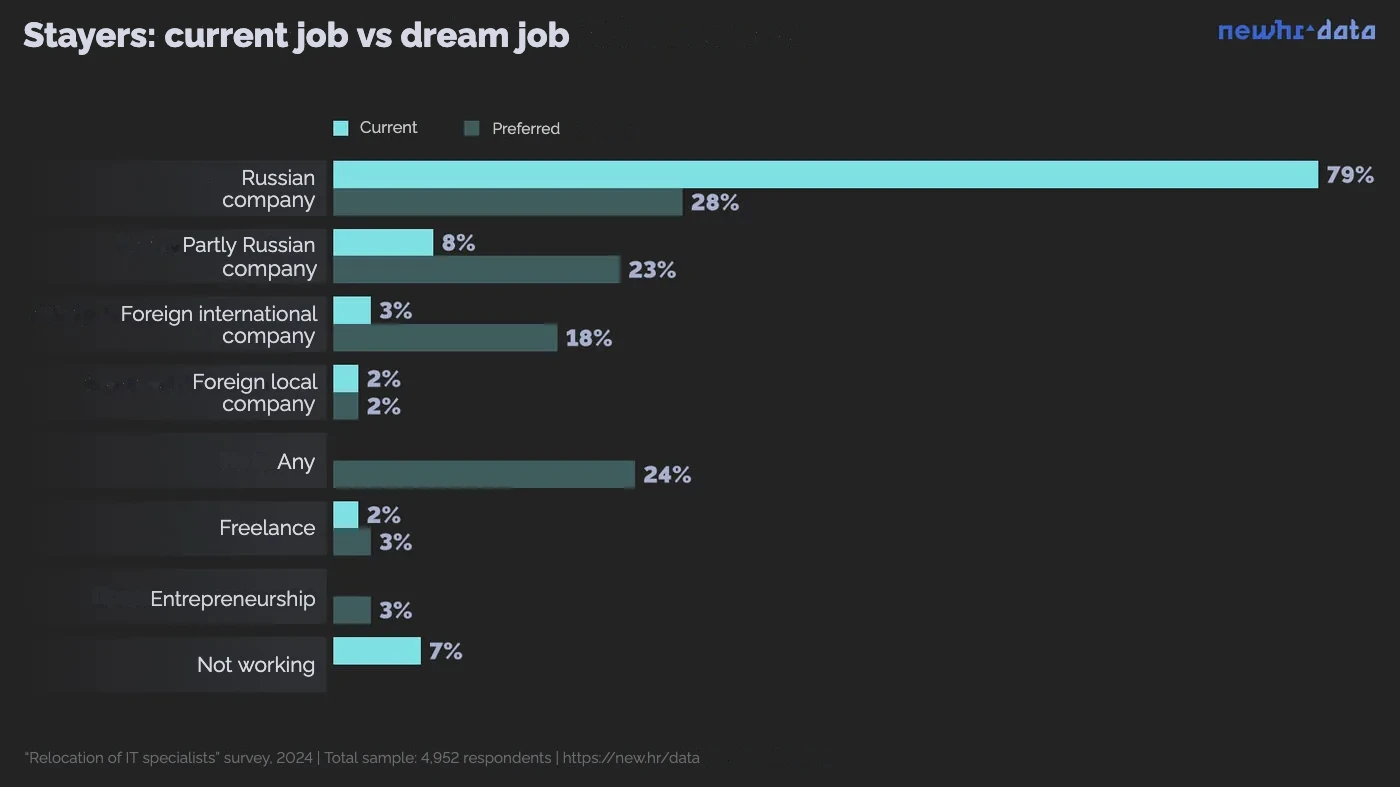
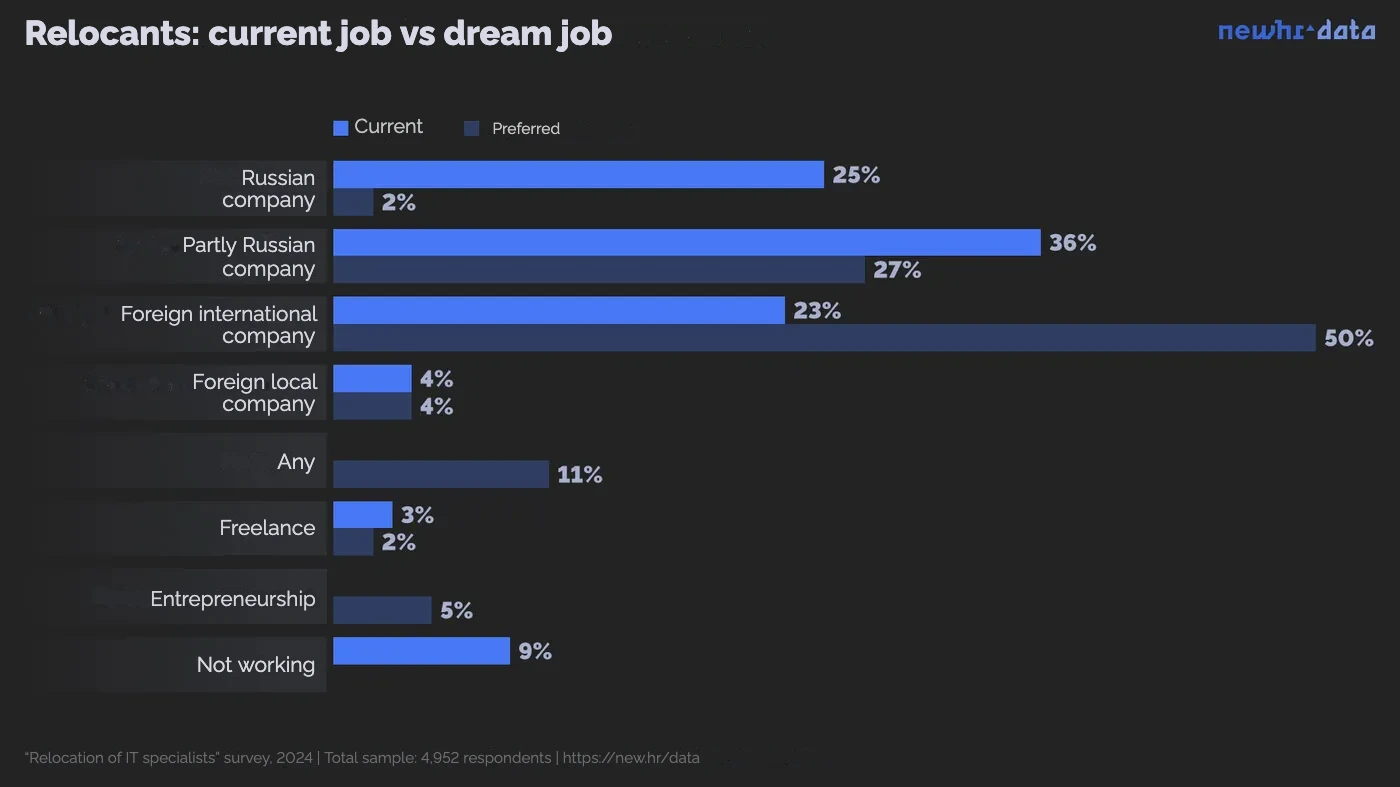
In this group of charts we compared the actual and desired workplaces of different groups.
To make people choose options that truly matter to them, we deliberately made the question about the desired workplace a closed one (only one option could be selected).
The share of those who want to work for Russian companies is lower than the share of those who actually work there. This holds for all groups, including those staying in Russia. Among relocants this share is very low (1–2%).
Employers should pay attention to the "Doesn't matter" segment among desired employers. This is the share of respondents (11–26%) who most likely have no clear strategy or preference regarding the company's location. Which means they can be attracted with interesting tasks and salary.
The difficulty of adapting to new cultural codes. In some cases people are not ready to accept a new culture and prefer working in a culturally close environment.
Kira Kuzmenko, CEO NEWHR Data
The general crisis in IT, which started in 2022 and is still not over. Many were laid off or let go from international companies. See the post in my Telegram channel: "When will the crisis on the global tech market end?".
Some Russian-speaking IT professionals deliberately choose to work on projects with Russian roots. When it comes to the European market, local projects are rarely innovative or technologically advanced. That's why some Russian-speaking IT professionals prefer remote work on a project linked to Russia over a less ambitious local one."
Already "emigrants"?
- 60% of those who left use the word "emigration"
Number of respondents: 4,952
- Relocation — a temporary move to another place, often for professional reasons.
- Emigration — a move to another country for permanent residence.
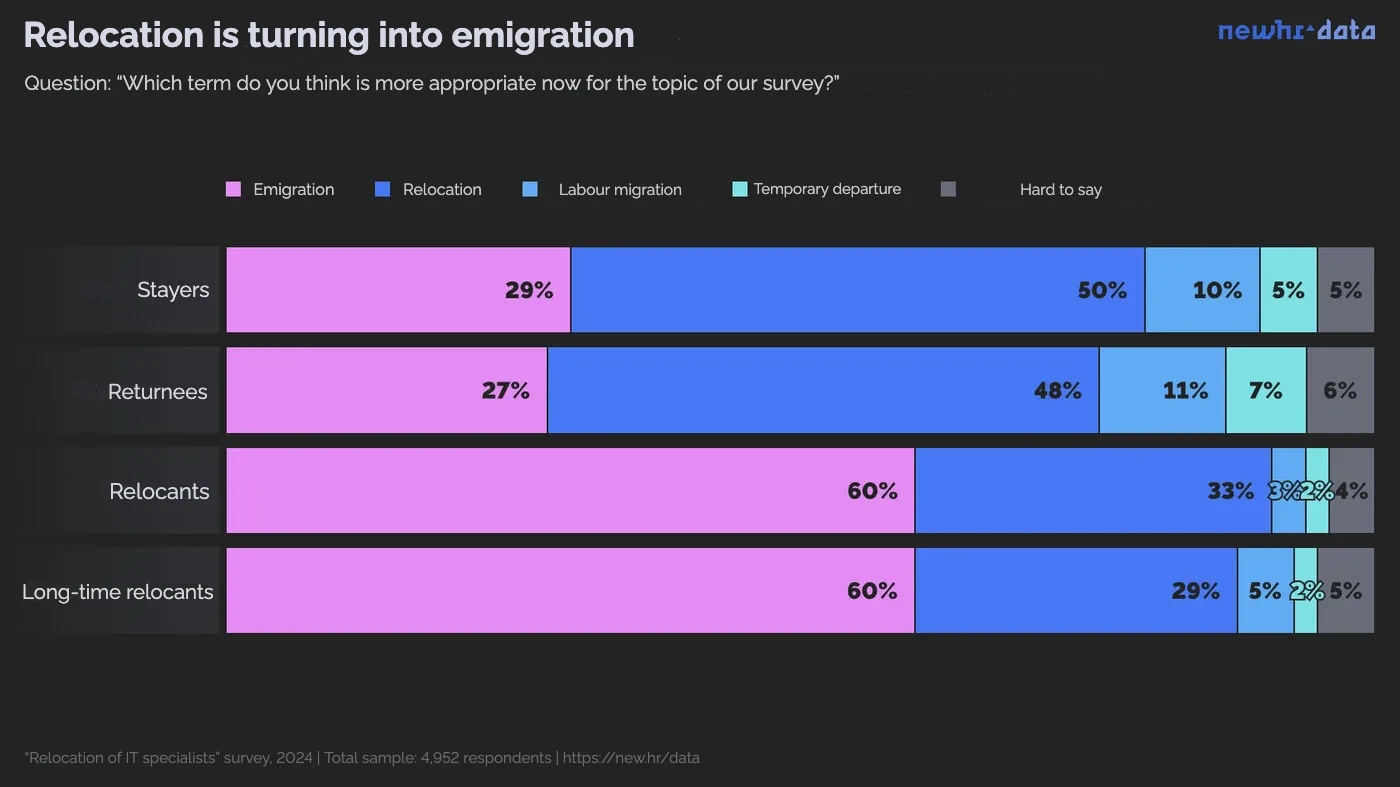
"For 2/3 of relocants, their departure is becoming emigration. Our survey data reflect their acceptance of their own identity: 'Yes, we are emigrants'.
The process began in 2022, when the vast majority of them left. Today it is harder for this group to pack up and go back than it was two years ago. Back then, little held them in the new place, while a lot remained in the old one, at home.
All this time many have been settling in abroad: sorting out documents, opening bank accounts, renting or buying housing, sending children to school, building connections and contacts. As a result, some of them are now closer to a new citizenship than to returning to Russia.
What does this mean for the market? People are less inclined to return, and no reverse migration wave should be expected. Most likely, those who will return are the ones for whom emigration didn't work out, namely building the legal, financial and social conditions for living and growing in the host country."
Alyona Makarova, Head of Research, NEWHR Data
Research summary
Who left?
- Most of those who left are mature professionals. We can see this from their age and grade.
- Respondents aged 30–40 relocated most actively.
- Seniors make up the largest group among relocants (41%). They are followed by middles (28%) and team leads (18%).
- But drawing conclusions only from the data above is risky, since more middles and seniors took part in our survey than team leads, top managers and juniors. This broadly matches the distribution of grades on the market, but does not give an accurate picture of people's relocation behaviour within a grade.
- That's why we present data on relocation behaviour within each grade:
- How many have returned?
- NEWHR Data figures differ noticeably from what has been published in official sources.
- According to data from the Russian Ministry of Digital Development, two thirds of the IT professionals who have left since 2022 have returned to the country. An expert of a parliamentary commission put this share even higher — at 80%.
- According to our research: by April–May 2024, 16% of the IT professionals in our sample who had left the country since 2022 had returned to Russia. If we add those who only plan to return, this share rises to just 19%.
- How many relocants plan to return?
- There are plans to return, but only among a few. Only 3% of relocants were preparing to return to Russia from abroad at the time of the survey (May 2024).
- Relocants' plans for how long their emigration will last: 44% said they will "never" return to Russia. 31% said they are staying abroad "until the situation in Russia changes".
- Where do relocants want to work?
- Relocants for the most part do not want to work for Russian companies.
- Only 1.7% of relocants want to move specifically to Russian companies. 64% are strongly against it.
- 27% of relocants want to work for "partly Russian companies", and only 0.5% are strongly against it.
- 50% of relocants want to work for international companies, and 1% are strongly against it. Yet only 23% of people in this segment actually work for international companies.
- A quarter of relocants want to work specifically for "partly Russian" companies, while at the time of the survey (May 2024) 36% of relocants worked there.
- 25% of current relocants keep working for Russian companies. Yet only 0.4% (less than half a percent) want to work there.
- Do relocants work for Russian companies?
- Yes.
- 25% of 2022–2024 relocants keep working for companies inside Russia. Yet only 0.4% of them said a Russian employer is their preferred option. 9% of them are aiming for partly Russian companies. The rest are interested in foreign employers.
- Long-time relocants also keep working for Russian companies: 13% of those who left before 2022.
- What are the current relocation dynamics?
- The general trend of 2024: relocation activity is slowing down and IT professionals are "putting down roots" where they are now.
- Those in Russia are mostly aiming to stay in Russia. Those who have relocated, on the contrary, want to put down roots in their current country and not move again.
- How can companies from Russia attract a relocant?
- Relocants are interested in working conditions that allow them to live abroad.
- So if you need to hire a relocant who is not ready to return to Russia, the employer will have to make compromises.
- For example, offer remote work, agree to a particular employment arrangement, offer pay terms that may appeal to a relocant.
- On the other hand, some relocants see Russian products as more technologically advanced, complex and ambitious than European ones. For example, in fintech, delivery, foodtech, edtech and other industries. Russian employers should emphasise this when selling a vacancy to such candidates.
- What are the relocation plans of those who stayed in Russia?
- 23% of the IT professionals among our respondents living in Russia are aiming to relocate.
- In our opinion, the percentage of those who actually carry out these plans will be much lower. Those who want to leave don't always realise that this is emigration with all its difficulties, not relocation (a temporary move).
- Those who consciously decide against relocation choose to build a career on the Russian market and refuse to consider offers from abroad.
- NEWHR recommendations on hiring Russian-speaking IT professionals abroad
- When hiring and opening an office abroad, take into account the top countries where IT professionals are now.
- Keep in mind that the activity of moves between countries has dropped significantly. This means it will be harder and harder to pull a relocant to a country that is new to them. Many have settled in their current countries and intend to integrate and legalise their status there.
- So if you can't attract specialists to an office in your location, offer remote work.
- Advantages of partly Russian companies worth using when selling your employer brand: cool, technologically advanced products and a familiar cultural code.
- Note that specialists are not spoiled by employer support. So if you offer help with a residence permit, family reunification and so on, it can become a notable competitive advantage.
- What to do if you are struggling to hire IT professionals?
Come to us at NEWHR Recruiting for hiring. We'll help you build a realistic search strategy so you can hire the experts you need within a reasonable time frame.
For candidates
Relocation of juniors and interns
- Unfortunately, juniors and interns (trainees) will find it hardest to relocate.
- According to our research, interns are the least relocating grade. Only 26% of the interns in our sample relocated; 65% are staying in Russia.
- There are only slightly more junior relocants. 30% of juniors became relocants; 57% are staying in the country.
- If you are an intern or junior in IT, think carefully before moving. Getting an offer abroad won't be easy.
- Either secure an offer while you are still in Russia. Or assess whether you have other sources of funding and support from your close ones.
- Why does support from close ones matter? You will need to focus seriously on your work tasks to grow out of being a junior as fast as possible. And that's not easy during relocation, when you have to deal with lots of other issues alongside work.
- Relocation of middles
- Middles are a grade that both relocated actively (28% of the relocant segment) and returned actively. Middles are the largest (33%) segment among returnees.
- It is possible that middles find it harder than seniors to gain a foothold abroad. The most likely reason: the costs of moving and the more expensive life in another country, while middles earn less than seniors.
- There are quite a lot of middles among those who didn't go anywhere and stayed in Russia (31%).
- In our view, middles' success in relocation depends not only on hard skills but also on soft skills. For example, on the current market an employer would rather relocate a senior than a middle. But if a middle, in addition to sufficient hard skills, shows communication skills, initiative, motivation and a willingness to lower salary expectations while growing to senior, the chance of interesting an employer will be higher.
- Our recommendation for middles: choose first of all countries with a long list of "partly Russian" employers. These are Serbia, Cyprus, Armenia. Your chances of getting hired by partly Russian companies are noticeably higher than by foreign ones, which clearly prefer seniors.
- Relocation of seniors
- Seniors are, obviously, the grade most in demand among employers (both Russian and foreign).
- Our research data show that seniors are the most relocating grade (41% of the 2022–2024 relocant segment). The share of seniors is also high among long-time relocants — 46%.
- Among those staying in Russia, the share of seniors is 26%. That's less than, for example, the share of middles (31%).
- If you are a senior and you're struggling to find a job abroad, we recommend first of all dropping the stereotypes of 2021. Don't expect to be flooded with job offers. When you enter the global market, you face global competition.
- The crisis in IT is still not over. The number of vacancies on the international market is still much lower than at the start of 2022. Many foreign companies have moved their hiring from Europe and the US to Asia. Read more about when the crisis on the global market will end here.
- Another tip: start your international career at partly Russian companies. It will be easier for you there thanks to a shared cultural code and lower English requirements.
- If you want to find a job at a fully foreign company, allow at least 6 months for the search.
- Relocation of managers
- Team leads don't do as well in relocation as seniors. But better than all the other grades. 51% of team leads are relocants and only 34% chose to stay in Russia.
- Among the top managers in our sample, relocants (42%) and those staying (41%) are split evenly.
- For top managers it is both harder and easier. Harder, because there are on average fewer suitable vacancies for them than for other grades. Easier, because top managers can be in fairly broad demand and on different markets.
- The main difficulties in finding a job abroad: high English requirements (no lower than C1), adapting to other management cultural codes and a relatively small number of vacancies on the market.
- If you are a manager and you're struggling to find a job abroad, try stepping down a grade or look for a job at partly Russian companies.
- Relocation of different specialisations
- According to our data, there are no IT professions for which relocation is easiest. We collected data on 21 specialisations. They all have a similar distribution of relocants and those who stayed.
- A small difference is visible only among testers. The share of relocants among testers is 1/6 lower than the average for other specialisations.
- If you want to know the relocation strategies of specialists in your profession, leave your email and we'll send you additional materials
- The overall relocant profile
- It's best if you are a senior relocant aged 34–37. You have seriously decided to move and are relocating with your family. Both you and your partner work. You look for a job first of all among "partly Russian" companies.
- The hardest time will be for an intern or junior aged 16–28 who is moving alone. Relocation will not be easy for you, but it is possible.
- Probably hardest of all for top managers. For them everything is too individual given their background and expectations. A great deal depends on the top manager personally, on his or her actions and choices.
- It will be easier for you to relocate if you…
- Are ready to move on your own and don't expect employer support.
- Plan at least three, or better at least six, months for the new job search.
- Have a financial cushion for 3–6 months
- Are ready for a drop in income and standard of living.
- Choose as your location a country where a sizeable IT community has already formed and can support you at first. Choose from the top 5 countries where Russian-speaking IT relocants are now.
- Start your international career at partly Russian companies. Use our free list of 400 companies with Eastern European roots that have entered the international market.
- If you have no experience of looking for a job on the global market…
- Look closely at partly Russian companies (those that have entered a foreign market). This way you avoid problems with cultural codes (this especially affects managers), and the interview process itself will feel familiar.
- Use our free list of 400 companies with Eastern European roots that have entered the international market.
- Subscribe to a vacancy channel that suits you. We publish vacancies from Russian-speaking companies there every day, including remote jobs and vacancies in different countries.
- If you are firmly aiming to work only for foreign companies…
- Pay attention to startups. On average they are easier to get into, and the competition may be lower than at large companies. Here is a handy list of startups sorted by country.
- Monitor vacancies on Wellfound, Otta, RemoteOK, We Work Remotely.
- First experience on the global market is sometimes easier and faster to gain through freelance or contract work. Take a look at these platforms: Toptal and Upwork.
- Looking for a job on the global market requires somewhat different skills. You should learn in advance how to build an effective job search system and start developing new skills.
- For example:
- Take our intensive course Hello New Job! You'll get a job search system and put together all the tools you need. The course is built so that you are sure to develop all the skills you need and understand the employer's logic!
- If you are not planning to change jobs right now…
- Don't wait until things get hot! The market is quite turbulent, so we recommend thinking about your future career now.
- Review your career strategy in light of the new market realities. It's useful to do this about once a year.
- Do strategic networking. Statistically, offers come fastest through referrals.
- Think about what you can already do for your professional brand. Recall the most difficult case of the past year, describe it in the STAR format and post it on LinkedIn.
- If you want to learn to look for a job once and for all...
Come to our course Hello New Job! — you'll put together all the tools you need for a job search and build up the candidate skills you need.
Relocation strategies of different professions
Our partners
We thank everyone who shared information about our research and helped us collect such an impressive sample! 💙
The list of partners is below. If you helped us find respondents but don't see your channel on the list, write to data@new.hr. If you'd like us to correct anything in the description, write to us too!
- Remocate.app — A Telegram channel and website with remote or relocation vacancies.
- Prodcast — A channel about job searching in the US from career coach Anna Naumova (ex Apple).
- Devs.kz — A channel about IT careers in Kazakhstan and Central Asian countries from Google experts.
- Roem.ru — A news site specialising in events on the Russian internet and in the Russian internet business.
- Podlodka Crew — Online IT conferences in a new format — one-week intensives with daily Zoom sessions, a Telegram community and top experts.
QA Sklad
- A channel with useful materials and links for testers.
Artsiom Rusau QA Life
- A channel about testing.
IT - стажировки и обучение
- A channel collecting information about internships and training in IT.
- Digital Ниндзя — Alexander Ilyin's personal channel about IT, things around IT and himself in IT.
Боль Тимлида
- A chat about team leads and for team leads.
Свои люди в Сербии
- A private chat for relocants created by Kira Kuzmenko.
Свои люди в Армении
- A private chat for relocants created by Kira Kuzmenko.
- Сербия и гедонизм — A channel about life in Serbia from corporate media editor Anastasia Derbasova.
- Осетинская — The Telegram channel of journalist Elizaveta Osetinskaya, author of the channel "Русские норм!", which tells the stories of people who have succeeded in Russia and around the world, and founder of The Bell, an online business publication.
- IT Relocation (Inflow) — A channel with vacancies from IT companies offering moves and relocation abroad from Russia, Ukraine and CIS countries.
Remote Junior
- A channel with remote vacancies for junior IT specialists.
- Gamedev Jobs (Inflow) — A channel with gamedev vacancies hand-picked by an industry veteran.
- Remote IT (Inflow) — A channel with remote vacancies and projects for IT specialists.
- Dev & ML Jobs за рубежом — A channel with vacancies from 200+ foreign companies with Russian-speaking founders or teams.
- Connectable Jobs Abroad — A channel with vacancies from 200+ foreign companies with Russian-speaking founders or teams.
- NEWHR — The channel of the NEWHR recruiting agency about its team and projects: news, interviews, expert commentary, materials on IT market realities and research results.
- Доказательный рекрутинг — The personal channel of Kira Kuzmenko (NEWHR) and Ksenia Zamukhovskaya (Postgres Professional) about solving business problems through hiring and surviving in a candidate's market.
- Hello, New Job! — A channel about job searching and employment: instructions, tips, useful practices.
- Hello, New Job! старт курса — The private chat of the "Hello, New Job!" course — Kira Kuzmenko's own course that teaches a systematic job search in today's reality.
Рекрутинг и жизнь
- A Telegram channel with memes from the lives of recruiters and candidates.
- Kira Kuzmenko — The personal page of Kira Kuzmenko, founder of NEWHR and author of the "Hello, New Job!" course.
- Рекрутинг, котики и апокалипсис — Kira Kuzmenko's personal Telegram channel about life inside recruiting and among cats.
- Anna Naumova — A career coach in the US: CV, LinkedIn, interviews, offer. Impostor syndrome and procrastination.
Yulia Pogrebenko
- HR Business Partner | People partner.
Aleksandr Petrenko
- Software Engineer | Golang Engineer.
- Aleksandra Kravchenko — Team Lead Marketing Operations, Zalando. Digital Marketing expert and result-oriented Leader.
Marianna Plekhanova
- HRD | HRBP at DataSakura.
Pavel Rasshcheplyaev
- IT Project manager | IT project coordinator.
Igor Larionov
- Software | Data Engineer - Adjunction.
- Alexander Zharkov — CEO at Hello IT Safari | Senior Software Engineer | Tech interview | Career Consultant.
Kristina Milkova
- Senior Associate Talent Acquisition at Publicis Sapient.
Irina Nikiforova
- Legal manager, Legal counsel, Lawyer, Contracts manager.
Kristina Mikhailova
- Snr. Product Manager IT.
Anton Tarasov
- Top Rated Freelancer | Web Developer | MODX Expert.
- Anna Sapega — HR Assessment | Learning and Development | HR Analysis | HR Generalist.
Evgeniy Vovney
- Lead Systems Engineer | Dev(Sec)Ops.
Valeriya Mikirtumova
- International Recruitment | Leading | Sourcing.
Irina Kolobova
- HR project management | Human Resources Director | HRBP.
Julianna Shevtsova
- HR with 12 years of experience.
Mark Kandaurov
- IT Recruiter.
Anton Suchkov
- Product designer | Design lead.
Georgy Neyaskin
Editor in Chief at NEWHR.
Egor Yatsenko
Founder & Sourcing coach at Sourcing School.
Mikhail Eshcherkin
- C&B specialist at HRBG.
Elena Tarasova
- Head of Recruitment & Career consultant — SalesMatch.
Andrei Shcherbukha
- Senior Project Manager | PMO.
Vlad V
- Frontend Developer.
- Job in IT & Digital — A channel with IT & Digital vacancies that you won't find on job sites.
- Job for Analysts & Data Scientists — A channel with vacancies for digital analysts and data scientists.
- Job for Sysadmin & DevOps — A channel with vacancies for DevOps engineers, system administrators and SREs.
Job for Go & Rust Developers
- A channel with vacancies for Go and Rust developers.
- Job for Producer — A channel with vacancies for producers: digital, gamedev, education, creative, media, production.
Job for PHP
- A channel with vacancies for PHP developers.
Job for PR & SMM
- A channel with PR and SMM vacancies.
- Job for Mobile — A channel with vacancies for mobile developers: iOS, Android, React Native.
Job for Python
- A channel with vacancies for Python developers.
- Job for IT TOP — A channel with vacancies for technical leaders: CTO, CIO, Head of Development/QA/DevOps.
- Job for Sales & BizDev — A channel with vacancies for salespeople, business developers, account managers and CCOs in IT & Digital.
- JVM Jobs — A channel with vacancies for Java, Groovy, Kotlin, Scala, Clojure developers.
Job for Gamedev
- A channel with gamedev vacancies.
Job for C & C++
- A channel with vacancies for C and C++ developers.
Job for Frontend & Node.js
- A channel with vacancies for JavaScript and Node.js developers.
- Job for Media & Content — A channel with vacancies for editors, copywriters and content managers.
Job for C# & .NET
- A channel with vacancies for C# and .NET developers.
Job for Chiefs
- A channel with vacancies for top managers in IT & Digital.
- Job for HR — A channel with vacancies for HR, recruiters, HR BPs and HRDs in IT & Digital.
- Job for Products and Projects — A channel with vacancies for product managers, product owners, project managers and CPOs.
- Job for QA — A channel with vacancies for testers, automation engineers, QA and TestOps.
Remote Geekjob
- A channel with remote vacancies for IT & Digital specialists.
Job for Junior
- A channel with vacancies for entry-level specialists in IT & Digital.
- Job for Designers — A channel with vacancies for designers, art directors and UX/UI designers.
Job for Marketing
A channel with digital marketing vacancies.
Adapted from the original article in Russian on newhr.org. Read the Russian version.