2022 sharply changed the priorities of many Russian-speaking candidates and employers in the IT market. In the second half of 2023, NEWHR Data studied the attitudes of technical leaders living abroad. In particular, we looked at how interested they are in Russian employers and what they need in the current situation.
Research goal
We wanted to find out what Russian employers can offer to attract in-demand CTO-level candidates. Such candidates used to have to be headhunted even before, and now they have become less accessible because of relocation.
We answer the question: what can a Russian employer offer today for a CTO who has moved abroad to consider its job offer?
In this article we describe the key results of our research in brief.
Who this article is for
- Russian companies that want to attract experienced Russian-speaking CTOs working outside Russia.
- Companies with Russian roots that hire Russian-speaking top executives abroad.
- CTOs and top managers who are interested in how leaders at their level choose employers.
You will learn what the candidates you are targeting pay attention to, and you will be able to factor this into your EVP, your value proposition for candidates.
Whose views we studied
Our focus was technical managers: leaders in positions such as engineering manager, head of development, CTO and so on. They have at least three managers reporting to them and at least 15 people in their organisation in total. For simplicity, in this article we will call them just "CTOs".
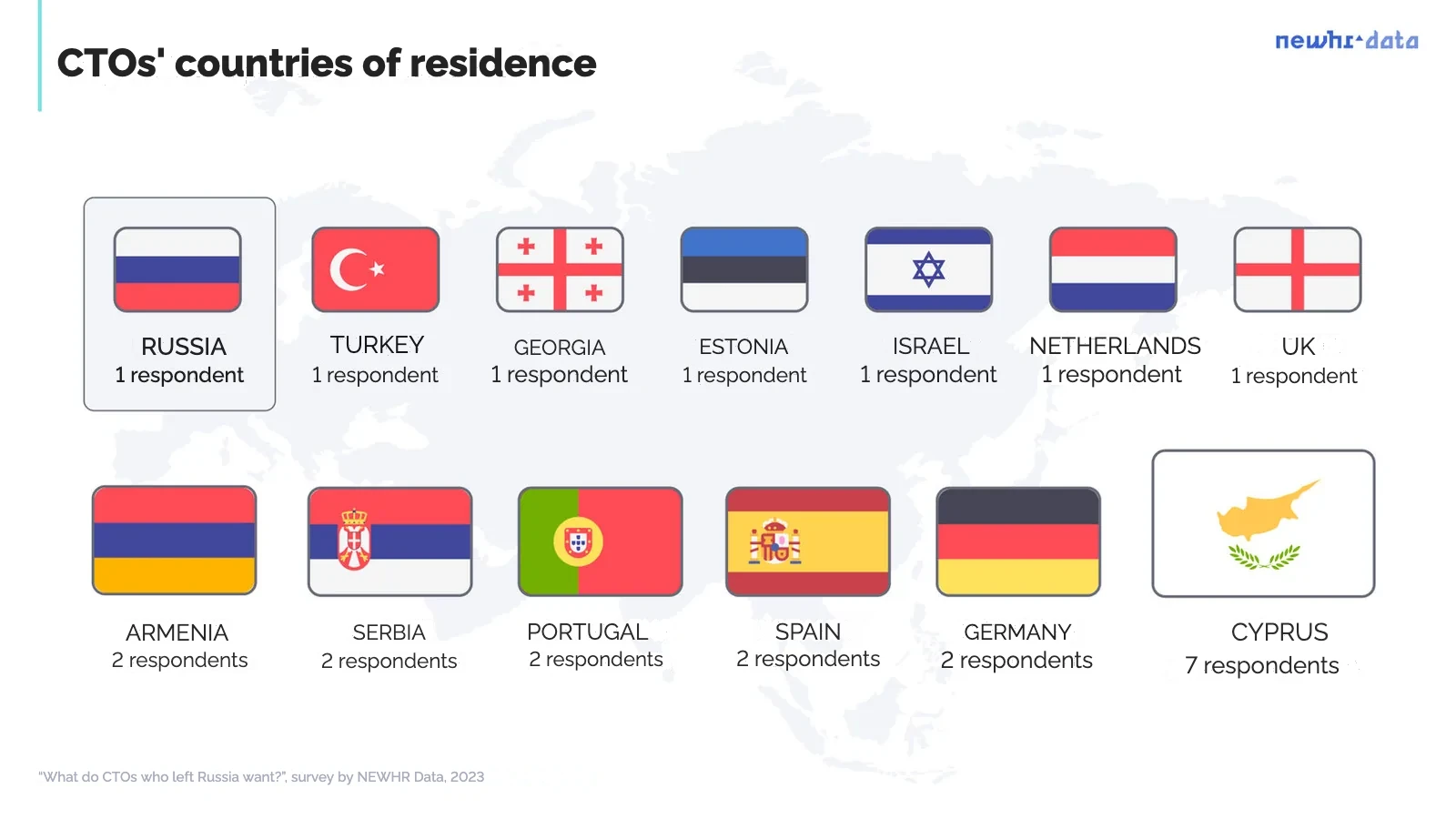
Our respondents are 24 experienced technical managers who currently live abroad and work both for foreign companies (Bolt, Delivery Hero, etc.) and for companies with roots in Russian-speaking markets (inDrive, TripleTen, Miro and others).
- Respondents' specialisation: technical, engineering, infrastructure.
- Total management experience: 3 to 10 years. This includes experience managing other managers (team leads) of 1 to 5 years.
- Team size: 3–16 managers and 30–550 specialists.
- Current position: CTO, engineering manager, VP of engineering, head of development, platform lead, head of backend.
- Companies they work for: large (big tech) and mid-sized technology companies.
- Not actively looking for a job.
- Mostly live abroad.
How we did the research
It was important for us to study respondents' needs, expectations, difficulties and concerns in depth. So we ran a qualitative study rather than a quantitative one (such as a survey with a standard questionnaire).
We collected the information we needed through in-depth semi-structured interviews, that is, conversations of 40–60 minutes with each respondent.
We have supported the observations and conclusions in this text with anonymous quotes from the interviews.
Why this sample?
On average, 6 to 12 interviews with a careful sample are enough to identify stable patterns of behaviour. For our purposes we settled on 24 interviews. That is enough to identify the main behaviour patterns of CTOs and the factors that influence them.
What types of employers do CTOs distinguish?
Based on the interviews, we can identify four types of employers that attract or repel CTOs living abroad.
1. "Domestic Russian" companies
Based in Russia and building products for the domestic market. According to our respondents, working for these companies carries certain risks:
- The country's technological lag has been growing since 2022.
- The state is expanding its influence in the economy.
- Product quality is declining.
- The Russian market is separating from the global one.
- Sanctions against companies from Russia.
Since our respondents mostly live abroad, they often find "domestic Russian" HR brands unattractive for professional fulfilment and career development.
Some CTOs said they keep following the Russian market in order to hire specialists for their teams. Others have lost touch with the agenda completely and no longer have a clear picture of what is happening in Russian IT.
2. Companies under state influence
These are "domestic Russian" companies whose business is directly or indirectly influenced by the state (some respondents call them by the slang word "gosukha", roughly "government shops"). Interview participants usually associate this category with:
- Low-quality projects.
- No aim to build high-quality products.
"Russia is complicated for me. I would have named 'Yandex' to you [as an attractive employer]. But in the current situation I really don't want to get involved. I've always been allergic to anything government."
3. "Russia-adjacent" companies
Based outside Russia but connected to the Russian IT industry. These can be branches and legal entities of Russian companies abroad. Or foreign companies with Russian-speaking founders and teams.
Our respondents mostly view such companies positively.
- These businesses work on the international market or are in the process of entering it.
- Unlike "domestic Russian" companies, they do not suffer from the risks of being in Russia. This means they are safe for respondents in terms of business development and obtaining legal status in other countries.
- They keep the organisational culture and working language that respondents are used to. So it is easier for respondents to adapt and grow in such companies.
Examples respondents named: EPAM, Wrike, Semrush, Miro, the companies of Yandex abroad, and so on.
"Maybe there are exceptions, like 'Yandex'. Because I know it, I love it and I understand how things are done there. But again: I won't go to the Russian 'Yandex'. We had talks with the Israeli one."
4. Foreign companies
These are companies with no ties to Russia and free of the risks of the Russian IT market. Some of the CTOs we spoke with already work at such companies. Others note that getting a job at a foreign company takes preparation and special effort.
What scares CTOs off the Russian market
A threat to personal safety from being in Russia.
"I love my country very much. But I don't want to go back there now. And right now I don't want to have any relationship with it, because everything is too risky."
Losses in professional development. In respondents' view, the Russian IT market is increasingly closing itself off from the global one. This brings risks of falling behind, and of having no access to cutting-edge technologies and projects in the local market.
"The Russian market is limited. Russia is one of the countries in the world. I want to be a citizen of the world and be able to work at any company that suits me in one way or another. So it's important to be able to work at an international company that will let me go on to work in any country and company in the world."
Projects under state influence are often of low quality and have no aim to build a good product.
Reputational risks. Experience at a Russian company may be viewed negatively by potential employers abroad.
Personal principles. Working for a Russian company and paying taxes into the Russian budget goes against the views of some of our respondents.
"Even remote work isn't interesting. I'd still be paying taxes there. And that is still, in some form, support for what is happening now."
Lower standard of living. Income and its purchasing power in Russia have fallen.
What CTOs want from employers in general
The concerns listed above lead to a list of respondents' needs that an employer could meet. The overall list of goals looks like this.
1. Safety guarantees for themselves and their families
Many CTOs explain their departure from Russia by concerns in exactly this area. Although life abroad has its own difficulties.
"I moved to Cyprus for personal reasons and so that the company would feel protected. But having moved here, I understand that this is not a place where I would like to stay. <...> There is a thought of moving [from Cyprus to another country]. But right now, in my view, it's impossible to make plans. We already have a semi-positive experience of moving. And whether to try to move somewhere in the next year is still unclear. Of course, there is a thought [that] if everything in Russia returned to normal in the foreseeable future, then maybe it would be worth going back. But not for now."
2. Remote work or an office
For some respondents, being able to choose where to live and work fully remotely is important.
Others are interested in having an office abroad (although everyone notes this is not a must-have). The point is that our respondents are managers, and it can be hard for them to manage a team remotely.
"If the company is from Russia, especially a large one, then it shouldn't be remote work! And remote work in general isn't really that interesting to me. I'm interested in working in an office today. I can clearly see how important it is for culture and for speeding up decision-making."
The ideal option is to work at a branch of the company outside Russia, in an attractive country. Interview participants consider, for example, Germany, the Netherlands, the UK, the US and Canada "attractive". Some respondents also put Cyprus, Portugal, Spain, Serbia, Croatia and other countries in this category.
3. Legal status
Some respondents want the employer to help them obtain legal status abroad: a residence permit, permanent residence and so on.
"You can keep repeating the magic words: interesting tasks, a more competitive salary and something else. But in reality all of it will break against one fact: to stay abroad legally right now, you need grounds for it."
"I'm not considering other countries for now, for at least about another year. <...> I depend on a work visa."
4. A familiar culture
An advantage of Russian employers for CTOs who have left is a familiar working language and organisational culture. "Russia-adjacent" employers with a familiar culture can be seen as a transitional stage before the candidate moves into the international market.
"I'm looking for exactly the kind of company where, ideally, nobody is a native speaker but everyone speaks English. And it's best of all to work with Russians, because the culture will be more or less similar too, and so will adaptation. I don't mean speaking Russian inside the company. That's not my goal. My goal is just to get into an environment where people have gone through the same problems and are understanding about it. They know it takes time to brush up your language."
5. Professional development
This covers conditions that may be hard to provide inside Russia after 2022:
- using cutting-edge technologies thanks to an open market and international projects;
- building high-quality, in-demand products that are not limited to the Russian market;
- working with world-class experts.
"I definitely don't like looking after things that already work, mindlessly tightening the bolts, doing maintenance. I prefer building."
6. Standard of living
CTOs would like their income and quality of life to stay at the same level despite the change of location.
Special requirements for "domestic Russian" employers
If a company works mainly on the Russian market, our respondents will care about:
- The option to work from an attractive country.
- A salary in foreign currency, protected from rouble exchange-rate swings and from losses when transferring money abroad.
"Work at a Russian company? <…> I think, yes, something could be worked out. At such a company you could take a higher position [than mine now]. Because I understand that right now I can't manage people in English at all. <...> But there [at a Russian company] you could go and do what I've been doing for the last five years. That is, set up processes in a team, help somehow, be useful. If they offer a good project, a good team, a good, well-established attitude inside, and the salary is pegged to a foreign currency, then okay."
- Compensation for the difficulty of working for a "domestic Russian" company. In particular, the chance to gain experience or build a financial cushion for further career development in other countries.
"I feel a bit safer here, where I live now [not in Russia]. But overall, probably, if I understand that this [an offer from a Russian company] will cover my life plans <...> and the salary is one and a half to two times higher than what I have now, I'll really think about it. Maybe I'll even agree [to return to Russia]. But for the same amount I won't even think about Moscow. Everything is great for me here [in my current place] too."
- The company builds products for the European or international market as well.
- A high-tech brand. Some companies in Russia, such as "Yandex", are still seen as such by CTOs.
"'Avito', Ozon, 'Tinkoff' are all the top of today's market, for the most part the creators of these technologies. <...> I don't know, Russia is cut off from the world now. How this will play out is unclear. But in general, of course, these companies are the top of the market for all these tools."
- A well-prepared, educated, professional team.
Are CTOs ready to work for companies from Russia?
It was important for us to find out how CTOs who have moved abroad feel about the idea of working for a Russian company. On this question, respondents can be divided into three segments.
Segment 1. Ready to consider working for a Russian company
They accept working for a company from Russia from outside the country. But ideally they would like to work for "Russia-adjacent" companies abroad.
"I definitely don't think that working at Russian companies is something bad. I look at it purely pragmatically. How it will change my strategic goals. If they could pay me in Moscow and in Saint Petersburg money, a salary, that is decent by, let's say, world standards, and at the same time… Well, that is, if my purchasing power could be the same as that of an average, let's say, European, then I don't mind. I'm ready to work in Russia remotely and so on."
Segment 2. Interested, but on certain conditions
Potentially ready to work for a Russian IT company as a transitional option. In this case respondents want to gain professional experience or a financial cushion in order to then get a job at a company outside Russia.
"If there were something that could really interest me, lure me away, it would be something big <…> For example, 500 people reporting to me — now that's a level! Probably, of the things I'd want: a large and stable company. And, obviously, ideally something not from Russia. You want to work because you like what you do, not because you're afraid you won't have enough money. So I have an idea of how much I would want [from a Russian company]."
Segment 3. Not ready to consider Russian companies in any form
These technical managers no longer plan their careers in the Russian market or do not want to work with companies from Russia on principle.
"Any work in Russia and for Russia in the near future will, one way or another, again be not about doing the job, but about cost-cutting, survival, restructuring, adaptation and so on, and so on, and so on. I don't want that."
"A Russian company is risky and sad."
For some, it is important to work in a culture different from the one common in the IT industry of Russia and a number of neighbouring countries.
"The best way would be to compare the CIS approach and the European approach. <...> [In the CIS and Russian big tech] it is either some degree of survival through crunch projects, crunch delivery, or an attempt to capture the market, again through crunch development. Everyone piles on at once and we do the five-year plan in three years.
Here [in Europe] everything is very different. The company's main focus is on being sustainable — very stable, specifically in the long term. Almost all changes that are made are made through quite a large number of experiments."
Conclusions and recommendations
1. "Domestic Russian" companies hold little appeal for in-demand Russian-speaking CTOs who have moved abroad. The main reason is Russia's country risks: a possible technological lag, growing state influence, declining product quality, a closed market.
1. CTOs are interested in "Russia-adjacent" and foreign companies, not "domestic Russian" ones. Study participants are especially wary of Russian companies under sanctions and under strong state influence.
1. "Russia-adjacent" companies attract Russian-speaking CTOs with a more familiar culture compared with other foreign employers.
1. CTOs are wary of returning to Russia from abroad. So they mainly consider vacancies with remote work or (in some cases) with an office abroad.
1. Some CTOs are ready to work for "domestic Russian" companies on special terms. For example, this could be a job that helps them gain unique experience or build a financial cushion for the future.
1. Companies from Russia that hire candidates abroad need to be present in the information space of the countries where Russian-speaking IT specialists live. Otherwise your HR brand may be forgotten outside Russia, or people may form an inaccurate picture of it.
1. The international recruiting agency NEWHR Recruiting can help you find candidates in Russia and abroad. We specialise in hiring developers, product managers, analysts, marketers and HR professionals. Write to us at contact@new.hr
Research author: NEWHR Data. We analyse the Russian IT market and the international tech market. We run public and commissioned research for companies. You will find more research at this link. Our email: data@new.hr
NEWHR Recruiting is an international recruiting agency specialising in hiring developers, product managers, analysts, marketers and HR professionals. If you need help finding experienced professionals around the world, write to: contact@new.hr
Hello New Job! is an author's training course that gives you a system for job hunting in today's conditions. The course is useful for those who are already looking or plan to look for a job in Russia, the US or Europe.
Subscribe to our Telegram channels so you don't miss interesting and useful materials: NEWHR, Hello New Job!, and also "Recruiting, cats and the apocalypse".
Adapted from the original article in Russian on newhr.org. Read the Russian version.