Market research · January 2025
Overemployment: a problem or the new normal in Russian-speaking IT? Part I
The NEWHR agency surveyed 3,169 IT specialists across 21 specializations, employees and employers.
- who does it and why
- how it affects the main job
- whether employer policies make a difference
- what works for business in the current situation

Kira Kuzmenko
CEO NEWHR
Overemployment became a hot topic in 2022, when the IT bubble burst, companies began mass layoffs, and for the first time in many years IT specialists found themselves in a situation where there were fewer vacancies than candidates. At the same time, IT salaries had grown significantly during the "fat years" of 2019−2021, and employees' expectations, of course, stayed at the same level.
That was when it became clear that some people were ready to deceive employers outright, combining 2 or more full-time jobs or topping up their income to the level they needed with side jobs outside working hours. Striking cases of this kind appeared on the market, and everyone started talking about the problem at once.
In 2024-2025 the topic did not go away, and we at NEWHR decided to find out whether the devil is really as scary as our collective imagination paints him. We surveyed 3,169 IT specialists (both employees and employers) to learn firsthand what is happening on the market now.
- Topics 1−4 on this page
- Read topics 5−8
- Go straight to the conclusions
About the research
How many? Who? From where?
The research was conducted as an online survey. Respondents were recruited through NEWHR's online media, partner channels and our own respondent database.
3,169 people
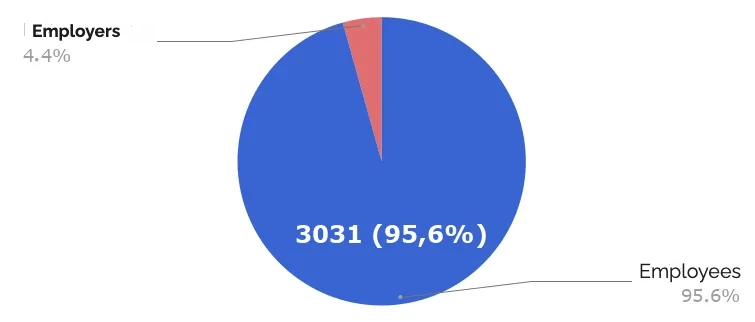
- 3,031 employees
- 138 employers
21 specializations
- Backend | Desktop | Embedded development
- Analytics
- Testing
- HR | Recruiting | HR-DevRel
- Frontend | Fullstack development
- Product management
- Project management
- And others*
6 grades
- Junior (Junior&Intern)
- Middle
- Senior
- Team lead
- Head of Departments
- Top Manager
4 types of companies
- Russian
- Partly Russian (operate abroad; founded by people from Russian-speaking markets)
- Foreign local (operate in the market of a single country)
- Foreign international (operate in many countries)
- * See all specialties of the survey participants
- Technical management | Software architecture
- Infrastructure | DevOps | SRE | NetEng | InfoSec
- Mobile development
- Design | 3D | animation | web | UX/UI/CX
- Digital | Offline marketing
- Data Science | ML | AI
- Data Engineering
- Top management | Founder
- Content | SMM | Technical content
- GameDev
- Sales | BizDev
- IT-Support
- PR
- Producing
Research terminology
Explaining the words
What we found: the term has many meanings
The term overemployment (commonly translated into Russian as "sverkhzanyatost") has become widespread in Russian-speaking IT. It is used for the phenomenon that in everyday speech is called a "side job," and in scientific terminology "secondary employment."
In the international field, however, overemployment is understood more narrowly: as a combination of two or more full-time jobs without the employers' knowledge. In this context the term takes on a potentially negative connotation.
The phenomenon itself is firmly associated with processes such as the hybridization and precarization of employment, and is seen as a marker of the systemic transformation of the labor market over the last 10 years.
- Our approach to the research — In this research we use the term overemployment in a broad sense, meaning both overwork and secondary employment in general (side jobs).
However, we place a special focus on "real" overemployment: an additional full-time job that is hidden from the employer.
We want to say a huge thank-you to everyone who took part in our research and helped us better understand this multifaceted phenomenon of the modern labor market. We invite you to explore the results!
If you would like to share your overemployment case (as an employee or as an employer), write to: over@new.hr.
Quotes from our respondents show the complexity and diversity of the overemployment phenomenon
"As an employer, I usually hire people for part-time side jobs paid by the hour. It pays off for simple projects with a fluctuating workload when there is no staff employee."
Quotes from our respondents show the complexity and diversity of the overemployment phenomenon
"I told them at work: either give me more money, or I'll look for a side job. They told me: go ahead [take a side job]."
Quotes from our respondents show the complexity and diversity of the overemployment phenomenon
"In Germany side jobs are prohibited by law. You have to get permission on request, and the question arises whether the company will approve it or not. IT specialists will most likely not get permission for a similar side job."
Quotes from our respondents show the complexity and diversity of the overemployment phenomenon
"I know that holding a second job is legal [from the point of view of the law]. The employer cannot influence this. Dismissal in this case is illegal."
Quotes from our respondents show the complexity and diversity of the overemployment phenomenon
"As an employer, I usually hire people for part-time side jobs paid by the hour. It pays off for simple projects with a fluctuating workload when there is no staff employee."
Quotes from our respondents show the complexity and diversity of the overemployment phenomenon
"I told them at work: either give me more money, or I'll look for a side job. They told me: go ahead [take a side job]."
Terminology: employees
- by whether or not they have secondary employment (mono-employed and poly-employed)
- by their attitude to secondary employment (principled and situational)
Mono-employed: those who do NOT practice side jobs. They work at one main job at the time of the survey, have not had a side job in the last 2 years and are not preparing to take one in the near future.
Poly-employed: those who practice side jobs. They work at more than one job at the time of the survey, or recently stopped having a side job, or are already starting one.
Principled: those who consciously and on principle practice mono-employment or poly-employment; repeat offenders.
Situational: those forced to practice side jobs for external and/or internal reasons in a particular situation.
By their practice of secondary employment, the poly-employed can be divided into those who practice the classic side job or classic overemployment.
Classic side job ("side job classic"): a practice in which people work a part-time side job and make no special effort to hide it from their employers. The legal arrangement varies.
Classic overemployment ("overemployment classic"): a practice in which people work full-time at another job and deliberately hide their overemployment from their employers. The legal arrangement varies.
Terminology: employers
- by hiring practices (normative and variable)
- by attitude to employees' secondary employment (tolerant and intolerant)
Normative: those who do NOT hire for side jobs, only for a main job. Opponents of side jobs.
Variable: those who hire employees for side jobs (mixed or only for side jobs). Supporters of side jobs.
Intolerant: they go after employees for having side jobs; opponents of side jobs on principle.
Tolerant: they do not go after employees and are not die-hard opponents of side jobs.
Other working concepts:
Types of companies
- Russian: founded and located in the Russian Federation (a variant is the Russian office of a foreign company).
- Partly Russian: has Russian roots, the team is mostly Russian-speaking, but the company is on a foreign market and has left Russia. The company may or may not continue doing business in Russia.
- Foreign local: the company has never been connected with Russia; most of the team are local specialists who speak the local language.
- Foreign international: the company has never been connected with Russia; the team is international.
- Company sizes
- Small: up to 50 employees
- Smaller mid-size: from 50 to 200 employees
- Medium: from 200 to 500 employees
- Large: from 500 to 1000 employees
- Major: from 1000 to 5000 employees
- Very large: more than 5000 employees
- A company that is part of a corporate ecosystem
- Types of people management
- Authoritarian, over-controlling: constant strict control of working hours and the tasks being done. Only the manager defines the tasks and how to solve them.
- Authoritarian: constant control, daily reports; only the manager defines the tasks and how to solve them.
- Liberal: flexible management; employees define the tasks and how to do them themselves, and the manager carries out final control of the quality and results of the work
- Democratic: weekly reports; the manager makes decisions in dialogue with employees.
- Democratic, self-control: periodic control; the manager makes decisions in dialogue with employees.
- Types of employer policy on side jobs
- Encouraging: additional professional projects are encouraged as developing employees' professional qualities.
- Tolerant: freedom of any alternative employment as long as it does not interfere with duties at the main job.
- Neutral: no ban on side jobs outside working hours. Whatever the employee does during that time is their business.
- Policy of privileges (individualized): there is no official policy; everything is decided individually.
- Prohibitive: a strict ban on any alternative employment (side job, sole proprietorship, self-employment).
Respondent profile
Who are all these people
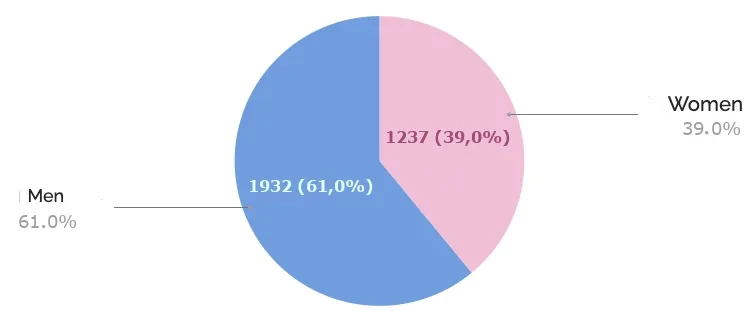
Total respondents: 3,169 people
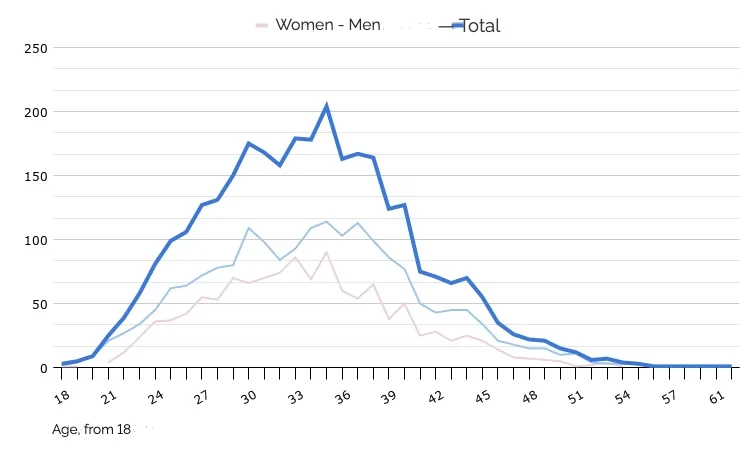
The typical respondent of this survey is a man, a senior backend developer aged 34, an employee of a large Russian company. With a 45% probability he has a side job, and in two cases out of three he is sure he is forced to do it for various internal and external reasons. He does not always do it, and only under certain circumstances.
Employees and employers
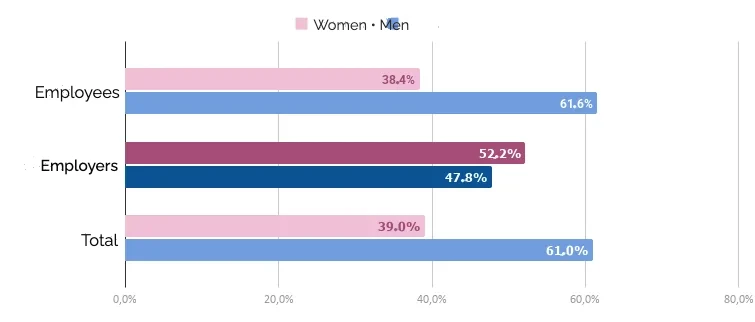
Respondents: split into employees and employers
Number of respondents: 3,169
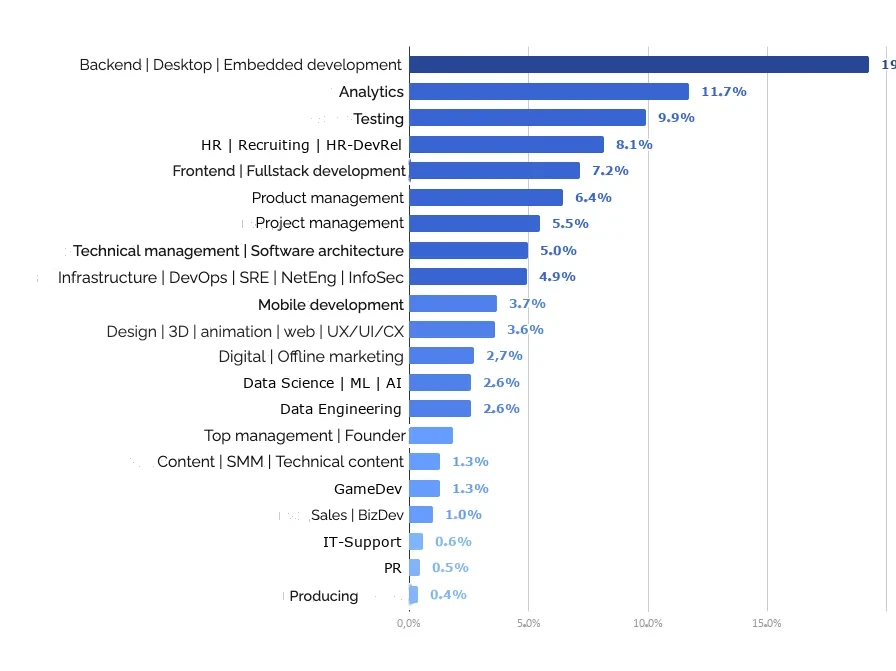
Employees' specialties
- Backend | Desktop | Embedded development
- Analytics
- Testing
- HR | Recruiting | HR-DevRel
- Frontend | Fullstack development
- Product management
- Project management
- Technical management | Software Architecture
- Infrastructure | DevOps | SRE | NetEng | InfoSec
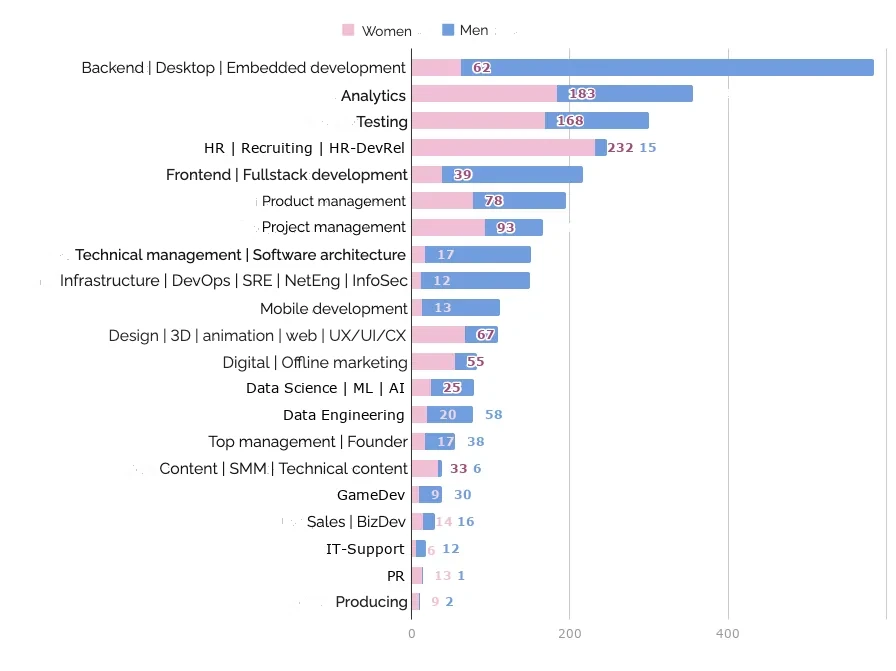
Specialties
Distribution by gender
Employees' specialties
Number of respondents: 3,031
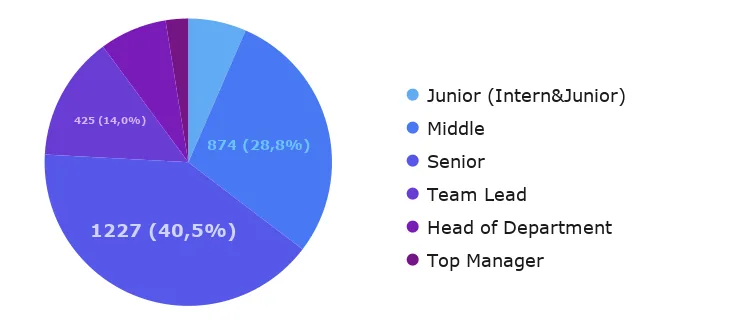
- Employees' grades — The sample best represents seniors (40.5%) and other senior grades.
- The share of middles is smaller than in the market structure.
- Interns and juniors are represented even more weakly (6.5% of the sample), so data on them should be treated with caution.
Respondents' grades
Number of respondents: 3,031
You can explore the profile of our respondents in more detail below: the charts show their age, gender, region of residence, etc. (see "Read more").
Topic 1. Side jobs: yes or no
To be or not to be?
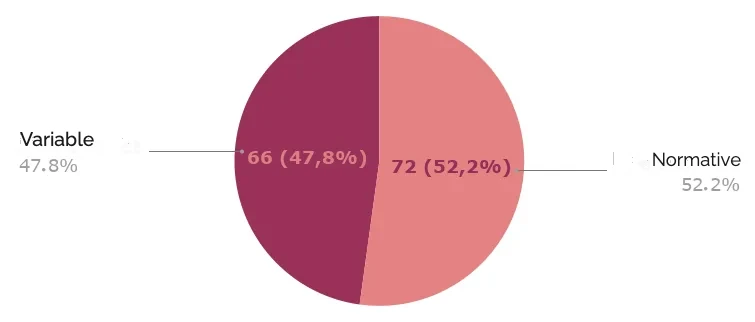
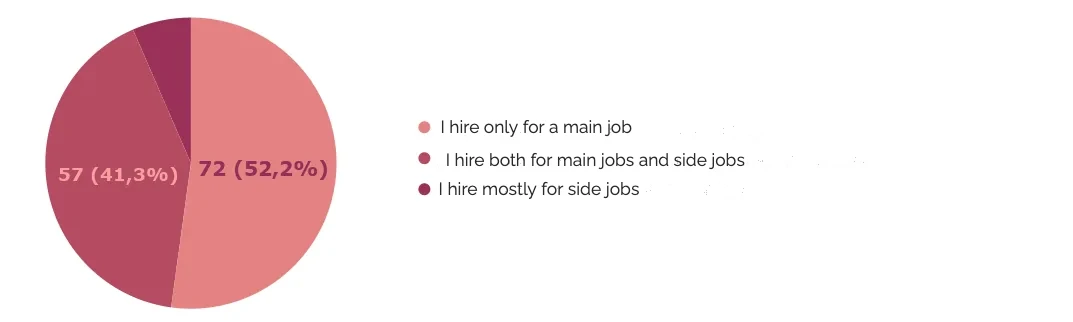
How do the employers in our research hire?
- 52% hire employees only for a main job;
- 48% consider it normal to bring in specialists through side jobs.
Keep in mind that the number of employer respondents is small (138 people) and representativeness is not ideal, so the sampling error may be about 8.5% at a 95% confidence level
More in the charts (see "Read more")
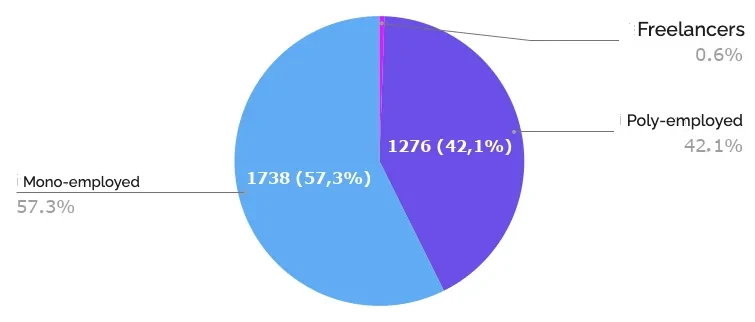
Do employees have side jobs?
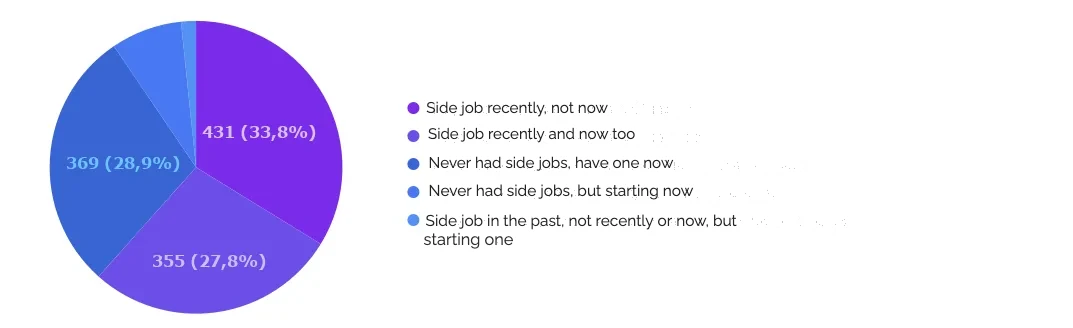
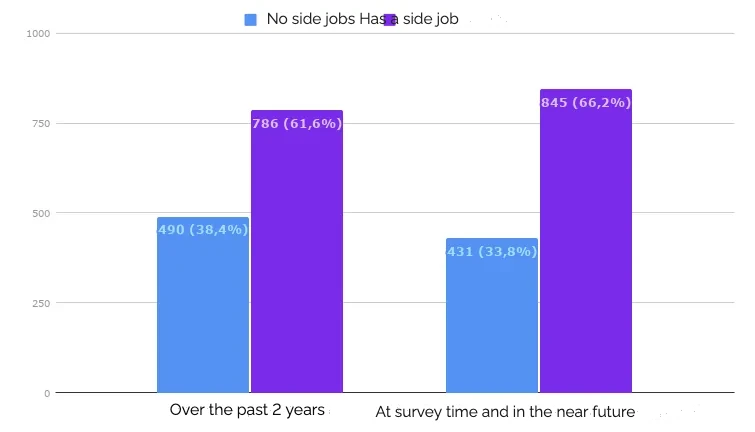
- Side jobs are unstable; it is a very changeable practice: up to a third of respondents change their habits within 2−2.5 years.
- There is definitely no significant trend toward growth in side jobs on the market. Over the last 2 years the number of people with side jobs in our sample grew by only 2%.
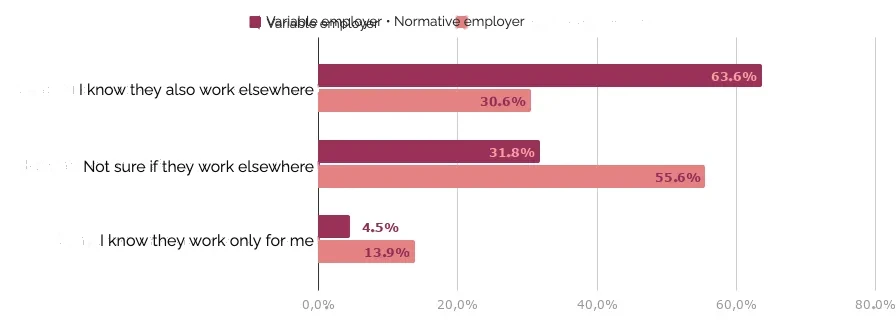
- Specialists have side jobs far less often than their employers think. At the same time, employers' opinion is strongly influenced by their own experience: if you hire other companies' employees, you are less inclined to count on the loyalty of your own.
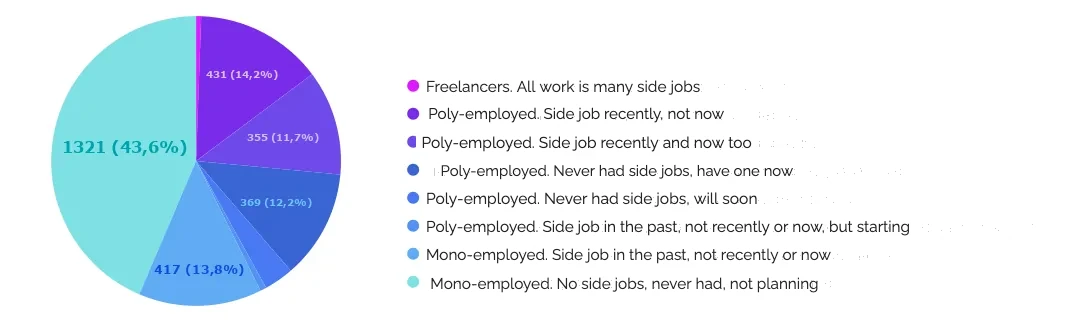
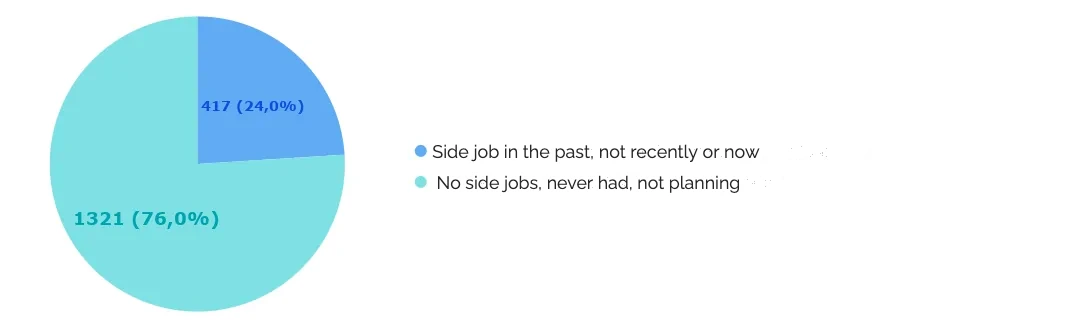
Do employees want side jobs?
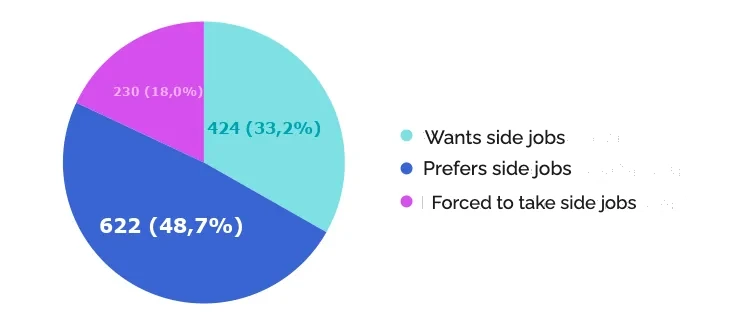
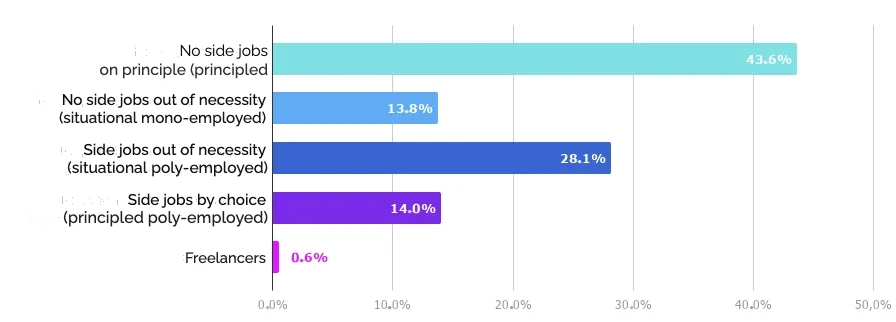
- Only 14% of all IT specialists in our sample have side jobs because they like doing it, without any need for it.
- Of those who have side jobs, 18% consider it a forced measure.
We identified 5 groups of specialists by their attitude to side jobs: from those who consider a side job a forced measure to those who will have a side job on principle under any circumstances. To learn the details and see the data we relied on, see "Read more"
Key takeaways of the section
It seems that despite the trends of the modern labor market, Russian-speaking IT specialists are in no hurry to part with the ideal norm: having a single main job.
In our sample we see only 14% who have side jobs on principle. And those who have never had a side job and do not want one make up 44%. The behavior of a significant share of employees is determined by context, i.e. these people react to circumstances.
This contradicts the impression formed in the general information space of the labor market: that most IT specialists have side jobs on principle, i.e. are conscious poly-employed repeat offenders. What is in the focus of the information field in fact has little to do with the real state of affairs.
Topic 2. Influencing factors
Never happened before, and here we go again
How can you predict whether an employee will have a side job?
Whether an employee has a side job is influenced first of all by their specialty and grade, as well as by the size of the company they work for. The type of company and even management's attitude toward employees play a much smaller role.
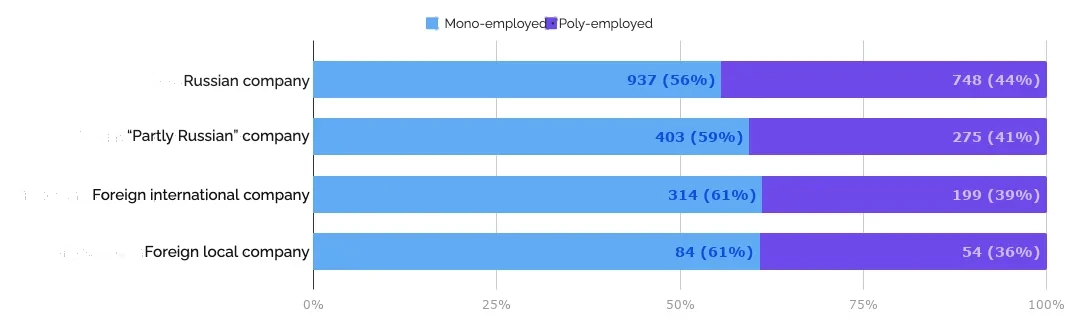
- Company type. The poly-employed and mono-employed are practically indistinguishable by company type. With one exception: employees of Russian employers have side jobs more often than their colleagues from partly Russian or foreign companies. But the difference is minimal: 3−5%.
- Age and gender. Side jobs are almost unrelated to gender and not at all related to the employee's age. But there are nuances here (we write about them below, see "Read more").
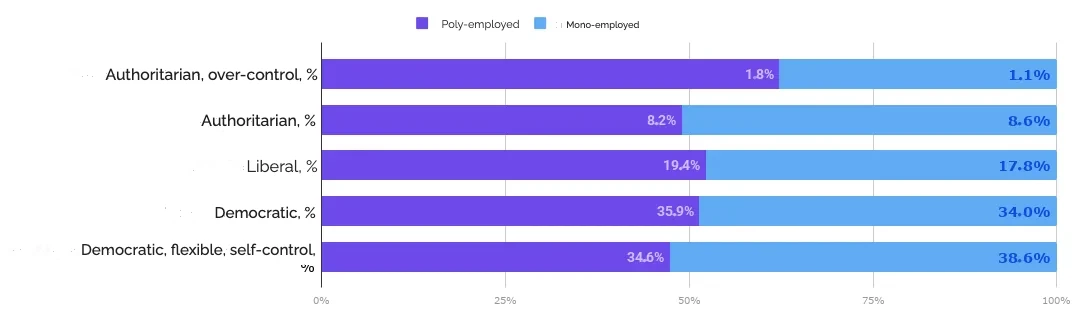
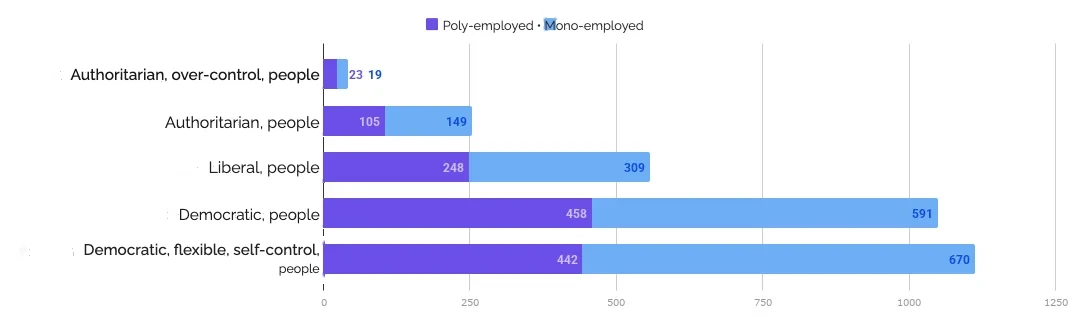
- Type of people management. Even this has a weak connection with whether an employee practices side jobs or not, although there is an interesting feature here too: the most authoritarian type of management is associated with a higher share of people with side jobs.
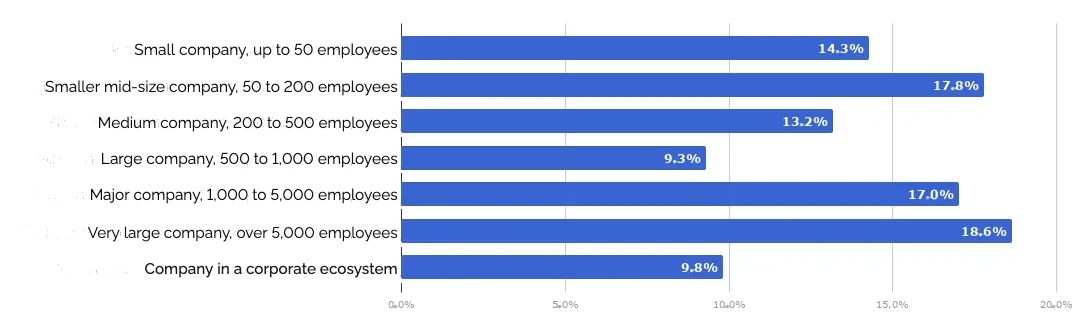
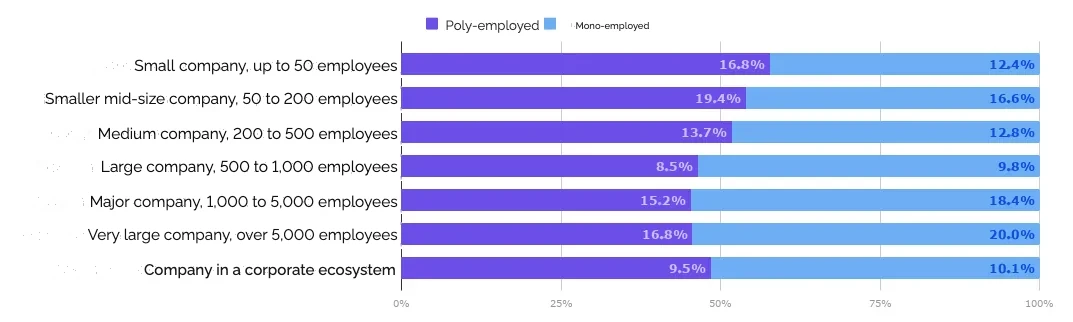
- Company size. The probability of side jobs is higher among employees of small, smaller mid-size and medium companies. In large ones people have side jobs less often.
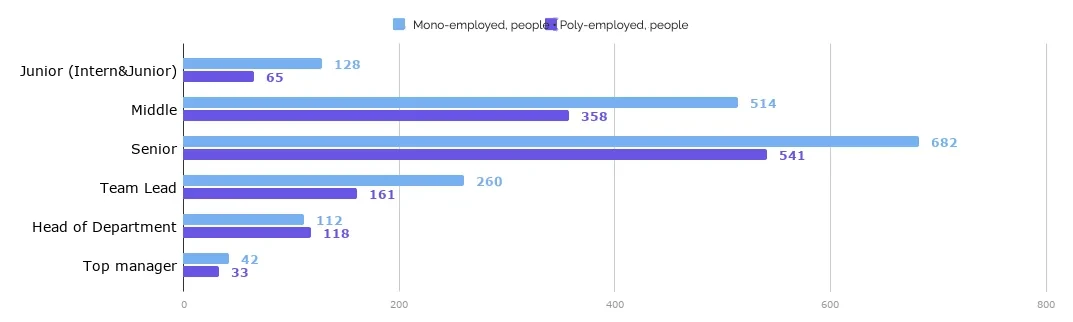
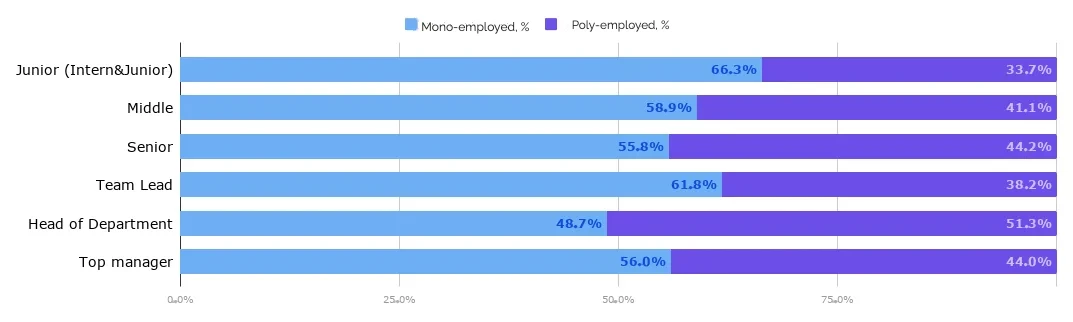
- Grade. The grades with the most side jobs are heads of departments; seniors lag far behind them. The people most devoted to their main employer are juniors and team leads.
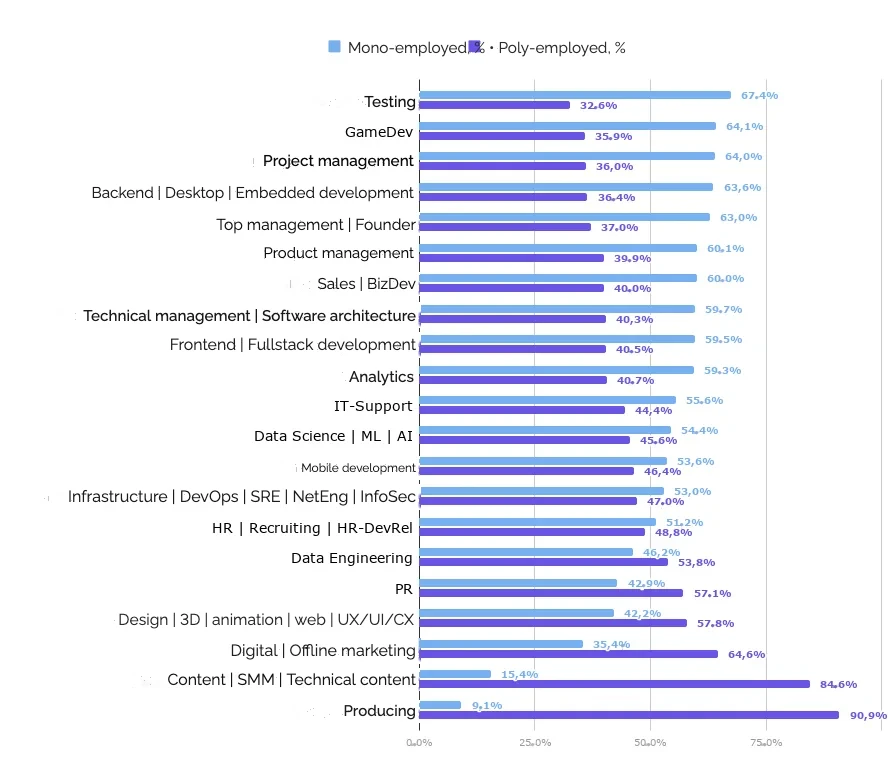
- Specialty. Testers, GameDev specialists, project managers and backend developers engage in side jobs least of all. Those with the most side jobs are specialists in producing, content and marketing (those who "live by their legs"). Keep in mind that in these professional groups the organization of employment and even the tradition of how specialists are formally engaged differ.
computer monitoring software;
Kira Kuzmenko, CEO NEWHR Data
surveillance cameras at workplaces (even with remote work!);
tracking of work activity every 20 minutes;
mandatory reports on lunch breaks and counting of all pauses in work.
Of course, in reality everything is somewhat more complicated. We do not recommend relying solely on these conclusions when assessing risks; we are simply noting patterns. To go deeper into the details and explore our data, see "Read more"
Definitions we identified within the research
- Russian: founded and located in the Russian Federation (a variant is the Russian office of a foreign company).
- Partly Russian: has Russian roots, the team is mostly Russian-speaking, but the company is on a foreign market and has left Russia. The company may or may not continue doing business in Russia.
- Foreign local: the company has never been connected with Russia; most of the team are local specialists who speak the local language.
- Foreign international: the company has never been connected with Russia; the team is international.
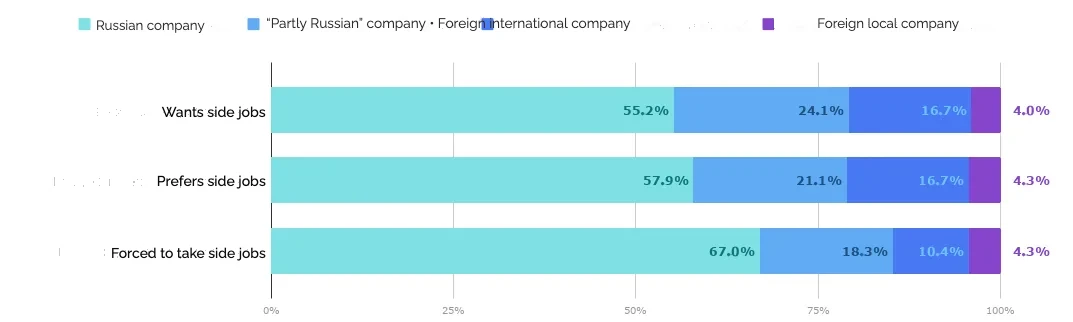
Types of management we identified for the research
- Authoritarian, over-controlling: constant strict control of working hours and the tasks being done. Only the manager defines the tasks and how to solve them.
- Authoritarian: constant control, daily reports; only the manager defines the tasks and how to solve them.
- Liberal: flexible management; employees define the tasks and how to do them themselves, and the manager carries out final control of the quality and results of the work
- Democratic: weekly reports; the manager makes decisions in dialogue with employees.
- Democratic, self-control: periodic control; the manager makes decisions in dialogue with employees.
How can you tell whether an employer hires for side jobs?
In the case of employers, the choice between a side job and a main job is influenced first of all by the type and size of the company. Here is how they behave when hiring:
- 80% of employers who hire for side jobs are small (up to 50 employees) and smaller mid-size (up to 200 employees) companies.
- More often these are partly Russian companies. Variable employers (who practice hiring for side jobs) are found among them 2 times more often than normative ones (who hire only for a main job).
- The work format of their main employees can be anything, but most often it is remote or hybrid. The office format is uncommon (roughly every 9th employer), but no less common than in companies that hire only for a main job.
- The largest companies and ecosystem corporations hire exclusively for a main job. The probability that they will take on an IT specialist for a side job tends to zero.
- Russian and foreign companies (both international and local) are about equally likely to hire people only for a main job. Partly Russian companies are less likely.
- The work format of main employees at such employers can be anything, but various hybrid options are found 1.5 times more often than among those who hire for side jobs.
The employer sample is small, so we can guarantee the existence of general patterns rather than exact figures (link to the audience profile).
Key takeaways of the section
It is important to note that our sample may be somewhat skewed toward employees and employers who practice side jobs: the topic occupies their attention, they are interested in getting the research results, and so they considered it worthwhile to take part in our survey. However, we can guarantee the reliability of the general patterns.
Top fields where most specialists in our sample have side jobs (more than 50%)
- Producing (91%)
- Content | SMM | Technical content (85%)
- Digital Marketing (65%)
- Design (58%)
- PR (57%)
- Data Engineering (54%)
The grades with the most side jobs are heads of departments
The most loyal are juniors and team leads
Heads of Department have side jobs most often. Juniors and team leads do so least often; it is hardest for them. For juniors, because of insufficient experience; for team leads, because of their involvement both in the company's hands-on work and in coordination and leadership.
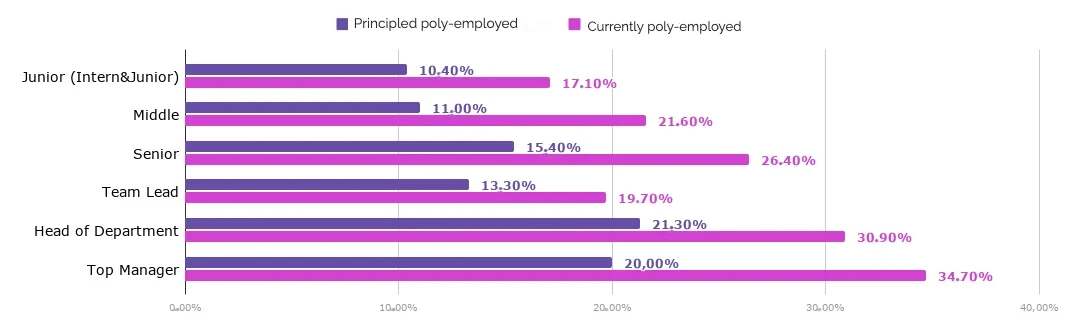
Only a third of all those with side jobs do it purely of their own accord. The rest are guided by circumstances
In terms of grades, the most ardent supporters of side jobs are those same heads of departments. Every fifth Head of Department in our sample (21.3%) will have a side job even if circumstances do not force them to. Line employees are not as eager to have side jobs as managers. And the most loyal are, once again, juniors. 60% of them are principled mono-employed.
Employees of small, smaller mid-size and medium companies have side jobs most often. Employees of large and major businesses do so less often
- The notional point where the trends intersect is a company of 500 people.
- The most authoritarian type of management leads to growth in side jobs
Employers with an authoritarian, over-controlling management style have the highest share of employees who had side jobs at the time of the survey. Moreover, in their own view, they did so under the pressure of circumstances. In other words, excessively strict control over staff is associated with the opposite result. Put differently, overtightening the nuts strips the thread.
Small and smaller mid-size companies hire employees for side jobs more often than others. Corporations do so least of all
80% of employers who take people on for side jobs are small (up to 50 employees) and smaller mid-size (up to 200 employees) companies. The largest companies and ecosystem corporations hire exclusively for a main job.
Companies with Russian roots hire employees for side jobs more often than others
Partly Russian companies (operating abroad; founded by people from Russian-speaking markets) are the most active supporters of hiring for side jobs. Among them, those hiring for side jobs are 2 times more numerous than those who take employees only for a main job.
Topic 3. Classic overemployment
Is the devil really that scary?
How widespread is overemployment?
- works full-time at both jobs;
- hides the existence of the alternative job from employers.
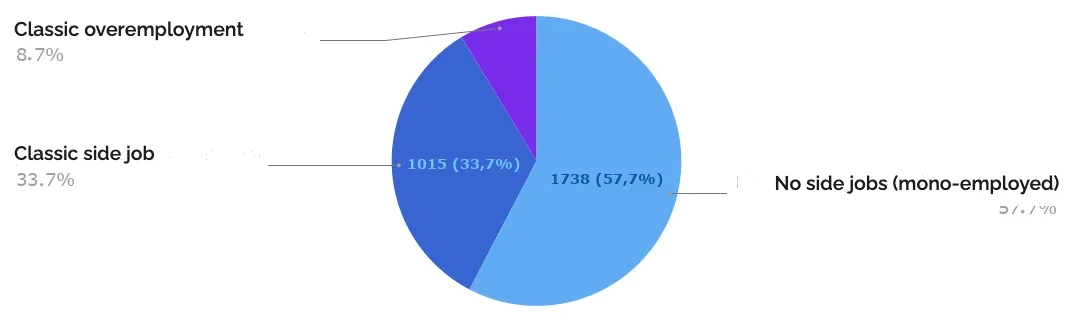
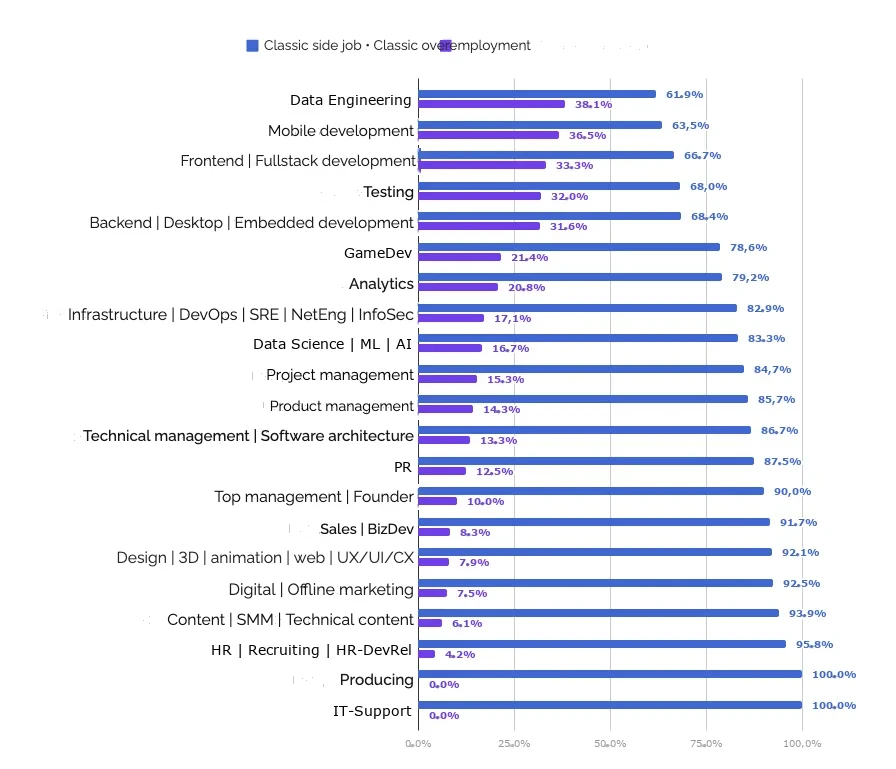
- 8.7% of employees resort to classic overemployment.
- Only 6.3% of employees were practicing it right at the time of the survey.
Share of classic overemployment in our sample
Number of respondents: 3,014
We go into more detail on the ratio between classic overemployment and the good old side job (and on how the number of overemployment fans has changed in recent years) under the "Read more" button.
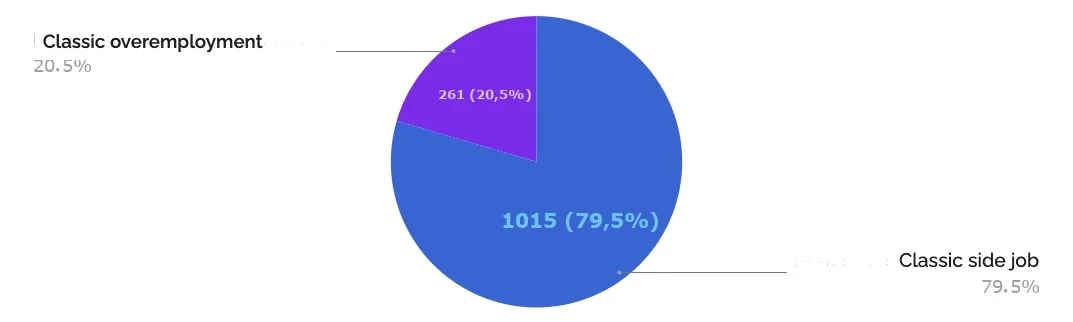
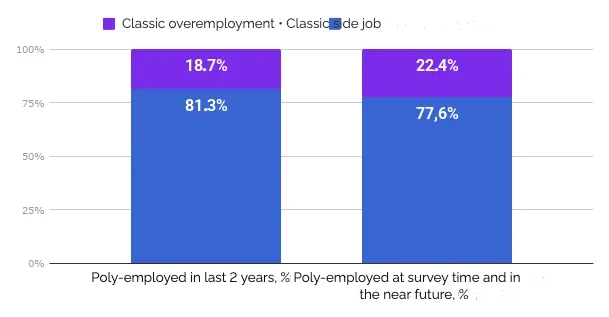
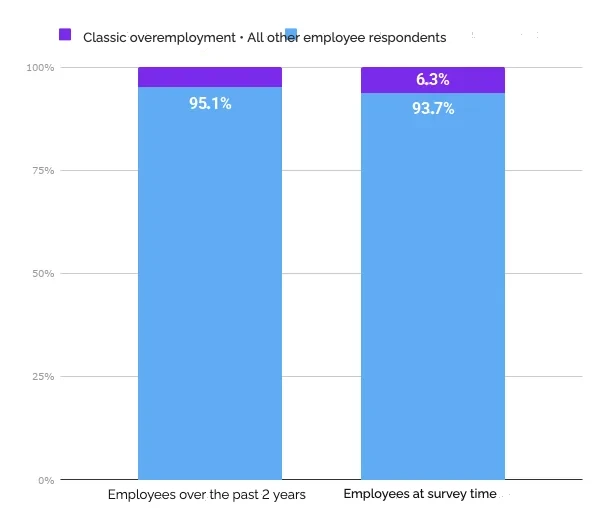
Side job vs overemployment. Who does what?
- Motives. Contrary to suspicions, employees resort to overemployment out of necessity (76%), not because they want to act this way (24%). I.e. the overemployed, by and large, are not principled "saboteurs."
- Specialties. Developers are most prone to overemployment. A third of developers, data engineers and testers with side jobs do them full-time and hide them from their employers. Overemployment is least common among IT recruiters, designers, and marketing and content specialists, although side jobs as such are very widespread in these fields.
- Grades. Classic overemployment is practiced most often by seniors and middles, least often by team leads and top managers. Note that overall the largest number of people with side jobs are among heads of departments (see the key takeaways of the "Influencing factors" section). This difference is due to the fact that overemployment is first of all a forced measure, while heads more often have side jobs of their own accord.
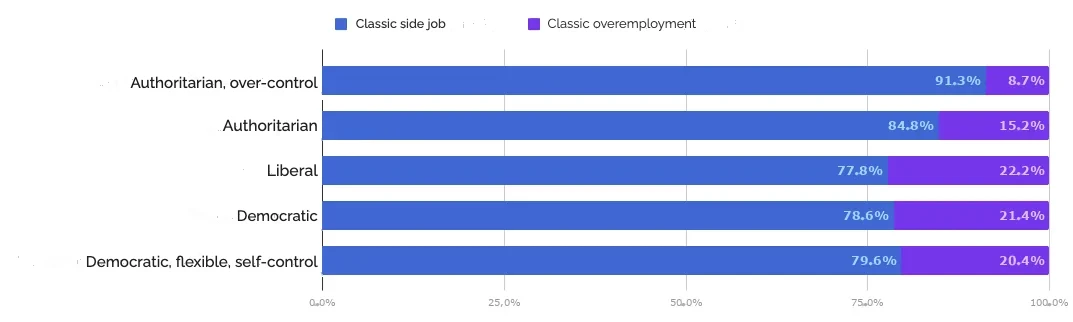
- Type of management in the company. The over-controlling authoritarian type of management is associated with the lowest level of overemployment, but recall that it is the one that correlates with a higher share of people with side jobs in general.
More on which factors influence side jobs and overemployment under the "Read more" button.
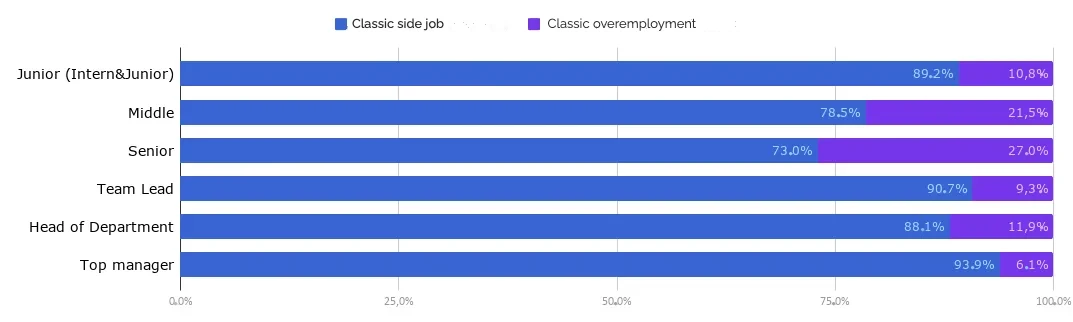
Key takeaways of the section
If you compare fans of overemployment with all of our respondents taken together, it becomes clear that the former make up a relatively small share of the sample. It seems the evil of pure overemployment is not encountered in our lives as often as people say.
Alena Makarova
Head of Research
NEWHR agency
"Looking around at their Russian-speaking IT employees, an employer can expect that only 1 in 16 is secretly working full-time for someone else. And a more sober estimate will most likely be 1 in 33."
Topic 4. Organizing a side job
This is where they wrapped the fish...
How do people organize side jobs?
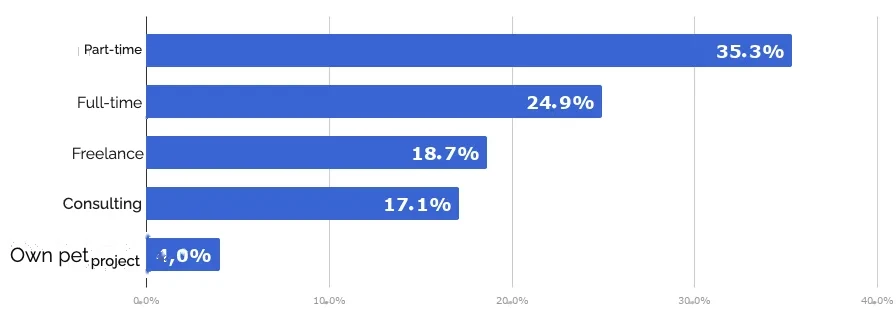
- ¾ of IT specialists with side jobs do them part-time (part-time, freelance, consulting, pet projects)
- People have side jobs primarily remotely. But there are also unique cases where individual employees manage to have a side job in the office
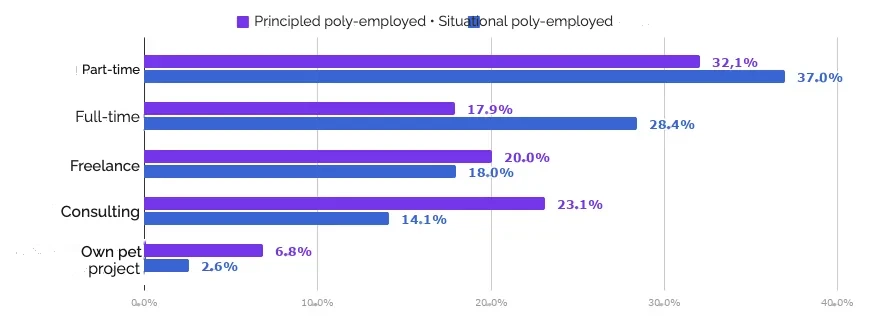
- Convinced, principled supporters of side jobs prefer the side job specifically, not overemployment. It matters to them not just to get extra money, but also to achieve professional self-fulfillment
- Signs of classic overemployment are more often seen in people who have side jobs out of necessity rather than "for the love of art"
To learn more about how side jobs are organized and see the data we relied on, follow the "Read more" button.
Which companies do people go to for side jobs?
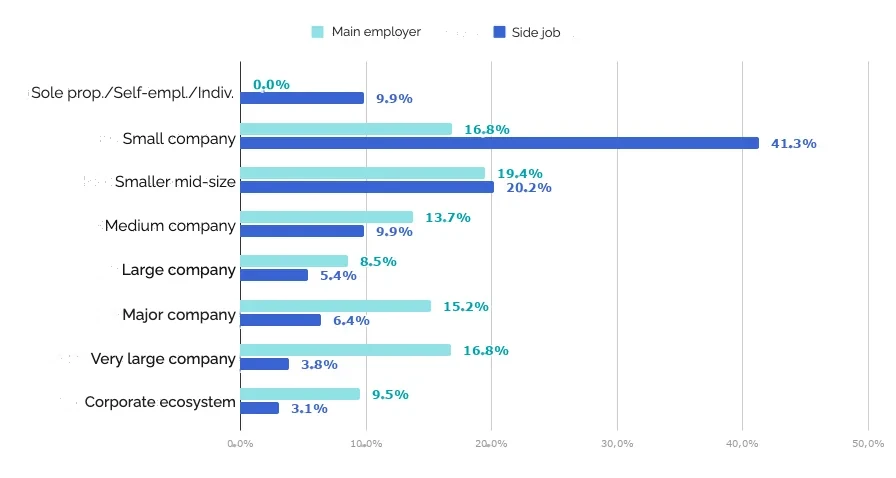
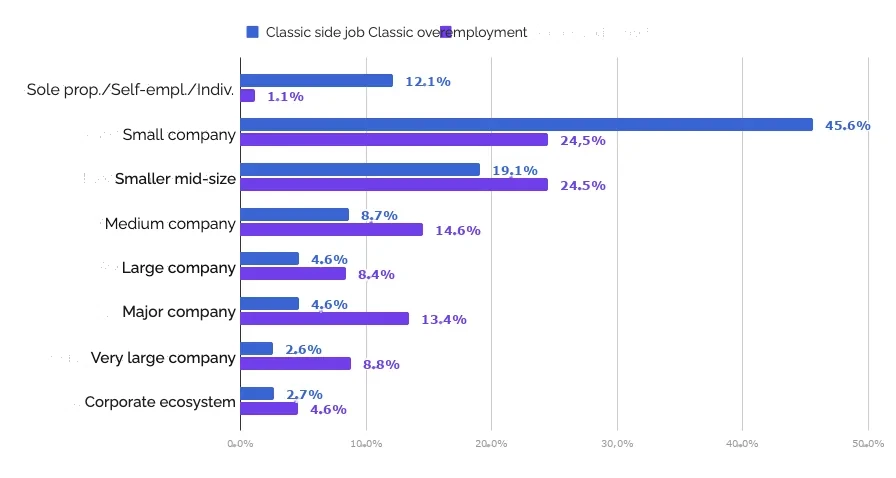
- IT specialists more often find a classic side job at small and smaller mid-size companies. At the same time, they can take on overemployment (a hidden second full-time job) at companies of any size.
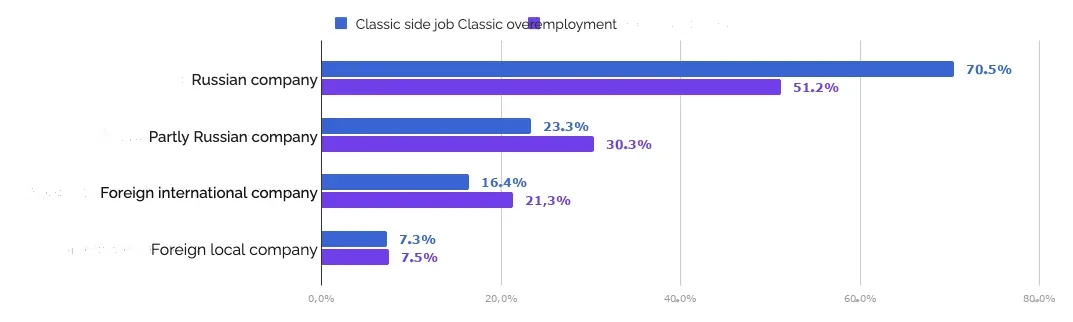
- The truly overemployed more often have side jobs at companies with Russian roots and at foreign international companies.
- How we arrived at these conclusions is explained under the "Read more" button.
How is the working relationship formalized?
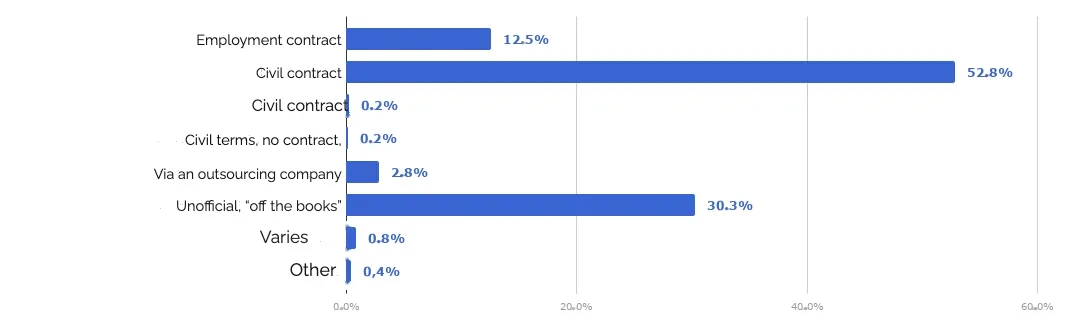
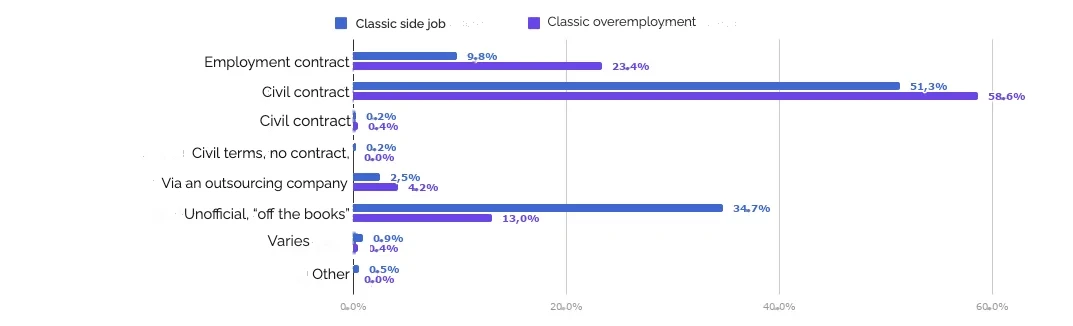
- 30% of those with side jobs do them without any documents at all, which puts them at risk.
- Fans of overemployment formalize their relationship with the employer much more often than ordinary side-jobbers. 80% of them sign a civil law contract (GPC contract) or an employment contract.
- As usual, details and charts are under the "Read more" button.
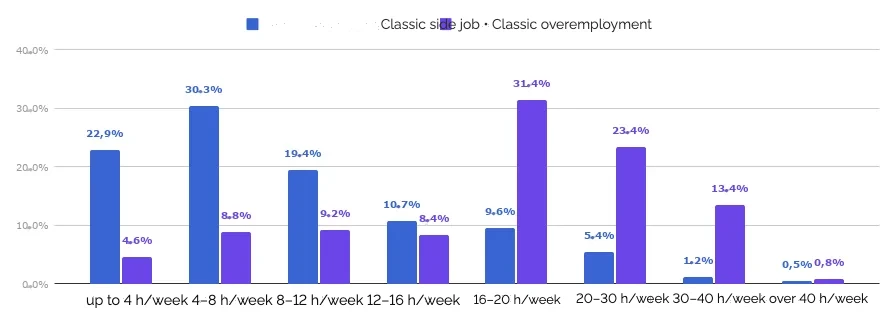
How much time goes into a side job?
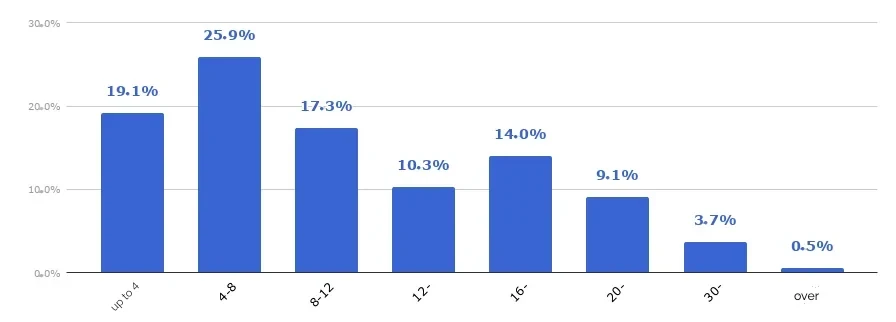
- Most of those with side jobs (62%) spend up to 12 hours a week on them. This mode quite allows a good specialist not to lose quality at either job.
- Overemployment really can wear employees out: on average, the overemployed spend 16−20 hours a week on their second employer.
- Only 14% of the overemployed devote a full working week to their second job.
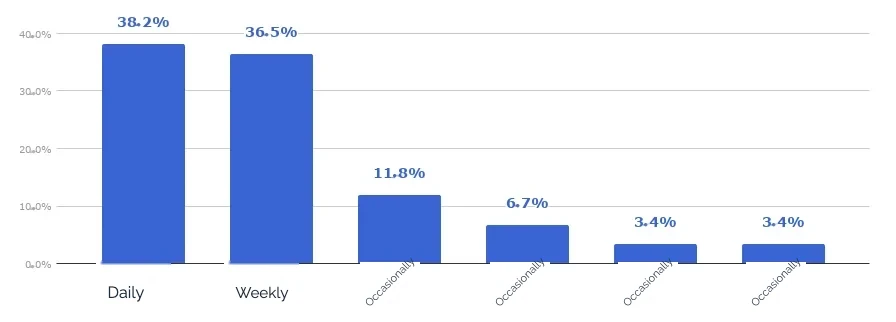
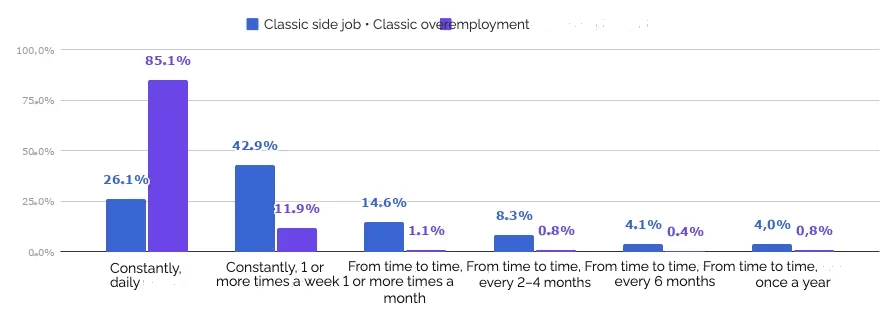
Detailed charts on the regularity of side jobs and the number of hours spent on them are under the "Read more" button.
Alena Makarova
Head of Research
NEWHR agency
"Two out of five people with side jobs may be lowering the quality of their work. But this is only a cautious hypothesis on our part, since the situations of the poly-employed can differ. For example, people may not work 40 hours at their main job (they get things done faster, do not have a full workload, etc.), or building professional skills at a side job may improve productivity at the main job."
Whose time do employees spend on side jobs?
- 43% of those with side jobs have done them at least once at the expense of their main job. However, most spend only their free time on side jobs.
- In the case of classic overemployment, 73% spend or have spent their main job's time on the side job.
When the poly-employed work their side jobs
Number of respondents: 1,276
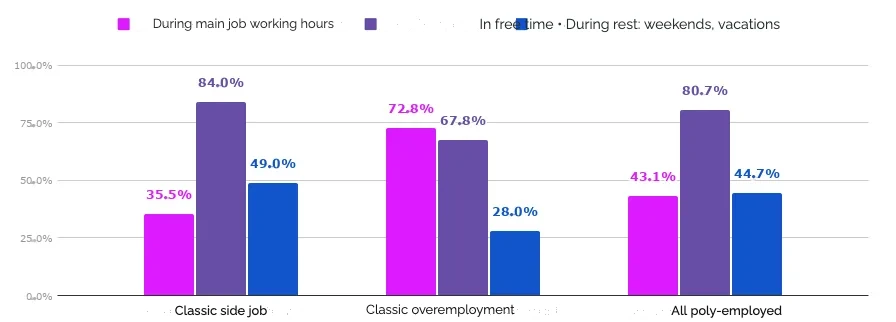
More on how the poly-employed spend their time under the "Read more" button.
Key takeaways of the section
It would seem that principled supporters of side jobs pose a great danger to the employer and sooner or later will start secretly working full-time at two companies. However, our research shows that this is not the case.
Those who have side jobs on principle (following their heart and for their soul) prefer side jobs specifically, not overemployment
It matters to them to achieve professional self-fulfillment, not just to get extra money. That is why they choose part-time employment and consulting. Overemployment, on the other hand, is more often perceived by the employee as a forced measure, in which professional growth and motives other than financial ones fade into the background.
An overemployed worker can be found in a company of any size
IT specialists find classic side jobs at small and smaller mid-size companies. But an overemployed worker can be hiding in a company of any scale. Most likely they will be on staff or under a civil law contract (GPC contract), whereas an "ordinary" side-jobber is more likely to do it off the books.
Most of those with side jobs "the old-fashioned way" do it without harm to either job, unlike adherents of overemployment
Most specialists with side jobs do them without harm to either job (provided, of course, that the main employer keeps to the standard 40-hour workload). But overemployment really can wear employees out. Moreover, it is this format of side job that is far more often practiced at the expense of one of the employers.
This is the page of Part I of the research
Part II is available at this link, and we have collected the key conclusions here
We significantly shortened the research text for publication on the website. To study our logic, see the charts and read additional conclusions, write to data@new.hr with the note "Where's the proof?"
Feedback and opinions
Quoted with minor changes to preserve anonymity
Spelling and punctuation preserved
"Your survey touched one of my 'pain points': why two jobs if you can find one with a higher salary… it got me thinking. Thank you."
Quoted with minor changes to preserve anonymity
Spelling and punctuation preserved
"At two of my jobs I had managers who were fine with side jobs. Moreover, at my new job my manager encourages it, […] she cares about her own and our professional development and financial well-being. The managers I've had consider it useful, because that way you gain more expertise and skills. […]"
Quoted with minor changes to preserve anonymity
Spelling and punctuation preserved
"You are doing important research, thank you"
Quoted with minor changes to preserve anonymity
Spelling and punctuation preserved
"As an employer, I usually hire people for part-time side jobs paid by the hour. It pays off for me when there is a simple project with a small fluctuating workload and no staff employee to give the project to. […] From what I've observed, people with side jobs regularly miss deadlines (they overestimate their speed and underestimate the tasks). And the quality of work also often declines over time. […]"
Quoted with minor changes to preserve anonymity
Spelling and punctuation preserved
"Interesting survey! Thank you! While answering, I realized how I feel about having two jobs :)"
Quoted with minor changes to preserve anonymity
Spelling and punctuation preserved
"I had trouble with the questions about the main employer banning side jobs, couldn't find an exact answer for my experience, in my case there is an explicit ban on side jobs, but if the conflict of interest is resolved, it is allowed"
Quoted with minor changes to preserve anonymity
Spelling and punctuation preserved
"Looking forward to the research results =) Since we've been running into this practice more and more"
Quoted with minor changes to preserve anonymity
Spelling and punctuation preserved
"We try to part ways with those who are 'caught' with a side job. First, we value loyalty, second it's inconvenient to work with people who 'lie' from the start. You never know what they'll lie about next time, which means you can't rely on them"
Quoted with minor changes to preserve anonymity
Spelling and punctuation preserved
"Your survey touched one of my 'pain points': why two jobs if you can find one with a higher salary… it got me thinking. Thank you."
Quoted with minor changes to preserve anonymity
Spelling and punctuation preserved
"At two of my jobs I had managers who were fine with side jobs. Moreover, at my new job my manager encourages it, […] she cares about her own and our professional development and financial well-being. The managers I've had consider it useful, because that way you gain more expertise and skills. […]"
Our partners
We thank everyone who shared information about the research and helped us collect such an impressive sample! 💙
The list of partners is below. If you helped us find respondents but did not find your channel on the list, write to data@new.hr. If you would like us to correct something in the description, write to us as well!
NEWHR
- International recruiting agency
- Hello New Job! — Job search and employment: instructions, tips, useful practices
Recruiting, Cats and the Apocalypse
- The channel of NEWHR founder Kira Kuzmenko
- IT Solutions Architecture — IT Solutions Architecture: conversations about the architecture of enterprise information systems
Evgeny Kornyshev
- Tester, mentor, course author
Nikita Zaltsman / Dev easy notes
- Mobile infrastructure developer
QA Sisters
- Support and development for women in QA
- MobileApps — mobile testing — About mobile testing, Android\IOS, smartphones and news from Europe. Author: Vlad Kazachek
- Tatiana (ex-Drozdova) Romanova — QA engineer with more than 5 years of experience organizing testing of complex products
Pykh
- Valentin Udaltsov's blog about hardcore PHP development
- Gennady Chursov — QA engineer with 10+ years of experience, author of a blog about testing and automation
Oleg Kozyrev
- Golang developer
- Anton Duenin — Tester, 5+ years in the profession, author of the Burning Tester channels.
- DDDevotion — A professional community uniting developers, architects and analysts who practice Domain-Driven Design (DDD) approaches.
About us
Adapted from the original article in Russian on newhr.org. Read the Russian version.