Market research · January 2025
Overemployment: a problem or the new normal in Russian-speaking IT? Part II
NEWHR surveyed 3,169 IT specialists in 21 specializations, both employees and employers.
- who does it and why
- how it affects the main job
- whether employer policies make a difference
- what works for business in the current situation

Kira Kuzmenko
CEO NEWHR
The topic of overemployment became widely discussed in 2022, when the IT bubble burst, companies started mass layoffs, and for the first time in many years IT specialists found themselves in a situation where there were fewer vacancies than candidates. At the same time, IT salaries had grown significantly during the "fat years" of 2019−2021, and workers' expectations, of course, stayed at the same level.
That was when it became clear that some people were ready to deceive employers outright — combining 2 or more full-time jobs or making up the income they needed with side jobs outside working hours. Striking cases of this kind appeared on the market, and everyone started talking about the problem at once.
In 2024-2025 the topic has not gone away, and we at NEWHR decided to find out whether the devil is as black as our collective imagination paints him. We surveyed 3,169 IT specialists (both employees and employers) to learn first-hand what is happening on the market now.
- Read topics 1−4
- Topics 5−8 are on this page
- Go to the conclusions
About the study
How many? Who? From where?
The study was conducted as an online survey. Respondents were recruited through NEWHR's online media, partner channels and our own respondent base.
3,169 people
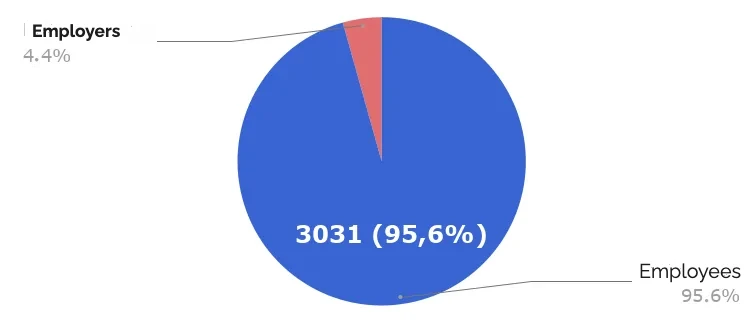
- 3,031 employees
- 138 employers
21 specializations
- Backend | Desktop | Embedded development
- Analytics
- Testing
- HR | Recruiting | HR-DevRel
- Frontend | Fullstack development
- Product management
- Project management
- And others*
6 grades
- Junior (Junior&Intern)
- Middle
- Senior
- Team lead
- Head of Departments
- Top Manager
4 types of companies
- Russian
- Partly Russian (operate abroad; founded by people from Russian-speaking markets)
- Foreign local (operate in the market of a single country)
- Foreign international (operate in many countries)
- * See all specializations of the survey participants
- Technical management | Software architecture
- Infrastructure | DevOps | SRE | NetEng | InfoSec
- Mobile development
- Design | 3D | animation | web | UX/UI/CX
- Digital | Offline marketing
- Data Science | ML | AI
- Data Engineering
- Top management | Founder
- Content | SMM | Technical content
- GameDev
- Sales | BizDev
- IT-Support
- PR
- Production
Study terminology
Explaining the words
What we found: the many meanings of the term
The term overemployment (a common Russian translation is "сверхзанятость", literally "over-employment") has become widespread in Russian-speaking IT. It is used for the phenomenon that in everyday speech is called a "side job" and in academic terminology "secondary employment".
In the international context, however, overemployment is understood more narrowly — as a combination of two or more full-time jobs without the employers' knowledge. In this context the term takes on a potentially negative connotation.
The phenomenon itself is firmly associated with processes such as the hybridization and precarization of employment, and is seen as a marker of the systemic transformation of the labor market over the last 10 years.
- Our approach to the study — In this study we use the term overemployment in a broad sense, meaning both overtime and secondary employment in general (side jobs).
However, we place a special focus on "true" overemployment — an additional full-time job that is hidden from the employer.
We want to say a huge thank you to everyone who took part in our study and helped us better understand this multifaceted phenomenon of today's labor market. We invite you to explore the results!
If you would like to share your overemployment case (as an employee or as an employer), write to: over@new.hr.
Quotes from our respondents show the complexity and diversity of the overemployment phenomenon
"As an employer, I usually hire people for part-time side jobs paid by the hour. It pays off for simple projects with a fluctuating workload when there is no staff employee."
Quotes from our respondents show the complexity and diversity of the overemployment phenomenon
"I told them at work — either give me more money, or I'll look for a side job. They said — go ahead [take on extra work]."
Quotes from our respondents show the complexity and diversity of the overemployment phenomenon
"In Germany, side jobs are prohibited by law. Permission has to be obtained on request, and the question is whether the company will approve it or not. IT specialists will most likely not get permission for a similar side job."
Quotes from our respondents show the complexity and diversity of the overemployment phenomenon
"I know that holding a second job is legal [from the point of view of the law]. The employer cannot influence this process. Dismissal in this case is illegal."
Quotes from our respondents show the complexity and diversity of the overemployment phenomenon
"As an employer, I usually hire people for part-time side jobs paid by the hour. It pays off for simple projects with a fluctuating workload when there is no staff employee."
Quotes from our respondents show the complexity and diversity of the overemployment phenomenon
"I told them at work — either give me more money, or I'll look for a side job. They said — go ahead [take on extra work]."
Terminology: employees
- by the presence or absence of secondary employment (mono-employed and poly-employed)
- by their attitude to secondary employment (principled and situational)
Mono-employed — those who do NOT have side jobs: they work at one main job at the time of the survey, have not had side jobs in the last 2 years and are not preparing to take one in the near future.
Poly-employed — those who have side jobs: they work at more than one job at the time of the survey, or have recently stopped working a side job, or are already starting one.
Principled — those who consciously and on principle practice mono-employment or poly-employment, repeat offenders.
Situational — those forced to take side jobs for external and/or internal reasons in a particular situation.
Terminology: employers
By their practice of secondary employment, the poly-employed can be divided into those who practice a classic side job or classic overemployment.
Normative — those who do NOT hire for side jobs, only for a main job. Opponents of side jobs.
Variative — those who hire employees for side jobs (mixed or only for side jobs). Supporters of side jobs.
Intolerant — they penalize employees for side jobs, principled opponents of side jobs.
Tolerant — they do not penalize, are not die-hard opponents of side jobs.
Other working concepts:
Company types
- Russian — founded and located in the Russian Federation (a variant is the Russian office of a foreign company).
- Partly Russian — has Russian roots, the team is mostly Russian-speaking, but the company operates on a foreign market and has left Russia. The company may or may not continue to do business in Russia.
- Foreign local — the company has never been connected with Russia, most of the team are local specialists who speak the local language.
- Foreign international — the company has never been connected with Russia, the team is international.
- Company sizes
- Small — up to 50 employees
- Smaller mid-size — from 50 to 200 employees
- Medium — from 200 to 500 employees
- Large — from 500 to 1000 employees
- Very large — from 1000 to 5000 employees
- Huge — more than 5000 employees
- A company that is part of a corporate ecosystem
- Types of people management
- Authoritarian, over-controlling — constant strict control of working time and tasks performed. Tasks and ways to solve them are defined only by the manager.
- Authoritarian — constant control, daily reports, tasks and ways to solve them are defined only by the manager.
- Liberal — flexible management, employees decide on tasks and how to do them themselves, the manager does a final check of the quality and results of the work
- Democratic — weekly reports, the manager makes decisions in dialogue with employees.
- Democratic, self-control — periodic control, the manager makes decisions in dialogue with employees.
- Types of employer policy on side jobs
- Encouraging — additional professional projects are encouraged as developing employees' professional qualities.
- Tolerant — freedom for any alternative employment as long as it does not interfere with duties at the main job.
- Neutral — no ban on side jobs outside working hours. Whatever an employee does at that time is their own business.
- Privilege policy (individualized) — no official policy at all, everything is decided individually.
- Prohibitive — a strict ban on any alternative employment (side jobs, sole proprietorship, self-employment).
Respondent profile
Who are all these people
Total respondents – 3,169 people
The typical respondent of this survey is a man, a senior backend developer aged 34, an employee of a large Russian company. With a probability of 45% he has a side job, and in two cases out of three he is sure he is forced to do it for various internal and external reasons. He does not do it all the time, only under certain circumstances.
Employees and employers
Respondents: split into employees and employers
Number of respondents: 3,169
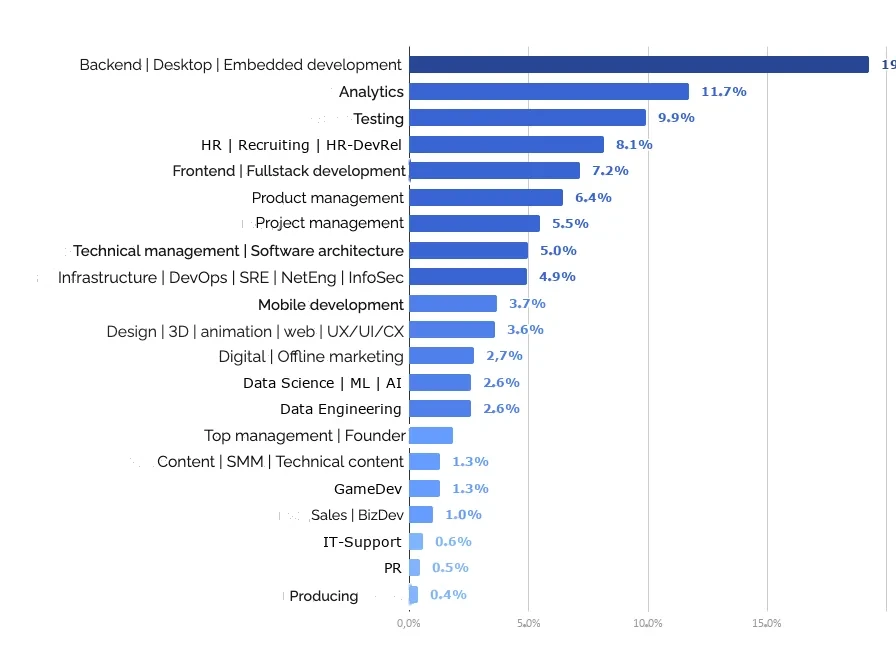
Employee specializations
- Backend | Desktop | Embedded development
- Analytics
- Testing
- HR | Recruiting | HR-DevRel
- Frontend | Fullstack development
- Product management
- Project management
- Technical management | Software Architecture
- Infrastructure | DevOps | SRE | NetEng | InfoSec
Specializations
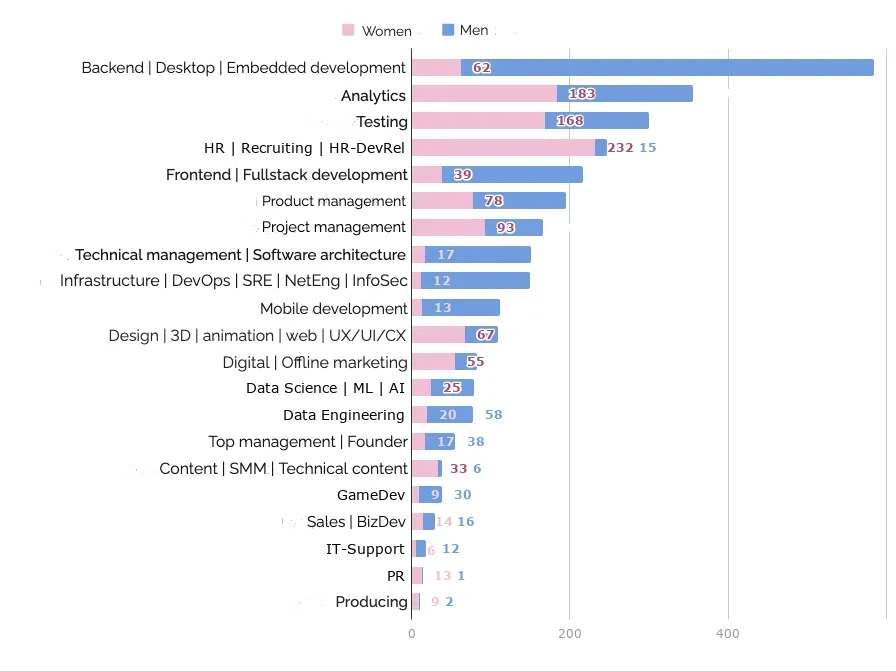
Distribution by gender
Employee specializations
Number of respondents: 3,031
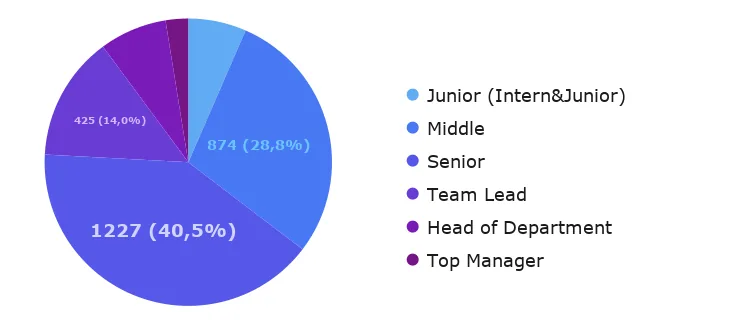
- Employee grades — The sample best represents seniors (40.5%) and other senior grades.
- The share of middles is smaller than in the market structure.
- Interns and juniors are represented even more weakly (6.5% of the sample), so data on them should be treated with caution.
Respondent grades
Number of respondents: 3,031
You can explore the profile of our respondents in more detail below — the charts show their age, gender, region of residence, etc. (see "Read more").
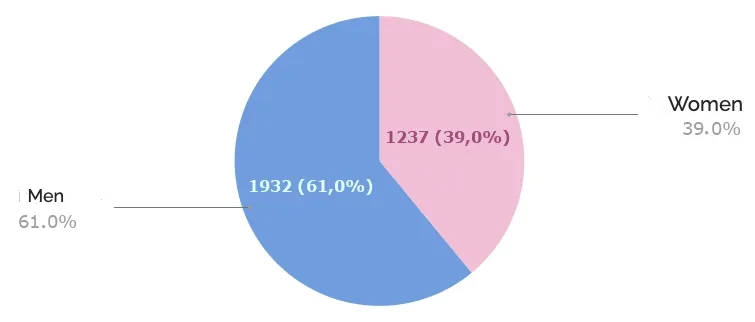
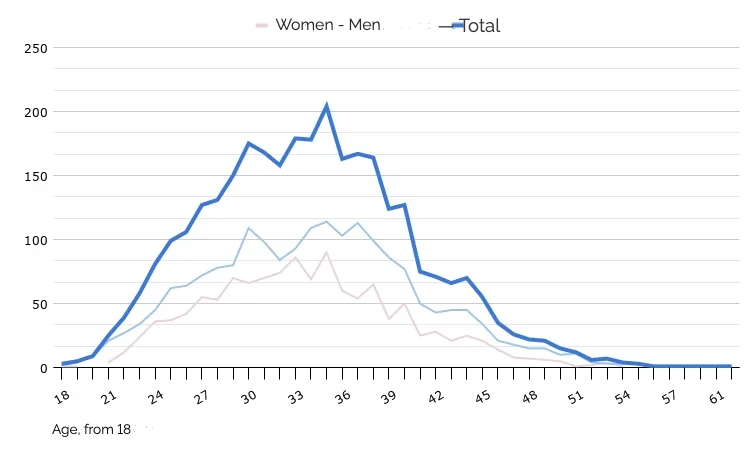
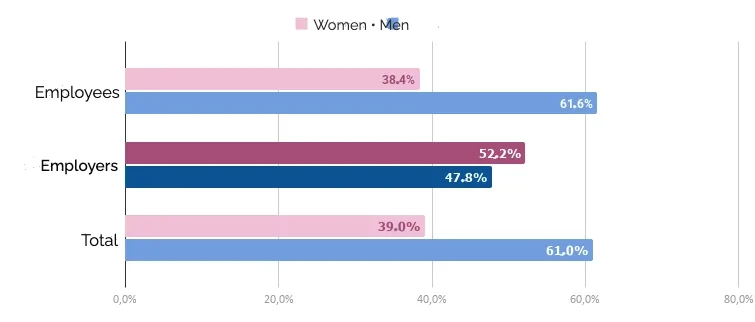
Read topics 1-4 in the previous part of the study
Topic 5. Reasons for side jobs
Why on earth and what for?
What do employers think?
- main employers assess their employees' drive for money soberly, while those who hire for side jobs underestimate it
- main employers tend to underestimate employees' drive for professional development; those who hire for side jobs turned out to be closer to the truth on this point
- Top 3 reasons for side jobs
- Money — 80%
- Professional experience in their own field — 40%
- Lack of control — 30%
- Money — 67%
- Professional experience in their own field — 62%
- Professional experience in a new field — 55%
- Money — 81%
- Professional opportunities — 51%
- Organizational opportunity — 39%
Why do IT specialists do it?
Employees: reasons for a side job
Number of respondents: 1,276
Multiple choice
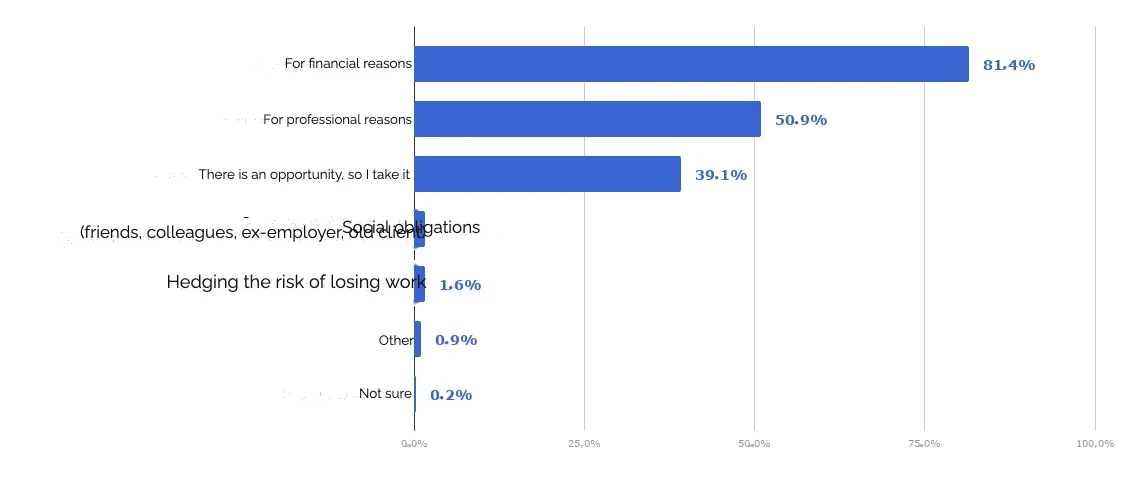
- Money is, as expected, in first place. However, there is a difference between a "regular" side job and overemployment. For overemployed people money comes first in 94% of cases, for the rest — in 78%. Moreover, with a classic side job, professional opportunities are much more important (55%) than with overemployment (36%).
- Money motivates individual contributors the most. For managers and top executives, however, professional opportunities are no less interesting than financial ones, and sometimes more. In general, professional motivation grows with grade — from junior (43%) to top (76%).
- Social obligations and diversifying the risk of being left without a job were added by our respondents themselves in open answers. This means these reasons matter to IT specialists with side jobs. These options may be far more common than the figures obtained, since they were not on the list of answers.
What does "for financial reasons" mean?
81.4% (1,038 people)
As we found out, IT specialists take side jobs not because they are starving and have nothing to feed the cat with or pay the rent with (that happens too, but it is rare). And not because they are all spoiled and greedy. They do it because they feel the need to live a full life through hobbies, goods and, what is especially notable, through big life projects (building a house or starting their own business, for example).
While the financial motivation of "regular" side-jobbers is more often tied to the innocent joys of life, overemployed people are more ambitious and earn extra money for a sense of independence and freedom, or plan to invest the funds in their own projects.
- I earn for the small and big joys of life (43.5%)
- I selflessly love money (23.6%)
- I want to invest in big life projects (22.6%)
- I top up to the income I need — for bread and butter (22.2%)
- I get money that makes me freer and more independent (21.1%)
- I get money that makes me freer and more independent (55.9%)
- I want to invest in big life projects (48.7%)
- I earn for the small and big joys of life (32.2%)
- I selflessly love money (22.6%)
- I top up to the income I need — for bread and butter (19.9%)
A "regular" side job most often brings IT specialists ⅒ of the income from their main job (39% of answers from respondents with old-style side jobs). Overemployed people, on the other hand, increase their income significantly and in 31% of cases receive an amount roughly equal to their main salary.
The top specializations with the most significant income from a side job of any type — more than 50% of the main job's income — are developers and specialists working with data. Side jobs bring the least to support and supporting specializations.
Our respondents' comments illustrate the many shades of financial motivation: from the most basic need for money to the desire to get everything at once. What these two extremes have in common is that such behavior is typical in conditions of significant risks, short planning horizons and instability.
Quotes from our respondents show the diversity of financial motivation (please remember that quotes are the opinion of individual respondents and may not reflect the position of most members of the profession).
"I had a main job, then I was offered a freelance contract, so I combined them for three months, there was no need for it, but financially it was very good"
Data Engineering, middle
Quotes from our respondents show the diversity of financial motivation (please remember that quotes are the opinion of individual respondents and may not reflect the position of most members of the profession).
"On a nominal salary of $4,000 you can't build a house or buy a car. And what other ways are there to earn $8,000 a month? Two jobs. And you don't need to slog for 10 years to become C-level. That's why I'm looking for a 3rd job. You can never have too much money. Time and energy allow it."
GameDev, senior
Quotes from our respondents show the diversity of financial motivation (please remember that quotes are the opinion of individual respondents and may not reflect the position of most members of the profession).
"My salary at my main job is badly delayed."
Development, middle
Quotes from our respondents show the diversity of financial motivation (please remember that quotes are the opinion of individual respondents and may not reflect the position of most members of the profession).
"I need a bit of cash in my Russian accounts."
Testing, middle
Quotes from our respondents show the diversity of financial motivation (please remember that quotes are the opinion of individual respondents and may not reflect the position of most members of the profession).
"The side job has cool perks like payroll projects — the salary and internet cost compensation come to my card."
Testing, junior
Quotes from our respondents show the diversity of financial motivation (please remember that quotes are the opinion of individual respondents and may not reflect the position of most members of the profession).
"I have a side job at a company where I used to work. I think it's easier for the company to pay me than to train newcomers. And for me it's easy and well paid — +15% to my main salary for +10% of working time."
Development, senior
Quotes from our respondents show the diversity of financial motivation (please remember that quotes are the opinion of individual respondents and may not reflect the position of most members of the profession).
"I was looking for a job and at the same time kept moving further and further with two companies. One made an offer and I accepted it. 3 weeks later the other made a fatter offer, and I also bargained well and accepted. In the 3rd month of probation I parted ways with one company by mutual agreement (didn't like the company's processes — researcher's note). Getting $15k for 3 months is nice, although exhausting."
Development, senior
Quotes from our respondents show the diversity of financial motivation (please remember that quotes are the opinion of individual respondents and may not reflect the position of most members of the profession).
"The main job isn't big enough in terms of money, tasks and authority. And the second job offers good conditions."
Marketing, top manager
Quotes from our respondents show the diversity of financial motivation (please remember that quotes are the opinion of individual respondents and may not reflect the position of most members of the profession).
"I get attractive one-off offers, hard to refuse) partly financial motivation + new knowledge and experience."
Recruiting, middle
Quotes from our respondents show the diversity of financial motivation (please remember that quotes are the opinion of individual respondents and may not reflect the position of most members of the profession).
"I want to eat!"
Top manager
Quotes from our respondents show the diversity of financial motivation (please remember that quotes are the opinion of individual respondents and may not reflect the position of most members of the profession).
"I had a main job, then I was offered a freelance contract, so I combined them for three months, there was no need for it, but financially it was very good"
Data Engineering, middle
Quotes from our respondents show the diversity of financial motivation (please remember that quotes are the opinion of individual respondents and may not reflect the position of most members of the profession).
"On a nominal salary of $4,000 you can't build a house or buy a car. And what other ways are there to earn $8,000 a month? Two jobs. And you don't need to slog for 10 years to become C-level. That's why I'm looking for a 3rd job. You can never have too much money. Time and energy allow it."
GameDev, senior
What does "for professional reasons" mean?
50.9% (650 people)
- professional development and experience (a chance to level up skills, try yourself in a new field, do interesting tasks, etc.)
- everything that does not add professionalism directly but can become a symbol of recognition or be useful when looking for a job (a striking line on the CV, the employer brand, high status in the professional community, etc.).
- Experience in a field of interest (34.4%)
- Leveling up skills (29.8%)
- Interesting tasks (25.1%)
- Experience on projects of a different scale (18.1%)
- A chance to implement interesting ideas without bureaucracy (12.5%)
- Leveling up skills (27.2%)
- Interesting tasks (21.8%)
- Experience in a field of interest (21.1%)
- Experience on projects of a different scale (15.3%)
- A chance to improve the CV (8%)
Those who practice overemployment show practicality and individualism more noticeably than supporters of a "regular" side job. For them, leveling up skills and professional tasks matter more, and only then experience in an interesting field. Overall, overemployed people care less about the professional side of a side job.
In the comments, respondents left opinions that show a need not just for upskilling, but also for a professional community and creative self-realization.
Quotes from our respondents on professional motivation (please remember that quotes are the opinion of individual respondents and may not reflect the position of most members of the profession).
"Development and experience in similar positions in other businesses."
Infrastructure | DevOps | SRE | NetEng | InfoSec, Head of Department
Quotes from our respondents on professional motivation (please remember that quotes are the opinion of individual respondents and may not reflect the position of most members of the profession).
"Professional resentment. I worked and slogged for 2 years, thought I'd be promoted to lead. In the end they didn't promote me and didn't raise my salary. After that I dropped my extra duties and stopped taking initiative. A lot of time freed up at my main job. I found a side job as a lead where I can realize my potential. I can't leave the first place yet."
Testing, senior
Quotes from our respondents on professional motivation (please remember that quotes are the opinion of individual respondents and may not reflect the position of most members of the profession).
"Creative realization. My main job has little to do with creativity."
Product management, team lead
Quotes from our respondents on professional motivation (please remember that quotes are the opinion of individual respondents and may not reflect the position of most members of the profession).
"Out of the blue, American VCs and consultancies reached out to me asking for consultations. It turned out to be so exciting that it would be a sin to refuse)) […] Plus Russian startups come along, there it's more about fun and wanting to help :)."
Product management, Head of Department
Quotes from our respondents on professional motivation (please remember that quotes are the opinion of individual respondents and may not reflect the position of most members of the profession).
"Leveling up skills that are needed at the side job but aren't useful at my main job. I take side jobs with an eye to the tech stacks being different from my beloved main job."
Backend | Desktop | Embedded development, middle
Quotes from our respondents on professional motivation (please remember that quotes are the opinion of individual respondents and may not reflect the position of most members of the profession).
"At my main job my professional skills are not in demand (the employer doesn't use them to the full). In an open dialogue with the employer it also turned out that they don't need the extended skills."
PR, middle
Quotes from our respondents on professional motivation (please remember that quotes are the opinion of individual respondents and may not reflect the position of most members of the profession).
"Communication and networking, because working remotely there isn't enough professional socialization, and this is solved by quantity. Going to forums and other events is hard now."
GameDev, senior
Quotes from our respondents on professional motivation (please remember that quotes are the opinion of individual respondents and may not reflect the position of most members of the profession).
"For me a side job is a chance to see how different kitchens work from the inside, learn something new, meet interesting and talented people, most often founders, and practice the language."
Design, team lead
Quotes from our respondents on professional motivation (please remember that quotes are the opinion of individual respondents and may not reflect the position of most members of the profession).
"A side job to get recognition as a professional. To boost my self-esteem."
Infrastructure | DevOps | SRE | NetEng | InfoSec, senior
Quotes from our respondents on professional motivation (please remember that quotes are the opinion of individual respondents and may not reflect the position of most members of the profession).
"The second job is a rest from the first one) the first has stuffiness and large clients from the corporate sector with all that implies, and the second has non-toxic communication."
Project management, team lead
Quotes from our respondents on professional motivation (please remember that quotes are the opinion of individual respondents and may not reflect the position of most members of the profession).
"Broadening experience and interesting tasks."
Design | 3D | animation | web | UX/UI/CX, senior
Quotes from our respondents on professional motivation (please remember that quotes are the opinion of individual respondents and may not reflect the position of most members of the profession).
"Development and experience in similar positions in other businesses."
Infrastructure | DevOps | SRE | NetEng | InfoSec, Head of Department
Quotes from our respondents on professional motivation (please remember that quotes are the opinion of individual respondents and may not reflect the position of most members of the profession).
"Professional resentment. I worked and slogged for 2 years, thought I'd be promoted to lead. In the end they didn't promote me and didn't raise my salary. After that I dropped my extra duties and stopped taking initiative. A lot of time freed up at my main job. I found a side job as a lead where I can realize my potential. I can't leave the first place yet."
Testing, senior
What does "there is an opportunity" mean?
39.1% (499 people)
- I have the desire and the energy — I want to, I can, and I do (27.6%)
- I handle my main tasks quickly and easily (18.8%)
- From time to time there are no tasks — quiet periods (8.8%)
Quotes from our respondents show various organizational reasons for a side job (please remember that quotes are the opinion of individual respondents and may not reflect the position of most members of the profession).
"I help my employer's partners fill vacancies if my manager asks."
HR | Recruiting | HR-DevRel, senior
Quotes from our respondents show various organizational reasons for a side job (please remember that quotes are the opinion of individual respondents and may not reflect the position of most members of the profession).
"I have the energy to work 70 hours a week, and I use it."
Backend | Desktop | Embedded development, middle
Quotes from our respondents show various organizational reasons for a side job (please remember that quotes are the opinion of individual respondents and may not reflect the position of most members of the profession).
"My main job allows part-time work on other projects if it doesn't create a conflict of interest. But I don't mention the second job, so there are no unnecessary questions."
Content | SMM | Technical content, middle
Quotes from our respondents show various organizational reasons for a side job (please remember that quotes are the opinion of individual respondents and may not reflect the position of most members of the profession).
"Also, the weekly quota [of the side job] can be done in 2−3 hours, so you can give the side job a little time on weekends."
Testing, junior
Quotes from our respondents show various organizational reasons for a side job (please remember that quotes are the opinion of individual respondents and may not reflect the position of most members of the profession).
"At my main job there is no control over the volume of tasks done or productivity, sometimes you can work 2 hours a day."
Testing, senior
Quotes from our respondents show various organizational reasons for a side job (please remember that quotes are the opinion of individual respondents and may not reflect the position of most members of the profession).
"I set tasks for myself and sell them to stakeholders. Nobody knows what I'm supposed to do. The company is a mess, strategic decisions are made chaotically, and in such conditions it's simply strange not to diversify your sources of income."
Technical management | Software architecture, Head of Department
Quotes from our respondents show various organizational reasons for a side job (please remember that quotes are the opinion of individual respondents and may not reflect the position of most members of the profession).
"I built the process and now I have time."
Technical management | Software architecture, Head of Department
Quotes from our respondents show various organizational reasons for a side job (please remember that quotes are the opinion of individual respondents and may not reflect the position of most members of the profession).
"Long pauses in decision-making and insufficient funding of the main project, against the background of long cycles in everything, make a fast pace pointless, and the workload drops, apathy sets in, which is neutralized well by a lively project on the side."
Sales | BizDev, Head of Department
Quotes from our respondents show various organizational reasons for a side job (please remember that quotes are the opinion of individual respondents and may not reflect the position of most members of the profession).
"If a side job opportunity comes up, I take it even if I don't feel like it. the energy will be found, although I try to make sure the side job doesn't harm my main job."
Design | 3D | animation | web | UX/UI/CX, middle
Quotes from our respondents show various organizational reasons for a side job (please remember that quotes are the opinion of individual respondents and may not reflect the position of most members of the profession).
"My main job is part-time."
HR | Recruiting | HR-DevRel, team lead
Quotes from our respondents show various organizational reasons for a side job (please remember that quotes are the opinion of individual respondents and may not reflect the position of most members of the profession).
"I help my employer's partners fill vacancies if my manager asks."
HR | Recruiting | HR-DevRel, senior
Quotes from our respondents show various organizational reasons for a side job (please remember that quotes are the opinion of individual respondents and may not reflect the position of most members of the profession).
"I have the energy to work 70 hours a week, and I use it."
Backend | Desktop | Embedded development, middle
What does "social obligations" mean?
1.6% (20 people)
This category includes situations where a specialist takes a side job to help friends and colleagues, or "works on" at a previous job, helping to smoothly hand over their responsibilities to a new employee, although they are not legally obliged to.
When naming this reason, our respondents emphasize the priority of social obligations specifically — friendship, mutual help, taking part in a common cause. Financial and professional motivation are either not mentioned at all or come second or third.
It is important to understand that this reason is more common than 1.6% of those with side jobs. This option was not in the offered list of answers; respondents formulated it themselves in open answers.
Quotes from our respondents on social obligations (please remember that quotes are the opinion of individual respondents and may not reflect the position of most members of the profession).
"An acquaintance asked me to help at his company — a startup."
HR | Recruiting | HR-DevRel, senior
Quotes from our respondents on social obligations (please remember that quotes are the opinion of individual respondents and may not reflect the position of most members of the profession).
"Friends of friends and colleagues of colleagues asked, I wanted to help out to strengthen professional and friendly ties."
Digital | Offline marketing, senior
Quotes from our respondents on social obligations (please remember that quotes are the opinion of individual respondents and may not reflect the position of most members of the profession).
"One-off help, a consultation, research for friends or former colleagues with whom I keep good ties. Here it's about keeping and maintaining professional ties through work, not through social networks…"
Analytics, team lead
Quotes from our respondents on social obligations (please remember that quotes are the opinion of individual respondents and may not reflect the position of most members of the profession).
"Human [reasons] - when you take a side job out of 'old friendship' and really want to help."
Analytics, senior
Quotes from our respondents on social obligations (please remember that quotes are the opinion of individual respondents and may not reflect the position of most members of the profession).
"In memory of the good old days. I've worked with this company for many years, and now it's like a way of life."
Testing, senior
Quotes from our respondents on social obligations (please remember that quotes are the opinion of individual respondents and may not reflect the position of most members of the profession).
"Acquaintances and former colleagues reach out, and I want to help them. Plus, I'm always curious to look inside another company and market, I don't miss the opportunity."
Digital marketing, senior
Quotes from our respondents on social obligations (please remember that quotes are the opinion of individual respondents and may not reflect the position of most members of the profession).
"To support my previous employer, loyalty to my previous team."
HR | Recruiting | HR-DevRel, senior
Quotes from our respondents on social obligations (please remember that quotes are the opinion of individual respondents and may not reflect the position of most members of the profession).
"A former colleague asked me to help with testing his own projects. We had a good relationship, so I decided not to refuse."
Testing, middle
Quotes from our respondents on social obligations (please remember that quotes are the opinion of individual respondents and may not reflect the position of most members of the profession).
"I don't want to abandon a client whom the devil once made me work for for financial reasons."
Mobile development, senior
Quotes from our respondents on social obligations (please remember that quotes are the opinion of individual respondents and may not reflect the position of most members of the profession).
"For a long time I've been carrying legacy infrastructure for friends, it's useful for them and a bit of money for me. There's no one to hand it over to. I'd like to, but there's no one."
Infrastructure | DevOps | SRE | NetEng | InfoSec, senior
Quotes from our respondents on social obligations (please remember that quotes are the opinion of individual respondents and may not reflect the position of most members of the profession).
"An acquaintance asked me to help at his company — a startup."
HR | Recruiting | HR-DevRel, senior
Quotes from our respondents on social obligations (please remember that quotes are the opinion of individual respondents and may not reflect the position of most members of the profession).
"Friends of friends and colleagues of colleagues asked, I wanted to help out to strengthen professional and friendly ties."
Digital | Offline marketing, senior
What does "risk diversification" mean?
1.6% (20 people)
For some of our respondents, an important incentive for a side job is the fear of losing their main job, status or income level. This anxiety can be influenced, among other things, by the employer's internal policy.
Our respondents also formulated this reason in open answers; it was not in the offered list. This means that in practice this motivation is more common than among 1.6% of those with side jobs.
Quotes from our respondents on hedging risks (please remember that quotes are the opinion of individual respondents and may not reflect the position of most members of the profession).
"After being fired in a single day, I started to feel uneasy that I could lose my job at any moment and then it would be hard to find one again. Two jobs gave me extra confidence that even if I was suddenly fired from one of them, I wouldn't be left completely without work. But after a layoff and dismissal from one of the jobs, I still didn't look for a side job again and decided to focus on one job."
Backend | Desktop | Embedded development, senior
Quotes from our respondents on hedging risks (please remember that quotes are the opinion of individual respondents and may not reflect the position of most members of the profession).
"Security. In recent years I've faced sudden layoffs and long searches for another job. A main job, even under the Russian Labor Code, gives no guarantees or protection — they can fire you in a single day, without payments. The world in recent years has been, to put it mildly, unstable. And a side job makes it possible not to be left without money and work, not to get into debt. That's why I believe there should be not one source of income in the form of a side job, but two or three. My colleagues, by the way, former and current, hold the same position."
Content | SMM | Technical content, senior
Quotes from our respondents on hedging risks (please remember that quotes are the opinion of individual respondents and may not reflect the position of most members of the profession).
"Income diversification reduces anxiety, if I lose one of the jobs, at least the second will remain and I won't starve."
Design | 3D | animation | web | UX/UI/CX, middle
Quotes from our respondents on hedging risks (please remember that quotes are the opinion of individual respondents and may not reflect the position of most members of the profession).
"My main job is extremely unstable, given the conditions I'm in, there is a well-founded risk of falling out of favor with the employer or becoming a slave. For me a side job is […] freedom of choice, the ability to say 'no' to my manager at my main job when he crosses the line, and he crosses it often, first with the team lead, now with the programmers too…"
Backend | Desktop | Embedded development, middle
Quotes from our respondents on hedging risks (please remember that quotes are the opinion of individual respondents and may not reflect the position of most members of the profession).
"The main job doesn't inspire confidence, everything is rather shaky, including late payments. You need to have a safety net."
Project management, team lead
Quotes from our respondents on hedging risks (please remember that quotes are the opinion of individual respondents and may not reflect the position of most members of the profession).
"Diversifying risks, and greater freedom of choice. For example, I can leave my main job at any time."
Mobile development, team lead
Quotes from our respondents on hedging risks (please remember that quotes are the opinion of individual respondents and may not reflect the position of most members of the profession).
"The threat of being fired becomes a very funny threat. …At the moment I'm on parental leave…"
Backend | Desktop | Embedded development, senior
Quotes from our respondents on hedging risks (please remember that quotes are the opinion of individual respondents and may not reflect the position of most members of the profession).
"I have several jobs because companies see me as just a number and can fire me at any moment. I take my income and invest it in real estate so as not to pay taxes and to have a constant passive income, thanks to which one day I'll be able to 'fire' myself."
Backend | Desktop | Embedded development, middle
Quotes from our respondents on hedging risks (please remember that quotes are the opinion of individual respondents and may not reflect the position of most members of the profession).
"Psychological resilience, no dependence on the employer's whims, a chance to compare and think about what really matters to you."
Backend | Desktop | Embedded development, senior
Quotes from our respondents on hedging risks (please remember that quotes are the opinion of individual respondents and may not reflect the position of most members of the profession).
"I feel independent of my employer."
Backend | Desktop | Embedded development, senior
Quotes from our respondents on hedging risks (please remember that quotes are the opinion of individual respondents and may not reflect the position of most members of the profession).
"After being fired in a single day, I started to feel uneasy that I could lose my job at any moment and then it would be hard to find one again. Two jobs gave me extra confidence that even if I was suddenly fired from one of them, I wouldn't be left completely without work. But after a layoff and dismissal from one of the jobs, I still didn't look for a side job again and decided to focus on one job."
Backend | Desktop | Embedded development, senior
Quotes from our respondents on hedging risks (please remember that quotes are the opinion of individual respondents and may not reflect the position of most members of the profession).
"Security. In recent years I've faced sudden layoffs and long searches for another job. A main job, even under the Russian Labor Code, gives no guarantees or protection — they can fire you in a single day, without payments. The world in recent years has been, to put it mildly, unstable. And a side job makes it possible not to be left without money and work, not to get into debt. That's why I believe there should be not one source of income in the form of a side job, but two or three. My colleagues, by the way, former and current, hold the same position."
Content | SMM | Technical content, senior
Key takeaways of the section
Money is the main but not the only significant reason for side jobs
Only 23% of those with side jobs are guided purely by financial motives. For half, professional development also matters, and almost a third take side jobs because they have the desire and energy for it after their main job. In addition, IT specialists may take side jobs out of social obligations, and also out of fear of being left without work altogether.
For employers whose employees are scattering to side jobs, it is important to understand the difference between "regular" side-jobbers and overemployed people
- The typical overemployed person most likely needs income growth and is ready to return to the fold of the main company if the financial need is met. More often than other groups, such "greedy" people are found among developers (mobile, frontend and fullstack) in individual contributor positions (middles and seniors).
- Those who choose a classic side job are interested both in money and in their professional growth. With such employees, it makes sense not only to think through options for income growth, but also to organize working time so that tasks give a sense of professional development and do not leave too much boring emptiness.
Topic 6. The impact of side jobs
On the one hand, on the other hand…
How do employers and employees assess the impact of a side job?
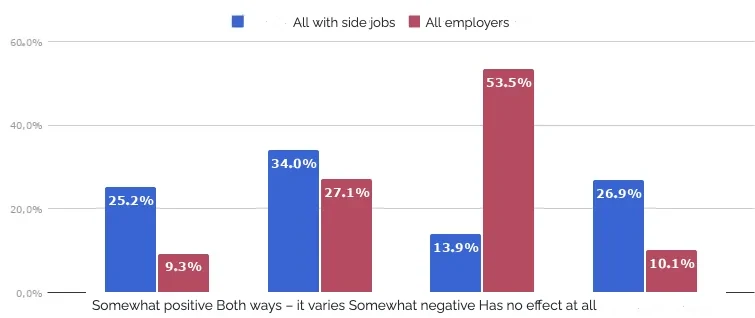
- A quarter of specialists with side jobs assess the impact of the side job on their main job as positive.
- For 60% it is ambiguous: they either believe a side job can affect the main job in different ways, or see no effect at all.
How does a side job affect the main job?
Opinion of employers (1,276) and employees (129)
Number of respondents: 1,405
Alena Makarova
Head of Research
at NEWHR
"The split in assessing the impact of side jobs between employees and employers points to their different focus. Each looks at it 'from their own bell tower' — based on different ideas about what should be taken into account at all.
For the employee, what matters a lot is overall professional satisfaction; the ability to get tasks done in both places; and also the fact that in some cases a side job is what makes it possible to stay at the main job at all, rather than look for a new one. For the employer, what matters more is the employee's productivity, which they interpret as person-hours spent on tasks. So the employer tends not to take into account the very possibility of losing an employee who for some reason is not satisfied with the main job. And the employee underestimates the losses that matter to the employer.
Only professional HR analytics based on comprehensive data can give a more or less adequate picture, unique to each business."
What do employers think?
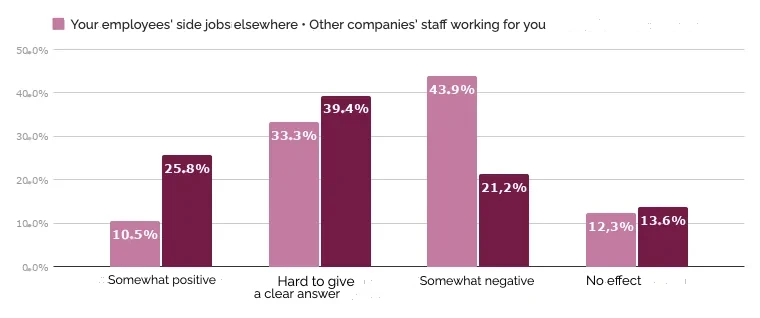
- The opinion of employers who are not against side jobs in principle also varies greatly — depending on the role they play in each particular case. If people go "on the side" from them, it is rather bad (almost 44% answered this way), but if people come to them for a side job, it is rather good and useful for the main employer: the share of negative assessments is cut in half (to 21.2%).
How does a side job affect the main job?
Employers whose employees have side jobs: 57 resp.
Employers who hire people for side jobs: 66 resp.
"At the recruiting agency NEWHR we regularly come across the question of side jobs when discussing vacancies. I know employers (most often startups) who build their hiring strategy specifically on employing seniors and top executives part-time.
Usually they are interested in buying top-notch expertise below market price, and at the same time getting mentoring for their employees. And a certain paradox arises: an employer who is ready to hire an expert part-time may, literally at the same moment, say that they take a hard line on side jobs for their current employees. Only after the direct question 'Isn't there a contradiction here?' do some think about it for the first time.
I see that both concepts can coexist quite calmly in the employer's head: if I need it and I benefit — then I'm happy about employees' (other people's) side jobs. But if my employees have chosen a side job with another employer themselves — that's bad.
At the same time, few employers think about the fact that employees can fulfill their professional or financial ambitions on the side, which allows them not to leave their current company."
Kira Kuzmenko, CEO NEWHR Data
What do employees think?
- Overemployed people more often note that their side job has a negative impact on their main job (25% chose the clearly negative option). "Regular" side-jobbers are more optimistic — only 11% of them consider the impact of a side job negative. Recall that among employers, 53.5% hold this opinion.
- Every fourth "classic" side-jobber (20.3%) and even every fifth overemployed person (26.4%) believe that side jobs have a positive effect on their main job.
- As employees' grade increases, the share of positive assessments of side jobs grows too (from 15.4% positive assessments among juniors to 45.5% among top managers).
- 45.5% of top managers
- 39% of heads of departments
- 26.1% of team leads
- 24.6% of seniors
- 20.9% of middles
- 15.4% of juniors
- 15.4% of juniors
- 15.2% of seniors
- 14.2% of middles
- 13% of team leads
- 11% of heads of departments
- 3% of top managers
Alena Makarova
Head of Research
at NEWHR
"This relationship is quite natural. For junior grades, who do a large number of simple tasks, time spent is a sensitive resource. The higher the grade, the more the complexity of tasks and the experience the employee puts into solving them matter, i.e. time is spent more productively. The additional experience an employee gains at a side job helps them at their main job too."
Are side jobs hard on employees?
- 66% answered that they feel strain, but it is not critical
- 19% say that a side job is easy and pleasant for them
- 15% admitted that a side job is hard for them
How do you assess having a side job? For you it is...
Number of respondents: 1,276
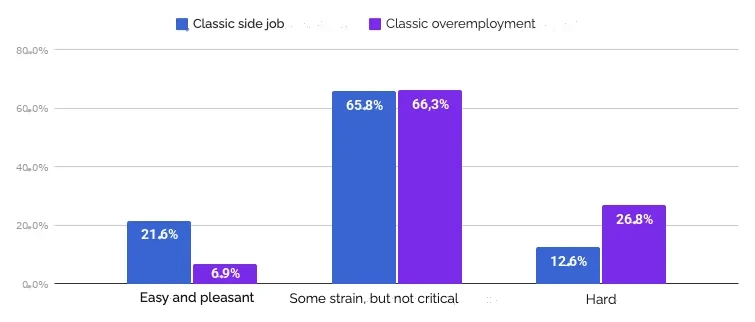
- The easier a side job is for people, the more often they assess its impact on the main employer positively.
- The higher the grade, the easier it is for employees to cope with secondary employment. However, it should be kept in mind that the forms of side jobs differ for junior grades and for the management level: the former "work with their hands", which takes more time and energy, while managers more often do consulting and mentoring. It seems the saying is confirmed here that it is more effective to work not 12 hours, but with your head.
- The difficulty of side jobs differs markedly between specializations.
- Data Science | ML | AI — 27%
- Backend | Desktop | Embedded development — 19%
- Design | 3D | animation | web | UX/UI/CX — 19%
- Top management — 30%
- Technical management | Software architecture — 26.7%
- Infrastructure | DevOps | SRE | NetEng | InfoSec — 24.3%
- Product management — 22.1%
Let's look in more detail at what exactly the negative and positive impact of a side job on the main job consists of.
Positive impact of a side job. What does it mean?
59.2% (755 people)
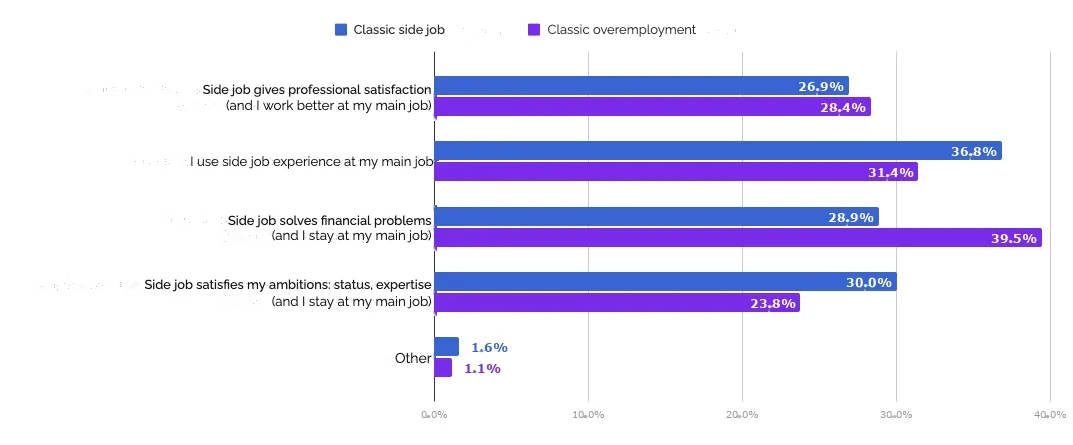
- 35.7% of those with side jobs apply the experience gained at their main employer.
- 31% believe that a side job in principle allows them to stay at their main job rather than look for a new one — since it solves financial problems.
- 29% note that a side job satisfies their career ambitions when the main job falls short on this.
- With overemployment, finances matter more to specialists. Two out of five overemployed people meet their financial needs thanks to the second job, which is what allows them to stay at the main one. For followers of the classic side job, experience they can also use at their main employer comes first.
- 28% of overemployed people and 27% of "regular" side-jobbers see a positive impact in the professional satisfaction from a side job, which lets them work better at their main job.
What is the positive impact of a side job on your main job?
Number of respondents: 1,276
Multiple choice
Negative impact of a side job. What does it mean?
40.28% (612 people)
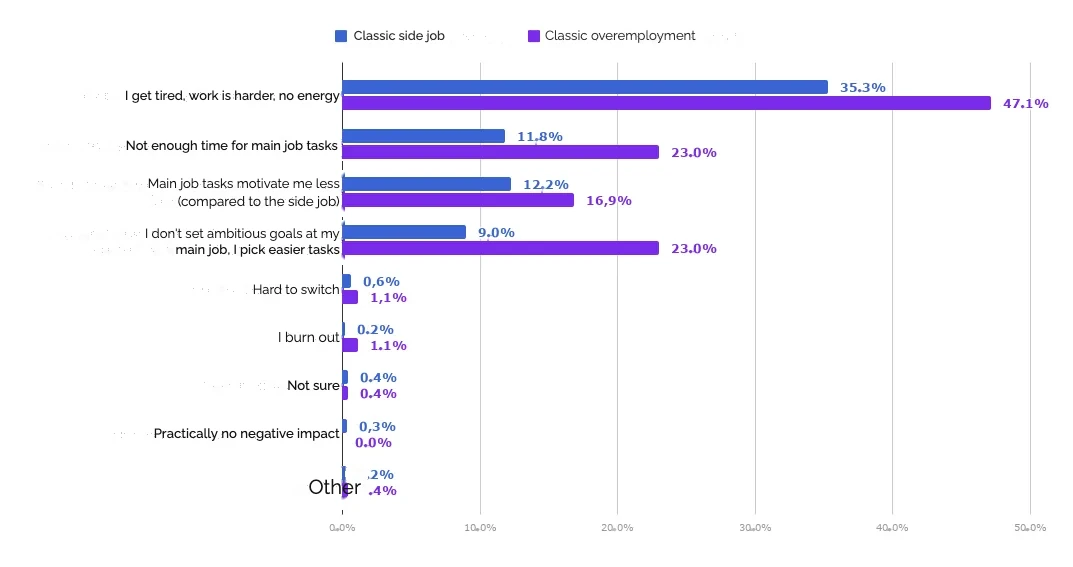
- 37.7% of those with side jobs note that they get tired, and this has a negative effect on their main job.
- 14% lack time to complete tasks at their main job.
- 13% are less motivated by tasks at their main job compared to the side job.
- 12% choose simpler tasks at their main job.
- With overemployment, employees feel the negative effects much more strongly than with a classic side job. Overemployed people are 1.3 times more likely to get so tired that they lack the energy for their main job, and 2 times more likely to fail to complete tasks at their main job. Finally, 2.5 times more overemployed people do not set ambitious goals for themselves and keep working "on autopilot".
What is the negative impact of a side job on your main job?
Number of respondents: 1,276
Multiple choice
Key takeaways of the section
Employers and employees each have their own truth
More than half of employers believe that a side job only harms the main job. Only 14% of those with side jobs agree with them. Each side has its own idea of what matters when assessing the impact of a side job. Thus, the employer often does not take into account that some employees stay at their main job largely thanks to a side job (since it helps them meet their unmet financial and professional needs). And the employee tends to underestimate the productivity losses that matter to the employer.
A side job has its price
37.7% of all those with side jobs get tired from the total workload and therefore work worse. In the case of overemployment this impact is even more noticeable: almost half (47.1%) of overemployed people get so tired that they lack the energy for their main job. And 23% fail to complete tasks at their main job on time — they simply lack the time.
IT specialists often underestimate the negative results of a side job
Although 37.7% of specialists with side jobs admit that they feel tired, only 15.5% answered that a side job is hard for them. This may mean that employees underestimate the long-term negative effects of secondary employment.
Employers' assessment of the impact of a side job is no less subjective
Employers' opinion is strikingly changeable. So, if your main employees "go on the side", you will most likely consider it harmful to the business. However, if you yourself hire other people's employees, the confidence that it is harmful to the other employer drops by half, while the perception of the benefits of side jobs grows 2.5 times.
To understand objectively how a side job affects a business, a comprehensive third-party assessment is needed
Our study clearly shows how conditional and subjective the assessments of side jobs are, both by employers and by employees. Respondents' opinions are formed largely by the need to justify their actions in their own eyes and in the eyes of others. Only a professional HR assessment based on comprehensive research will help form an objective picture of the impact of side jobs on a particular business.
Topic 7. Policy and sanctions
With a kind word and a gun
What is an employer policy?
Corporate policy (CP) means the norms, rules and principles that guide a company in its activities. This systemic tool helps an organization act not only effectively but also legally, stably and ethically, and helps employees understand the expectations, standards and values within the company. Put simply, corporate policy is an internal mechanism that defines the "rules of the game" within a particular business.
There is no single standard or legally fixed mandatory list of corporate policies under current Russian law. Depending on the area of application and the company's specific goals, the policy (or policies) are created for the specific subject. However, there are some issues (for example, protection and processing of personal data) that must be set out in an internal local act on a mandatory basis.
Any corporate policy is an internal regulatory act of the company. When concluding an employment contract, the company is obliged to familiarize the future employee with the entire list of local regulatory acts (policies) in force, against signature, and when changes are made, to repeat this procedure.
Ira Yamboglo
Corporate practice lawyer
"Restrictions on secondary employment may be introduced to protect business interests and prevent risks. The grounds listed are not exhaustive. The company's status and jurisdiction matter here. As a general rule, an employer cannot arbitrarily deprive employees of the right to additional employment without good and legally justified reasons — decisions must be made in good faith and with a balance of the interests of both parties.
If we are talking about special industry restrictions in the Russian jurisdiction (for example, for civil servants, officials, employees of companies with state participation or employees with access to commercial or state secrets), the restrictions and bans are set out directly in the law — to prevent corruption, conflicts of interest and to protect national interests"
- Restriction on working for competitors. Company employees are prohibited from working at companies that directly or indirectly compete with the main employer.
- Restriction on activities that create a conflict of interest. An employee may not carry out activities on the side (including work for suppliers, clients, subsidiaries/affiliated companies, related structures) that may lead to a conflict of interest or make it possible to influence the company's decisions in favor of these parties.
- Restriction on activities that may damage the company's reputation. An employee may not take part in the activities of an organization whose business reputation raises reasonable doubts, nor if such activity may negatively affect the image or business reputation of the main employer.
- Restriction on entrepreneurial activity in certain areas. An employee must not, independently or through affiliated persons, carry out entrepreneurial activity in areas that compete with the company's business if this leads to duplication of services or involves using the company's resources/information for personal interests.
Kira Kuzmenko
CEO of NEWHR
"In my experience, employees and even managers more often rely on informal rules within the company rather than on a corporate policy approved by a lawyer. These rules are passed on at meetings with colleagues, stand-ups and in behind-the-scenes conversations.
Over the years I have seen hundreds of cases where candidates simply did not know how the restrictions in their company actually work. The most common answer to the question of why employees are 'not allowed' to have side jobs is: 'That's what I was told', — although there is not a word about it in the official documents. The opposite also happens: when the employer's policy formally prohibits outside employment, but the manager is ready to make an exception for a valuable specialist.
The result is a paradox: IT specialists take informal rules much more seriously than signed documents.
My recommendation for managers: even if you have documented internal regulations, be sure to say out loud at a general meeting how exactly your company treats side jobs, and remind employees of it from time to time at meetings."
In this study we use the term "employer policy" in a broad sense, meaning not only the company's regulatory acts, but also the informal rules that actually regulate employee behavior.
Policy on side jobs: employees vs employers
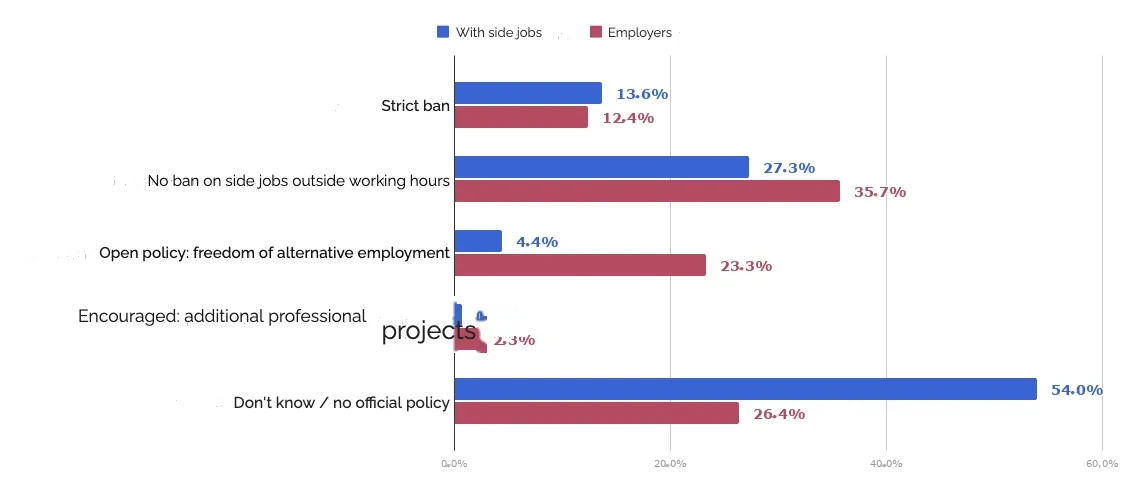
- Employees' and employers' ideas about what their company's policy on secondary employment is differ seriously (see chart). The only option on which opinions coincide is a strict ban on side jobs. The share of employees with side jobs who believe it is prohibited in their company matches the percentage of employers who actually follow such a policy*.
- Employers on the whole assess their policy as more democratic than their employees do.
- A policy of encouraging additional professional projects is practically absent in Russian-speaking IT: only 2.3% of employers and 0.7% of employees with side jobs chose this option.
What policy on side jobs does your company follow?
Number of respondents: 1,276
Are there differences among employers?
Employers who hire employees for side jobs practically never prohibit side jobs themselves (although 48% of them view their main employees' side jobs negatively). But companies that hire people only full-time are much more likely to follow a policy of a strict ban on any secondary employment. Yet even among them, the leading option is simply no ban on side jobs outside working hours.
- 37.5% — no ban on side jobs in free time
- 20.8% — strict ban on any side job
- 15.3% — freedom of alternative employment
- 1.4% — encourage their employees' side jobs
- 28.8% — no ban on side jobs in free time
- 28.8% — freedom of alternative employment
- 3% — encourage their employees' side jobs
- 1.5% — strict ban on any side job
We asked our employer respondents the question:
"Why do you follow the chosen policy on employees' side jobs?"
Employees' side jobs are encouraged
Variative employer | Partly Russian company | Small (up to 50 employees)
"One company can rarely provide a wide range of professional activity for top specialists, and I only hire those."
Strict ban policy
Normative employer | Partly Russian company | Large (500−1000 employees)
"We are convinced that an employee cannot be focused on two jobs at the same time, and for our model this is critical, we literally lose money on it."
Strict ban policy
Normative employer | Russian company | Small (up to 50 employees)
"So that they work well at their main place of work."
Strict ban policy
Normative employer | Foreign international company | Medium (200−500 employees)
- Reduced efficiency and productivity;
- Possible NDA violation;
- Increased risk of losing the employee, since their loyalty to the company is already diluted."
No ban on side jobs in free time
Variative employer | Foreign international company | Small (up to 50 employees)
"A ban has to be monitored, and monitoring costs more than finding a new person to replace someone who is not coping."
No ban on side jobs in free time
Variative employer | Partly Russian company | Smaller mid-size (50−200 employees)
"I have a negative attitude to side jobs for competitors. To a regular [side job, my attitude is] rather neutral. But it is always a reason to talk to the employee and clarify why they need this side job. After all, we have so many tasks — and we are usually ready to pay for them."
No ban on side jobs in free time
Normative employer | Russian company | Huge (more than 5000 employees)
"Because I understand employees. If I prohibit it outright and tighten the screws, I may face good employees simply leaving for a higher salary."
No ban on side jobs in free time
Normative employer | Foreign international company | Very large (1000−5000 employees)
"There is no ban, but the employee is obliged to inform the employer about working somewhere else. The absence of a ban is dictated by the labor law of the jurisdiction in which the company operates."
No ban on side jobs in free time
Variative employer | Russian company | Small (up to 50 employees)
"In 2024, 60% of employees who were dismissed during probation due to low efficiency had a side job. We are ready to work with a person if they either only freelance or only work full-time for us. Experience has shown that those who try to combine two jobs end up poorly engaged, deliver low results, and this is so noticeable that it demotivates the team."
No ban on side jobs in free time
Variative employer | Partly Russian company | Small (up to 50 employees)
"In remote work it is impossible to prohibit side jobs, there is no point fighting it."
Freedom of alternative employment
Normative employer | Russian company | Very large (1000−5000 employees)
"I don't micromanage. If an employee delivers the required performance, I don't care whether they work somewhere else."
Freedom of alternative employment
Variative employer | Russian company | Very large (1000−5000 employees)
"As an employer, we lose out heavily on salary levels, especially in the last 6−12 months, so we put no obstacles in the way of employees' side jobs in order to keep our core workforce."
Freedom of alternative employment
Variative employer | Partly Russian company | Smaller mid-size (50−200 employees)
"There is no emphasis on time — we have a results culture, i.e. we expect the employee to complete tasks, and if they do it in less time — well done :)."
Employees' side jobs are encouraged
Variative employer | Foreign local company | Small (up to 50 employees)
"The IT field is very multifaceted and there are a lot of tasks. I myself often want to work on other projects, broaden my horizons, but without leaving my main job."
Employees' side jobs are encouraged
Variative employer | Partly Russian company | Small (up to 50 employees)
"One company can rarely provide a wide range of professional activity for top specialists, and I only hire those."
Strict ban policy
Normative employer | Partly Russian company | Large (500−1000 employees)
"We are convinced that an employee cannot be focused on two jobs at the same time, and for our model this is critical, we literally lose money on it."
And among employees?
A reminder that IT specialists often do not know at all how their employer treats side jobs (54% of old-style side-jobbers and 53% of overemployed people believe their company has no clear policy, or do not know what it is)
However, employees who do have an idea of their employer's policy show some differences. Overemployed people more often believe their company has a strict ban on any side job (25% of them have side jobs under such an employer policy). With a classic side job, people more often think they have no ban on side jobs outside working hours (30% of cases).
What sanctions do employees expect for a side job?
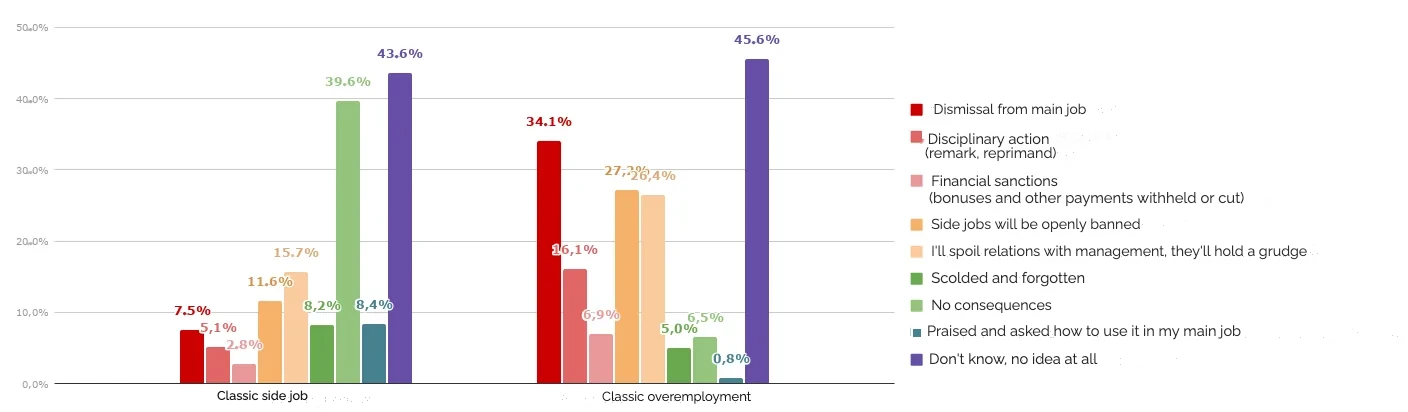
- Followers of the "regular", good old side job are especially optimistic. Compared to them, overemployed people more often expect sad consequences for themselves and their careers (although even among them the most common option is having no clear idea of the punishment).
- 43.6% — have no idea at all about the consequences
- 39.6% — hope there will be no consequences
- 15.7% — think they will spoil relations with management
- 11.6% — fear they will get a direct ban on side jobs
- 45.6% — have no idea at all about the consequences
- 34.1% — fear they will be fired from their main job
- 27.2% — fear they will get a direct ban on side jobs
- 26.4% — think they will spoil relations with management
What consequences do you expect if your main employer finds out about your side job?
Number of respondents: 1,276
The link between employees' vaguely optimistic ("I don't know what will happen if they find out about my side job at my main job, I hope nothing") and vaguely apocalyptic ("I don't know what will happen, maybe they'll fire me or hold a grudge") expectations and the employer's policy is not always direct and unambiguous.
How are the type of employer policy and employees' expectations related?
- If the employer follows a strict ban on side jobs, employees' most significant expectations are, of course, about negative consequences (dismissal, disciplinary action, poor treatment by management). However, even under such a policy, 22% have no idea what exactly awaits them. And from 2% to 5% expect to be praised, or scolded and then forgotten. Apparently, these respondents know their direct managers well or are managers themselves.
- The option employers love, "no ban on side jobs outside working hours", does not reassure many employees. Only 44% of those with side jobs under such a policy believe nothing will happen to them for it, while 56% are wary of all sorts of other things. In particular, 30% do not know what to expect from the employer, and from 2% to 6% expect sanctions up to and including dismissal (among them both overemployed people and those who honestly work side jobs outside working hours).
- As expected, with an undefined employer policy (recall that more than half of those with side jobs do not know what policy their company follows), most employees are not sure about the consequences of a side job: 60% chose the option "I don't know, I have no idea at all". Only 30% believe there will be no consequences, and 16% fear they will spoil relations with management.
Are there differences in expectations among employees?
Followers of overemployment are aware that their way of working side jobs carries higher risks: they more often expect dismissal and other negative consequences. However, under any option, even with a ban on any side job at all, the threat of dismissal is high in their eyes, but does not approach 100%.
Another feature of overemployed people: some of them tend to doubt that punishment will really follow. Even under a strict ban on side jobs, 20% of overemployed people do not know what awaits them if the deception is revealed. They always have hope that the consequences will be softened.
How often do employees hide side jobs?
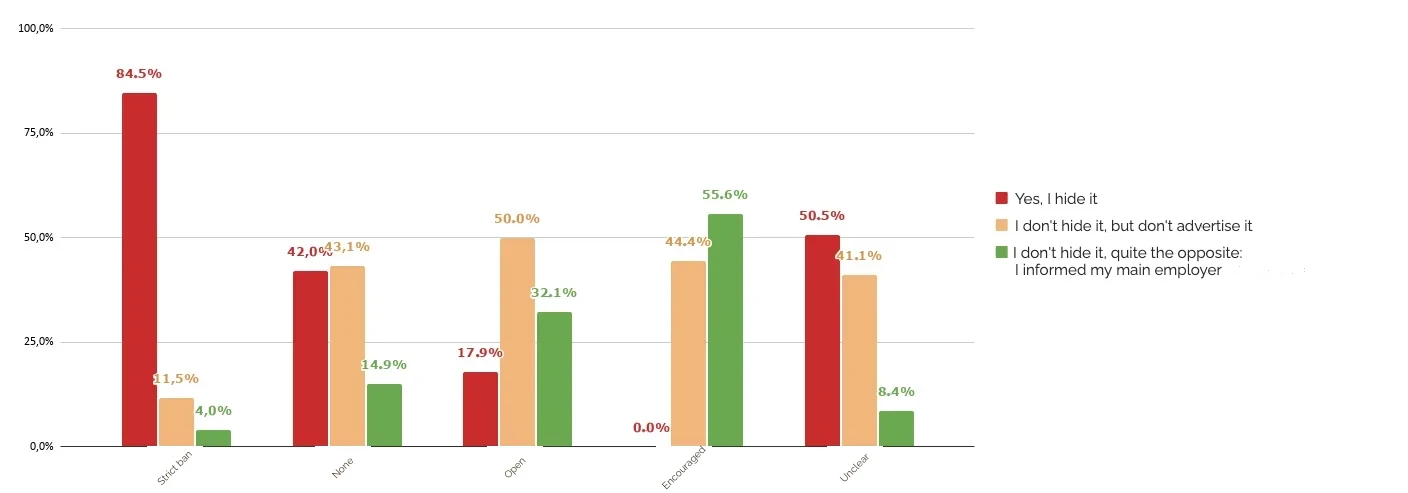
Vague ideas about the consequences lead IT specialists to prefer hiding the fact of a side job. Half of all those with side jobs hide it from their main employer. Of them, 25.5% hide it thoroughly, and 25.5% do so just "in case".
Do you hide at your main job that you have a side job?
Number of respondents: 1,276
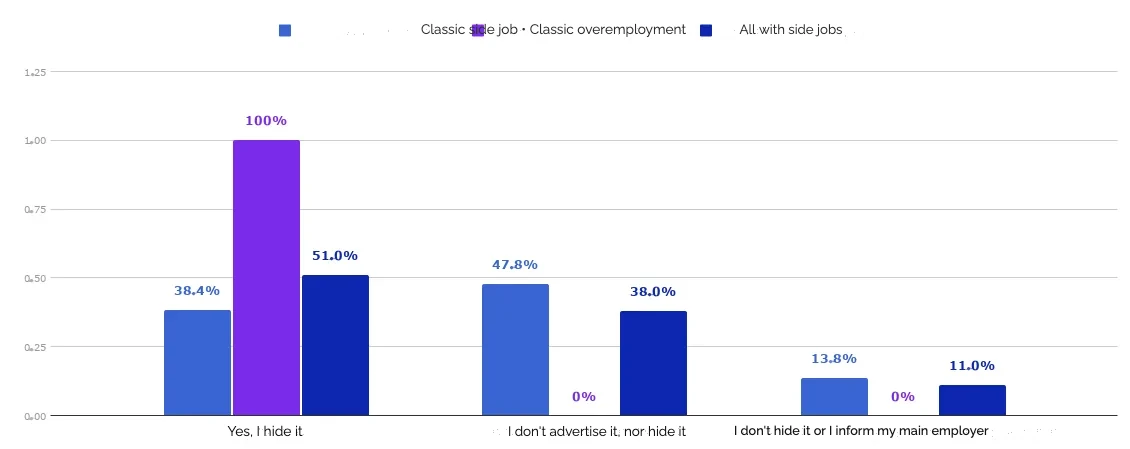
Most employees with a "regular" side job make no special effort to hide it. And roughly one in seven sees a benefit in letting the main employer know about the side job.
As expected, 100% of overemployed people hide having a second job, but not everyone approaches it with spy-like thoroughness.
- 47.8% — do not hide the side job, but do not advertise it either
- 22.7% — hide it just in case
- 15.8% — carefully hide the side job from the main employer
- 13.8% — do not hide the side job from the main employer
- 63.6% — carefully hide the side job from the main employer
- 36.4% — hide it just in case
- Side jobs are most often hidden by individual contributors, and most carefully by seniors (57% of seniors with side jobs do it secretly). Those who show it openly are top managers (24% inform the employer about their alternative employment).
- The most secretive specializations are Data Engineering, development and testing. The share of those hiding their side job among them ranges within 60−62%.
Does the employer's policy affect how secretive employees are?
- With an unclear employer policy, 50.5% of those with side jobs will actively hide, and another 40% will prefer not to advertise the side job. Given the significant levels of unawareness (recall that more than half of those with side jobs do not know how their main employer treats it), IT specialists prefer to keep quiet — just in case something goes wrong.
What is your main employer's policy on side jobs elsewhere? Do you hide your side job from them?
Number of respondents: 1,276
"At the recruiting agency NEWHR we sometimes meet specialists who have not looked for a job for a long time and, coming to today's labor market, state in their CV that they worked for two employers in parallel. They see nothing wrong with it — after all, both companies knew and did not mind. However, today, when the topic of overemployment is widely discussed, combining jobs can become a red flag for a hiring company. The candidate may be rejected without going into details.
If you combined two projects with the consent of both parties, it is better to state this directly in your CV — so that the recruiter does not have unnecessary suspicions.
If you are asked about it at an interview, you can calmly answer: 'I am ready to provide the contacts of both employers if you want to check how I handled my tasks and whether the work was really done with their knowledge.'
Kira Kuzmenko, CEO NEWHR Data
Key takeaways of the section
Employees' and employers' opinions about their company's policy on side jobs differ seriously
¾ of employers think they follow a clear policy on secondary employment. Yet half of their employees with side jobs simply do not know what it is.
IT specialists' ideas about sanctions for side jobs are very vague
60% of those with side jobs have no idea at all what will happen if their main employer finds out. The situation is reminiscent of the song about the hares, where the hares (side-jobbers of all stripes) go about their business, while somewhere in the fog there are vague mutterings about what sanctions threaten them. These very hares do not fully understand whether it is all nonsense or a real danger.
The lack of a clear employer policy makes employees more secretive
With such vague ideas about the consequences, people tend to hide the fact of a side job — just in case. 51% of all those with side jobs hide it from their main employer. Even if the employer's policy relies solely on the country's current legislation, it seems it would not hurt to communicate its content to the broad masses more often. Especially if the company aims to regulate its employees' side jobs.
Topic 8. Policy effectiveness
However much you feed the wolf…
How do employers and employees assess the effectiveness of company policy?
We wrote in more detail about what company policy is (both in the strict legal sense and in the broad sense) in the previous section. In this part we look at how employers and employees assess the effectiveness of the employer's policy on side jobs.
Employers are optimistic in assessing their own policy on side jobs. 41% believe their policy is effective for most employees. At the same time, employees with side jobs often cannot assess their management's policy at all, since they do not know what it is.
Assessment of the effectiveness of the employer's policy:
- 41.1% — Effective for most employees
- 26.4% — No defined policy
- 26.4% — Effective for some employees
- 6.2% — Ineffective for most employees
- 54% — No defined policy
- 21.3% — Effective for some employees
- 15.8% — Effective for most employees
- 8.9% — Ineffective for most employees
- What is important to know: — When employees know what their employers' policy on side jobs is, they tend to assess it as rather effective. 67.5% of employers and 37% of those with side jobs believe their company's policy works in principle (for some or for most employees).
- The opinion that the current policy is ineffective is not popular with either side.
Does a strict ban policy work?
Employers consider a strict ban on side jobs more effective than employees do. That is, employers more often believe their employees do not have side jobs than employees actually give up side jobs. The gap is not huge, but it is clearly pronounced.
Other data confirm this. 13.6% of our respondents with side jobs are covered by a strict ban policy. Most are sure that if they are "caught", serious punishments will follow — disciplinary action (up to and including dismissal), financial sanctions, worse relations with management. And yet they have side jobs.
Assessment of the effectiveness of a strict ban on side jobs:
- 43.8% — Effective for most employees
- 43.8% — Effective for some employees
- 12.5% — Not effective at all
- 42% — Effective for some employees
- 29.3% — Effective for most employees
- 28.7% — Not effective at all
- What is important to know: — Employees covered by a strict prohibitive policy assessed it as by and large effective — 71% think it is effective for most or at least some employees. However, 29% believe the ban does not work.
- Overall there are few differences in views between "regular" side-jobbers and overemployed people. But there is a nuance related precisely to the perception of a strict ban policy. It lets us understand the logic of overemployment adepts: half of overemployed people are sure that the employer's strict policy is actually flexible. That is, it works for some colleagues but does not apply to others. So if you try hard, you can "slip through". It turns out that the strictness of the policy is offset by the optional nature of its enforcement.
Will IT specialists keep working side jobs?
¾ of all those with side jobs (both "regular" ones and overemployed people) intend to keep doing it, at least for the next year or two. Only one in seven is inclined to stop.
Are you ready to keep working a side job in the near future?
Number of respondents: 1,276
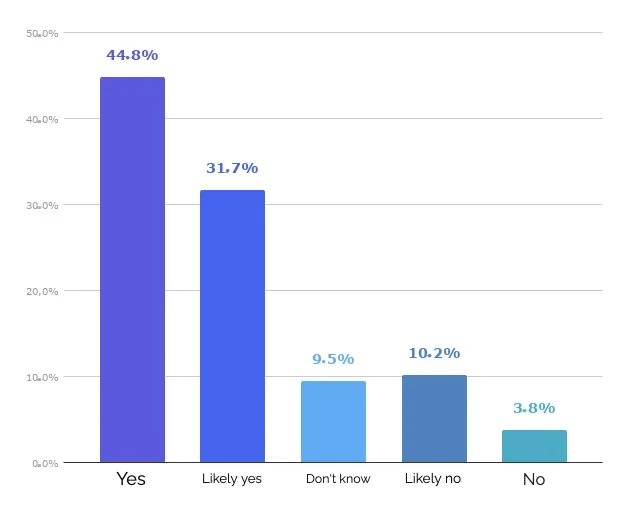
- What is important to know: — Although overemployed people are more afraid of negative consequences than "regular" side-jobbers, both are similar in their plans for the future:
- 76% — plan to continue in the near future
- 14% — plan to stop working side jobs
- 10% — undecided
- 77% — plan to continue in the near future
- 15% — plan to stop working side jobs
- 8% — undecided
The employer's policy on side jobs affects the plans of its employees with side jobs, but not radically.
- 73% — will keep working side jobs even under a strict ban
- 75% — will keep working side jobs under an undefined, unclear employer policy
- 80% — will keep working side jobs when there is no ban on side jobs outside working hours
- 84% — will keep working side jobs with freedom for any alternative activity
Alena Makarova
Head of Research
at NEWHR
"It is necessary to understand that we are dealing with the policy that has historically developed in the company, with the status quo: the employee is used to a certain situation, acts within it and in 77% of cases does not plan to change anything. Will the employee's behavior change if their employer chooses a different policy (for example, introduces a strict ban on side jobs)? Most likely — yes.
Recall that among our respondents with side jobs, only 13.6% do so under a strict ban policy. And under flexible options — 32.4%, that is, 2.5 times more. Thus, a strict ban policy can indeed lead to a reduction in the number of people with side jobs. But hardly by 2.5 times. As the study shows (see text below), sanctions are not the leading reason for giving up a side job."
What has to happen for IT specialists to stop working side jobs?
In respondents' answers we see a wide variety of reasons that may influence employees' decision to stop working side jobs. And none of them is dominant.
This means there is no magic pill that can cure employees of side jobs. In each case, individual therapy is more useful. For some it is enough to get thoroughly tired, get a pay raise and move to the office, for others — to save up the amount needed for a dream and get more interesting tasks at the main job. Finding out what works for each employee is the job of HR.
- Fatigue and inability to cope with obligations at the main job
- Financial reasons (reaching the desired income, solving financial problems or achieving current goals)
- Sanctions at the main job
Under what conditions are you ready to stop working side jobs?
Number of respondents: 1,276
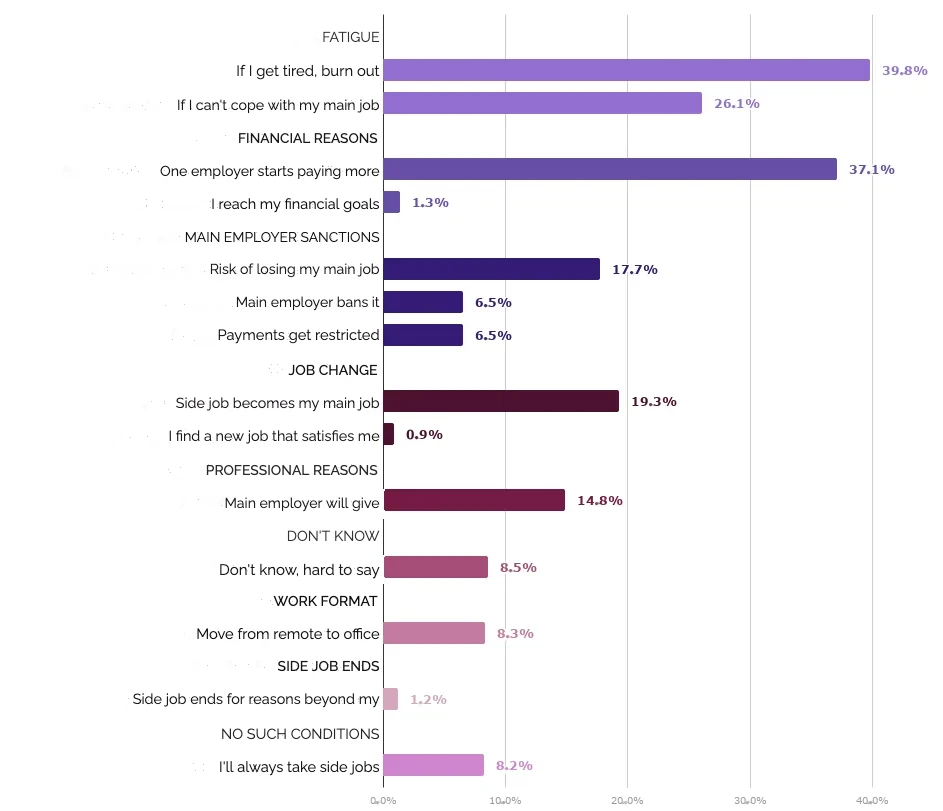
"Why a side job and not a new job?"
Overemployment
Senior | Frontend | Fullstack development
"Because I like my main job, I don't want to quit. But if during downtime you can earn the same amount again and also gain extra experience — why not."
"Regular" side job
Senior | Content | SMM | Technical content
"Different tasks. At the side job my soul rests, there's more freedom, no bureaucracy and full-on rock 'n' roll."
"Regular" side job
Middle | Product management
"Additional income. A chance to try myself at a dream company while staying at a comfortable (backup) job in case I don't like the side job or the colleagues at the second job. That's how it was for me, I gave up the second job and calmly went back to the main one."
"Regular" side job
Head of Department | Product management
"This way the total income is higher. It's easy to pass on my knowledge to smaller companies. More professional tasks for development. A wider community. Risk diversification."
Overemployment
Middle | Infrastructure | DevOps | SRE | NetEng | InfoSec
"I get benefits from both jobs in different countries — health insurance, vacations, paid courses. With two jobs I'll earn more money, I can't find one job with that kind of salary. [I get] diverse experience, since the companies differ in tech stack. Also the feeling that there's a safety net — if I don't like one job/get fired/other problems, no big deal, because there's the other one."
"Regular" side job
Middle | Backend | Desktop | Embedded development
"When the next grade is far away in terms of knowledge, you can get up to speed faster thanks to a large volume of work. The money is above market."
"Regular" side job
Senior | Analytics
"Lack of recognition at my main job and of career growth. When it's not customary to talk and give feedback, and the best you can hear is 'fine, I like working with you', while the feeling that the result is unfinished remains, — you start looking for [something] new."
"Regular" side job
Senior | Frontend | Fullstack development
"I've reached the salary ceiling in my profession, to grow further I'd have to either become a head/build a personal brand/become an infobiz guru/start my own startup/go to FAANG/ etc. That would take a huge amount of time and effort, and it's not a given that I'd like it/fit in there. And here I found a side job, and my salary went up one and a half to two times."
"Regular" side job
Top manager | Founder
"For a year and a half I haven't been able to find a new [job] that suits me in every way."
"Regular" side job
Senior | GameDev
"Difficult situation on the market. With a side job there's a little more sense of stability."
"Regular" side job
Senior | Analytics
"The problem of choice: I like working at startup-type companies where you can play different roles, try new things, without bureaucracy, but there's no confidence in stability and reliability, so I have to 'sit on two chairs'."
"Regular" side job
Senior | Backend | Desktop | Embedded development
"Because the side job is a pet project. It is effectively funded by the main job."
Overemployment
Senior | Mobile development
"No one on the Russian labor market will pay me $8,000 for one job, and I really need money for medical treatment. And for a year of work on two projects in different directions you get two years of experience and all-round development as a specialist."
Overemployment
Senior | Testing
"I've hit the market ceiling on money, I'm unlikely to get more than +5−10% of my current salary at another job."
"Regular" side job
Junior | Product management
"Because the second job lets me combine it with my main job and have additional, pleasant earnings that are a nice bonus to the main ones."
Overemployment
Senior | Frontend | Fullstack development
"Because I like my main job, I don't want to quit. But if during downtime you can earn the same amount again and also gain extra experience — why not."
"Regular" side job
Senior | Content | SMM | Technical content
"Different tasks. At the side job my soul rests, there's more freedom, no bureaucracy and full-on rock 'n' roll."
Key takeaways of the section
A strict ban policy on side jobs does bring some results
Under such an employer policy we see 2.5 times fewer employees with side jobs than under more tolerant options. Both employers and employees recognize it as effective.
However, regardless of the employer's policy, most IT specialists with side jobs are ready to keep going
In their own opinion, only fatigue and solving financial issues can stop employees. Sanctions from the employer and professional self-realization matter less.
It seems that, on the whole, employers' fight against their employees' side jobs is not worth the effort spent on it
And in the case of overemployment, an effective approach should include, in addition to a clear and understandable employer policy, work on the reasons for this practice.
Max Postnikov
CPO of salary analytics
at NEWHR
"Several decades ago, it was considered normal to work for the same employer almost all your life. Today the average tenure at one company is 3 to 5 years, and this figure keeps shrinking. Moreover, the grade system based on length of service is gradually becoming a thing of the past.
Let's compare two employees. One has 8 years of experience at one company, where he did bug fixing and supported an outdated framework. The other has 4 years, during which he wrote several services from scratch, worked at a startup and at a large corporation. Obviously, the second specialist will be more in demand.
For me, overemployment in IT is another marker that the format of work as a whole is changing. Since a specialist's value is determined not by the number of years in the profession but by the breadth and diversity of their experience, the project format will become the new normal. Everyone will sign short-term contracts with businesses and build their own career trajectory."
Can overemployment be defeated at all?
According to our study, the overemployment phenomenon is not yet widespread and does not seriously threaten most employers. To assess its true negative impact on business, a comprehensive professional assessment is needed, not the subjective position of individual employers. Isolated cases of overemployment are "cured" by good HR policy. Mass cases — by money and professional opportunities. It seems the only truly effective approach is painstaking human resource management.
Perhaps over time the development of technology, the precarization of employment and income stagnation will lead to a transformation of the market in which multiple employment (Multiple Job Holding) becomes the norm. However, according to our study, today most IT specialists practice side jobs rather in the sense classic for Russia, which took shape back in the 1990s — for personal professional growth and to protect themselves in an unstable market.
We have significantly shortened the text of the study for publication on the website. To explore our logic, see the charts and read additional conclusions, write to data@new.hr with the subject "Where's the proof?"
Reviews and opinions
Quoted with minor changes to preserve anonymity
Spelling and punctuation preserved
"Your survey touched one of my 'pain points' - why two jobs if you can find one with a bigger salary...made me think. Thank you."
Quoted with minor changes to preserve anonymity
Spelling and punctuation preserved
"At two of my jobs I had managers who were fine with side jobs. Moreover, at my new job my manager encourages it, […] she cares about her own and our professional development and financial well-being. The managers I've had consider it useful, because this way more expertise and skills appear. […]"
Quoted with minor changes to preserve anonymity
Spelling and punctuation preserved
"You're doing important research, thank you"
Quoted with minor changes to preserve anonymity
Spelling and punctuation preserved
"As an employer, I usually hire people for part-time side jobs paid by the hour. It pays off for me when there is a simple project with a small fluctuating workload and no staff employee to give this project to. [...] From my observations, people with side jobs regularly miss deadlines (they overestimate their speed and underestimate the tasks). And the quality of work also often deteriorates over time. [...]"
Quoted with minor changes to preserve anonymity
Spelling and punctuation preserved
"Interesting survey! Thank you! While answering I realized my attitude to two jobs :)"
Quoted with minor changes to preserve anonymity
Spelling and punctuation preserved
"I had difficulties with the questions about the main employer's ban on side jobs, couldn't find an exact answer for my experience, in my case there is an explicit ban on side jobs, but if the conflict of interest is resolved, it is allowed"
Quoted with minor changes to preserve anonymity
Spelling and punctuation preserved
"Looking forward to the results of the study =) As we've been coming across this practice more and more"
Quoted with minor changes to preserve anonymity
Spelling and punctuation preserved
"We try to part ways with those who are 'caught' with a side job. Firstly, we value loyalty, secondly it's uncomfortable to work with people who 'lie' from the start. You never know what he'll lie about next time, which means you can't rely on him"
Quoted with minor changes to preserve anonymity
Spelling and punctuation preserved
"Your survey touched one of my 'pain points' - why two jobs if you can find one with a bigger salary...made me think. Thank you."
Quoted with minor changes to preserve anonymity
Spelling and punctuation preserved
"At two of my jobs I had managers who were fine with side jobs. Moreover, at my new job my manager encourages it, […] she cares about her own and our professional development and financial well-being. The managers I've had consider it useful, because this way more expertise and skills appear. […]"
Our partners
We thank everyone who posted information about the study and helped us collect such an impressive sample! 💙
The list of partners is below. If you helped us find respondents but did not find your channel in the list, write to data@new.hr. If you want us to correct something in the description, write to us too!
NEWHR
- International recruiting agency
- Hello New Job! — Job search and employment: instructions, tips, useful practices
Recruiting, Kitties and the Apocalypse
- The channel of NEWHR founder Kira Kuzmenko
- IT Solutions Architecture — IT Solutions Architecture — conversations about the architecture of enterprise information systems
Evgeny Kornyshev
- Tester, mentor, course author
Nikita Zaltsman / Dev easy notes
- Mobile infrastructure developer
QA Sisters
- Supporting and developing women in QA
- MobileApps — mobile testing — About mobile testing, Android\IOS, smartphones and news from Europe. Author — Vlad Kazachek
- Tatyana (ex-Drozdova) Romanova — QA engineer with more than 5 years of experience organizing testing of complex products
Pykh
- Valentin Udaltsov's blog about hardcore PHP development
- Gennady Chursov — QA engineer with 10+ years of experience, author of a blog about testing and automation
Oleg Kozyrev
- Golang developer
- Anton Duenin — Tester, 5+ years in the profession, author of the Burning Tester channels.
- DDDevotion — A professional community uniting developers, architects and analysts who practice Domain-Driven Design (DDD).
About us
Adapted from the original article in Russian on newhr.org. Read the Russian version.