Hunting analytics · April 2025
Headhunting product and data analysts
What it costs to hire a strong specialist
The labour market is constantly changing, and the professions of "product analyst" and "data analyst" are among the key ones for IT/Tech companies and keep evolving. At NEWHR we closely follow what is happening in these professions. For example, we recently published an analyst market research, in which we surveyed almost 1,300 people and described in detail what analysts do and what they want.
At the same time, we think it's important to share the accumulated expertise of the NEWHR recruiting agency on what is happening with the profession in the labour market, so we are bringing back the hunting analytics format, in which we cover:
- what it costs today to hire a specialist;
- what raises or lowers their price;
- what else, besides money, improves your chances of attracting a candidate.
Who we are talking about
In this review we write about product and data analysts. We'll cover heads of analytics in the next piece.
First and foremost, we talk about Russian-speaking analysts from product and technology companies, living both in Russia and outside it. We did not take into account analysts working in non-IT/Tech industries, even though those industries may already have large established analytics practices (industry, oil production, logistics, pharma, manufacturing, etc.).
Most of the experienced analysts we assessed are not actively looking for a job but are open to interesting offers. Such candidates are usually ready for work that is interesting in terms of professional growth and other prospects. We did not include in our assessment candidates who are looking for a job extremely urgently and are therefore potentially willing to accept anything the market offers.
How analysts' income is structured
Judging by the results of our large market research, in 2024 analysts' salaries grew by 10−30% on average.
Most of an analyst's salary is fixed. Bonuses are most often within 10%-20% of the base salary. At the same time, the higher an analyst's grade, the larger the share of bonuses in their total income.
It's hard to assess an analyst's cost in isolation from a specific project. Each candidate is assessed individually, depending on the specific company's needs.
The general rule: the more your experience and background match the business's needs, the more the company will be willing to pay you.
Nevertheless, there are several factors that almost certainly affect candidates' cost. More on them below.
Product analyst
Tasks:
- Finding business insights in data
- Formulating hypotheses based on research
- Working with key metrics
- Data visualisation
- A/B tests
Salary range:
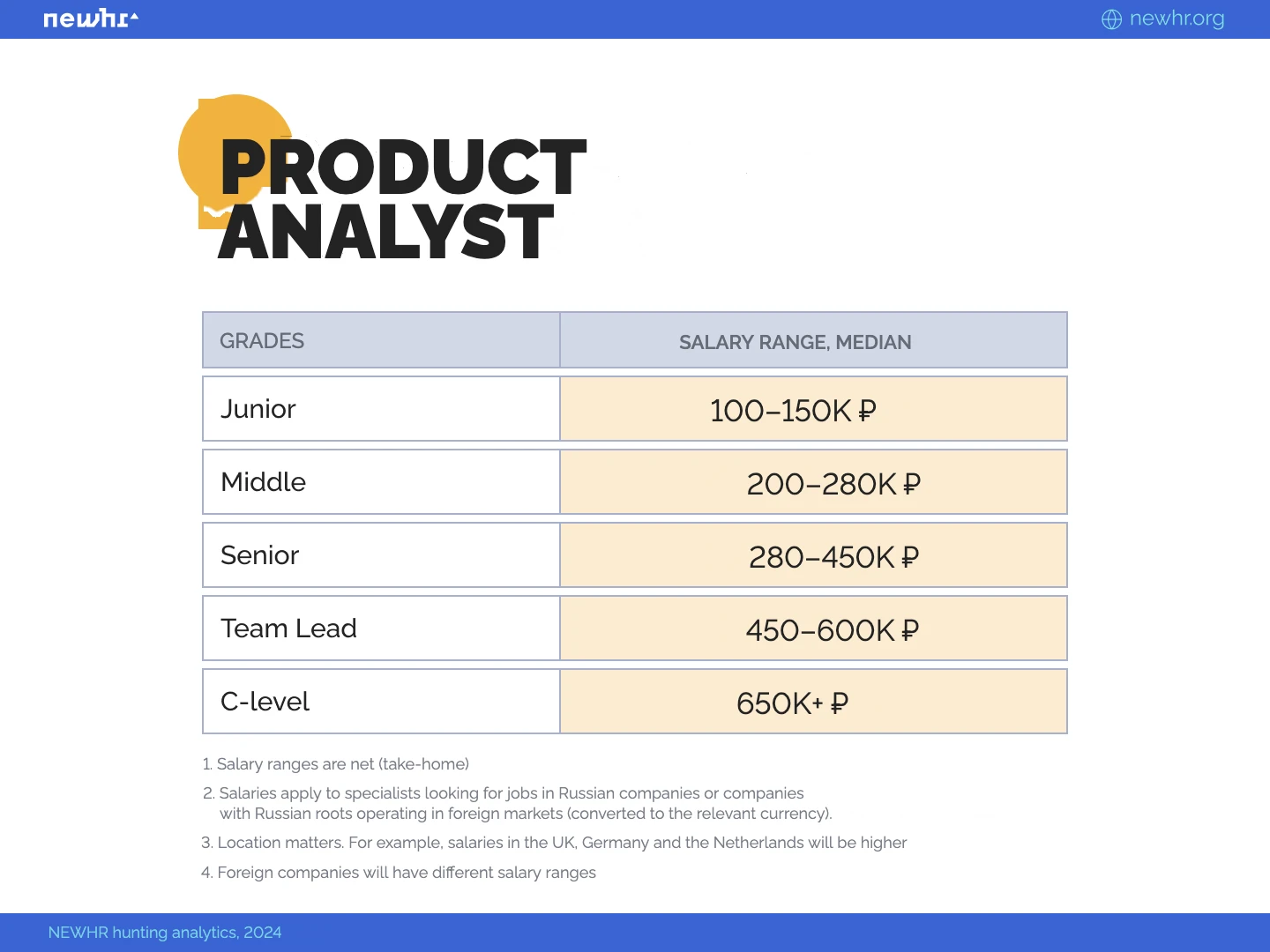
What raises a product analyst's price:
- Deep domain expertise (Fintech, Gamedev, etc.).
- The ability to solve business problems with analytics tools.
- Full-stack skills: a varied analytics background, understanding of infrastructure, data structures, and methods of collection, processing and storage.
- The ability to communicate with stakeholders: brief the internal client well and present the results of their work in language the client understands.
- For certain employers, narrowly focused expertise (monetisation, Growth, recommender systems, user account area, etc.).
- Command of DS and ML tools.
What can lower a product analyst's price:
- The obvious trigger: a lack of the experience the employer needs.
- Not knowing the analytics tools that matter to the employer.
- Weak communication: inability to gather requirements, get into the specifics of the business, present the results of their work.
- For some industries (Gamedev, iGaming, Hedge Funds), a lack of domain expertise is critical.
Data analyst
Tasks and specifics:
- Collecting and processing data from various sources
- Turning raw data into information that is clear and useful for the business
- A data analyst's scope may be similar to that of a product analyst. The key difference: less business expertise, more technical expertise
- As a rule, as they gain experience, data analysts move either into product analytics or into data engineering
Salary range:
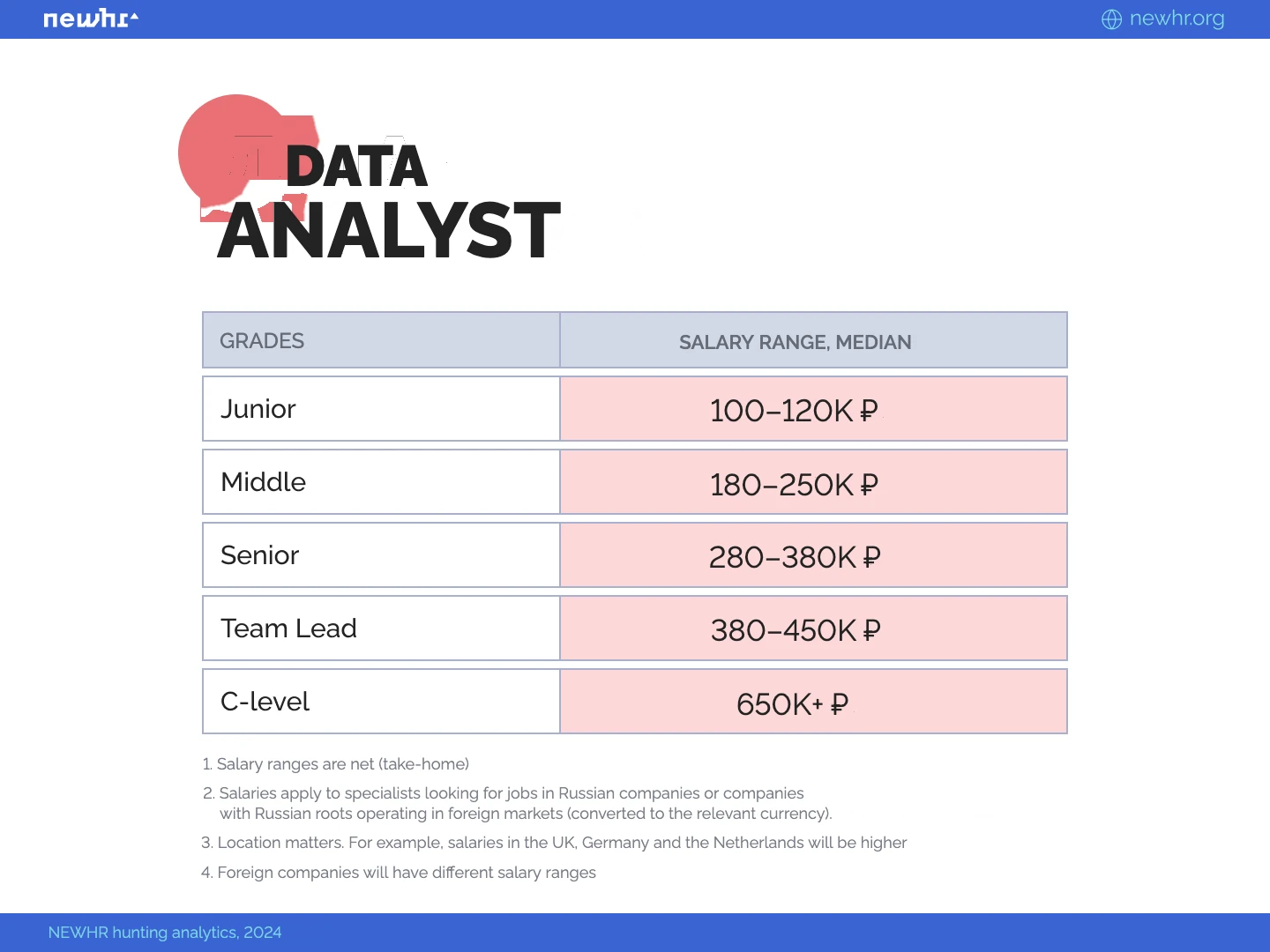
What raises a data analyst's price:
- The ability to solve business problems while keeping technical depth.
- A wide toolkit: DWH, ETL, BI tools.
- Optimising the company's spending on working with data.
- Command of DS and ML tools.
- Strong communication skills and an understanding of the business context.
What can lower a data analyst's price:
- Weak command of SQL and Python, poor knowledge of mathematics and statistics.
- Inability to present the results of their work and explain their value to the business.
- Narrow specialisation in rare tooling (for example, no experience with standard market tools, only with in-house ones).
Relevant for all analysts
What raises a candidate's price:
- Experience building analytics from scratch.
- A strong personal brand.
- The ability to generate non-obvious hypotheses and to work not only with analytical factors but also with economic, logistical, political and other factors.
- Senior salaries can go far beyond any upper limit and exceed the range of the grade itself. This is due to the expert nature of the role and the impact of the tasks they solve on business efficiency.
100% remote work from any location lowers the cost of hiring for companies, especially on the international market.
Industry specifics
Analysts' salary expectations differ by industry:
- They are at the top of the range in startups (companies partly build the risks associated with raising investment into compensation) and in FinTech (hedge funds, trading, crypto).
- The median of the range usually covers companies for which hiring analysts is an ongoing task, so they closely monitor the salary market (including competitors' salaries) and track fluctuations.
- Median values will also be found at companies that meet various interests of analyst candidates (remote work, the option to be paid in foreign currency, an established analytics culture), i.e. there is no point in overpaying and hedging risks.
- The least is paid by companies for which analytics is not a core product, where data is not the basis for business decisions, and analytics is more of a supporting function. As a rule, the range of analysts' tasks at such companies is much narrower.
How to hunt a strong analyst?
First and foremost, analysts are attracted by:
A good salary
Judging by the results of our recent research, the importance of salary has risen sharply compared to last year and has become an important factor in loyalty to the employer.
Interesting tasks
Analysts are strongly motivated by professional growth and the chance to work on new tasks from a different product or field
When hunting experienced specialists, we recommend that Russian companies also look at those who are in neighbouring countries (primarily Georgia, Armenia, Kazakhstan, Belarus, Uzbekistan). Today analysts in this "buffer zone" are more willing to talk to employers from Russia than in 2022 and 2023.
What else increases an experienced analyst's interest in a vacancy:
- The chance to grow in the role at the new place.
- Analytics culture: direct influence of analytics on the product and business, modern tooling, data availability and quality.
- The option to work 100% remotely.
- Flexible working hours.
- Working in a team of experienced analysts, a strong expert/team lead.
- The chance to work for a well-known brand.
- Company stability.
Factors that make a vacancy less attractive:
- A little-known company.
- No ambitious development plans and no articulated business strategy.
- Micromanagement by the manager and a habit of managing the team without arguments and explanations.
- No professional environment, when there is no one to learn from.
- An outdated technology stack or the use of entirely in-house analytics tools, with no way to introduce a modern stack.
- A purely support analytics function with no influence on business decisions.
- No opportunity for vertical and/or professional growth.
- No resources and no way to get them.
Where does this data come from?
At NEWHR we have been researching the analyst market since 2018 and see important market trends as they develop. We supplement expert data with quantitative research (you can explore our latest market research here).
Adapted from the original article in Russian on newhr.org. Read the Russian version.