Hunting analytics · August 2025
Hunting analytics: heads of analytics
What it costs to hire a strong specialist
NEWHR continues its series of pieces on hunting strong employees. In it we cover:
- what it costs today to hire a specialist;
- what raises or lowers their price;
- what else, besides money, improves your chances of attracting a candidate.
Today we'll talk about heads of analytics.
If you are looking for a great product or data analyst at junior to senior level for your team, read our previous piece on hunting. Today we'll focus on the salaries and expectations of team leads and C-level.
This is expert analytics from the NEWHR recruiting agency, based on data we collected throughout 2024 directly from candidates and employers.
Why does this matter?
At NEWHR we know how important it is for employers to rely on real data when planning a hiring budget, and for candidates when entering the market and assessing their value as specialists. That is why we publish our open hunting analytics and run salary research for companies. Our goal is to make the labour market more transparent and easier to understand.
Who we are talking about
First and foremost, we write about Russian-speaking employees of product and technology companies. These specialists may live in Russia or outside it.
We did not take into account heads of analytics working in non-IT/Tech industries, even though those industries may already have large established analytics practices (industry, oil production, logistics, pharma, manufacturing, etc.).
Most of the experienced leaders we assessed are not actively looking for a job but are open to interesting offers. Such candidates are usually ready only for work that is interesting in terms of professional growth and other prospects.
Team Lead
- A playing coach. Manages a team and handles some of the tasks personally.
- Usually has up to 7 direct reports.
- Reports to the Head of Analytics or CDO, depending on the company structure.
Head of Analytics
The top-level leader in some companies (where there is no CDA or CAO)
- Manages one or several analytics verticals.
- Leads several team leads.
- Reports to the CDO/CAO or directly to the CEO.
C-level
Chief Data Officer / Chief Analytics Officer
- Manages the company's entire Data function.
- Is responsible for strategic tasks.
- Leads one or several heads of the company's various Data functions (different analytics verticals, BI, DS, ML, often including data architecture and infrastructure), depending on the scale and/or structure of the company.
- Reports directly to the CEO and/or the business owners.
- As a rule, sits on the company's board.
How heads of analytics' income is structured
Leaders' income usually consists of several parts*:
- base fixed salary;
- regular bonuses (quarterly, annual);
- one-off bonuses for delivering specific agreements/projects;
- long-term incentives (LTI);
- options (in some companies) and/or a bonus based on the results of the whole company.
*What exactly the variable part of income consists of depends on each individual company's compensation policy.
And while most of an individual analyst's salary is fixed, as the grade rises the variable component (regular and one-off bonuses, LTI) plays an increasingly important role. For C-level and/or heads of large teams, the bonus can reach 10−12 monthly salaries per year (excluding LTI).
The higher an analyst's grade, the more often the final fixed salary is determined not only by the company's range but also by the candidate's negotiating skills.
Salary range
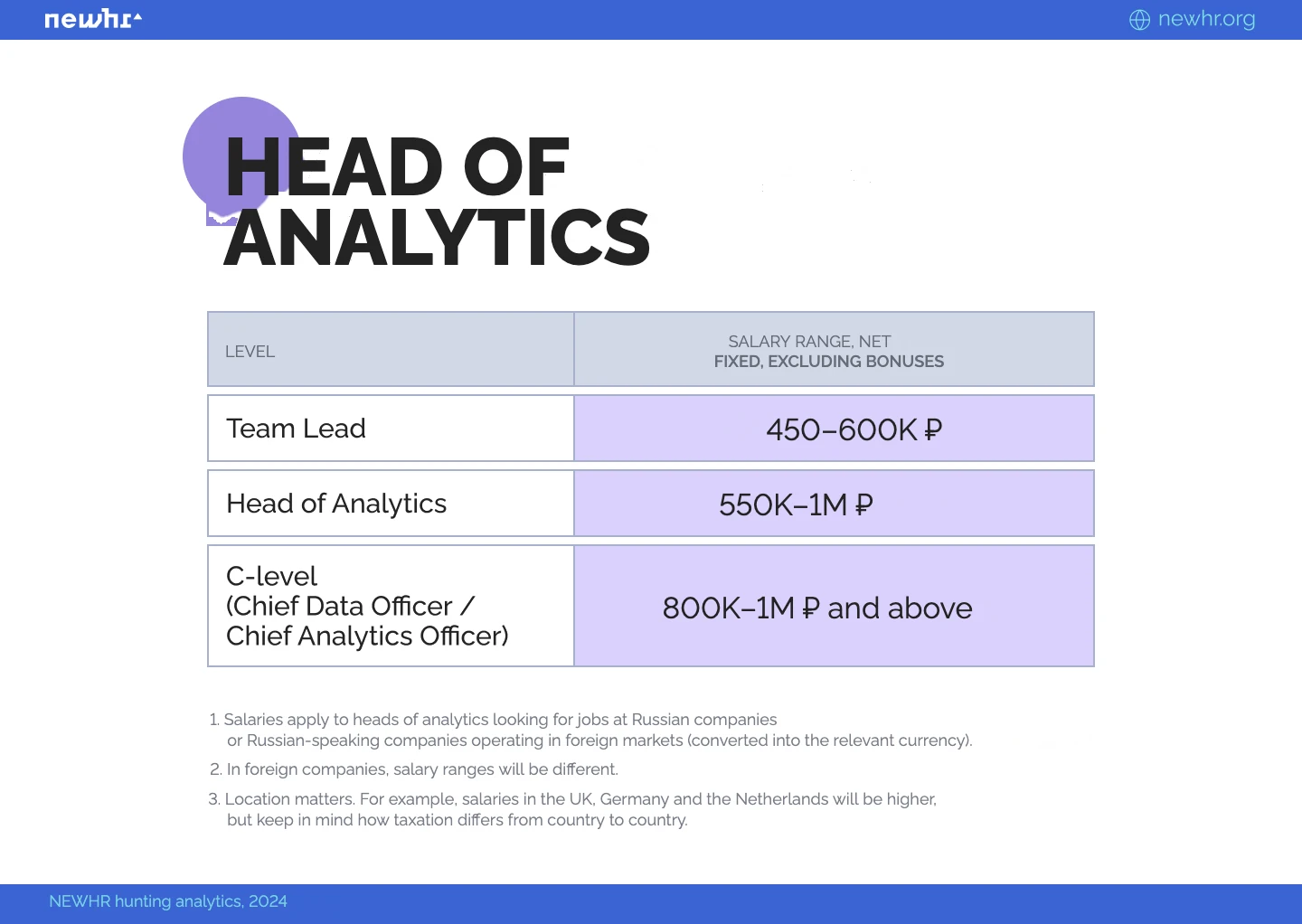
Candidates who have lived in Europe for a long time or moved there deliberately (on their own, not because "the company relocated them") usually think in gross terms and in the salary ranges of their specific country, so in net terms they may earn less than candidates from countries with low tax rates.
Candidates who initially had no ambition to move will, in case of relocation, most likely factor the tax rates of the new country into their salary. As a result, their salary expectations will be higher than those of candidates who are already in the required country.
What raises a head of analytics' price:
- The size and structure of the team they manage.
- The ability to shape strategy.
- The ability to communicate directly with the board and "sell" analytics to stakeholders.
- The ability to build and manage the budget of the analytics function.
- Experience building, scaling and retaining teams: understanding how many analysts, and of what level and specialisation, need to be hired/let go.
- System design in analytics: a deep understanding of analytics architecture, the ability to get personally involved in complex tasks, and to validate suitable tooling, timelines and risks.
- Experience building analytics from scratch.
What can lower a head of analytics' price:
- A small team (when the leader is essentially a team lead).
- No complex cases and projects in their experience that affect the whole business (this could be, for example, a move to a different analytics stack, launching new businesses or business lines).
- A lack of complex management experience: layoffs, team optimisation, hiring under tight deadlines, etc.
- For the international market: no international education, no experience at international companies or on international projects (including volunteer ones).
- An insufficient level of English reduces the chances of getting an offer in general.
How to hunt a strong analyst?
First and foremost, analysts are attracted by:
A good salary
Judging by the results of our recent research, the importance of salary has risen sharply compared to last year and has become an important factor in loyalty to the employer.
A focus on results
The higher the leader's level, the more weight the variable part of compensation usually carries. The chance to earn a large bonus for a specific result often drives leaders.
What increases a head of analytics' interest in a vacancy:
- Career growth, the chance to move to the business side, scaling the role/increasing influence on the business.
- Carte blanche in decision-making (backed by a dedicated budget).
- The chance to shape the company's analytics culture: direct influence of analytics on the product and business, modern analytics tooling, data availability and quality.
- The chance to deliver large analytics projects or launch analytics products.
- Reporting directly to the CEO.
- Delivering complex projects/tasks: rebuilding current processes or building something from scratch.
- Adding various cases to their "portfolio": strategic, managerial, project-based, etc.
- For many: professional challenges, for example, the chance to launch a startup from scratch or bring the company's analytics out of a crisis.
Factors that make a vacancy less attractive:
- No ambitious development plans and/or no articulated business strategy.
- Micromanagement by the manager/founder and a habit of managing the team without arguments and explanations.
- No demand from the board for high-quality analytics (analytics in the company doesn't influence business decisions, and everyone is fine with that).
- The offer largely repeats the leader's current tasks and area of responsibility, gives no new challenges and no sense of the next step in their development.
- No resources and no way to get them.
Where does this data come from?
At NEWHR we have been researching the analyst market since 2018 and see important market trends as they develop. We supplement expert data with quantitative research (you can explore our latest market research here).
Adapted from the original article in Russian on newhr.org. Read the Russian version.