In 2023 the world's largest IT companies kept tightening their belts, cutting salaries and staff. At the same time, more than a year had passed since the economic shocks in Russia that began in February 2022 and the mass departure of IT specialists from the country.
A study by NEWHR Data helps us understand what Russian-speaking candidates want from employers and where they are heading in this turbulent situation.
The study was conducted as a survey in September 2023. The questionnaire consisted of 45 closed and open questions. We recruited respondents through our online media and the NEWHR Recruiting candidate database.
807 IT specialists, 16 specialisations
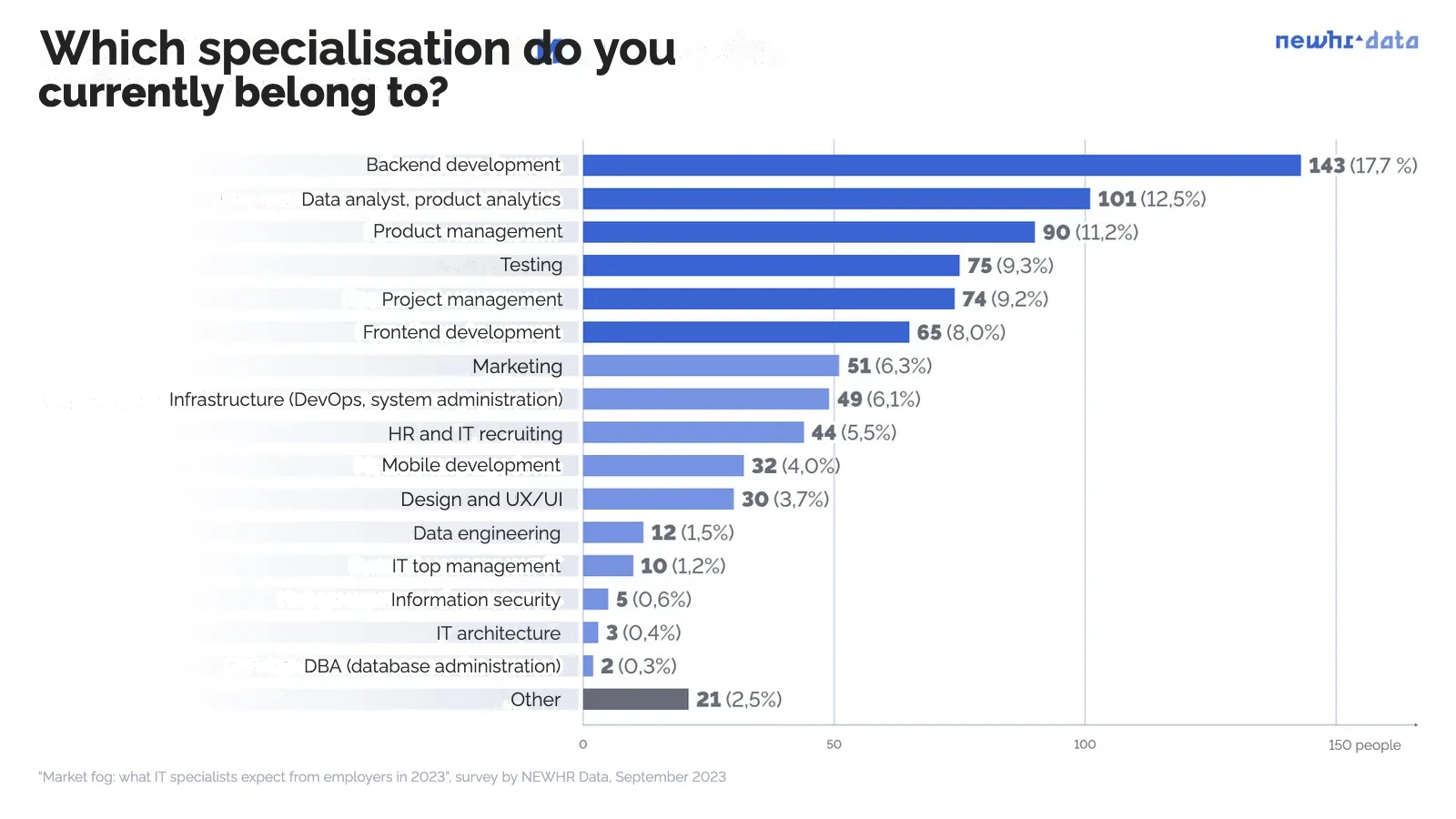
Our sample was 807 people. The survey was most often completed by backend and frontend developers, product and data analysts, product and project managers, and testing specialists.
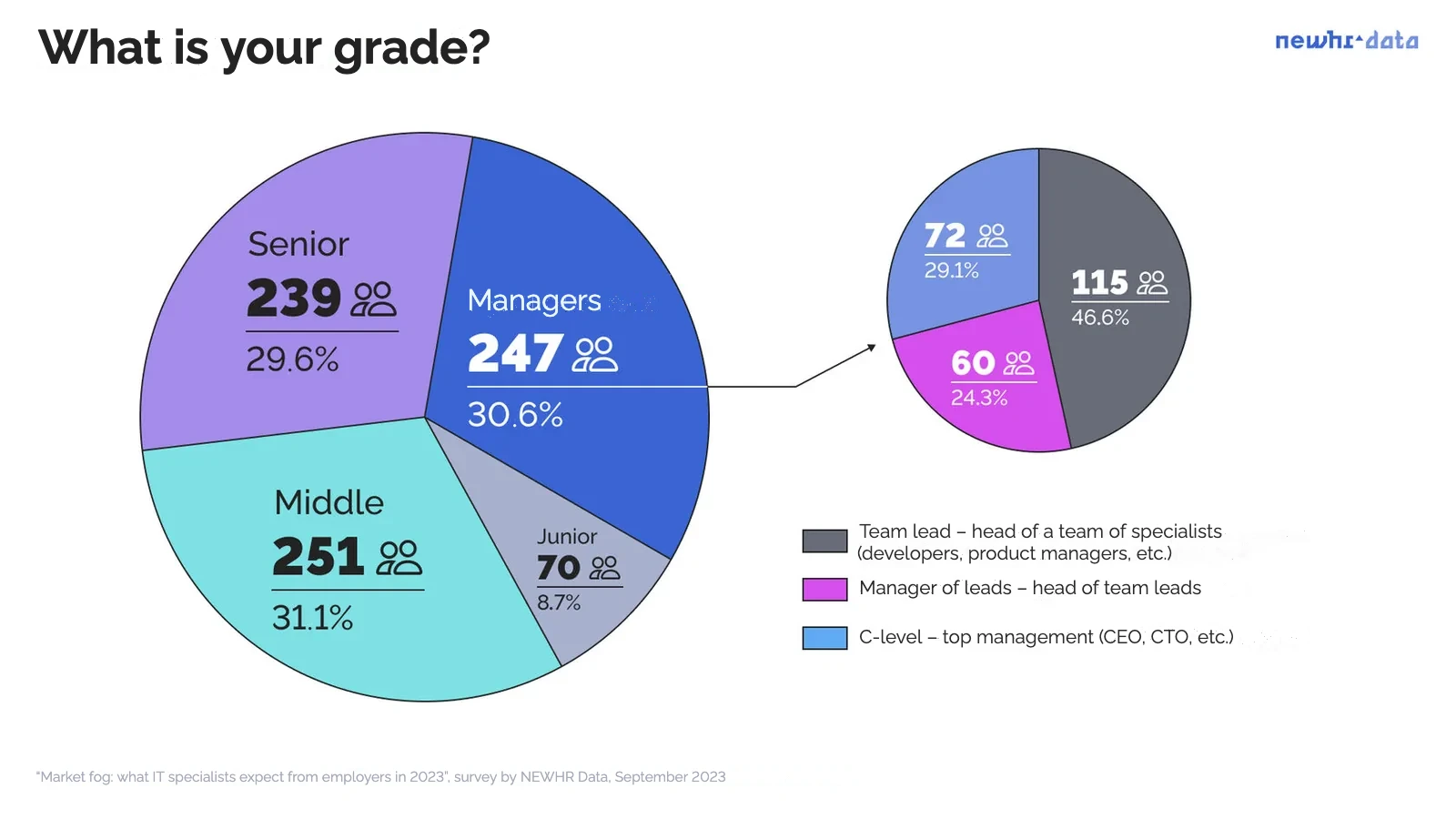
In terms of grade, they are mostly managers, as well as middle and senior specialists. Only 9% were juniors — noticeably fewer than in the real labour market. In other words, our study is mainly about experienced Russian-speaking IT specialists: middles and above. NEWHR Data's conclusions and recommendations apply first and foremost to these grades.
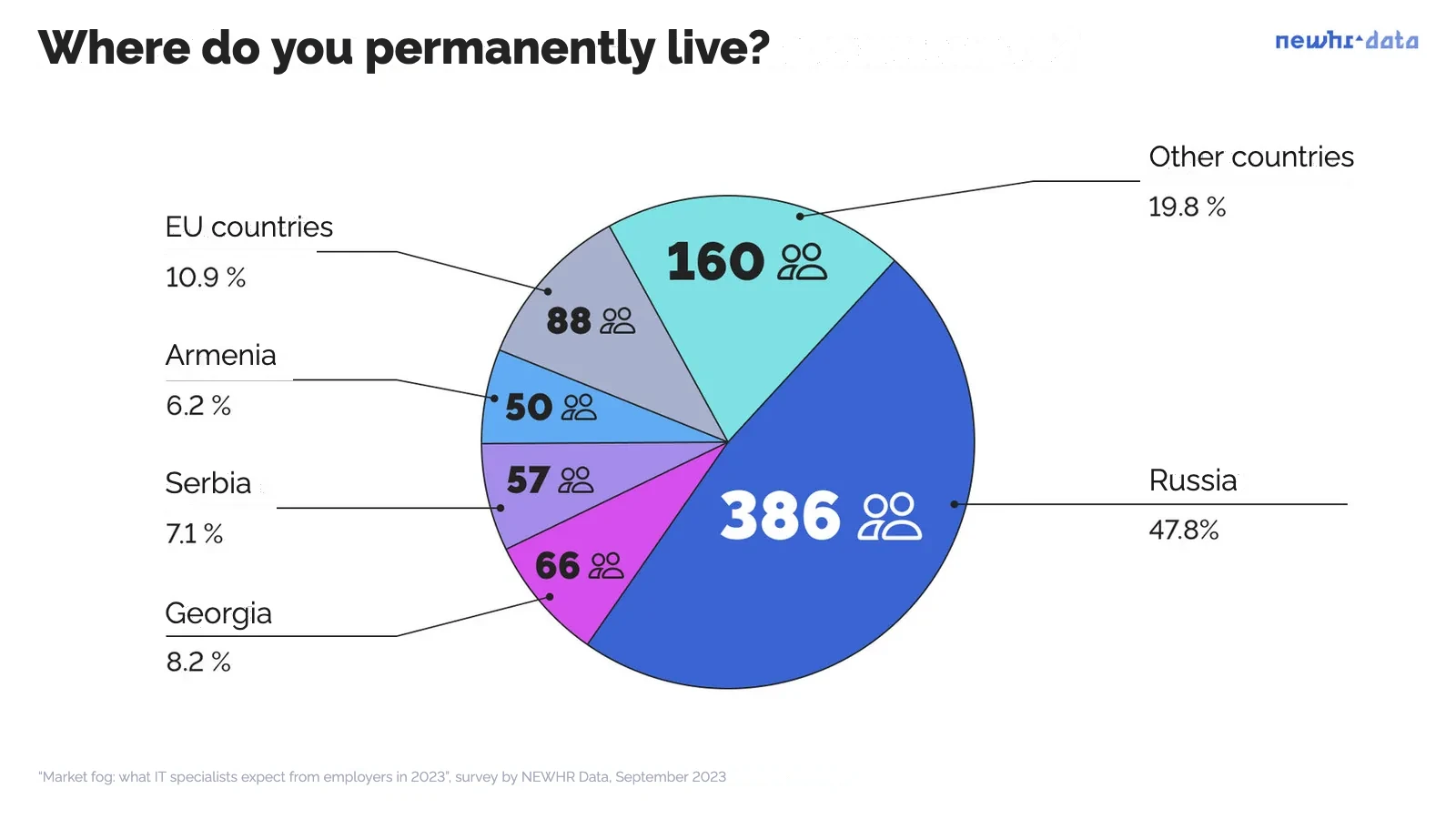
Top countries where Russian-speaking IT specialists live
Half of our sample (48%) lives in Russia. One in ten lives in an EU country. The top 10 countries other than Russia where Russian-speaking IT specialists permanently live are Georgia, Serbia, Armenia, Cyprus, Montenegro, Turkey, Kazakhstan, Belarus, Germany and Uzbekistan.
Our respondents are spread across 49 countries: from China and the Philippines to the US and Brazil.
Most respondents (64%) work for companies or company branches located in Russia. The rest work for foreign companies (top 5 countries: Cyprus, USA, Serbia, Armenia, UAE).
- 31% of those who work for Russian companies live abroad.
- Among employees of foreign companies, only 10% live in Russia.
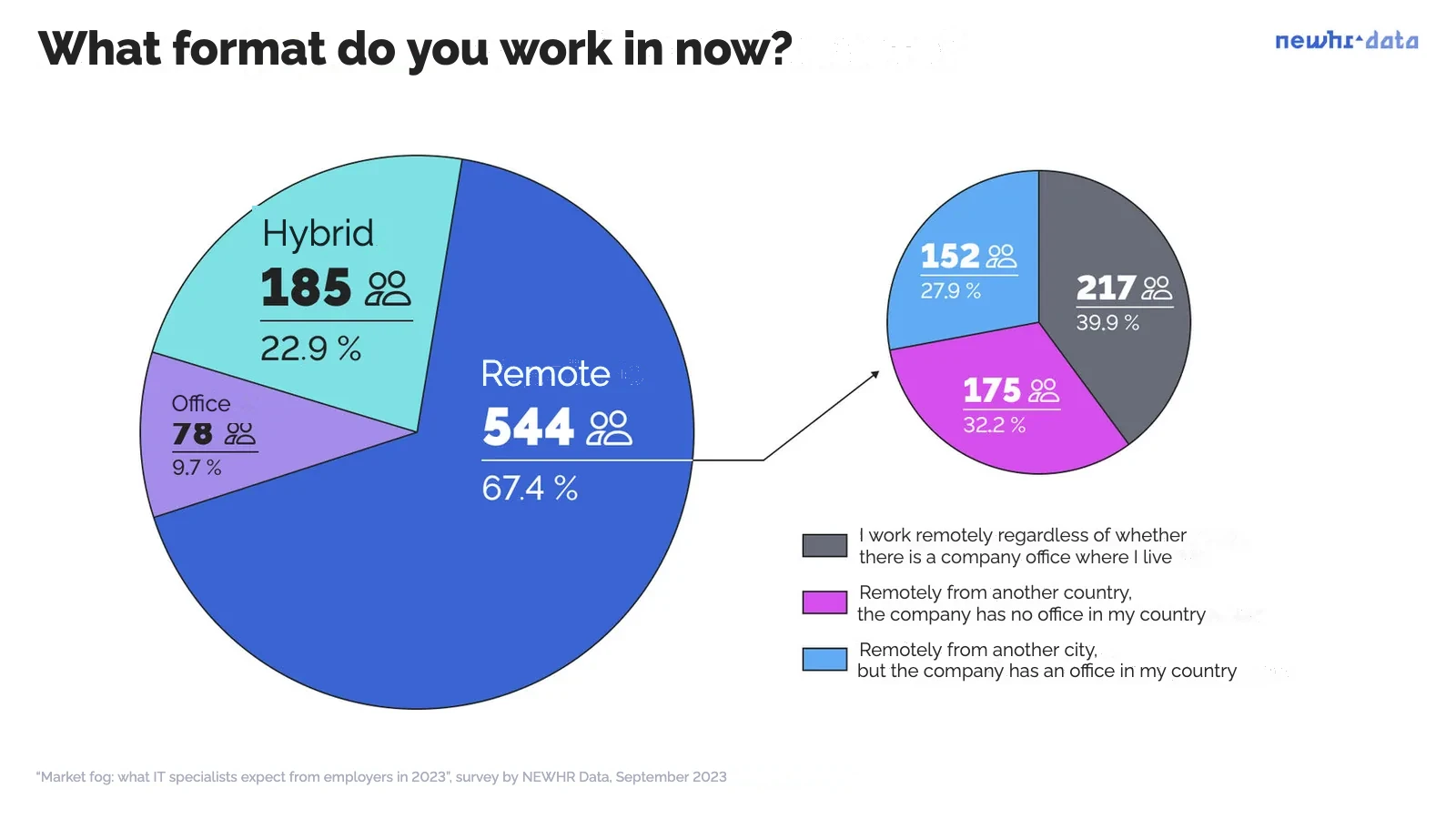
Most IT specialists work remotely
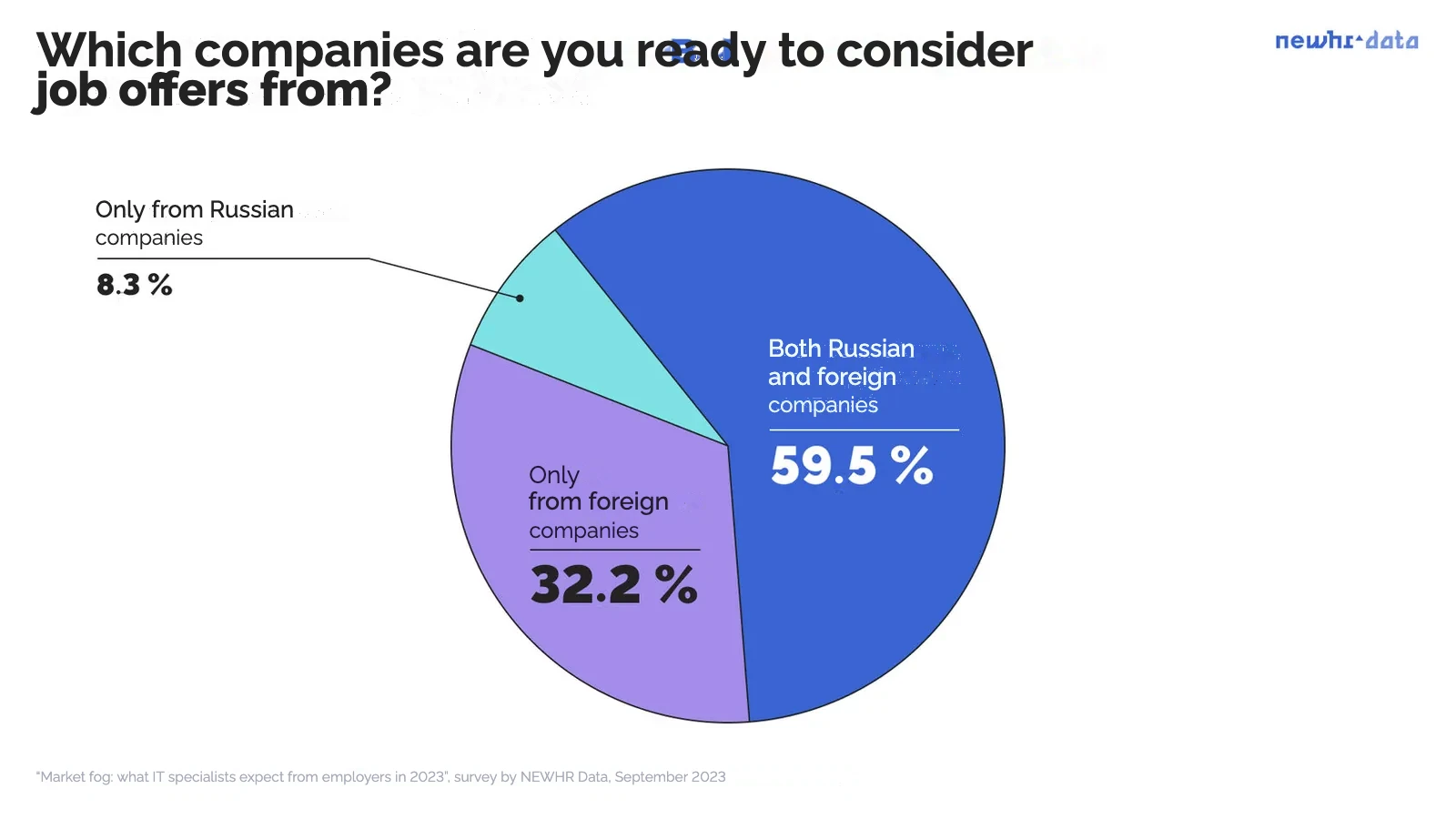
92% are ready to consider offers from international companies
We asked respondents which country's companies they are ready to work for. Based on their answers, we divided them into three groups.
- Two markets. Respondents who consider both the Russian and foreign labour markets. They made up 60% of the sample.
- Abroad only. A third of our sample is ready to work exclusively for foreign companies. There are noticeably fewer juniors in this segment. This makes sense, given that it is especially hard for juniors to find work in other countries.
- Russia only. A small group of respondents who are ready to accept offers only from Russian companies.
The most recognisable employers
We asked where exactly respondents would or would not like to work. Questions on this topic were both open (no answer options) and closed (with a list of companies to choose from).
Open questions show the "spontaneous awareness" of HR brands — how well candidates recall their names without prompting. In the open question, the top answer was not a specific company but "Hard to say":
- 45% could not name a single employer they would like to work for;
- 37% could not name a single employer that puts them off.
It turns out that many experienced IT specialists have no specific dream employers in mind and often choose depending on circumstances (for example, based on the vacancies available).
Here is how often respondents named specific companies.
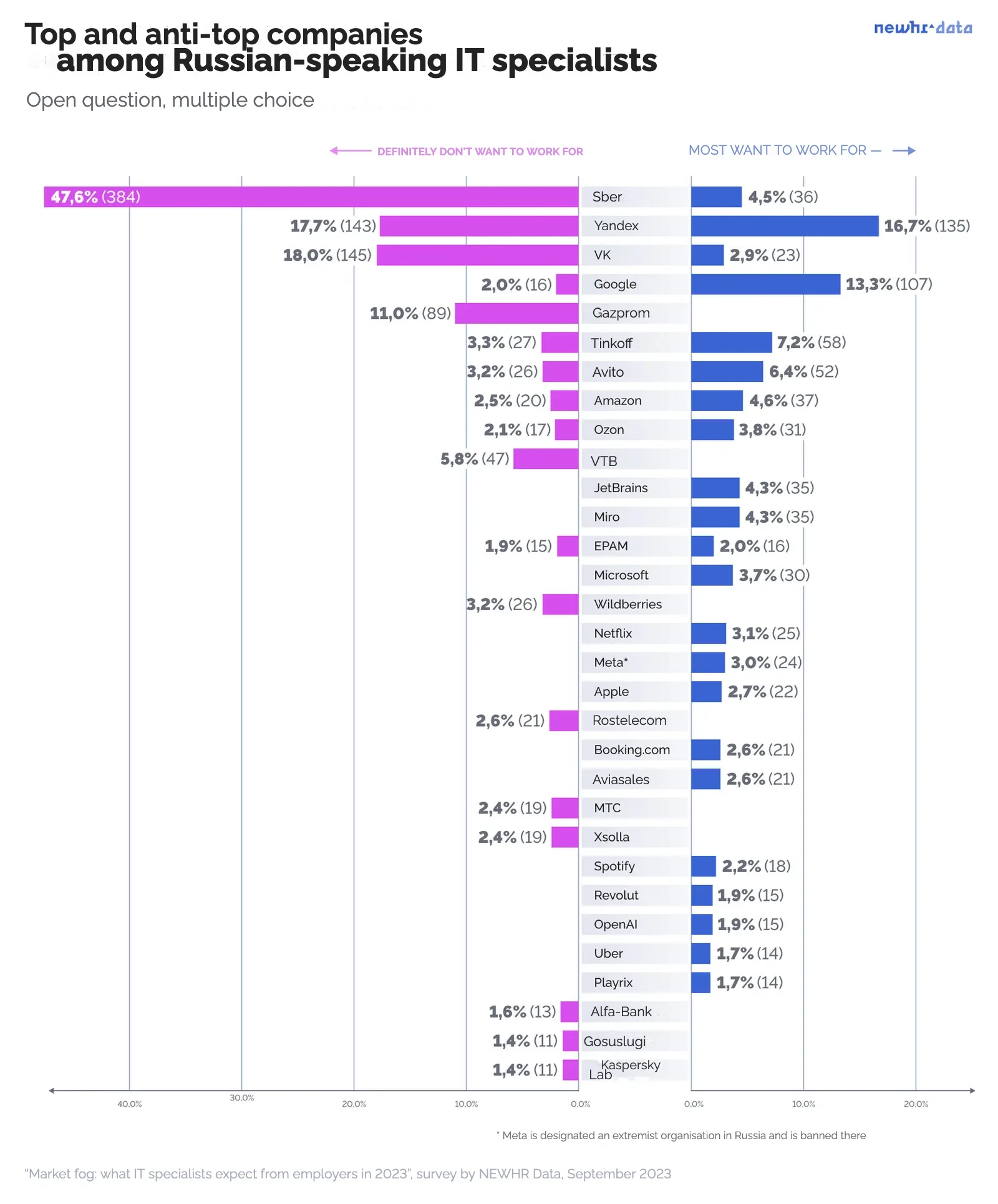
- Yandex is well known to candidates in both a positive and a negative sense. The company has a strong HR brand, and candidates have a strong emotional connection to it.
- Respondents also often mentioned VK and Sber. Mostly as employers they would "recoil from in horror".
- The second tier of desirable Russian companies includes Ozon, Tinkoff and Avito. They were mentioned more often in a positive sense.
- Among foreign companies, global IT giants dominate: Google, Amazon, Microsoft and others. Respondents also wrote in foreign players that are well known in the Russian-speaking IT community and have corresponding roots, such as JetBrains, EPAM or Aviasales.
This set of companies suggests that many respondents want to work abroad but so far have only a superficial understanding of foreign HR brands. For candidates, the foreign market seems to be shrouded in fog, against which Russian companies look better known and easier to understand.
Besides specific names, respondents often named categories of companies. Notable shares in the anti-rating went to:
- State-owned companies (14%). We grouped into this category answers such as "all contractors of the Ministry of Education and the Ministry of Finance", "all state banks", "everyone with the prefix Ros-", "the public sector" and so on. Given that Sber, VK, Gazprom and VTB lead the anti-top of companies, we can say that IT specialists are often put off by an employer's ties to the Russian state.
- Some named groups by location and industry: companies in Russia (2%), banks (2%) and gambling (2%).
Choosing from a list is easier
In the closed questions, we asked respondents to choose several options from a list of 25 Russian employers (or to add companies that were not on the list). These questions were asked only to people who consider working for Russian companies.
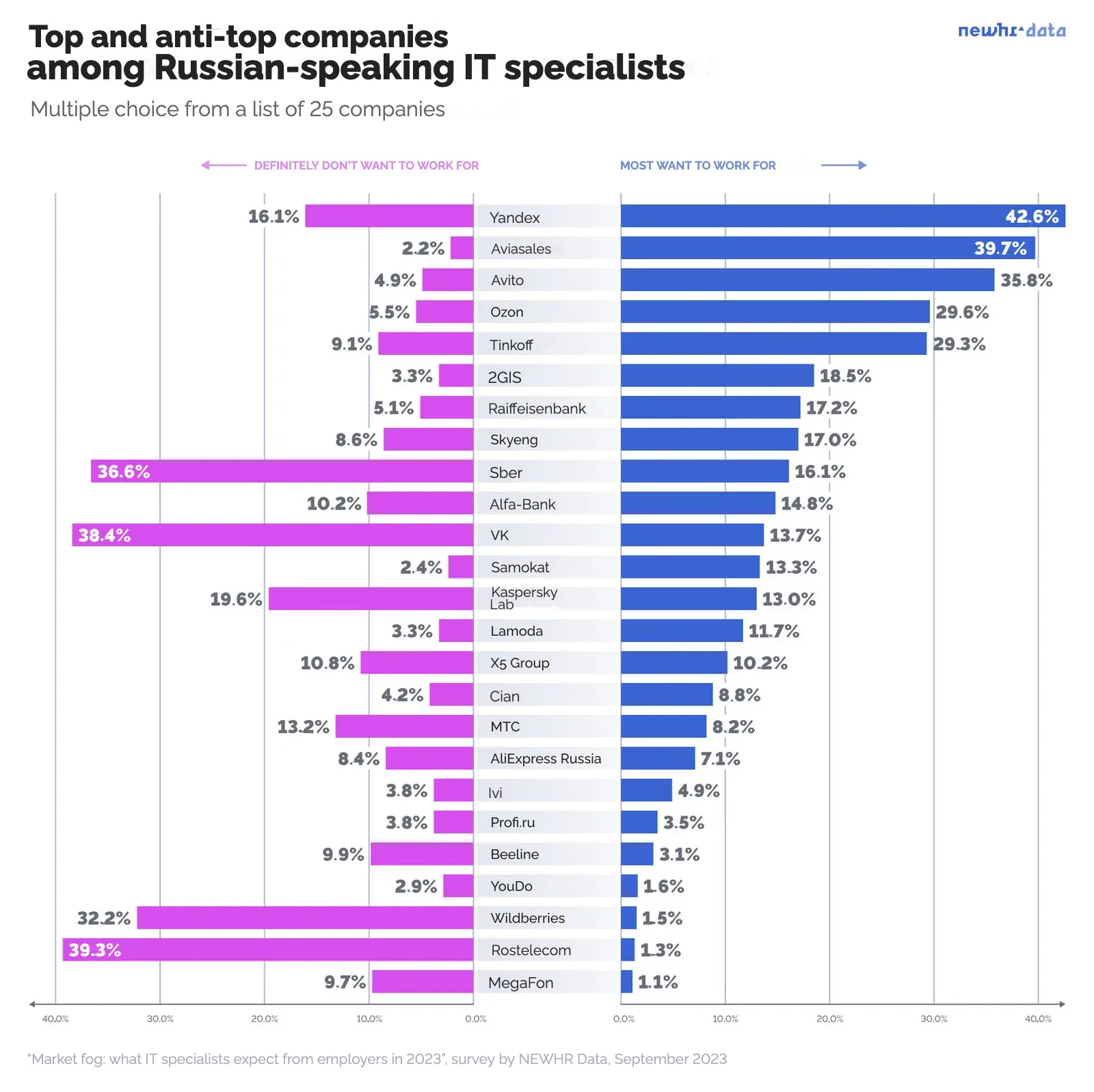
Some HR brands turned out to be noticeably more desirable than in the open question (for example, Aviasales and Avito). Others gained a lot in the anti-rating, such as Rostelecom and Wildberries.
Almost no one mentioned Raiffeisenbank, 2GIS and Skyeng in the open questions. Yet in the closed question these companies suddenly turned out to be desirable employers for 17–18% of respondents. This shows how important it is for most market players to keep reminding candidates about themselves rather than waiting for candidates to take the initiative.
What IT specialists expect from Russian employers
We asked respondents why they choose Russian companies or turn down work there. Here is what mattered most to respondents interested in Russian companies.
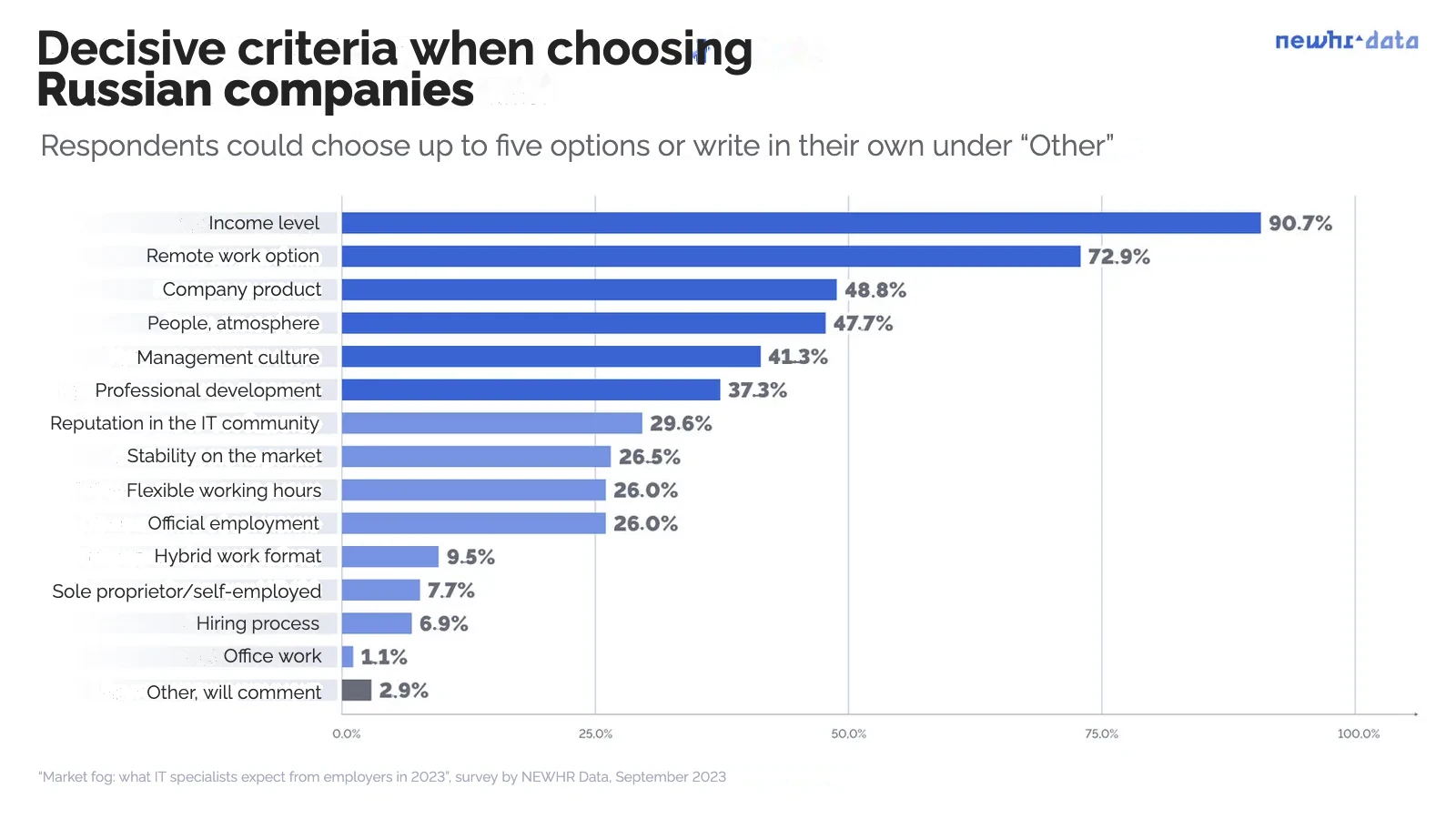
We clarified respondents' wishes through a series of follow-up questions. In particular, we asked about salary level, the components of a company's reputation, professional development, the hiring process and more. Let's look at these factors in more detail.
Income is the most important criterion when choosing an employer and in hiring negotiations. Surprisingly, 9% of respondents did not list it among the most important criteria for choosing a company. Respondents' income expectations for working at a Russian company turned out to be moderate:
- Candidates would like a salary increase when moving to a new employer.
- No one expects an above-market salary, bonuses or additional payments.
- People expect stable income and social guarantees from the company.
In a follow-up question about management culture, respondents said the following matter to them:
- Clear and flexible work processes.
- Efficient task delivery, trust in employees' professionalism.
- Support from managers.
- Decision-making in dialogue with the team.
- Minimal bureaucracy and distance from managers.
The most valuable components of professional development for candidates:
- The level of the team, working with "top professionals".
- Working on diverse and non-standard tasks to develop their skills.
In terms of employer reputation, it was important to study participants that:
- The company's product benefits people.
- The company's product is high quality, so that they want to take part in building it.
- The company's brand is well known ("it will be a great line on my CV").
We also asked respondents an optional question: "If you did not find characteristics that matter to you when choosing Russian companies in the previous questions, write them in yourself! What should a company have for you to choose it?". In their answers, respondents noted in particular that the employer's independence from the Russian public sector and a salary not in roubles matter to them.
What puts IT specialists off Russian companies
We separately asked respondents why they turn down certain Russian employers. Largely this mirrors the positive qualities of an employer (unsatisfactory pay, an uninteresting product and so on).
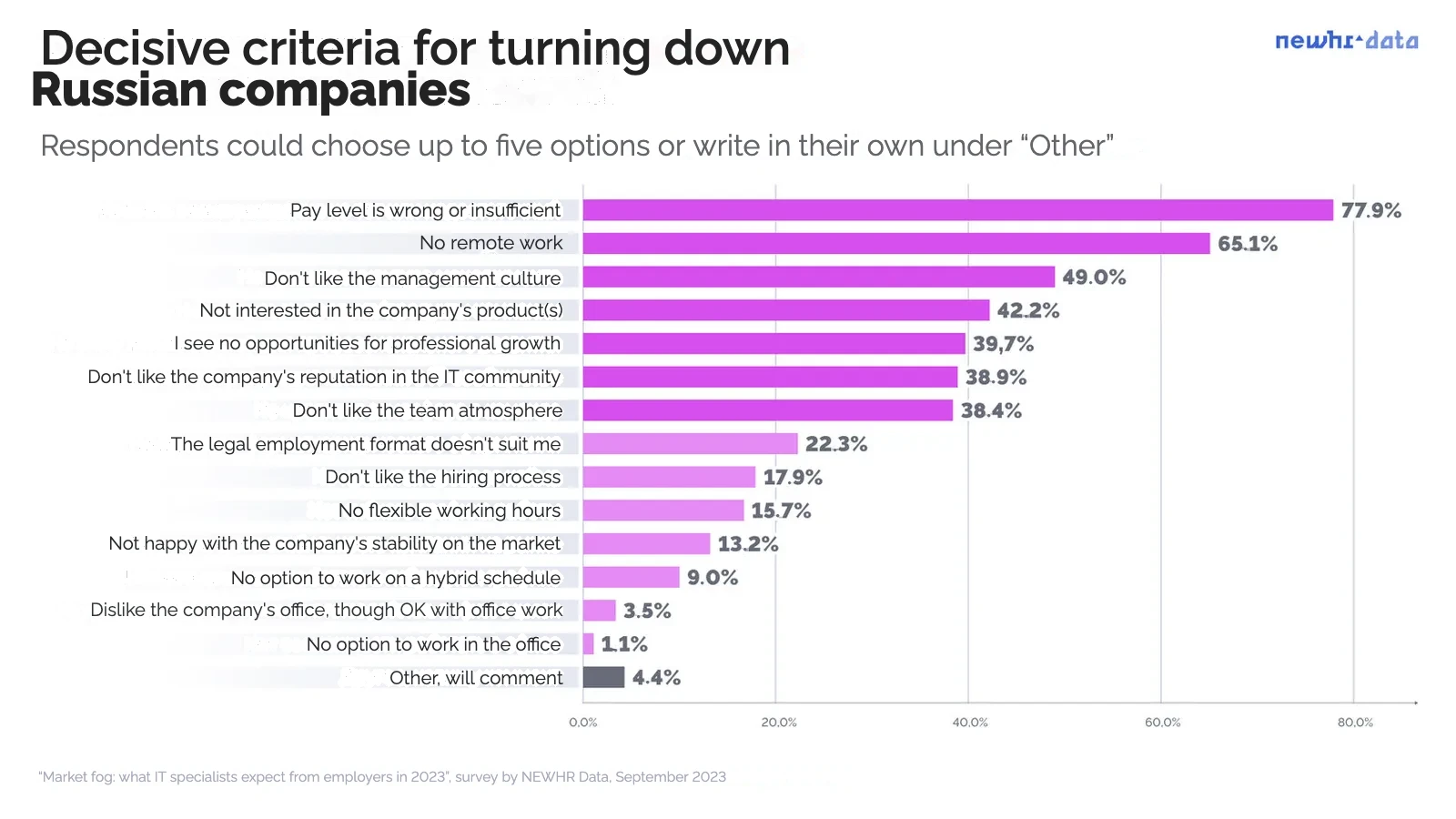
We also clarified respondents' wishes through a series of follow-up questions.
Respondents would definitely dislike it if:
- They are offered a lower salary than at their previous job (68%).
- The salary stays at the current level (32%).
- There are no social guarantees (29%).
Among the negative factors here, the most frequently cited were:
- "Has a negative reputation in its relations with its employees".
- Ethically questionable products (adult, gambling, etc.); low-quality products.
- Cooperation with government bodies.
In this area, candidates are put off by:
- Monotonous tasks.
- Weak product, technology and analytics culture.
- A non-transparent career development system.
Respondents feel most negative about:
- A bureaucratic management culture.
- No feedback or support from the manager.
- A narrow scope of responsibility, no chance to influence the product and processes.
- Slow approval of decisions.
Study participants most often mentioned poor communication during the hiring process, as well as its length.
In the open question, respondents also named ties to the state, the hiring process, and dissatisfaction with the industry and the product as negative factors.
Only 25% of the respondents who were asked the open question answered it. Although this is a minority, it is important to treat the topics they raised as areas of "acute pain". After all, if a person took the time to type an answer by hand, it really matters to them. If a company touches these areas, it risks negative publicity from this "outraged minority" in the professional community.
Other sensitive topics: unprofessional or authoritarian leadership; employee overwork; strict control and regulation of working hours; poor management and so on.
Foreign employers: what attracts and what repels
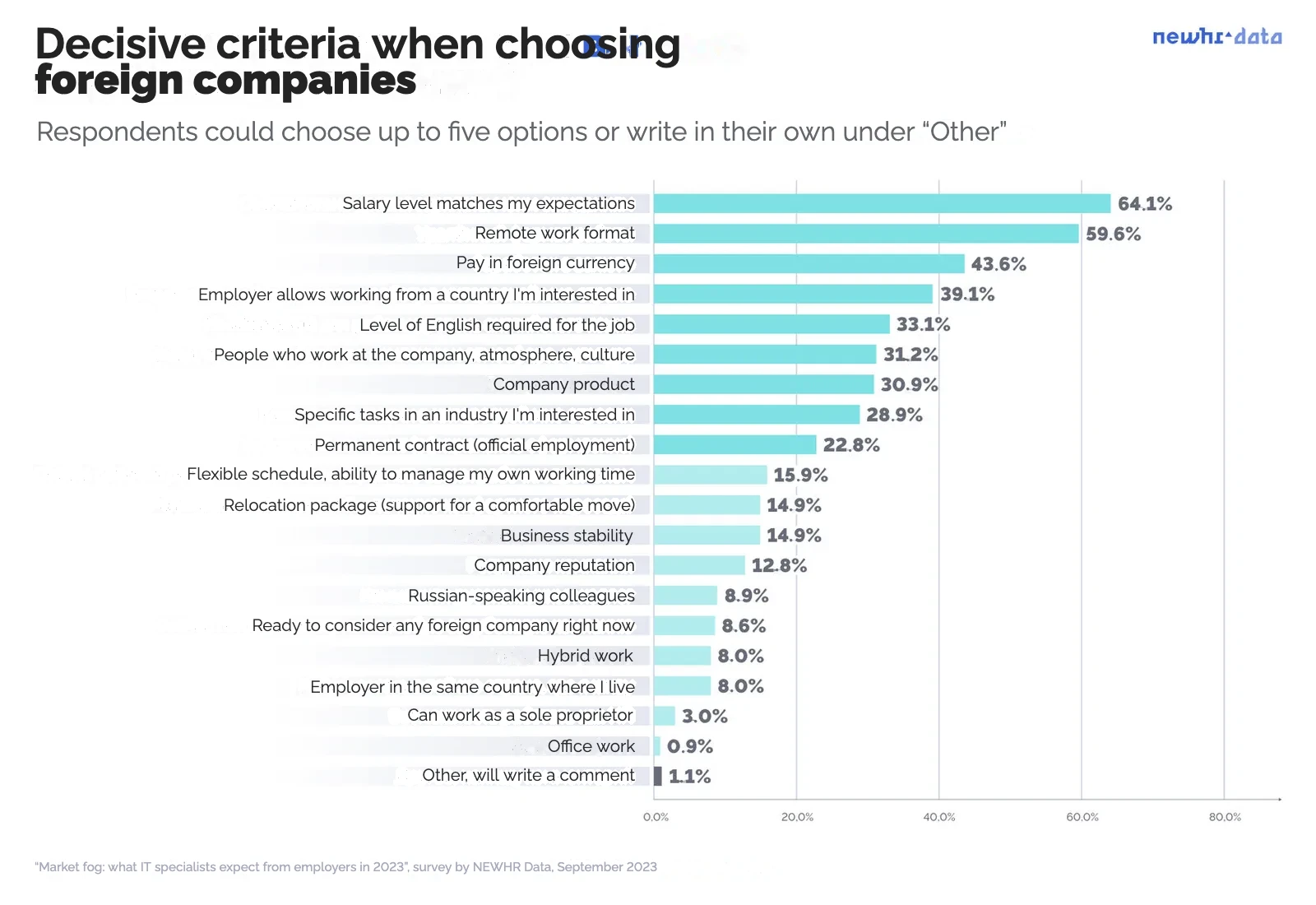
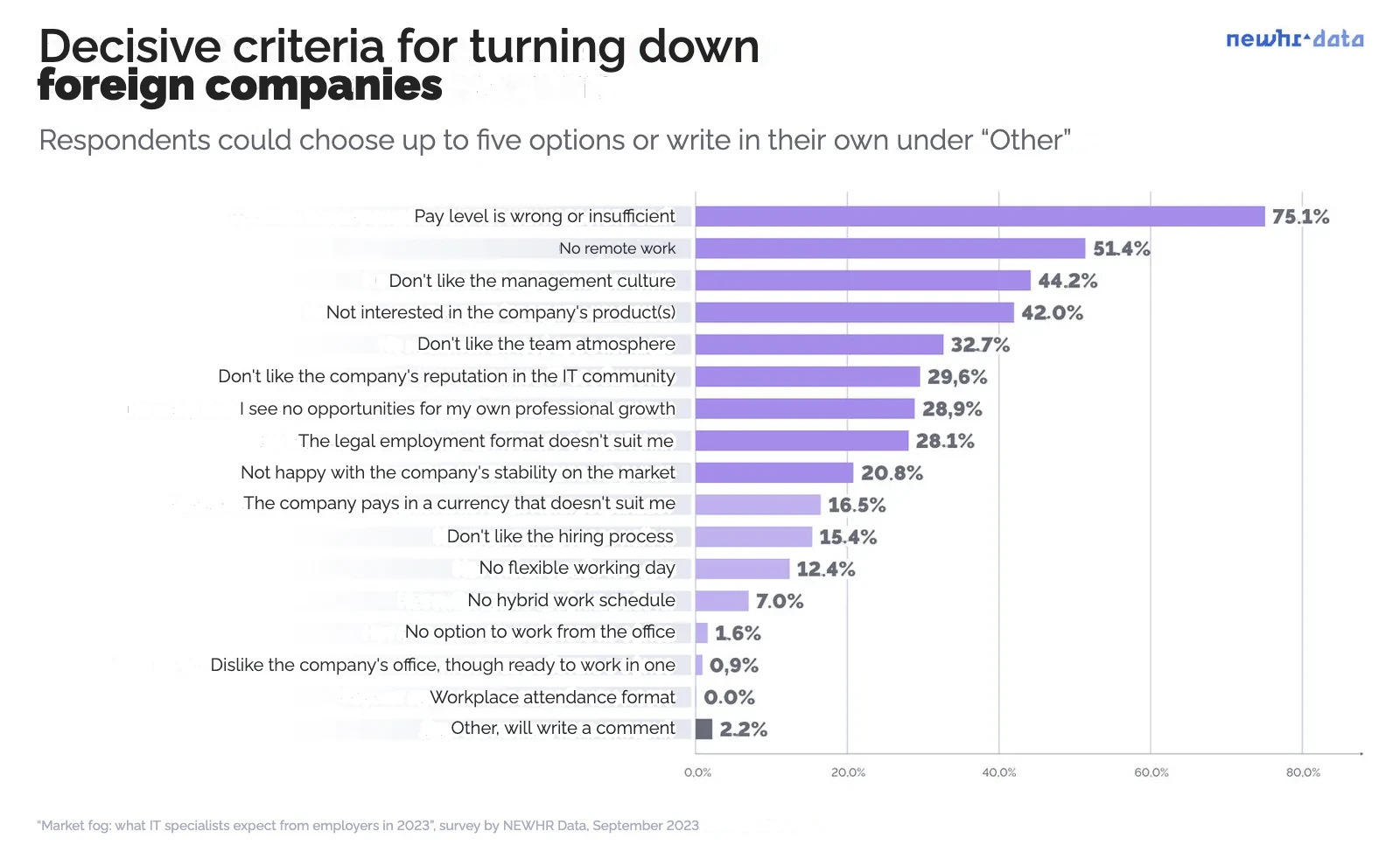
We separately asked respondents about their preferences regarding foreign employers. These questions were asked only to those who in one way or another consider working for a foreign company.
As with Russian companies, salary and remote work top the list. The specific needs of migrant employees also ranked high: earning in foreign currency, help with a work permit, reasonable English-level requirements.
Is there a chance to attract those who have turned away from the Russian market?
32% of our respondents are ready to consider only foreign employers. Most of these people live outside Russia.
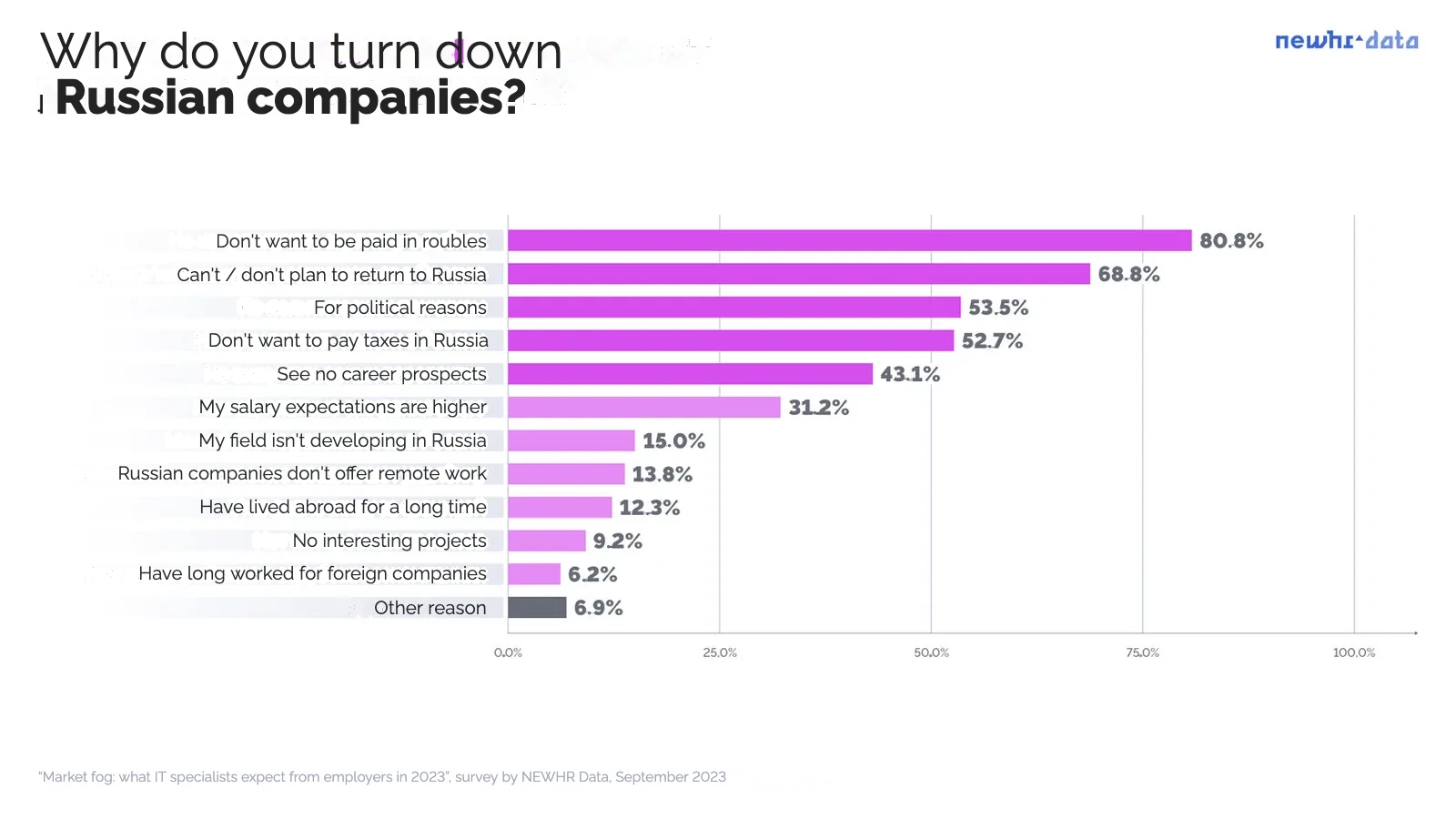
Getting them to work for a Russian company will be a challenge. If the candidate you need is one of the "abroad-only" group, you can try to overcome the typical objections to working for a Russian company. To identify these barriers, we asked a separate question to respondents in the "abroad only" segment.
The leading reasons for "rejecting Russia" are unwillingness to be paid in roubles and to pay taxes in Russia, inability or unwillingness to return to the country, and politics.
IT specialists want to work abroad but are not always ready for it
- 19% of candidates are interested in working in an international team only if the company has a Russian-speaking community.
- 39% of specialists targeting work both abroad and in Russia admitted that their English is not fluent enough, so for now they prefer to work for a Russian company.
- 43% of those targeting both foreign and Russian companies would like to be paid in foreign currency. At the same time, only 34% of people in the same segment care whether the company has a branch abroad. So some people who are ready to work both in Russia and outside it have an actual mismatch: after all, a Russian legal entity (not a foreign branch) can pay salaries only in roubles. This may indicate that a group of respondents has a general desire to work abroad but clearly lacks practical knowledge and experience.
Where they get information
We separately asked which sources respondents rely on when forming their view of employers. The answers differed depending on which markets the candidates were targeting.
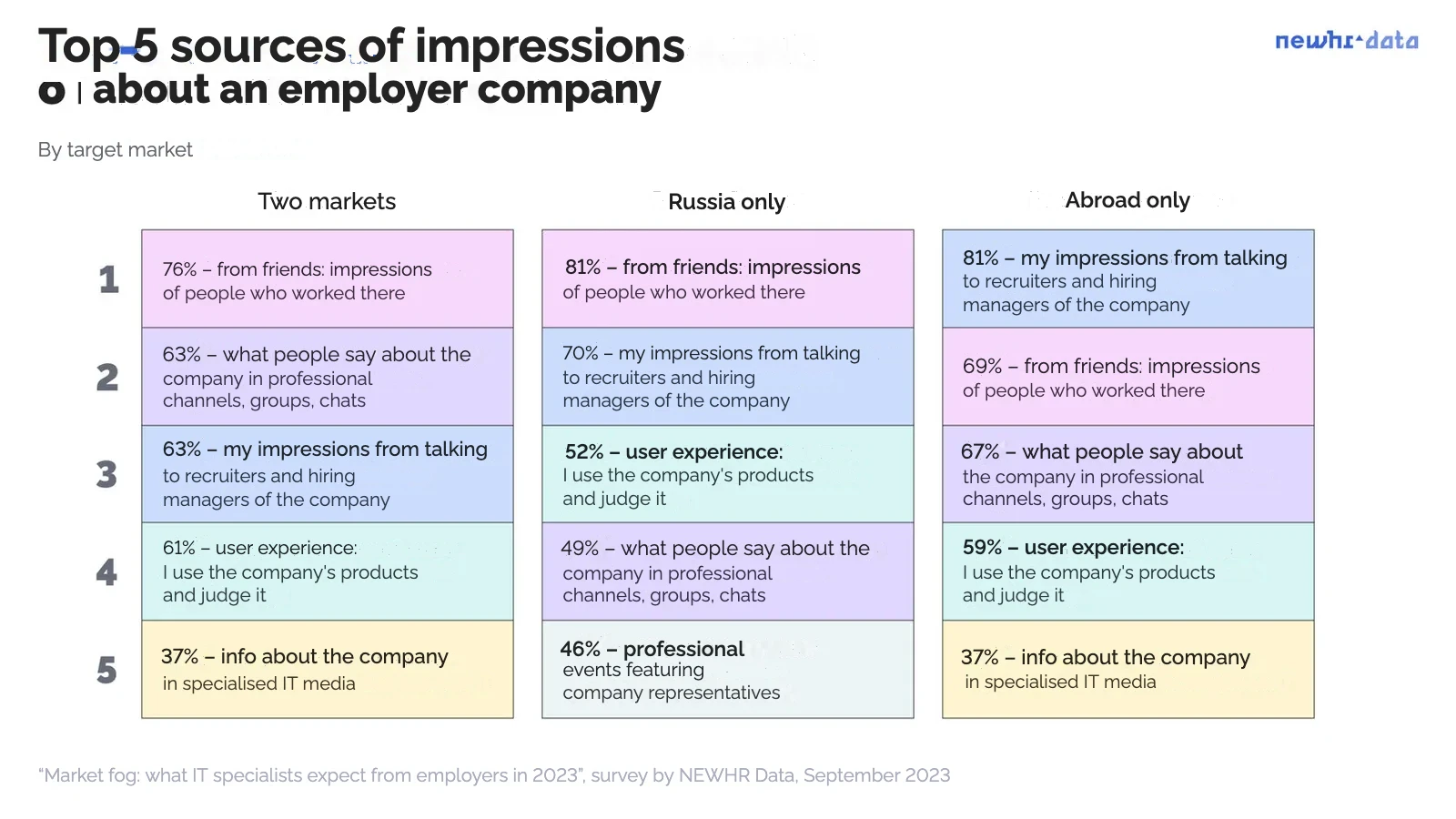
- Among people who in one way or another consider employers from Russia, the top source of information was acquaintances who have worked at the company.
- Among those targeting only foreign companies, acquaintances gave way to recruiters and hiring managers. This can be explained by the fact that Russian-speaking IT specialists do not yet have as wide a network in other countries and more often have to rely on personal impressions from the hiring process or on information from the company's official resources.
- The "Russia only" segment pays noticeably less attention to what professional media and groups write about a company (perhaps because this segment has more juniors, who are not yet as familiar with the information landscape). At the same time, the "Russia only" group gives noticeably more weight to professional events they can attend in person (unlike those who have left and are interested in the foreign market).
How to attract candidates? 10 recommendations from NEWHR Recruiting
Most of our sample are experienced specialists (middle grade and above). It is exactly these candidates who find it easier to get a job abroad. Especially if, along with experience in their field, they speak English well and have good communication skills.
Half of our study's sample lives abroad. 60% of respondents said they are ready to consider offers from both foreign and Russian employers. Another 32% — only from foreign companies.
Here are NEWHR's recommendations for attracting such candidates.
1. Ties to the state are perceived negatively. Where possible, distance yourself from the Russian state: ties to it put off many respondents.
1. Most are ready for offers from Russia. Abroad, you can attract specialists who target both markets (Russian + foreign). They are good target candidates for Russian companies. Moreover, 38% of respondents living abroad work for Russian companies. They view many Russian HR brands positively, so it also makes sense to approach them with vacancies.
1. Candidates care about money and remote work. Alongside the top-priority question of salary level, candidates value the option to work remotely.
1. Relocated specialists also care about legalisation. Specialists living abroad also value help with legalisation in another country, a signed contract, a convenient payment format and tax compensation.
1. Those eyeing foreign employers value an "international" setting. Two thirds of candidates ready to work both in Russia and outside it do not mind working in an international team. For one in three in the same segment, it matters that a Russian company has a branch abroad.
1. A Russian-speaking environment and culture as an advantage. A significant share of IT specialists have only a vague idea of the foreign market and are not confident in their English. They can still be attracted by a familiar culture, work communication in Russian and a Russian-speaking community of colleagues (even if they have left Russia). "Intermediate" English on a CV is a marker for finding good specialists abroad. A candidate's lack of confidence in their English may tip them in favour of a Russian company.
1. Expand your HR brand's presence outside Russia (if your goal is to attract specialists who have left). According to our data, most people ready to work for Russian companies live in Georgia, Serbia, Armenia, Montenegro, the UAE, Kazakhstan and Cyprus. There are active IT communities in Serbia, Cyprus, Armenia and Georgia. These countries can be added to your information space for finding candidates, even if your products focus only on Russia.
1. Join communities abroad. To attract specialists who have recently left, Russian employers can take part more often in industry events abroad and be active in local Russian-speaking communities (both professional and general relocation ones).
1. Work with the barriers of those who don't want to work in Russia. If your candidates are set against working for Russian companies, you can try to address the reasons they refuse. Most often our respondents turn down Russian employers because they do not want to be paid in roubles, live or pay taxes in Russia, as well as for political reasons.
1. If a candidate is not ready for a full-time job, consider part-time. Part-time work (for example, as a consultant) can be a good compromise to get expertise from the right specialist. This format is common for managers and C-level executives. Medium and small companies can bring in senior specialists in the same role.
Study author: NEWHR Data. We analyse the Russian IT market and the international tech market. We conduct public and commissioned research for companies. You can find more studies here. Our email: data@new.hr
NEWHR Recruiting is an international recruiting agency specialising in hiring developers, product managers, analysts, marketers and HR. If you need help finding experienced professionals anywhere in the world, write to us: contact@new.hr
Hello New Job! is an author's training course that gives you a system for job hunting in today's reality. The course is useful both for those already looking for a job and for those planning to look for one in Russia, the US or Europe.
Subscribe to our Telegram channels so you don't miss interesting and useful content: "NEWHR", "Hello New Job!", "Recruiting, Cats and the Apocalypse".
Adapted from the original article in Russian on newhr.org. Read the Russian version.