Hunting analytics · April 2026
Hunting analytics: Human Resources Director (HRD)
How much it costs to hire a good specialist
A new issue of NEWHR's expert analytics on the real cost of hiring on today's market is out! It is based on non-public data we received in 2024–2025 directly from candidates and employers
Today the focus is on the HRD (Human Resources Director). We will describe in detail:
- how much it costs to hire a strong HRD;
- what raises/lowers their cost;
- what else, besides money, increases a company's chances of attracting a candidate.
We regularly publish analytics articles on various professions in IT/Tech and adjacent fields, so that employers can rely on up-to-date information when looking for employees, and candidates can assess their value on the labour market realistically.
Who we have already written about:
- product managers
- CPO
- data and product analysts
- heads of analytics
- recruiters on the international market
We are preparing materials on developers, CTOs and CMOs. Stay tuned!
All our hunting materials can be read at this link.
Why does this matter?
At NEWHR we know how important it is to rely on real data when dealing with the labour market, both as an employer and as a candidate. That is why we publish public hunting analytics and produce salary analytics for companies. Our goal is to make the labour market more transparent and understandable.
Who we are writing about
In this article we write about Russian-speaking human resources directors (HRDs), primarily from product technology companies.
We focus on HRDs from small and medium-sized organisations (from 100 to 2,000 employees).
Most of the specialists we assessed are not actively looking for a job but are open to interesting offers. Such candidates are usually focused not only on money: they are also interested in the work from the point of view of professional growth and other prospects.
We did not include in our assessment candidates who are urgently looking for a job and are therefore potentially ready to accept what the market offers instead of options that genuinely interest them.
What an HRD is responsible for:
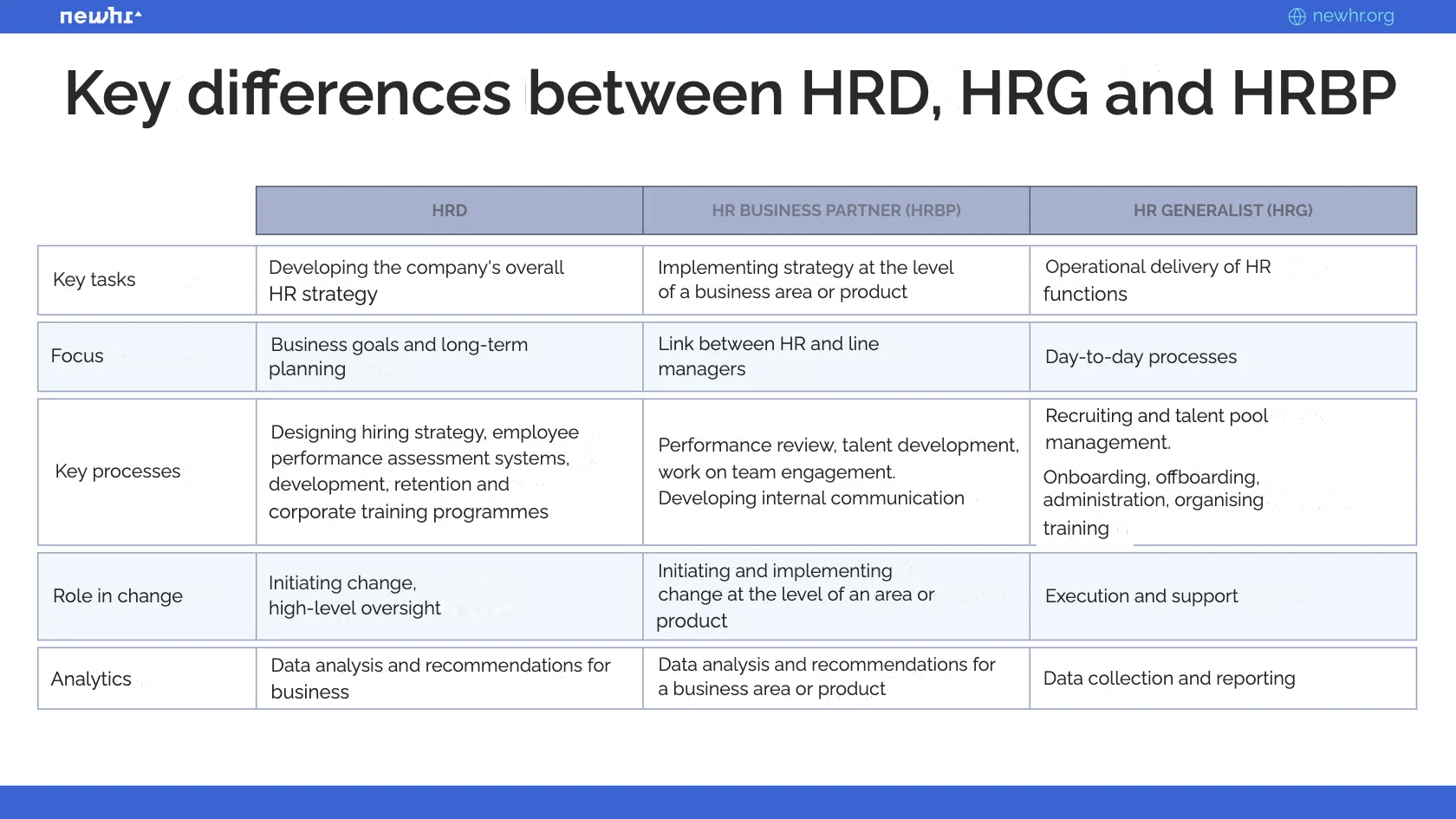
In the classic sense, the HRD role primarily involves developing the company's HR strategy and high-level oversight of its implementation, managing the team and building systems as a whole, while operational management is the responsibility of leads/heads of individual units.
In practice, however, especially at small companies or at the team-building stage, the HRD may be the only HR specialist (or have only a very small team to help). In that case the HRD combines the strategic and operational levels of work, merging the roles of HRD, HRBP and HRG.
HRG (HR Generalist) — an HR specialist with broad expertise, responsible for the operational delivery of HR functions.
HRBP (HR Business Partner) — a strategic partner for the leaders of a specific business area, product or function (development, marketing, back office, etc.). Unlike an HRD, implements the people strategy at the level of one part of the business.
It also happens that a company calls its only operational HR person the HRD. In that case the position does not correspond at all to the classic understanding of an HR director's functions.
Overall, the HR function today is evolving and moving from purely operational tasks towards strategic partnership with the business. Depending on the specifics of the local market and the maturity of the business, this process may be at different stages.
In some countries (for example, the US) the HR function is already fully integrated into business processes, while in others (including many Russian companies) HR is rather at the stage of transition to a strategic model. But the overall trend remains the same.
"Companies regularly come to us at NEWHR Recruiting to hire HRDs, HRBPs and HRGs, and I can see that since 2022 businesses first of all want a data-driven HR (whatever the level).
Hiring managers (CEOs and founders) expect HR to have a deep understanding of business goals amid high uncertainty, and the ability to build and successfully implement an HR strategy aimed both at optimising the current workforce and at retaining the strongest employees. At the same time, the business expects HR to focus on KPIs and argue its case clearly: how exactly investment in human resources will pay off."
Kira Kuzmenko, CEO of NEWHR
How HRD income is structured
At medium-sized and large companies:
HRD income usually consists of 2 parts: a base salary and a variable part that depends on meeting certain targets (KPIs, OKRs).
If HR is a strategic business partner, it bears direct responsibility for business/financial metrics such as the company's sales and profit, EBITDA, HR ROI (Return on Investment). Most often an HRD is evaluated on a combination of overall business metrics and HR metrics (turnover, performance, eNPS, Employee Engagement, etc.; the specific metrics depend on the business's focus at the time).
The variable part of a business-oriented HRD's income is an annual bonus, or an annual bonus combined with quarterly bonuses. When HR has no business goals, the variable part is more often limited to quarterly bonuses only.
Types of bonus payments:
- Annual bonus — - Tied to achieving the company's KPIs/OKRs
- Typical size: 15–50% of base salary*
*These are averaged figures; the size of the bonus will depend on the specific company's policy. - Quarterly bonuses — - Paid for meeting HR metrics
- Size: 10–30% of base salary
At startups/scale-ups:
A common long-term incentive tool for employees at startups is options. They help offset a relatively modest base salary and compete with large market players.
The terms of an option programme depend on the stage at which an employee joins: the younger the company, the higher the percentage. It is important to understand that at the very earliest stages many startups have no HRD at all; the function may be performed by the founder, the CEO or an HRG (often the only HR person at the company). An HRD usually joins a company at the scale-up stage.
Salary range
The HRD market is extremely varied. A specialist's income level will depend on location, industry and company size. But first of all, an HRD's cost depends on how strong the strategic component of the role is: whether the HR director is a real member of the management team or performs mostly operational and executive functions.
Our analytics gives averaged ranges for product technology companies and for HRDs in the classic sense of the role, that is, as a strategic executive.
Europe (annual income in euros, gross)
Average base salary: €80–120k
The range is very wide, as it depends on the candidate's qualifications, the segment of the IT market (in some industries, for example crypto, salaries are traditionally above market) and the specifics of the location.
By country
£105–130k (€120–150k)
UK
€110–140k
Germany
€80–110k
Cyprus
€95–130k
France
€65–100k
Italy
€65–105k
Portugal
In expensive locations, office work will as a rule be paid better than remote work (since candidates factor rent, transport costs, etc. into the amount they expect).
Russia (monthly income in roubles, net)
Average base salary
450–650 thousand
Small and medium-sized companies
750–950 thousand
Large companies
Operational HRDs may cost 300–400 thousand a month.
What affects an HRD's cost
What raises an HRD's cost?
First of all, an employee's salary depends on how "business-oriented" their role actually is: whether the HRD is a real member of the management team or performs mostly operational tasks. Business-oriented HRDs cost significantly more than operational ones.
Other pluses:
- Experience of taking part in developing the company's overall strategy and an understanding of how to integrate the people management strategy with the business strategy.
- Experience of taking a company through large-scale organisational transformations.
- The ability to work within a data-driven paradigm and focus on business metrics.
- Experience with demanding clients: building a team on tight deadlines, revising the hiring strategy and the structure of roles in the company, etc.
- A strong personal brand.
What can lower an HRD's cost?
- A focus on operational activities: managing current human resources and maintaining processes.
- Projects that are too simple, classic volume recruiting without standout cases.
- A long career break or job-hopping.
How to headhunt a strong HRD?
Besides salary, an HRD's interest in a vacancy is increased by:
Real impact on the business:
building the HR function in partnership with top management.
A clear request to develop the HR function:
when the company wants to build a deliberate culture, not "urgently hire 50 people".
Interesting challenges:
for example, creating and developing a people strategy while the company is growing or entering new markets.
A budget for developing HR projects
and the company's readiness for change.
What reduces an HRD's interest in a vacancy:
- Maintaining processes without real impact on the business.
- No budget or resources.
- High staff turnover and a weak HR brand.
How we can help you
Adapted from the original article in Russian on newhr.org. Read the Russian version.