Hiring trends · May 2025
What should businesses do about the change in personal income tax (NDFL) in Russia?
A detailed explainer based on a round table with the HR directors of Aviasales, Cian and Postgres Professional
Since the start of 2025, Russia has had a progressive personal income tax (NDFL) rate: the higher a person's income, the larger the percentage they pay to the state.
This means a cascade of changes for everyone in the market: valuable employees may start looking for ways to recover the income they are losing; companies willing to compensate the difference may gain an advantage in the competition for talent; the cost of hiring may rise, or companies will come up with other forms of compensation, change their bonus structures and rebuild their relationships with employees.
All this creates a somewhat tense situation in HR, especially at the start of the year, when most market players are shaping their own policy on these questions:
- Should the company compensate the income difference for employees who fall under the new rate, or not?
- What risks should be considered in each case?
- How exactly should the essence of these changes be explained to employees so that it is clear and transparent to everyone?
To find out what concrete steps can be taken, we spoke with three HR directors:
Yulia Baidina Setka
(Cian, 1100+ employees)
Polina Gavra LinkedIn
(Aviasales, 1100+ employees)
Ksenia Zamukhovskaya LinkedIn
(Postgres Professional, 400+ employees)
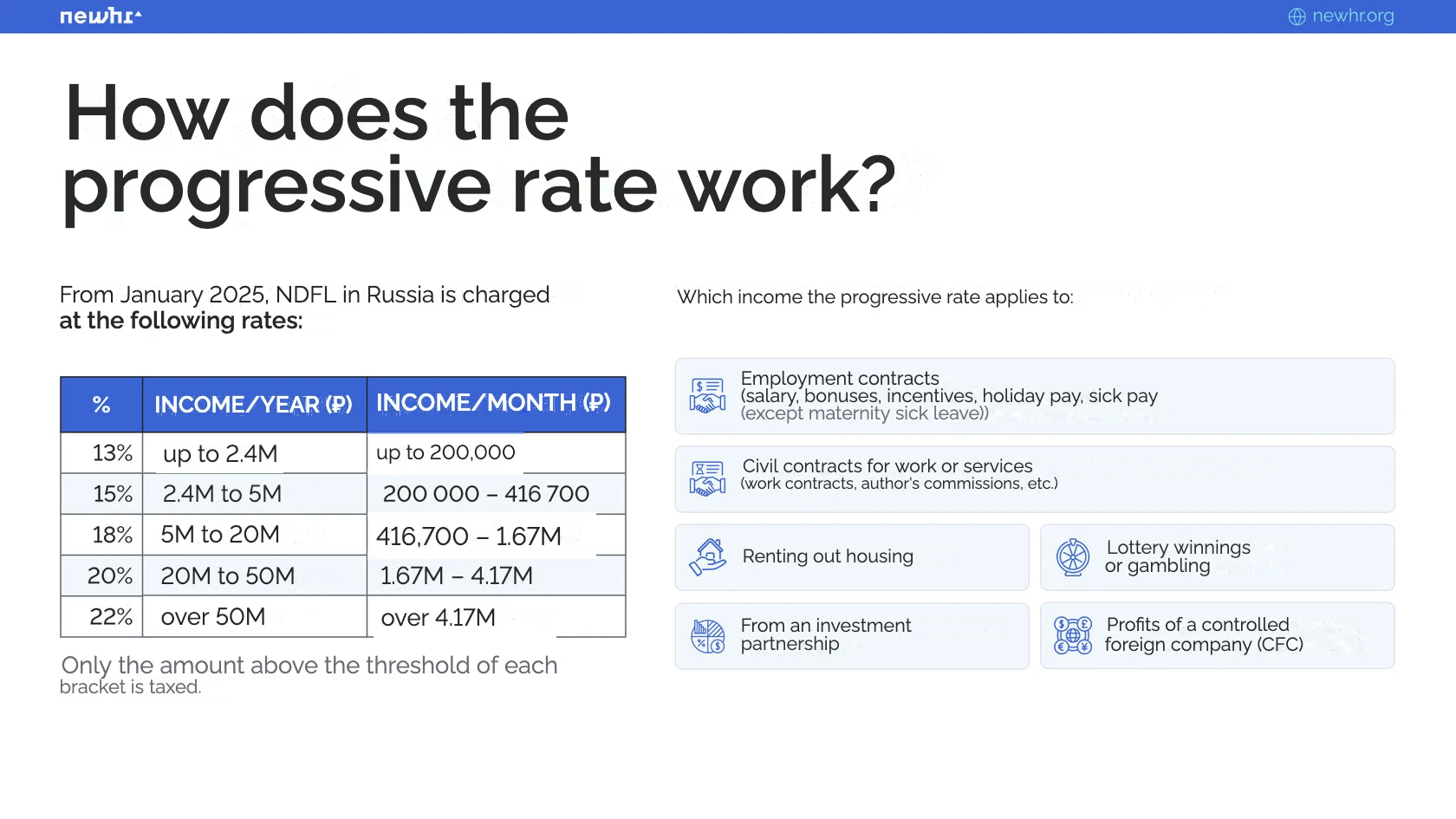
NDFL is calculated on a person's entire annual income from all sources. If several companies pay the person, each withholds NDFL at its own rate (for example, 15%). If the employee's total annual income exceeds this limit, the Federal Tax Service (IFNS) will recalculate the tax.
What does this mean for the employer?
Almost any payment from the company becomes a building block of the employee's total income. And the higher this income, the more noticeable the difference will be at the end of the year. Officially, Russia has about 2 million workers earning more than 2.4 million roubles a year (just over three percent of the working population). However, there is a high chance that, because of inflation and wage growth, more and more people will fall under the higher tax rate while their purchasing power stays the same. According to Forbes forecasts[1], soon 5−10% of working Russians will feel the changes.
What counts towards NDFL:
- Salary
- Bonuses and awards
- Reimbursement of costs for fitness, training (with some exceptions), housing rent, etc.
The main risks for business under the new rules:
More expensive hiring
In IT, where salaries are above average and the talent shortage is especially acute, the share of people affected by the new rules will be even higher than forecast. The changes will of course hit top managers hardest, as well as roles built around high bonuses, such as salespeople, business developers and others.
At the NEWHR recruiting agency we see that many candidates on the job market started building higher amounts into their salary expectations back in late 2024 to compensate for future losses.
Losing key employees
Statistically, specialists who change employers regularly see their salaries grow faster than those who stay in one place for years.
The progressive tax will deepen the job-hopping trend: an in-demand specialist, even one loyal to the company, will be far more willing to take a call from a competitor's headhunter after seeing a smaller amount in their account for the first time.
Higher payroll
The most obvious way to retain valuable people is to raise salaries to compensate for losses from the tax. Given that payroll in the IT sector already reaches 70% of all costs in some cases, this tactic can hit the company's budget.
It is also worth remembering that salary increases aimed at offsetting losses from the higher rate will themselves lead to a higher tax.
Extra workload for accounting and HR
Of course, accounting and HR need to get used to the new reality themselves and, if necessary, get training. But most importantly, while employees adapt, HR carries a heavy communication load. There will be a lot to explain: why the salary suddenly went down, where the bonuses are, whether there will be indexation. So it is critical to build a dialogue with the team to explain the new reality, reduce dissatisfaction and simply not lose your mind over the number of questions.
What to do in this situation?
In conversation with NEWHR, the experts outlined several possible strategies for business. Let's look at each one separately.
Compensating the difference (in full or in part)
Almost a quarter (24%) of Russian companies are ready to compensate employees for lower income[2]. Many of the experts we interviewed are used to discussing pay with employees in net terms and covering the tax difference and other costs themselves (this is relevant, for example, for companies whose employees work remotely from different countries, so that they have a common pay level), and they will keep doing so in 2025.
Advantages of this approach:
Lower staff turnover
The employer need not fear that valuable employees will be poached by someone offering more.
A stronger HR brand and positive attitude among employees
High productivity
Nothing changes for the employee, which means everyone can focus on work rather than trying to master an NDFL calculator.
"At least in 2025, we will talk to employees and candidates in terms of their net income. This approach fits our internal culture better, although we will certainly keep watching market practice on how NDFL is handled."
Polina Gavra, HRD at Aviasales
Refusing to compensate
25% of the experts we surveyed (the survey was run in NEWHR PRO, a private Telegram channel for employers from the IT industry) chose not to compensate employees (the market average for this figure is higher). And they too have strong arguments.
Advantages of this decision:
Avoiding extra costs
As we already wrote, payroll in IT companies is already significantly higher than in many industries, and the share of employees whose NDFL losses would need to be offset will only grow.
Besides, one should not forget the extra operational load and the cost of the staff who will handle recalculating compensation (especially if the company has high salaries, many bonuses, and an employee pays tax at several rates within one year).
Insurance against reputational losses
If at some point the employer cannot pay the promised compensation, it is the employer, not rising taxes, who will be "to blame". From an HR brand perspective, this is a much more serious mistake than a situation in which the company never takes on such responsibility in the first place.
"When a company compensates progressive NDFL, certain risks appear for it; at some point it puts itself in a rather unpredictable position in terms of employees' expectations. So it is important for a company to assess its strengths and weaknesses objectively in order to make the right value proposition to a candidate, not only from a financial point of view but also taking into account all the interesting aspects of future collaboration."
Yulia Baidina, HRD at Cian
A smaller income gap between existing and new employees
The experts at our round table confirmed that many in-demand candidates on the job market, preparing for NDFL losses, are already building higher amounts into their salary requirements than those who signed contracts with the company a year or two ago. Add compensation payments to this, and the income gap becomes quite significant.
"There is a high chance that by the end of the year companies will end up with a gap between employees hired from the market and internal ones. Most likely, the numbers will differ a lot. In this case it is easier to plan salary reviews for employees and, towards the end of the year, look at rates within grades: whether they are growing or not, by specialisation."
Ksenia Zamukhovskaya, HRD at Postgres Professional
Returning responsibility to the employee and a relationship of equals
According to some of the people we spoke with, in the coming years employer-employee relations in Russia will move towards a model in which salary is discussed in gross rather than net terms as a matter of course, and everyone deals with their own taxes.
"In Russia, a certain infantilism on the part of employees is the norm. There is an employer who will calculate everything and fill in all the paperwork, while the employee just throws up their hands. This applies not only to NDFL but also to tax deductions, of which there are quite a few, but far from everyone knows how to use them. I think the new rules are the start of a path towards greater employee independence and smarter management of their own finances."
Ksenia Zamukhovskaya, HRD at Postgres Professional
Alternative forms of employee support
Today, more than ever, it is useful to remember the concept of a total rewards system. Your advantage does not have to be money alone. Here is what else the experts suggest paying attention to.
Voluntary health insurance (DMS) and other benefits not subject to NDFL
Voluntary health insurance for the employee and their family paid by the employer is one of the most sought-after benefits, and it is not taxed. Other possible options: paying for mobile phone service, company transport, a hybrid work format or remote work.
Shares and options
With the introduction of the progressive NDFL scale, long-term incentive schemes (for example, options, both real and phantom) become a more attractive reward for employees[3], since the maximum tax rate on income from them stays at 15%.
Non-financial incentives
Opportunities for self-fulfilment, great experience, a supportive corporate culture and even a prestigious line on a CV may sound like something minor, but for most employees these are weighty arguments. For example, according to a Glassdoor study[4], the company's mission and opportunities to grow within the organisation turned out to be more important for respondents than a high salary.
"Let's be honest. In IT, if a person goes on the market purely to increase their income, they will achieve that. There will always be a company willing to pay more. So it is important to build the value of a position in a broader sense, showing the scale of the tasks, additional benefits, the transparency and convenience of internal processes and, crucially, the atmosphere in the team and how comfortable communication is. For Cian, for example, these are strong advantages that our candidates consider no less carefully than the question of income alone."
Yulia Baidina, HRD at Cian
How to communicate the decision to employees?
So you have chosen a strategy. How do you explain to the team what lies ahead?
- Set the agenda — It is useful to approach any change in a company from the standpoint of effective marketing and PR. Ideally, you should shape the information space and prepare your audience. It is not only that colleagues are more likely to react positively to your decisions with this approach (although that is definitely a plus), but also that, at the peak of interest, the necessary information will actually be remembered rather than just flash by in the stream of mailings. All the experts we interviewed started preliminary communication back in 2024.
"We have been talking to employees about NDFL since summer 2024. Our communication usually follows a certain template. We always start with a dialogue, where we say what the problem is and why it deserves attention. And only then do we start talking about the decisions the company has made."
Polina Gavra, HRD at Aviasales
- Talk to team leads — The first people an HRD usually talks to are the leads: it is important to win the support of managers who will help find the right approach to their teams and explain to them what lies ahead concretely, gently and knowledgeably.
- Present decisions in an accessible form — Each company has its own way of getting information to employees: corporate channels, mailings, digests, wiki systems or Q&As with management. The main thing is to make the information as accessible as possible.
Break large amounts of information into micro-blocks. Back up theory with concrete examples. Encourage hands-on learning (for example, attach a calculator that lets employees make a preliminary calculation of their progressive tax rate; you can find these online or build one in-house).
Another way to keep the information in view is to connect a bot, as CIAN did. It will "vacuum" the corporate wiki, answer users' frequent questions and point them to a specific article.
- Involve the community — At Aviasales, for example, in addition to a public channel and an employee support service, there is a well-developed internal community, and employees often help each other find the information they need or share their own experience. This spreads the load and lets people feel each other's support.
- Show the bigger picture — Not all companies are ready for transparent communication with employees. But in a crisis this approach can become a lifeline for the business (provided, of course, that employees have reason to trust management). Try to explain honestly why you will not, for example, top up the pay of those whose income falls because of NDFL, and offer other forms of compensation.
- Prepare for negativity — However hard you try, someone will always be unhappy with any decision the company makes. Explaining the new rules in theory is one thing; talking to a team lead who has received less than planned for the first time is quite another.
The basic rule for handling negativity is not to react to the emotional side, but to pick out the factual points and answer them with clear arguments. If you feel tension rising, increase how often you communicate with employees, collect questions and explain the business's position during Q&A sessions or in the corporate newsletter.
Conclusions
2025 will certainly not be easy for business. The country's tax system is changing radically for the first time in 20 years, and many will need time to get used to it. Whatever strategy your company chooses, it carries both advantages and potential risks.
Compensating NDFL risks higher payroll and operating costs, an income gap between employees from different hiring "eras", a jump in average market salaries, and the risk of failing to keep your promises to employees.
Refusing to compensate, meanwhile, may give competitors an advantage in hiring, cause employee dissatisfaction and put existing contracts at risk.
Either way, do not forget alternative ways to retain talent: benefits not subject to NDFL, long-term financial incentive schemes, non-financial rewards and simply treating the company's employees with respect.
At the time this material was prepared, a significant share of the leaders we interviewed had framed their strategy roughly like this: "We won't do anything for now. We'll wait, see what others do, and then decide." And this too is a perfectly reasonable strategy amid uncertainty.
In this situation, the main thing is to remember:
- Monitor the market — This will help you not miss the moment when one strategy or another "wins" and becomes common practice.
- Stay in constant communication with employees — This way you can understand what the team really wants, choose individual benefits and compensation, and notice dissatisfaction among key players in time.
- Adjust your strategy when needed — The best tool in this situation is scenario planning, which will help you prepare a set of decisions for different ways events may unfold. We hope this material helps you make a balanced decision and not rely on rumours.
Sources:
- Forbes: What Russia's tax changes will lead to: seven consequences
- Vedomosti: Almost a quarter of employers are ready to compensate employees for the NDFL increase
- Vedomosti: New taxes and a rise in IPOs have led to a boom in option-based incentive programmes
- Glassdoor: Which Workplace Factors Drive Employee Satisfaction Around the World?
Adapted from the original article in Russian on newhr.org. Read the Russian version.